| Age | Commit message (Collapse) | Author | Lines |
|---|
|
|
|
|
|
Nilstrieb:no-merge-commits-for-you-only-bors-is-allowed-to-do-that, r=jyn514"
This reverts commit 4839886f0abe208ab8f2bb73a3076a59fe2ab60c, reversing
changes made to ce85c98575e3016cf2007d90a85be321e592aa96.
|
|
|
|
The primary motivation is to have the cargo docs show up on https://doc.rust-lang.org/nightly/nightly-rustc/cargo, but as a nice side effect this makes `x doc cargo` work locally.
|
|
|
|
|
|
|
|
|
|
|
|
This tool is to be ran at specific points in the release process to replace
the version place holder made by stabilizations with the version number.
|
|
|
|
These submodules were previously updated in python because Cargo gives a hard error if toml files
are missing from the workspace:
```
error: failed to load manifest for workspace member `/home/jnelson/rust-lang/rust/src/tools/rls`
Caused by:
failed to read `/home/jnelson/rust-lang/rust/src/tools/rls/Cargo.toml`
Caused by:
No such file or directory (os error 2)
failed to run: /home/jnelson/rust-lang/rust/build/x86_64-unknown-linux-gnu/stage0/bin/cargo build --manifest-path /home/jnelson/rust-lang/rust/src/bootstrap/Cargo.toml
```
However, bootstrap doesn't actually need to be part of the workspace.
Remove it so we can move submodule handling fully to Rust, avoiding duplicate code between Rust and Python.
Note that this does break `cargo run`; it has to be `cd src/bootstrap && cargo run` now.
Given that we're planning to make the main entrypoint a shell script (or rust binary),
I think this is a good tradeoff for reduced complexity in bootstrap.py.
|
|
This was part of Mark's original PR in https://github.com/rust-lang/rust/commit/ecb424f12992a4aebace8a153d5efea040327a01,
but I missed it when writing #92260.
|
|
|
|
Rather than compiling rustbuild and all its dependencies with
`debuginfo=2`, this compiles dependencies without debuginfo and
rustbuild with `debuginfo=1`. On my laptop, this brings compile times
down from ~1:20 to ~1:05.
|
|
The wrapper is installed as `ld` and `ld64` in the `lib\rustlib\<host_target>\bin\gcc-ld`
directory and its sole purpose is to invoke `rust-lld` in the parent directory with
the correct flavor.
|
|
Libgccjit codegen
This PR introduces a subtree for a gcc-based codegen backend to the repository, per decision in https://github.com/rust-lang/compiler-team/issues/442. We do not yet expect to ship this backend on nightly or run tests in CI, but we do verify that the backend checks (i.e., `cargo check`) successfully.
Work is expected to progress primarily in https://github.com/rust-lang/rustc_codegen_gcc, with semi-regular upstreaming, like with other subtrees.
|
|
|
|
|
|
config not being applied
|
|
* Make html-checker run by default on rust compiler docs as well
* Ensure html-checker is run on CI
* Lazify tidy binary presence check
|
|
- Add clippy_dev to the rust workspace
Before, it would give an error that it wasn't either included or
excluded from the workspace:
```
error: current package believes it's in a workspace when it's not:
current: /home/joshua/rustc/src/tools/clippy/clippy_dev/Cargo.toml
workspace: /home/joshua/rustc/Cargo.toml
this may be fixable by adding `src/tools/clippy/clippy_dev` to the `workspace.members` array of the manifest located at: /home/joshua/rustc/Cargo.toml
Alternatively, to keep it out of the workspace, add the package to the `workspace.exclude` array, or add an empty `[workspace]` table to the package's manifest.
```
- Change clippy's copy of compiletest not to special-case
rust-lang/rust. Using OUT_DIR confused `clippy_dev` and it couldn't find
the test outputs. This is one of the reasons why `cargo dev bless` used
to silently do nothing (the others were that `CARGO_TARGET_DIR` and
`PROFILE` weren't set appropriately).
- Run clippy_dev on test failure
I tested this by removing a couple lines from a stderr file, and they
were correctly replaced.
- Fix clippy_dev warnings
|
|
Update stdarch submodule (to before it switched to const generics)
https://github.com/rust-lang/rust/pull/83278#issuecomment-812389823: This unblocks #82539.
Major changes:
- More AVX-512 intrinsics.
- More ARM & AArch64 NEON intrinsics.
- Updated unstable WASM intrinsics to latest draft standards.
- std_detect is now a separate crate instead of a submodule of std.
I double-checked and the first use of const generics looks like https://github.com/rust-lang/stdarch/commit/8d5017861ed594a2baf169e632379862d516e013, which isn't included in this PR.
r? `@Amanieu`
|
|
|
|
This also includes a cherry-pick of
https://github.com/rust-lang/stdarch/commit/ec1461905b421cf0c56adeebb49bbf55bb33fd17
and https://github.com/rust-lang/stdarch/pull/1108 to fix a build
failure.
It also adds a re-export of various macros to the crate root of libstd -
previously they would show up automatically because std_detect was defined
in the same crate.
|
|
|
|
|
|
|
|
|
|
|
|
|
|
Add a tool to run `x.py` from any subdirectory
This adds a binary called `x` in `src/tools/x`. All it does is check the current directory and its ancestors for a file called `x.py`, and if it finds one, runs it.
By installing x, you can easily run `x.py` from any subdirectory, and only need to type `x`.
It can be installed with `cargo install --path src/tools/x`
This is a copy of a [binary I've been using myself when working on rust](https://github.com/casey/bootstrap), currently published to crates.io as `bootstrap`.
It could be changed to avoid indirecting through `x.py`, and instead call the bootstrap module directly. However, this seemed like the simplest thing possible, and won't break if the details of how the bootstrap module is invoked change.
|
|
This adds a binary called `x` in `src/tools/x`. All it does is check the
current directory and its ancestors for a file called `x.py`, and if it
finds one, runs it.
By installing x, you can easily `x.py` from any subdirectory.
It can be installed globally with `cargo install --path src/tools/x`
|
|
|
|
|
|
|
|
|
|
|
|
This commit is a proof-of-concept for switching the standard library's
backtrace symbolication mechanism on most platforms from libbacktrace to
gimli. The standard library's support for `RUST_BACKTRACE=1` requires
in-process parsing of object files and DWARF debug information to
interpret it and print the filename/line number of stack frames as part
of a backtrace.
Historically this support in the standard library has come from a
library called "libbacktrace". The libbacktrace library seems to have
been extracted from gcc at some point and is written in C. We've had a
lot of issues with libbacktrace over time, unfortunately, though. The
library does not appear to be actively maintained since we've had
patches sit for months-to-years without comments. We have discovered a
good number of soundness issues with the library itself, both when
parsing valid DWARF as well as invalid DWARF. This is enough of an issue
that the libs team has previously decided that we cannot feed untrusted
inputs to libbacktrace. This also doesn't take into account the
portability of libbacktrace which has been difficult to manage and
maintain over time. While possible there are lots of exceptions and it's
the main C dependency of the standard library right now.
For years it's been the desire to switch over to a Rust-based solution
for symbolicating backtraces. It's been assumed that we'll be using the
Gimli family of crates for this purpose, which are targeted at safely
and efficiently parsing DWARF debug information. I've been working
recently to shore up the Gimli support in the `backtrace` crate. As of a
few weeks ago the `backtrace` crate, by default, uses Gimli when loaded
from crates.io. This transition has gone well enough that I figured it
was time to start talking seriously about this change to the standard
library.
This commit is a preview of what's probably the best way to integrate
the `backtrace` crate into the standard library with the Gimli feature
turned on. While today it's used as a crates.io dependency, this commit
switches the `backtrace` crate to a submodule of this repository which
will need to be updated manually. This is not done lightly, but is
thought to be the best solution. The primary reason for this is that the
`backtrace` crate needs to do some pretty nontrivial filesystem
interactions to locate debug information. Working without `std::fs` is
not an option, and while it might be possible to do some sort of
trait-based solution when prototyped it was found to be too unergonomic.
Using a submodule allows the `backtrace` crate to build as a submodule
of the `std` crate itself, enabling it to use `std::fs` and such.
Otherwise this adds new dependencies to the standard library. This step
requires extra attention because this means that these crates are now
going to be included with all Rust programs by default. It's important
to note, however, that we're already shipping libbacktrace with all Rust
programs by default and it has a bunch of C code implementing all of
this internally anyway, so we're basically already switching
already-shipping functionality to Rust from C.
* `object` - this crate is used to parse object file headers and
contents. Very low-level support is used from this crate and almost
all of it is disabled. Largely we're just using struct definitions as
well as convenience methods internally to read bytes and such.
* `addr2line` - this is the main meat of the implementation for
symbolication. This crate depends on `gimli` for DWARF parsing and
then provides interfaces needed by the `backtrace` crate to turn an
address into a filename / line number. This crate is actually pretty
small (fits in a single file almost!) and mirrors most of what
`dwarf.c` does for libbacktrace.
* `miniz_oxide` - the libbacktrace crate transparently handles
compressed debug information which is compressed with zlib. This crate
is used to decompress compressed debug sections.
* `gimli` - not actually used directly, but a dependency of `addr2line`.
* `adler32`- not used directly either, but a dependency of
`miniz_oxide`.
The goal of this change is to improve the safety of backtrace
symbolication in the standard library, especially in the face of
possibly malformed DWARF debug information. Even to this day we're still
seeing segfaults in libbacktrace which could possibly become security
vulnerabilities. This change should almost entirely eliminate this
possibility whilc also paving the way forward to adding more features
like split debug information.
Some references for those interested are:
* Original addition of libbacktrace - #12602
* OOM with libbacktrace - #24231
* Backtrace failure due to use of uninitialized value - #28447
* Possibility to feed untrusted data to libbacktrace - #21889
* Soundness fix for libbacktrace - #33729
* Crash in libbacktrace - #39468
* Support for macOS, never merged - ianlancetaylor/libbacktrace#2
* Performance issues with libbacktrace - #29293, #37477
* Update procedure is quite complicated due to how many patches we
need to carry - #50955
* Libbacktrace doesn't work on MinGW with dynamic libs - #71060
* Segfault in libbacktrace on macOS - #71397
Switching to Rust will not make us immune to all of these issues. The
crashes are expected to go away, but correctness and performance may
still have bugs arise. The gimli and `backtrace` crates, however, are
actively maintained unlike libbacktrace, so this should enable us to at
least efficiently apply fixes as situations come up.
|
|
|
|
This reverts commit 13db3cc1e8d2fd4b8e7c74d91002274d7b62801b.
|
|
Generating the coverage map
@tmandry @wesleywiser
rustc now generates the coverage map and can support (limited)
coverage report generation, at the function level.
Example commands to generate a coverage report:
```shell
$ BUILD=$HOME/rust/build/x86_64-unknown-linux-gnu
$ $BUILD/stage1/bin/rustc -Zinstrument-coverage \
$HOME/rust/src/test/run-make-fulldeps/instrument-coverage/main.rs
$ LLVM_PROFILE_FILE="main.profraw" ./main
called
$ $BUILD/llvm/bin/llvm-profdata merge -sparse main.profraw -o main.profdata
$ $BUILD/llvm/bin/llvm-cov show --instr-profile=main.profdata main
```
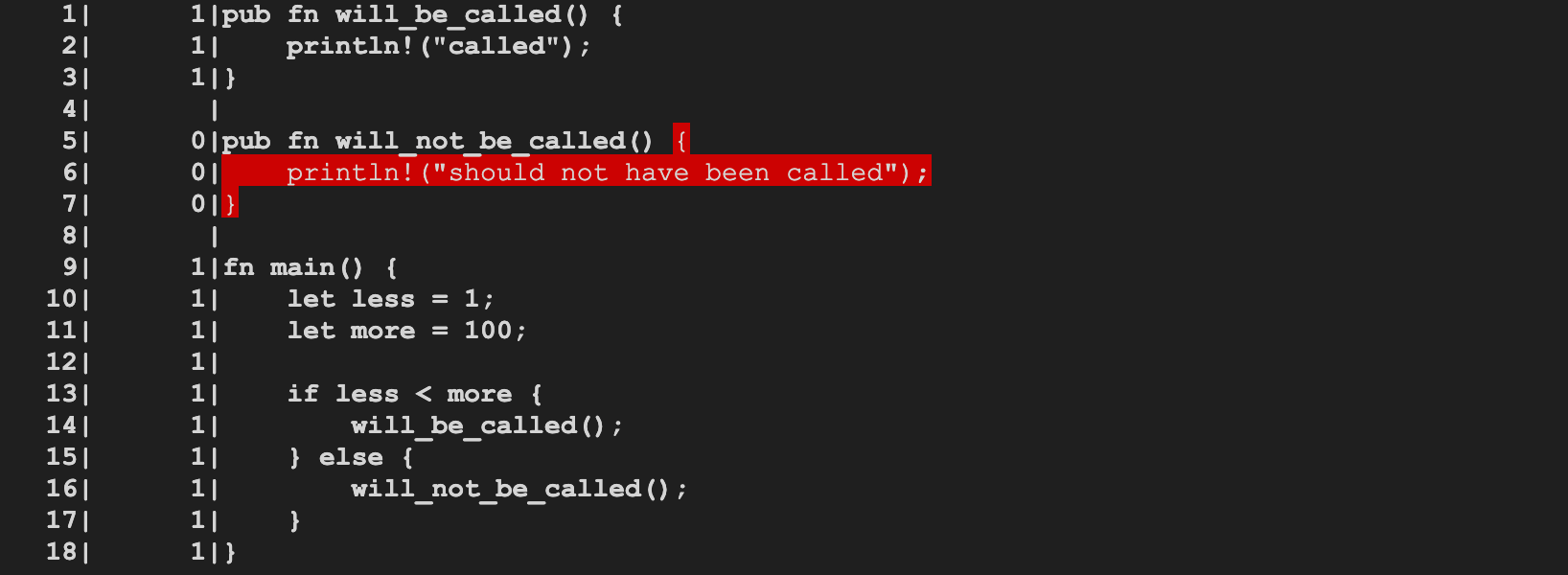
r? @wesleywiser
Rust compiler MCP rust-lang/compiler-team#278
Relevant issue: #34701 - Implement support for LLVMs code coverage instrumentation
|
|
This commit is a proof-of-concept for switching the standard library's
backtrace symbolication mechanism on most platforms from libbacktrace to
gimli. The standard library's support for `RUST_BACKTRACE=1` requires
in-process parsing of object files and DWARF debug information to
interpret it and print the filename/line number of stack frames as part
of a backtrace.
Historically this support in the standard library has come from a
library called "libbacktrace". The libbacktrace library seems to have
been extracted from gcc at some point and is written in C. We've had a
lot of issues with libbacktrace over time, unfortunately, though. The
library does not appear to be actively maintained since we've had
patches sit for months-to-years without comments. We have discovered a
good number of soundness issues with the library itself, both when
parsing valid DWARF as well as invalid DWARF. This is enough of an issue
that the libs team has previously decided that we cannot feed untrusted
inputs to libbacktrace. This also doesn't take into account the
portability of libbacktrace which has been difficult to manage and
maintain over time. While possible there are lots of exceptions and it's
the main C dependency of the standard library right now.
For years it's been the desire to switch over to a Rust-based solution
for symbolicating backtraces. It's been assumed that we'll be using the
Gimli family of crates for this purpose, which are targeted at safely
and efficiently parsing DWARF debug information. I've been working
recently to shore up the Gimli support in the `backtrace` crate. As of a
few weeks ago the `backtrace` crate, by default, uses Gimli when loaded
from crates.io. This transition has gone well enough that I figured it
was time to start talking seriously about this change to the standard
library.
This commit is a preview of what's probably the best way to integrate
the `backtrace` crate into the standard library with the Gimli feature
turned on. While today it's used as a crates.io dependency, this commit
switches the `backtrace` crate to a submodule of this repository which
will need to be updated manually. This is not done lightly, but is
thought to be the best solution. The primary reason for this is that the
`backtrace` crate needs to do some pretty nontrivial filesystem
interactions to locate debug information. Working without `std::fs` is
not an option, and while it might be possible to do some sort of
trait-based solution when prototyped it was found to be too unergonomic.
Using a submodule allows the `backtrace` crate to build as a submodule
of the `std` crate itself, enabling it to use `std::fs` and such.
Otherwise this adds new dependencies to the standard library. This step
requires extra attention because this means that these crates are now
going to be included with all Rust programs by default. It's important
to note, however, that we're already shipping libbacktrace with all Rust
programs by default and it has a bunch of C code implementing all of
this internally anyway, so we're basically already switching
already-shipping functionality to Rust from C.
* `object` - this crate is used to parse object file headers and
contents. Very low-level support is used from this crate and almost
all of it is disabled. Largely we're just using struct definitions as
well as convenience methods internally to read bytes and such.
* `addr2line` - this is the main meat of the implementation for
symbolication. This crate depends on `gimli` for DWARF parsing and
then provides interfaces needed by the `backtrace` crate to turn an
address into a filename / line number. This crate is actually pretty
small (fits in a single file almost!) and mirrors most of what
`dwarf.c` does for libbacktrace.
* `miniz_oxide` - the libbacktrace crate transparently handles
compressed debug information which is compressed with zlib. This crate
is used to decompress compressed debug sections.
* `gimli` - not actually used directly, but a dependency of `addr2line`.
* `adler32`- not used directly either, but a dependency of
`miniz_oxide`.
The goal of this change is to improve the safety of backtrace
symbolication in the standard library, especially in the face of
possibly malformed DWARF debug information. Even to this day we're still
seeing segfaults in libbacktrace which could possibly become security
vulnerabilities. This change should almost entirely eliminate this
possibility whilc also paving the way forward to adding more features
like split debug information.
Some references for those interested are:
* Original addition of libbacktrace - #12602
* OOM with libbacktrace - #24231
* Backtrace failure due to use of uninitialized value - #28447
* Possibility to feed untrusted data to libbacktrace - #21889
* Soundness fix for libbacktrace - #33729
* Crash in libbacktrace - #39468
* Support for macOS, never merged - ianlancetaylor/libbacktrace#2
* Performance issues with libbacktrace - #29293, #37477
* Update procedure is quite complicated due to how many patches we
need to carry - #50955
* Libbacktrace doesn't work on MinGW with dynamic libs - #71060
* Segfault in libbacktrace on macOS - #71397
Switching to Rust will not make us immune to all of these issues. The
crashes are expected to go away, but correctness and performance may
still have bugs arise. The gimli and `backtrace` crates, however, are
actively maintained unlike libbacktrace, so this should enable us to at
least efficiently apply fixes as situations come up.
|
|
rustc now generates the coverage map and can support (limited)
coverage report generation, at the function level.
Example:
$ BUILD=$HOME/rust/build/x86_64-unknown-linux-gnu
$ $BUILD/stage1/bin/rustc -Zinstrument-coverage \
$HOME/rust/src/test/run-make-fulldeps/instrument-coverage/main.rs
$ LLVM_PROFILE_FILE="main.profraw" ./main
called
$ $BUILD/llvm/bin/llvm-profdata merge -sparse main.profraw -o main.profdata
$ $BUILD/llvm/bin/llvm-cov show --instr-profile=main.profdata main
1| 1|pub fn will_be_called() {
2| 1| println!("called");
3| 1|}
4| |
5| 0|pub fn will_not_be_called() {
6| 0| println!("should not have been called");
7| 0|}
8| |
9| 1|fn main() {
10| 1| let less = 1;
11| 1| let more = 100;
12| 1|
13| 1| if less < more {
14| 1| will_be_called();
15| 1| } else {
16| 1| will_not_be_called();
17| 1| }
18| 1|}
|
|
This commit moves the compiler-builtins-specific build logic from
`src/bootstrap/bin/rustc.rs` into the workspace `Cargo.toml`'s
`[profile]` configuration. Now that rust-lang/cargo#7253 is fixed we can
ensure that Cargo knows about debug assertions settings, and it can also
be configured to specifically disable debug assertions unconditionally
for compiler-builtins. This should improve rebuild logic when
debug-assertions settings change and also improve build-std integration
where Cargo externally now has an avenue to learn how to build
compiler-builtins as well.
|
|
This commit intends to fix an accidental regression from #70846. The
goal of #70846 was to build compiler-builtins with a maximal number of
CGUs to ensure that each module in the source corresponds to an object
file. This high degree of control for compiler-builtins is desirable to
ensure that there's at most one exported symbol per CGU, ideally
enabling compiler-builtins to not conflict with the system libgcc as
often.
In #70846, however, only part of the compiler understands that
compiler-builtins is built with many CGUs. The rest of the compiler
thinks it's building with `sess.codegen_units()`. Notably the
calculation of `sess.lto()` consults `sess.codegen_units()`, which when
there's only one CGU it disables ThinLTO. This means that
compiler-builtins is built without ThinLTO, which is quite harmful to
performance! This is the root of the cause from #73135 where intrinsics
were found to not be inlining trivial functions.
The fix applied in this commit is to remove the special-casing of
compiler-builtins in the compiler. Instead the build system is now
responsible for special-casing compiler-builtins. It doesn't know
exactly how many CGUs will be needed but it passes a large number that
is assumed to be much greater than the number of source-level modules
needed. After reading the various locations in the compiler source, this
seemed like the best solution rather than adding more and more special
casing in the compiler for compiler-builtins.
Closes #73135
|
|
|
|
|
|
Change opt-level from 2 back to 3
In Cargo.toml, the opt-level for `release` and `bench` was overridden to be 2. This was to work around a problem with LLVM 7. However, rust no longer uses LLVM 7, so this is hopefully no longer needed?
I tried a little bit to replicate the original problem, and could not. I think running this through CI is the best way to smoke test this :) Even if things break dramatically, the comment should be updated to reflect that things are still broken with LLVM 9.
I'm just getting started playing with the compiler, so apologies if I've missed an obvious problem here.
fixes #52378
(possibly relevant is the [current update to LLVM 10](https://github.com/rust-lang/rust/pull/67759))
|
