| Age | Commit message (Collapse) | Author | Lines |
|---|
|
Introduce `proc_macro_back_compat` lint, and emit for `time-macros-impl`
Now that future-incompat-report support has landed in nightly Cargo, we
can start to make progress towards removing the various proc-macro
back-compat hacks that have accumulated in the compiler.
This PR introduces a new lint `proc_macro_back_compat`, which results in
a future-incompat-report entry being generated. All proc-macro
back-compat warnings will be grouped under this lint. Note that this
lint will never actually become a hard error - instead, we will remove
the special cases for various macros, which will cause older versions of
those crates to emit some other error.
I've added code to fire this lint for the `time-macros-impl` case. This
is the easiest case out of all of our current back-compat hacks - the
crate was renamed to `time-macros`, so seeing a filename with
`time-macros-impl` guarantees that an older version of the parent `time`
crate is in use.
When Cargo's future-incompat-report feature gets stabilized, affected
users will start to see future-incompat warnings when they build their
crates.
|
|
Validate rustc_layout_scalar_valid_range_{start,end} attributes
Fixes #82251, fixes #82981.
|
|
Now that future-incompat-report support has landed in nightly Cargo, we
can start to make progress towards removing the various proc-macro
back-compat hacks that have accumulated in the compiler.
This PR introduces a new lint `proc_macro_back_compat`, which results in
a future-incompat-report entry being generated. All proc-macro
back-compat warnings will be grouped under this lint. Note that this
lint will never actually become a hard error - instead, we will remove
the special cases for various macros, which will cause older versions of
those crates to emit some other error.
I've added code to fire this lint for the `time-macros-impl` case. This
is the easiest case out of all of our current back-compat hacks - the
crate was renamed to `time-macros`, so seeing a filename with
`time-macros-impl` guarantees that an older version of the parent `time`
crate is in use.
When Cargo's future-incompat-report feature gets stabilized, affected
users will start to see future-incompat warnings when they build their
crates.
|
|
|
|
|
|
Change x64 size checks to not apply to x32.
Rust contains various size checks conditional on target_arch = "x86_64", but these checks were never intended to apply to x86_64-unknown-linux-gnux32. Add target_pointer_width = "64" to the conditions.
|
|
Account for `if (let pat = expr) {}`
Fix #82827.
|
|
Implement built-in attribute macro `#[cfg_eval]` + some refactoring
This PR implements a built-in attribute macro `#[cfg_eval]` as it was suggested in https://github.com/rust-lang/rust/pull/79078 to avoid `#[derive()]` without arguments being abused as a way to configure input for other attributes.
The macro is used for eagerly expanding all `#[cfg]` and `#[cfg_attr]` attributes in its input ("fully configuring" the input).
The effect is identical to effect of `#[derive(Foo, Bar)]` which also fully configures its input before passing it to macros `Foo` and `Bar`, but unlike `#[derive]` `#[cfg_eval]` can be applied to any syntax nodes supporting macro attributes, not only certain items.
`cfg_eval` was the first name suggested in https://github.com/rust-lang/rust/pull/79078, but other alternatives are also possible, e.g. `cfg_expand`.
```rust
#[cfg_eval]
#[my_attr] // Receives `struct S {}` as input, the field is configured away by `#[cfg_eval]`
struct S {
#[cfg(FALSE)]
field: u8,
}
```
Tracking issue: https://github.com/rust-lang/rust/issues/82679
|
|
Let a portion of DefPathHash uniquely identify the DefPath's crate.
This allows to directly map from a `DefPathHash` to the crate it originates from, without constructing side tables to do that mapping -- something that is useful for incremental compilation where we deal with `DefPathHash` instead of `DefId` a lot.
It also allows to reliably and cheaply check for `DefPathHash` collisions which allows the compiler to gracefully abort compilation instead of running into a subsequent ICE at some random place in the code.
The following new piece of documentation describes the most interesting aspects of the changes:
```rust
/// A `DefPathHash` is a fixed-size representation of a `DefPath` that is
/// stable across crate and compilation session boundaries. It consists of two
/// separate 64-bit hashes. The first uniquely identifies the crate this
/// `DefPathHash` originates from (see [StableCrateId]), and the second
/// uniquely identifies the corresponding `DefPath` within that crate. Together
/// they form a unique identifier within an entire crate graph.
///
/// There is a very small chance of hash collisions, which would mean that two
/// different `DefPath`s map to the same `DefPathHash`. Proceeding compilation
/// with such a hash collision would very probably lead to an ICE and, in the
/// worst case, to a silent mis-compilation. The compiler therefore actively
/// and exhaustively checks for such hash collisions and aborts compilation if
/// it finds one.
///
/// `DefPathHash` uses 64-bit hashes for both the crate-id part and the
/// crate-internal part, even though it is likely that there are many more
/// `LocalDefId`s in a single crate than there are individual crates in a crate
/// graph. Since we use the same number of bits in both cases, the collision
/// probability for the crate-local part will be quite a bit higher (though
/// still very small).
///
/// This imbalance is not by accident: A hash collision in the
/// crate-local part of a `DefPathHash` will be detected and reported while
/// compiling the crate in question. Such a collision does not depend on
/// outside factors and can be easily fixed by the crate maintainer (e.g. by
/// renaming the item in question or by bumping the crate version in a harmless
/// way).
///
/// A collision between crate-id hashes on the other hand is harder to fix
/// because it depends on the set of crates in the entire crate graph of a
/// compilation session. Again, using the same crate with a different version
/// number would fix the issue with a high probability -- but that might be
/// easier said then done if the crates in questions are dependencies of
/// third-party crates.
///
/// That being said, given a high quality hash function, the collision
/// probabilities in question are very small. For example, for a big crate like
/// `rustc_middle` (with ~50000 `LocalDefId`s as of the time of writing) there
/// is a probability of roughly 1 in 14,750,000,000 of a crate-internal
/// collision occurring. For a big crate graph with 1000 crates in it, there is
/// a probability of 1 in 36,890,000,000,000 of a `StableCrateId` collision.
```
Given the probabilities involved I hope that no one will ever actually see the error messages. Nonetheless, I'd be glad about some feedback on how to improve them. Should we create a GH issue describing the problem and possible solutions to point to? Or a page in the rustc book?
r? `@pnkfelix` (feel free to re-assign)
|
|
Partially address #82827.
|
|
|
|
Rust contains various size checks conditional on target_arch = "x86_64",
but these checks were never intended to apply to
x86_64-unknown-linux-gnux32. Add target_pointer_width = "64" to the
conditions.
|
|
- Rename `broken_intra_doc_links` to `rustdoc::broken_intra_doc_links`
- Ensure that the old lint names still work and give deprecation errors
- Register lints even when running doctests
Otherwise, all `rustdoc::` lints would be ignored.
- Register all existing lints as removed
This unfortunately doesn't work with `register_renamed` because tool
lints have not yet been registered when rustc is running. For similar
reasons, `check_backwards_compat` doesn't work either. Call
`register_removed` directly instead.
- Fix fallout
+ Rustdoc lints for compiler/
+ Rustdoc lints for library/
Note that this does *not* suggest `rustdoc::broken_intra_doc_links` for
`rustdoc::intra_doc_link_resolution_failure`, since there was no time
when the latter was valid.
|
|
When token-based attribute handling is implemeneted in #80689,
we will need to access tokens from `HasAttrs` (to perform
cfg-stripping), and we will to access attributes from `HasTokens` (to
construct a `PreexpTokenStream`).
This PR merges the `HasAttrs` and `HasTokens` traits into a new
`AstLike` trait. The previous `HasAttrs` impls from `Vec<Attribute>` and `AttrVec`
are removed - they aren't attribute targets, so the impls never really
made sense.
|
|
AST: Remove some unnecessary boxes
|
|
|
|
|
|
Also remove `ast::Mod` which is mostly redundant now
|
|
Crate root is sufficiently different from `mod` items, at least at syntactic level.
Also remove customization point for "`mod` item or crate root" from AST visitors.
|
|
This is a pure refactoring split out from #80689.
It represents the most invasive part of that PR, requiring changes in
every caller of `parse_outer_attributes`
In order to eagerly expand `#[cfg]` attributes while preserving the
original `TokenStream`, we need to know the range of tokens that
corresponds to every attribute target. This is accomplished by making
`parse_outer_attributes` return an opaque `AttrWrapper` struct. An
`AttrWrapper` must be converted to a plain `AttrVec` by passing it to
`collect_tokens_trailing_token`. This makes it difficult to accidentally
construct an AST node with attributes without calling `collect_tokens_trailing_token`,
since AST nodes store an `AttrVec`, not an `AttrWrapper`.
As a result, we now call `collect_tokens_trailing_token` for attribute
targets which only support inert attributes, such as generic arguments
and struct fields. Currently, the constructed `LazyTokenStream` is
simply discarded. Future PRs will record the token range corresponding
to the attribute target, allowing those tokens to be removed from an
enclosing `collect_tokens_trailing_token` call if necessary.
|
|
Document `NodeId`
|
|
|
|
Add lint for `panic!(123)` which is not accepted in Rust 2021.
This extends the `panic_fmt` lint to warn for all cases where the first argument cannot be interpreted as a format string, as will happen in Rust 2021.
It suggests to add `"{}",` to format the message as a string. In the case of `std::panic!()`, it also suggests the recently stabilized
`std::panic::panic_any()` function as an alternative.
It renames the lint to `non_fmt_panic` to match the lint naming guidelines.
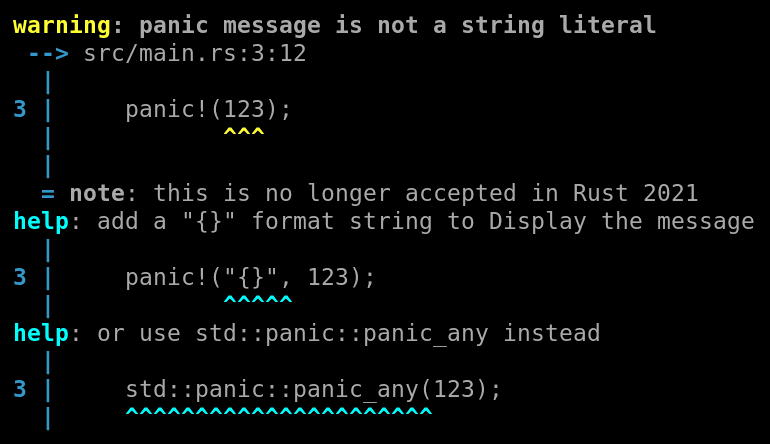
This is part of #80162.
r? ```@estebank```
|
|
|
|
|
|
This allows to directly map from a DefPathHash to the crate it
originates from, without constructing side tables to do that mapping.
It also allows to reliably and cheaply check for DefPathHash collisions.
|
|
|
|
|
|
|
|
Signed-off-by: wcampbell <wcampbell1995@gmail.com>
|
|
|
|
Set tokens on AST node in `collect_tokens`
A new `HasTokens` trait is introduced, which is used to move logic from
the callers of `collect_tokens` into the body of `collect_tokens`.
In addition to reducing duplication, this paves the way for PR #80689,
which needs to perform additional logic during token collection.
|
|
A new `HasTokens` trait is introduced, which is used to move logic from
the callers of `collect_tokens` into the body of `collect_tokens`.
In addition to reducing duplication, this paves the way for PR #80689,
which needs to perform additional logic during token collection.
|
|
|
|
|
|
|
|
rustc_parse: Better spans for synthesized token streams
I think using the nonterminal span for synthesizing its tokens is a better approximation than using `DUMMY_SP` or the attribute span like #79472 did in `expand.rs`.
r? `@Aaron1011`
|
|
Edit rustc_ast::tokenstream docs
Fix some punctuation and wording, and add intra-documentation links.
|
|
|
|
Fix some punctuation and wording, and add intra-documentation links.
|
|
(clippy::match_ref_pats)
|
|
- Adds optional default values to const generic parameters in the AST
and HIR
- Parses these optional default values
- Adds a `const_generics_defaults` feature gate
|
|
|
|
Implement edition-based macro :pat feature
This PR does two things:
1. Fixes the perf regression from https://github.com/rust-lang/rust/pull/80100#issuecomment-750893149
2. Implements `:pat2018` and `:pat2021` matchers, as described by `@joshtriplett` in https://github.com/rust-lang/rust/issues/54883#issuecomment-745509090 behind the feature gate `edition_macro_pat`.
r? `@petrochenkov`
cc `@Mark-Simulacrum`
|
|
Edit rustc_ast::ast::FieldPat docs
Punctuation fixes.
|
|
|
|
Rollup of 13 pull requests
Successful merges:
- #79812 (Lint on redundant trailing semicolon after item)
- #80348 (remove redundant clones (clippy::redundant_clone))
- #80358 (Edit rustc_span documentation)
- #80457 (Add missing commas to `rustc_ast_pretty::pp` docs)
- #80461 (Add llvm-libunwind change to bootstrap CHANGELOG)
- #80464 (Use Option::map_or instead of open coding it)
- #80465 (Fix typo in ffi-pure.md)
- #80467 (More uses of the matches! macro)
- #80469 (Fix small typo in time comment)
- #80472 (Use sans-serif font for the "all items" page links)
- #80477 (Make forget intrinsic safe)
- #80482 (don't clone copy types)
- #80487 (don't redundantly repeat field names)
Failed merges:
r? `@ghost`
`@rustbot` modify labels: rollup
|
|
|
|
|
|
use matches!() macro in more places
|
