| Age | Commit message (Collapse) | Author | Lines |
|---|
|
|
|
|
|
We now collect tokens for the underlying node wrapped by `StmtKind`
instead of storing tokens directly in `Stmt`.
`LazyTokenStream` now supports capturing a trailing semicolon after it
is initially constructed. This allows us to avoid refactoring statement
parsing to wrap the parsing of the semicolon in `parse_tokens`.
Attributes on item statements
(e.g. `fn foo() { #[bar] struct MyStruct; }`) are now treated as
item attributes, not statement attributes, which is consistent with how
we handle attributes on other kinds of statements. The feature-gating
code is adjusted so that proc-macro attributes are still allowed on item
statements on stable.
Two built-in macros (`#[global_allocator]` and `#[test]`) needed to be
adjusted to support being passed `Annotatable::Stmt`.
|
|
This is preparation for PR #78296, which will require us to handle
statement items in addition to normal items.
|
|
|
|
Add lint for panic!("{}")
This adds a lint that warns about `panic!("{}")`.
`panic!(msg)` invocations with a single argument use their argument as panic payload literally, without using it as a format string. The same holds for `assert!(expr, msg)`.
This lints checks if `msg` is a string literal (after expansion), and warns in case it contained braces. It suggests to insert `"{}", ` to use the message literally, or to add arguments to use it as a format string.
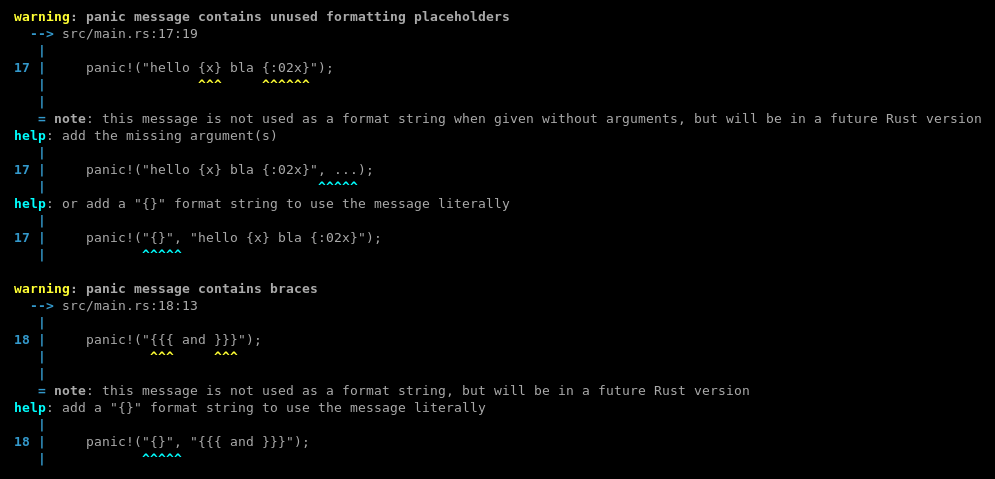
This lint is also a good starting point for adding warnings about `panic!(not_a_string)` later, once [`panic_any()`](https://github.com/rust-lang/rust/pull/74622) becomes a stable alternative.
|
|
|
|
|
|
cleanup: Remove `ParseSess::injected_crate_name`
Its only remaining use is in pretty-printing where the necessary information can be easily re-computed.
|
|
|
|
|
|
The discussion seems to have resolved that this lint is a bit "noisy" in
that applying it in all places would result in a reduction in
readability.
A few of the trivial functions (like `Path::new`) are fine to leave
outside of closures.
The general rule seems to be that anything that is obviously an
allocation (`Box`, `Vec`, `vec![]`) should be in a closure, even if it
is a 0-sized allocation.
|
|
rustc_target: Further cleanup use of target options
Follow up to https://github.com/rust-lang/rust/pull/77729.
Implements items 2 and 4 from the list in https://github.com/rust-lang/rust/pull/77729#issue-500228243.
The first commit collapses uses of `target.options.foo` into `target.foo`.
The second commit renames some target options to avoid tautology:
`target.target_endian` -> `target.endian`
`target.target_c_int_width` -> `target.c_int_width`
`target.target_os` -> `target.os`
`target.target_env` -> `target.env`
`target.target_vendor` -> `target.vendor`
`target.target_family` -> `target.os_family`
`target.target_mcount` -> `target.mcount`
r? `@Mark-Simulacrum`
|
|
with an eye on merging `TargetOptions` into `Target`.
`TargetOptions` as a separate structure is mostly an implementation detail of `Target` construction, all its fields logically belong to `Target` and available from `Target` through `Deref` impls.
|
|
|
|
|
|
This allows us to avoid synthesizing tokens in `prepend_attr`, since we
have the original tokens available.
We still need to synthesize tokens when expanding `cfg_attr`,
but this is an unavoidable consequence of the syntax of `cfg_attr` -
the user does not supply the `#` and `[]` tokens that a `cfg_attr`
expands to.
|
|
(From the PR feedback.)
Co-authored-by: Esteban Küber <esteban@kuber.com.ar>
|
|
The panic message might contain braces which should never be
interpreted as format placeholders, which panic!() will do in a future
edition.
|
|
Preparation for a subsequent change that replaces
rustc_target::config::Config with its wrapped Target.
On its own, this commit breaks the build. I don't like making
build-breaking commits, but in this instance I believe that it
makes review easier, as the "real" changes of this PR can be
seen much more easily.
Result of running:
find compiler/ -type f -exec sed -i -e 's/target\.target\([)\.,; ]\)/target\1/g' {} \;
find compiler/ -type f -exec sed -i -e 's/target\.target$/target/g' {} \;
find compiler/ -type f -exec sed -i -e 's/target.ptr_width/target.pointer_width/g' {} \;
./x.py fmt
|
|
Use std methods on char instead of open coding them
|
|
|
|
|
|
Since 63793 the discriminant_value intrinsic is safe to call. Remove
unnecessary unsafe block around calls to this intrinsic in built-in
derive macros.
|
|
builtin_macros: Fix use of interpolated identifiers in `asm!`
Fixes https://github.com/rust-lang/rust/issues/77584
|
|
|
|
|
|
|
|
This was a big hack, and built-in macros should be able to deal with `NtIdents` in the input by themselves like any other parser code.
|
|
Point at named argument not found when using `format_args_capture` instead of whole format string
|
|
Updated html_root_url for compiler crates
Closes #77103
r? @jyn514
|
|
|
|
|
|
|
|
|
|
We currently only attach tokens when parsing a `:stmt` matcher for a
`macro_rules!` macro. Proc-macro attributes on statements are still
unstable, and need additional work.
|
|
A `Visibility` does not have outer attributes, so we only capture tokens
when parsing a `macro_rules!` matcher
|
|
An `AttrItem` does not have outer attributes, so we only capture tokens
when parsing a `macro_rules!` matcher
|
|
A `Ty` does not have outer attributes, so we only capture tokens
when parsing a `macro_rules!` matcher
|
|
A `Block` does not have outer attributes, so we only capture tokens when
parsing a `macro_rules!` matcher
|
|
clippy::single-char-push-str
|
|
of whole format string
|
|
If a comma in a format call is replaced with a similar token, then we
emit an error and continue parsing, instead of stopping at this point.
|
|
Previous implementation used the `Parser::parse_expr` function in order
to extract the format expression. If the first comma following the
format expression was mistakenly replaced with a dot, then the next
format expression was eaten by the function, because it looked as a
syntactically valid expression, which resulted in incorrectly spanned
error messages.
The way the format expression is exctracted is changed: we first look at
the first available token in the first argument supplied to the
`format!` macro call. If it is a string literal, then it is promoted as
a format expression immediatly, otherwise we fall back to the original
`parse_expr`-related method.
This allows us to ensure that the parser won't consume too much tokens
when a typo is made.
A test has been created so that it is ensured that the issue is properly
fixed.
|
|
|
