| Age | Commit message (Collapse) | Author | Lines |
|---|
|
|
|
Remove LLVM attribute removal
This was necessary before, because `declare_raw_fn` would always apply
the default optimization attributes to every declared function.
Then `attributes::from_fn_attrs` would have to remove the default
attributes in the case of, e.g. `#[optimize(speed)]` in a `-Os` build.
(see [`src/test/codegen/optimize-attr-1.rs`](https://github.com/rust-lang/rust/blob/03a8cc7df1d65554a4d40825b0490c93ac0f0236/src/test/codegen/optimize-attr-1.rs#L33))
However, every relevant callsite of `declare_raw_fn` (i.e. where we
actually generate code for the function, and not e.g. a call to an
intrinsic, where optimization attributes don't [?] matter)
calls `from_fn_attrs`, so we can remove the attribute setting
from `declare_raw_fn`, and rely on `from_fn_attrs` to apply the correct
attributes all at once.
r? `@ghost` (blocked on #94221)
`@rustbot` label S-blocked
|
|
r=estebank
Direct users towards using Rust target feature names in CLI
This PR consists of a couple of changes on how we handle target features.
In particular there is a bug-fix wherein we avoid passing through features that aren't prefixed by `+` or `-` to LLVM. These appear to be causing LLVM to assert, which is pretty poor a behaviour (and also makes it pretty clear we expect feature names to be prefixed).
The other commit, I anticipate to be somewhat more controversial is outputting a warning when users specify a LLVM-specific, or otherwise unknown, feature name on the CLI. In those situations we request users to either replace it with a known Rust feature name (e.g. `bmi` -> `bmi1`) or file a feature request. I've a couple motivations for this: first of all, if users are specifying these features on the command line, I'm pretty confident there is also a need for these features to be usable via `#[cfg(target_feature)]` machinery. And second, we're growing a fair number of backends recently and having ability to provide some sort of unified-ish interface in this place seems pretty useful to me.
Sponsored by: standard.ai
|
|
Revert "Auto merge of #92419 - erikdesjardins:coldland, r=nagisa"
Should fix (untested) #94390
Reopens #46515, #87055
r? `@ehuss`
|
|
At the very least this serves to deduplicate the diagnostics that are
output about unknown target features provided via CLI.
|
|
If they are trying to use features rustc doesn't yet know about,
request a feature request.
Additionally, also warn against using feature names without leading `+`
or `-` signs.
|
|
r=michaelwoerister
Fix MinGW target detection in raw-dylib
LLVM target doesn't have to be the same as Rust target so relying on it is wrong.
It was one of concerns in https://github.com/rust-lang/rust/pull/88801 that was not fixed in https://github.com/rust-lang/rust/pull/90782.
|
|
This was necessary before, because `declare_raw_fn` would always apply
the default optimization attributes to every declared function,
and then `attributes::from_fn_attrs` would have to remove the default
attributes in the case of, e.g. `#[optimize(speed)]` in a `-Os` build.
However, every relevant callsite of `declare_raw_fn` (i.e. where we
actually generate code for the function, and not e.g. a call to an
intrinsic, where optimization attributes don't [?] matter)
calls `from_fn_attrs`, so we can simply remove the attribute setting
from `declare_raw_fn`, and rely on `from_fn_attrs` to apply the correct
attributes all at once.
|
|
This reverts commit 4f49627c6fe2a32d1fed6310466bb0e1c535c0c0, reversing
changes made to 028c6f1454787c068ff5117e9000a1de4fd98374.
|
|
LLVM really dislikes this and will assert, saying something along the
lines of:
```
rustc: llvm/lib/MC/MCSubtargetInfo.cpp:60: void ApplyFeatureFlag(
llvm::FeatureBitset&, llvm::StringRef, llvm::ArrayRef<llvm::SubtargetFeatureKV>
): Assertion
`SubtargetFeatures::hasFlag(Feature) && "Feature flags should start with '+' or '-'"`
failed.
```
|
|
This matches the noundef attributes we apply on arguments/return types.
|
|
Add LLVM attributes in batches instead of individually
This should improve performance.
~r? `@ghost` (blocked on #94127)~
|
|
|
|
No branch protection metadata unless enabled
Even if we emit metadata disabling branch protection, this metadata may
conflict with other modules (e.g. during LTO) that have different branch
protection metadata set.
This is an unstable flag and feature, so ideally the flag not being
specified should act as if the feature wasn't implemented in the first
place.
Additionally this PR also ensures we emit an error if
`-Zbranch-protection` is set on targets other than the supported
aarch64. For now the error is being output from codegen, but ideally it
should be moved to earlier in the pipeline before stabilization.
|
|
This should improve performance.
|
|
At opt-level=0, apply only ABI-affecting attributes to functions
This should provide a small perf improvement for debug builds,
and should more than cancel out the perf regression from adding noundef (https://github.com/rust-lang/rust/pull/93670#issuecomment-1038347581, #94106).
r? `@nikic`
|
|
Bump bootstrap to 1.60
This bumps the bootstrap compiler to 1.60 and cleans up cfgs and Span's rustc_pass_by_value (enabled by the bootstrap bump).
|
|
LLVM target doesn't have to be the same as Rust target so relying on it is wrong.
|
|
|
|
debuginfo: Simplify TypeMap used during LLVM debuginfo generation.
This PR simplifies the TypeMap that is used in `rustc_codegen_llvm::debuginfo::metadata`. It was unnecessarily complicated because it was originally implemented when types were not yet normalized before codegen. So it did it's own normalization and kept track of multiple unnormalized types being mapped to a single unique id.
This PR is based on https://github.com/rust-lang/rust/pull/93503, which is not merged yet.
The PR also removes the arena used for allocating string ids and instead uses `InlinableString` from the [inlinable_string](https://crates.io/crates/inlinable_string) crate. That might not be the best choice, since that crate does not seem to be very actively maintained. The [flexible-string](https://crates.io/crates/flexible-string) crate would be an alternative.
r? `@ghost`
|
|
review comments.
|
|
Use undef for (some) partially-uninit constants
There needs to be some limit to avoid perf regressions on large arrays
with undef in each element (see comment in the code).
Fixes: #84565
Original PR: #83698
Depends on LLVM 14: #93577
|
|
r=michaelwoerister
properly handle fat pointers to uninhabitable types
Calculate the pointee metadata size by using `tcx.struct_tail_erasing_lifetimes` instead of duplicating the logic in `fat_pointer_kind`. Open to alternatively suggestions on how to fix this.
Fixes #94149
r? ````@michaelwoerister```` since you touched this code last, I think!
|
|
Partially move cg_ssa towards using a single builder
Not all codegen backends can handle hopping between blocks well. For example Cranelift requires blocks to be terminated before switching to building a new block. Rust-gpu requires a `RefCell` to allow hopping between blocks and cg_gcc currently has a buggy implementation of hopping between blocks. This PR reduces the amount of cases where cg_ssa switches between blocks before they are finished and mostly fixes the block hopping in cg_gcc. (~~only `scalar_to_backend` doesn't handle it correctly yet in cg_gcc~~ fixed that one.)
`@antoyo` please review the cg_gcc changes.
|
|
|
|
Change `char` type in debuginfo to DW_ATE_UTF
Rust previously encoded the `char` type as DW_ATE_unsigned_char. The more appropriate encoding is `DW_ATE_UTF`.
Clang also uses the DW_ATE_UTF for `char32_t` in C++.
This fixes the display of the `char` type in the Windows debuggers. Without this change, the variable did not show in the locals window.
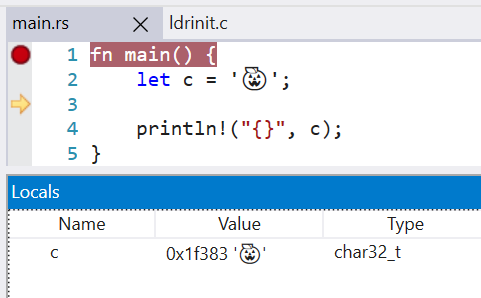
LLDB 13 is also able to display the char value, when before it failed with `need to add support for DW_TAG_base_type 'char' encoded with DW_ATE = 0x8, bit_size = 32`
r? `@wesleywiser`
|
|
Rust previously encoded the `char` type as DW_ATE_unsigned_char. The more
appropriate encoding is DW_ATE_UTF.
Clang uses this same debug encoding for char32_t.
This fixes the display of `char` types in Windows debuggers as well as LLDB.
|
|
|
|
Co-authored-by: Erik Desjardins <erikdesjardins@users.noreply.github.com>
Co-authored-by: Tomasz Miąsko <tomasz.miasko@gmail.com>
|
|
The previous implementation was written before types were properly
normalized for code generation and had to assume a more complicated
relationship between types and their debuginfo -- generating separate
identifiers for debuginfo nodes that were based on normalized types.
Since types are now already normalized, we can use them as identifiers
for debuginfo nodes.
|
|
|
|
Improve `unused_unsafe` lint
I’m going to add some motivation and explanation below, particularly pointing the changes in behavior from this PR.
_Edit:_ Looking for existing issues, looks like this PR fixes #88260.
_Edit2:_ Now also contains code that closes #90776.
|
|
Main motivation: Fixes some issues with the current behavior. This PR is
more-or-less completely re-implementing the unused_unsafe lint; it’s also only
done in the MIR-version of the lint, the set of tests for the `-Zthir-unsafeck`
version no longer succeeds (and is thus disabled, see `lint-unused-unsafe.rs`).
On current nightly,
```rs
unsafe fn unsf() {}
fn inner_ignored() {
unsafe {
#[allow(unused_unsafe)]
unsafe {
unsf()
}
}
}
```
doesn’t create any warnings. This situation is not unrealistic to come by, the
inner `unsafe` block could e.g. come from a macro. Actually, this PR even
includes removal of one unused `unsafe` in the standard library that was missed
in a similar situation. (The inner `unsafe` coming from an external macro hides
the warning, too.)
The reason behind this problem is how the check currently works:
* While generating MIR, it already skips nested unsafe blocks (i.e. unsafe
nested in other unsafe) so that the inner one is always the one considered
unused
* To differentiate the cases of no unsafe operations inside the `unsafe` vs.
a surrounding `unsafe` block, there’s some ad-hoc magic walking up the HIR to
look for surrounding used `unsafe` blocks.
There’s a lot of problems with this approach besides the one presented above.
E.g. the MIR-building uses checks for `unsafe_op_in_unsafe_fn` lint to decide
early whether or not `unsafe` blocks in an `unsafe fn` are redundant and ought
to be removed.
```rs
unsafe fn granular_disallow_op_in_unsafe_fn() {
unsafe {
#[deny(unsafe_op_in_unsafe_fn)]
{
unsf();
}
}
}
```
```
error: call to unsafe function is unsafe and requires unsafe block (error E0133)
--> src/main.rs:13:13
|
13 | unsf();
| ^^^^^^ call to unsafe function
|
note: the lint level is defined here
--> src/main.rs:11:16
|
11 | #[deny(unsafe_op_in_unsafe_fn)]
| ^^^^^^^^^^^^^^^^^^^^^^
= note: consult the function's documentation for information on how to avoid undefined behavior
warning: unnecessary `unsafe` block
--> src/main.rs:10:5
|
9 | unsafe fn granular_disallow_op_in_unsafe_fn() {
| --------------------------------------------- because it's nested under this `unsafe` fn
10 | unsafe {
| ^^^^^^ unnecessary `unsafe` block
|
= note: `#[warn(unused_unsafe)]` on by default
```
Here, the intermediate `unsafe` was ignored, even though it contains a unsafe
operation that is not allowed to happen in an `unsafe fn` without an additional `unsafe` block.
Also closures were problematic and the workaround/algorithms used on current
nightly didn’t work properly. (I skipped trying to fully understand what it was
supposed to do, because this PR uses a completely different approach.)
```rs
fn nested() {
unsafe {
unsafe { unsf() }
}
}
```
```
warning: unnecessary `unsafe` block
--> src/main.rs:10:9
|
9 | unsafe {
| ------ because it's nested under this `unsafe` block
10 | unsafe { unsf() }
| ^^^^^^ unnecessary `unsafe` block
|
= note: `#[warn(unused_unsafe)]` on by default
```
vs
```rs
fn nested() {
let _ = || unsafe {
let _ = || unsafe { unsf() };
};
}
```
```
warning: unnecessary `unsafe` block
--> src/main.rs:9:16
|
9 | let _ = || unsafe {
| ^^^^^^ unnecessary `unsafe` block
|
= note: `#[warn(unused_unsafe)]` on by default
warning: unnecessary `unsafe` block
--> src/main.rs:10:20
|
10 | let _ = || unsafe { unsf() };
| ^^^^^^ unnecessary `unsafe` block
```
*note that this warning kind-of suggests that **both** unsafe blocks are redundant*
--------------------------------------------------------------------------------
I also dislike the fact that it always suggests keeping the outermost `unsafe`.
E.g. for
```rs
fn granularity() {
unsafe {
unsafe { unsf() }
unsafe { unsf() }
unsafe { unsf() }
}
}
```
I prefer if `rustc` suggests removing the more-course outer-level `unsafe`
instead of the fine-grained inner `unsafe` blocks, which it currently does on nightly:
```
warning: unnecessary `unsafe` block
--> src/main.rs:10:9
|
9 | unsafe {
| ------ because it's nested under this `unsafe` block
10 | unsafe { unsf() }
| ^^^^^^ unnecessary `unsafe` block
|
= note: `#[warn(unused_unsafe)]` on by default
warning: unnecessary `unsafe` block
--> src/main.rs:11:9
|
9 | unsafe {
| ------ because it's nested under this `unsafe` block
10 | unsafe { unsf() }
11 | unsafe { unsf() }
| ^^^^^^ unnecessary `unsafe` block
warning: unnecessary `unsafe` block
--> src/main.rs:12:9
|
9 | unsafe {
| ------ because it's nested under this `unsafe` block
...
12 | unsafe { unsf() }
| ^^^^^^ unnecessary `unsafe` block
```
--------------------------------------------------------------------------------
Needless to say, this PR addresses all these points. For context, as far as my
understanding goes, the main advantage of skipping inner unsafe blocks was that
a test case like
```rs
fn top_level_used() {
unsafe {
unsf();
unsafe { unsf() }
unsafe { unsf() }
unsafe { unsf() }
}
}
```
should generate some warning because there’s redundant nested `unsafe`, however
every single `unsafe` block _does_ contain some statement that uses it. Of course
this PR doesn’t aim change the warnings on this kind of code example, because
the current behavior, warning on all the inner `unsafe` blocks, makes sense in this case.
As mentioned, during MIR building all the unsafe blocks *are* kept now, and usage
is attributed to them. The way to still generate a warning like
```
warning: unnecessary `unsafe` block
--> src/main.rs:11:9
|
9 | unsafe {
| ------ because it's nested under this `unsafe` block
10 | unsf();
11 | unsafe { unsf() }
| ^^^^^^ unnecessary `unsafe` block
|
= note: `#[warn(unused_unsafe)]` on by default
warning: unnecessary `unsafe` block
--> src/main.rs:12:9
|
9 | unsafe {
| ------ because it's nested under this `unsafe` block
...
12 | unsafe { unsf() }
| ^^^^^^ unnecessary `unsafe` block
warning: unnecessary `unsafe` block
--> src/main.rs:13:9
|
9 | unsafe {
| ------ because it's nested under this `unsafe` block
...
13 | unsafe { unsf() }
| ^^^^^^ unnecessary `unsafe` block
```
in this case is by emitting a `unused_unsafe` warning for all of the `unsafe`
blocks that are _within a **used** unsafe block_.
The previous code had a little HIR traversal already anyways to collect a set of
all the unsafe blocks (in order to afterwards determine which ones are unused
afterwards). This PR uses such a traversal to do additional things including logic
like _always_ warn for an `unsafe` block that’s inside of another **used**
unsafe block. The traversal is expanded to include nested closures in the same go,
this simplifies a lot of things.
The whole logic around `unsafe_op_in_unsafe_fn` is a little complicated, there’s
some test cases of corner-cases in this PR. (The implementation involves
differentiating between whether a used unsafe block was used exclusively by
operations where `allow(unsafe_op_in_unsafe_fn)` was active.) The main goal was
to make sure that code should compile successfully if all the `unused_unsafe`-warnings
are addressed _simultaneously_ (by removing the respective `unsafe` blocks)
no matter how complicated the patterns of `unsafe_op_in_unsafe_fn` being
disallowed and allowed throughout the function are.
--------------------------------------------------------------------------------
One noteworthy design decision I took here: An `unsafe` block
with `allow(unused_unsafe)` **is considered used** for the purposes of
linting about redundant contained unsafe blocks. So while
```rs
fn granularity() {
unsafe { //~ ERROR: unnecessary `unsafe` block
unsafe { unsf() }
unsafe { unsf() }
unsafe { unsf() }
}
}
```
warns for the outer `unsafe` block,
```rs
fn top_level_ignored() {
#[allow(unused_unsafe)]
unsafe {
#[deny(unused_unsafe)]
{
unsafe { unsf() } //~ ERROR: unnecessary `unsafe` block
unsafe { unsf() } //~ ERROR: unnecessary `unsafe` block
unsafe { unsf() } //~ ERROR: unnecessary `unsafe` block
}
}
}
```
warns on the inner ones.
|
|
Move ty::print methods to Drop-based scope guards
Primary goal is reducing codegen of the TLS access for each closure, which shaves ~3 seconds of bootstrap time over rustc as a whole.
|
|
|
|
|
|
Adopt let else in more places
Continuation of #89933, #91018, #91481, #93046, #93590, #94011.
I have extended my clippy lint to also recognize tuple passing and match statements. The diff caused by fixing it is way above 1 thousand lines. Thus, I split it up into multiple pull requests to make reviewing easier. This is the biggest of these PRs and handles the changes outside of rustdoc, rustc_typeck, rustc_const_eval, rustc_trait_selection, which were handled in PRs #94139, #94142, #94143, #94144.
|
|
|
|
Even if we emit metadata disabling branch protection, this metadata may
conflict with other modules (e.g. during LTO) that have different branch
protection metadata set.
This is an unstable flag and feature, so ideally the flag not being
specified should act as if the feature wasn't implemented in the first
place.
Additionally this PR also ensures we emit an error if
`-Zbranch-protection` is set on targets other than the supported
aarch64. For now the error is being output from codegen, but ideally it
should be moved to earlier in the pipeline before stabilization.
|
|
|
|
|
|
Rollup of 10 pull requests
Successful merges:
- #89892 (Suggest `impl Trait` return type when incorrectly using a generic return type)
- #91675 (Add MemTagSanitizer Support)
- #92806 (Add more information to `impl Trait` error)
- #93497 (Pass `--test` flag through rustdoc to rustc so `#[test]` functions can be scraped)
- #93814 (mips64-openwrt-linux-musl: correct soft-foat)
- #93847 (kmc-solid: Use the filesystem thread-safety wrapper)
- #93877 (asm: Allow the use of r8-r14 as clobbers on Thumb1)
- #93892 (Only mark projection as ambiguous if GAT substs are constrained)
- #93915 (Implement --check-cfg option (RFC 3013), take 2)
- #93953 (Add the `known-bug` test directive, use it, and do some cleanup)
Failed merges:
r? `@ghost`
`@rustbot` modify labels: rollup
|
|
debuginfo: Support fat pointers to unsized tuples.
This PR makes fat pointer debuginfo generation handle the case of unsized tuples.
Fixes #93871
|
|
Add MemTagSanitizer Support
Add support for the LLVM [MemTagSanitizer](https://llvm.org/docs/MemTagSanitizer.html).
On hardware which supports it (see caveats below), the MemTagSanitizer can catch bugs similar to AddressSanitizer and HardwareAddressSanitizer, but with lower overhead.
On a tag mismatch, a SIGSEGV is signaled with code SEGV_MTESERR / SEGV_MTEAERR.
# Usage
`-Zsanitizer=memtag -C target-feature="+mte"`
# Comments/Caveats
* MemTagSanitizer is only supported on AArch64 targets with hardware support
* Requires `-C target-feature="+mte"`
* LLVM MemTagSanitizer currently only performs stack tagging.
# TODO
* Tests
* Example
|
|
There needs to be some limit to avoid perf regressions on large arrays
with undef in each element (see comment in the code).
|
|
This should provide a small perf improvement for debug builds,
and should more than cancel out the regression from adding noundef,
which was only significant in debug builds.
|
|
compiler: clippy::complexity fixes
useless_format
map_flatten
useless_conversion
needless_bool
filter_next
clone_on_copy
needless_option_as_deref
|
|
Fix ICE when using Box<T, A> with pointer sized A
Fixes #78459
Note that using `Box<T, A>` with a more than pointer sized `A` or using a pointer sized `A` with a Box of a DST will produce a different ICE (#92054) which is not fixed by this PR.
|
|
Upgrade to LLVM 14
LLVM patch state:
* [x] https://github.com/llvm/llvm-project/commit/a55727f334b39600bfc71144b11b42aae6b94e0b Backported.
* [x] https://github.com/rust-lang/llvm-project/commit/c3c82dc12402dd41441180c0c6cf7aed7e330c53 Backported as https://github.com/llvm/llvm-project/commit/917c47b3bf0dfc45a2a5ba12c1397d647ecf4017.
* [x] https://github.com/rust-lang/llvm-project/commit/6e8f9ab632d12271355d10d34c9835a7ba14e4b9 No plan to upstream.
* [x] https://github.com/llvm/llvm-project/commit/319f4b2d52e31b000db75a0a2484b5f2ab90534a Backported.
* [x] https://github.com/rust-lang/llvm-project/commit/8b2c25d321f877161f85218479e2d1317d770e18 No plan to upstream.
* [x] https://github.com/rust-lang/llvm-project/commit/75fef2efd427362c8f16b2d09e6ebf44069e3919 No plan to upstream.
* [ ] https://github.com/rust-lang/llvm-project/commit/adef757547de5a570d9f6a00d3e6ac16c666ab79 Upstreamed as https://github.com/llvm/llvm-project/commit/2d2ef384b2f6e723edb793d08f52e7f4dc94ba3a. Needs backport.
* [x] https://github.com/rust-lang/llvm-project/commit/4b7c1b4910e9fa9e04f23f06be078e168ef4c0ee No plan to upstream.
* [x] https://github.com/rust-lang/llvm-project/commit/3f5ab0c061adb723f25b94243828b6b5407720c8 No plan to upstream.
* [x] https://github.com/rust-lang/llvm-project/commit/514d05500e0e15e358f05f5c4cec78a805858f8e No plan to upstream.
* [ ] https://github.com/rust-lang/llvm-project/commit/54c586958564582b3341d1838a5de86541e5fecf Under review at https://reviews.llvm.org/D119695 and https://reviews.llvm.org/D119856.
Release timeline:
* LLVM 14.0.0 final planned for Mar 15.
* Rust 1.60.0 planned for Apr 7.
Compile-time:
* https://perf.rust-lang.org/compare.html?start=250384edc5d78533e993f38c60d64e42b21684b2&end=b87df8d2c7c5d9ac448c585de10927ab2ee1b864
* A slight improvement on average, though no big changes either way.
* There are some larger max-rss improvements.
r? `@ghost`
|
|
|
