| Age | Commit message (Collapse) | Author | Lines |
|---|
|
Initial work on Miri permissive-exposed-provenance
Rustc portion of the changes for portions of a permissive ptr-to-int model for Miri. The main changes here are changing `ptr_get_alloc` and `get_alloc_id` to return an Option, and also making ptr-to-int casts have an expose side effect.
|
|
|
|
|
|
|
|
|
|
Miri/interpreter debugging tweaks
Some changes I made to make debugging Miri with trace logging less terrible.
r? ``@oli-obk``
|
|
Miri provenance cleanup
Reviewing https://github.com/rust-lang/rust/pull/95826 by ``@carbotaniuman`` made me realize that we could clean things up a little here.
``@carbotaniuman`` please let me know if you're okay with landing this (it will create a lot of conflicts with your PR), or if you'd prefer incorporating the ideas from this PR into yours. I think we want to end up in a situation where the function you called `ptr_reify_alloc` returns just two things, a concrete tag and an offset. Getting an `AllocId` from a concrete tag should be infallible like now. However a concrete tag and `Tag` don't have to be the same type.
r? ``@oli-obk``
|
|
into_pointer_or_addr
|
|
|
|
|
|
|
|
|
|
writes do
|
|
|
|
interpret: err instead of ICE on size mismatches in to_bits_or_ptr_internal
We did this a while ago already for `to_i32()` and friends, but missed this one. That became quite annoying when I was debugging an ICE caused by `read_pointer` in a Miri shim where the code was passing an argument at the wrong type.
Having `scalar_to_ptr` be fallible is consistent with all the other `Scalar::to_*` methods being fallible. I added `unwrap` only in code outside the interpreter, which is no worse off than before now in terms of panics.
r? ````@oli-obk````
|
|
|
|
|
|
|
|
Spellchecking some comments
This PR attempts to clean up some minor spelling mistakes in comments
|
|
Address some spelling mistakes in strings, private function names, and function params.
|
|
This PR attempts to clean up some minor spelling mistakes in comments
|
|
Try to evaluate in try unify and postpone resolution of constants that contain inference variables
We want code like that in [`ui/const-generics/generic_const_exprs/eval-try-unify.rs`](https://github.com/rust-lang/rust/compare/master...b-naber:eval-in-try-unify?expand=1#diff-8027038201cf07a6c96abf3cbf0b0f4fdd8a64ce6292435f01c8ed995b87fe9b) to compile. To do that we need to try to evaluate constants in `try_unify_abstract_consts`, this requires us to be more careful about what constants we try to resolve, specifically we cannot try to resolve constants that still contain inference variables.
r? `@lcnr`
|
|
|
|
|
|
|
|
Fix many spelling mistakes
Signed-off-by: codehorseman <cricis@yeah.net>
|
|
There are a few places were we have to construct it, though, and a few
places that are more invasive to change. To do this, we create a
constructor with a long obvious name.
|
|
Signed-off-by: codehorseman <cricis@yeah.net>
|
|
|
|
|
|
Currently some `Allocation`s are interned, some are not, and it's very
hard to tell at a use point which is which.
This commit introduces `ConstAllocation` for the known-interned ones,
which makes the division much clearer. `ConstAllocation::inner()` is
used to get the underlying `Allocation`.
In some places it's natural to use an `Allocation`, in some it's natural
to use a `ConstAllocation`, and in some places there's no clear choice.
I've tried to make things look as nice as possible, while generally
favouring `ConstAllocation`, which is the type that embodies more
information. This does require quite a few calls to `inner()`.
The commit also tweaks how `PartialOrd` works for `Interned`. The
previous code was too clever by half, building on `T: Ord` to make the
code shorter. That caused problems with deriving `PartialOrd` and `Ord`
for `ConstAllocation`, so I changed it to build on `T: PartialOrd`,
which is slightly more verbose but much more standard and avoided the
problems.
|
|
Miri/CTFE: properly treat overflow in (signed) division/rem as UB
To my surprise, it looks like LLVM treats overflow of signed div/rem as UB. From what I can tell, MIR `Div`/`Rem` directly lowers to the corresponding LLVM operation, so to make that correct we also have to consider these overflows UB in the CTFE/Miri interpreter engine.
r? `@oli-obk`
|
|
|
|
|
|
Use undef for (some) partially-uninit constants
There needs to be some limit to avoid perf regressions on large arrays
with undef in each element (see comment in the code).
Fixes: #84565
Original PR: #83698
Depends on LLVM 14: #93577
|
|
|
|
|
|
CTFE engine: Scalar: expose size-generic to_(u)int methods
This matches the size-generic constructors `Scalar::from_(u)int`, and it would have helped in https://github.com/rust-lang/miri/pull/1978.
r? `@oli-obk`
|
|
Implement LowerHex on Scalar to clean up their display in rustdoc
Follow-up of https://github.com/rust-lang/rust/pull/94091.
r? ````@RalfJung````
|
|
|
|
Move ty::print methods to Drop-based scope guards
Primary goal is reducing codegen of the TLS access for each closure, which shaves ~3 seconds of bootstrap time over rustc as a whole.
|
|
|
|
Fix rustdoc const computed value
Fixes #85088.
It looks like this now (instead of hexadecimal):
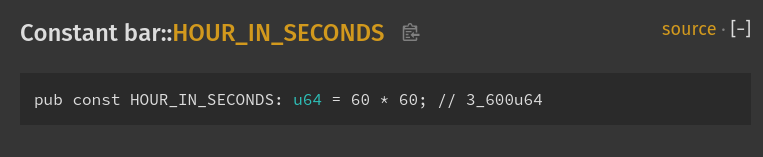
r? ````@oli-obk````
|
|
|
|
|
|
|
|
Make it possible to pretty print invalid constants by introducing a
fallible variant of `destructure_const` and falling back to debug
formatting when it fails.
|
|
`Decoder` has two impls:
- opaque: this impl is already partly infallible, i.e. in some places it
currently panics on failure (e.g. if the input is too short, or on a
bad `Result` discriminant), and in some places it returns an error
(e.g. on a bad `Option` discriminant). The number of places where
either happens is surprisingly small, just because the binary
representation has very little redundancy and a lot of input reading
can occur even on malformed data.
- json: this impl is fully fallible, but it's only used (a) for the
`.rlink` file production, and there's a `FIXME` comment suggesting it
should change to a binary format, and (b) in a few tests in
non-fundamental ways. Indeed #85993 is open to remove it entirely.
And the top-level places in the compiler that call into decoding just
abort on error anyway. So the fallibility is providing little value, and
getting rid of it leads to some non-trivial performance improvements.
Much of this commit is pretty boring and mechanical. Some notes about
a few interesting parts:
- The commit removes `Decoder::{Error,error}`.
- `InternIteratorElement::intern_with`: the impl for `T` now has the same
optimization for small counts that the impl for `Result<T, E>` has,
because it's now much hotter.
- Decodable impls for SmallVec, LinkedList, VecDeque now all use
`collect`, which is nice; the one for `Vec` uses unsafe code, because
that gave better perf on some benchmarks.
|
|
|
|
|
