| Age | Commit message (Collapse) | Author | Lines |
|---|
|
|
|
|
|
Instead of via `Const::new_error`
|
|
|
|
|
|
Fix #72634.
|
|
Relate alias ty with variance
In the new solver, turns out that the subst-relate branch of the alias-relate predicate was relating args invariantly even for opaques, which have variance :skull:.
This change is a bit more invasive, but I'd rather not special-case it [here](https://github.com/rust-lang/rust/blob/aeaa5c30e5c9041264a2e8314b68ad84c2dc3169/compiler/rustc_trait_selection/src/solve/alias_relate.rs#L171-L190) and then have it break elsewhere. I'm doing a perf run to see if the extra call to `def_kind` is that expensive, if it is, I'll reconsider.
r? ``@lcnr``
|
|
|
|
rustdoc: show crate name beside smaller logo
*Blocked on https://github.com/rust-lang/cargo/pull/12800*
## Summary
In this PR, the crate name and version are always shown in the sidebar, even in subpages, and the lateral navigation is always shown in the sidebar, even in modules.
Clicking the crate name does the same thing clicking the logo always did: take you to the crate root (the crate's home page, at least within Rustdoc).
The Rust logo is also no longer shown by default for non-Rust docs.
### Screenshots
<details><summary>Before</summary>
| | Macro | Module |
|--|-------|--------|
| In crate | 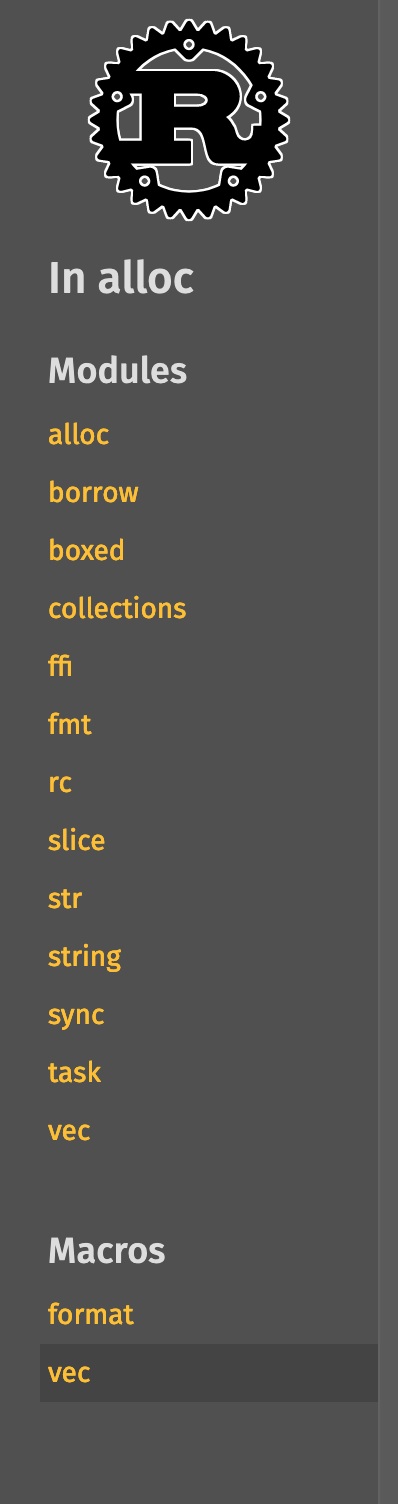 |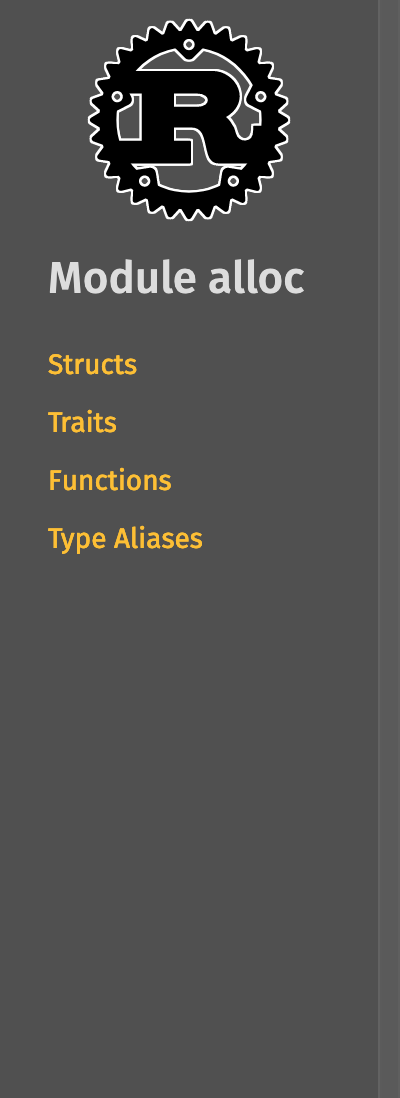
| In module[^1] |  | 
[^1]: This PR also includes a bug fix for derive macros not showing up in the lateral navigation part of the sidebar
</details>
#### Whole sidebar screenshots
| | Macro | Module |
|--|-------|--------|
| In crate | 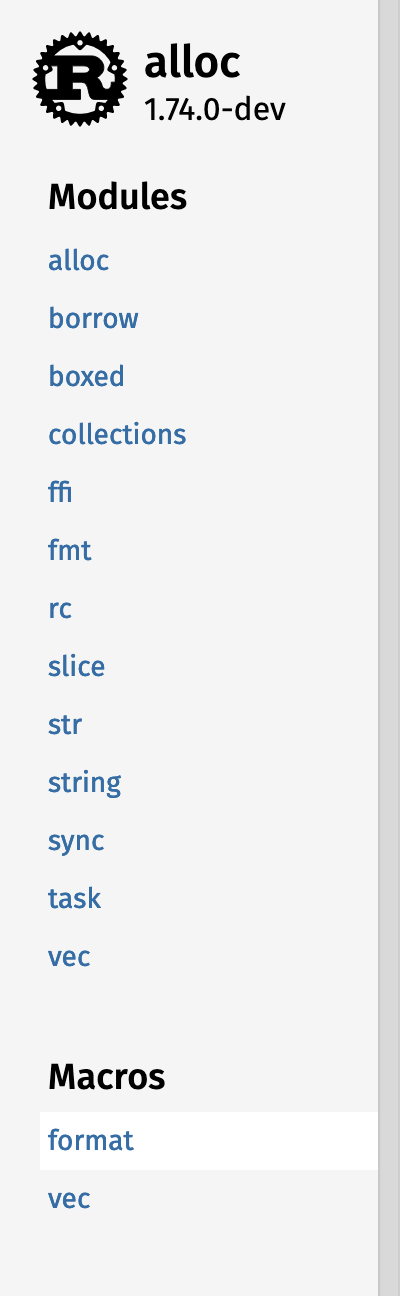 | 
| In module | 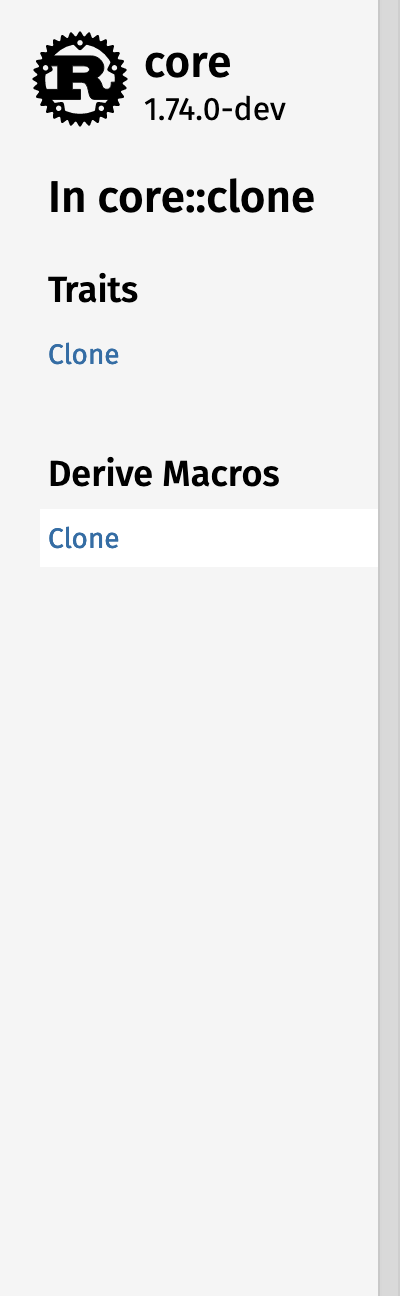 | 
#### Different logo configurations
| | Short crate name | Long crate name |
|---------|------------------|-----------------|
| Root | ![short-root] | ![long-root]
| Subpage | ![short-subpage] | ![long-subpage]
[short-root]: https://github.com/rust-lang/rust/assets/1593513/9e2b4fa8-f581-4106-b562-1e0372c13f79
[short-subpage]: https://github.com/rust-lang/rust/assets/1593513/8331cdb8-fa13-4671-a1e2-dcc1cdca7451
[long-root]: https://github.com/rust-lang/rust/assets/1593513/7d377fec-0f1d-4343-9f82-0e35a8f58056
[long-subpage]: https://github.com/rust-lang/rust/assets/1593513/3b3094a4-63c9-477c-8c15-b6075837df30
##### Without a logo

### Preview pages
https://notriddle.com/rustdoc-html-demo-5/sidebar-layout-rocket/rocket/index.html
https://notriddle.com/rustdoc-html-demo-5/sidebar-layout-rocket/rocket_sync_db_pools/index.html
https://notriddle.com/rustdoc-html-demo-5/sidebar-layout-rust-compiler/index.html
https://notriddle.com/rustdoc-html-demo-5/sidebar-layout-rust/std/index.html
https://notriddle.com/rustdoc-html-demo-5/sidebar-layout-rocket/tokio/index.html
## Motivation
This improves visual information density (the construct with the logo and crate name is *shorter* than the logo on its own, because it's not square) and navigation clarity (we can now see what clicking the Rust logo does, specifically).
Compare this with the layout at [Phoenix's Hexdocs] (which is what this proposal is closely based on), the old proposal on [Internals Discourse] (which always says "Rust standard library" in the sidebar, but doesn't do the side-by-side layout).
[Phoenix's Hexdocs]: https://hexdocs.pm/phoenix/1.7.7/overview.html
[Internals Discourse]: https://internals.rust-lang.org/t/poc-of-a-new-design-for-the-generated-rustdoc/11018
## Guide-level explanation
This PR cleans up some of the sidebar navigation.
It makes the logo in the desktop sidebar a bit smaller, and puts the crate name and version next to it (either beside it, or below it, depending on if there's space), making it clearer what clicking on it does: click the crate name to open the crate's home page. It also removes the Rust logo from non-official-Rust crates, again to make the navigation and supply chain clearer (since the crate name has been added, the logo is no longer necessary for navigation).
It adds a bit more clarifying information for lateral navigation. On items that don't add their own sidebar items, it just shows its siblings directly below the crate name and logo, but for other items, it shows "In crate alloc" instead of just "In alloc". It also shows the lateral navigation tools on module pages, making modules consistent with every other item.
## Drawbacks
While this actually takes up less screen real estate than the old layout on desktop, it takes up more HTML. It's also a bit more visually complex.
## Rationale and alternatives
I could do what the Internals POC did and keep the vertically stacked layout all the time, instead of doing a horizontal stack where possible. It would take up more screen real estate, though.
## Prior art
This design is lifted almost verbatim from Hexdocs. It seems to work for them. [`opentelemetry_process_propagator`], for example, has a long application name.
[`opentelemetry_process_propagator`]: https://hexdocs.pm/opentelemetry_process_propagator/OpentelemetryProcessPropagator.html
## Unresolved questions
Maybe we should encourage crate authors to include their own logo more often? It certainly helps give people a better sense of "place." This seems to be blocked on coming up with an API to do it without requiring them to host the file somewhere.
## Future possibilities
Beyond this, plenty of other changes could be made to improve the layout, like
* Fix things so that clicking an item in the sidebar doesn't cause it to scroll back to the top.
* The [Internals demo](https://utherii.github.io/new.html) does this right: clicking an item in the sidebar changes the content area, but the sidebar itself does not change. This is nice, because clicking is cheap and I can skim the opening few paragraphs while browsing.
* The layout of the docs sidebar causes trouble to implement this, because it's different on different pages, but at least fix this on the file browser.
* Come up with a less cluttered way to do disclosure. There's a lot of `[-]` on the page.
* We don't lack ideas to fix this one. We have *too many*.
* Do a better job of separating local navigation (vec::Vec links to vec::IntoIter) and the table of contents (vec::Vec links to vec::Vec::new).
* A possibility: add a Back arrow next to the "In [module]" header?
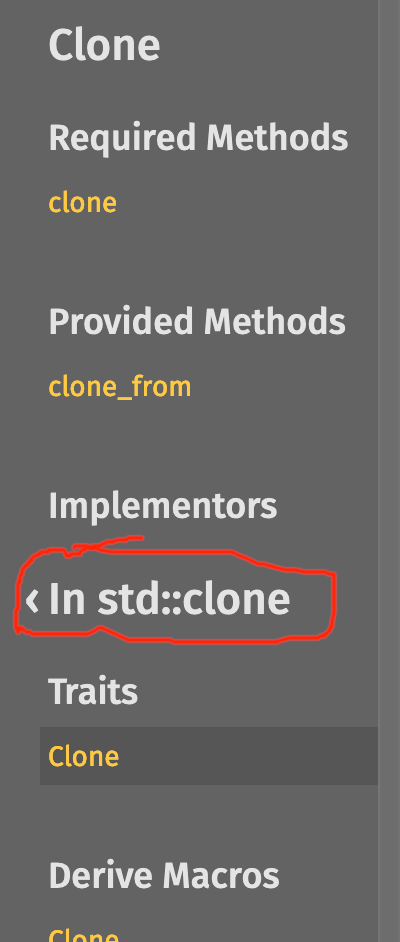
* Give readers more control of how much rustdoc shows them, and giving doc authors more control of how much it generates. Basically, https://github.com/rust-lang/rust/pull/115660 is great, let's do it too.
But those are mostly orthogonal, not future possibilities unlocked by this change.
|
|
Extend `impl`'s `def_span` to include its where clauses
Typically, we highlight the def-span of an impl in a diagnostic due to either:
1. coherence error
2. trait evaluation cycle
3. invalid implementation of built-in trait
I find that an impl's where clauses are very often required to understanding why these errors come about, which is unfortunate since where clauses may be located on different lines and don't show up in the error. This PR expands the def-span of impls to include these where clauses.
r? cjgillot since you've touched this code a while back to make some spans shorter, but you can also reassign to wg-diagnostics or compiler if you're busy or have no strong opinions.
|
|
improve the suggestion of `generic_bound_failure`
- Fixes #115375
- suggest the bound in the correct scope: trait or impl header vs assoc item. See `tests/ui/suggestions/lifetimes/type-param-bound-scope.rs`
- don't suggest a lifetime name that conflicts with the other late-bound regions of the function:
```rust
type Inv<'a> = *mut &'a ();
fn check_bound<'a, T: 'a>(_: T, _: Inv<'a>) {}
fn test<'a, T>(_: &'a str, t: T, lt: Inv<'_>) { // suggests a new name `'a`
check_bound(t, lt); //~ ERROR
}
```
|
|
|
|
|
|
Generalize small dominators optimization
* Use small dominators optimization from 640ede7b0a1840415cb6ec881c2210302bfeba18 more generally.
* Merge `DefLocation` and `LocationExtended` since they serve the same purpose.
|
|
|
|
Clean up `rustc_features`
Plenty more to be done, but this is a decent start.
r? `@Nilstrieb`
|
|
remove Key impls for types that involve an AllocId
I don't understand how but somehow that leads to issues like https://github.com/rust-lang/rust/issues/83085? Anyway removing unused impls doesn't seem like a bad idea. The concerning part is that of course nothing will stop us from having such impls again in the future, alongside re-introducing bugs like #83085.
r? `@oli-obk`
|
|
fix fast-path for try_eval_scalar_int
Cc https://github.com/rust-lang/rust/pull/116281 `@Nadrieril`
|
|
dont call mir.post_mono_checks in codegen
It seems like all tests are still passing when I remove this... let's see what CI says.
|
|
add some docs to hooks/mod.rs
r? `@oli-obk`
|
|
|
|
update some comments around swap()
Based on ``@eddyb's`` comment [here](https://github.com/rust-lang/unsafe-code-guidelines/issues/461#issuecomment-1742156410).
And then I noticed the wrong capitalization for Miri and fixed it in some other places as well.
|
|
Bring back generic parameters for indices in rustc_abi and make it compile on stable
This effectively reverses https://github.com/rust-lang/rust/pull/107163, allowing rust-analyzer to depend on this crate again,
It also moves some glob imports / expands them in the first commit because they made it more difficult for me to reason about things.
|
|
|
|
|
|
Remove is global hack
In attempt to fix https://github.com/rust-lang/rust/issues/114057 we found several issues with how compiler computes layouts, this change removes `is_global` from `and` to stop impl from being shadowed.
In depth conversation can be read here https://rust-lang.zulipchat.com/#narrow/stream/146212-t-compiler.2Fconst-eval/topic/Getting.20different.20types.20from.20almost.20same.20inputs
This is a fix candidate opened for performance run.
r? `@lcnr`
|
|
|
|
Remove mir::LocalDecl::internal.
It does not serve any purpose, as we don't have typeck-based generator witnesses any more.
|
|
The word "active" is currently used in two different and confusing ways:
- `ACTIVE_FEATURES` actually means "available unstable features"
- `Features::active_features` actually means "features declared in the
crate's code", which can include feature within `ACTIVE_FEATURES` but
also others.
(This is also distinct from "enabled" features which includes declared
features but also some edition-specific features automatically enabled
depending on the edition in use.)
This commit changes the `Features::active_features` to
`Features::declared_features` which actually matches its meaning.
Likewise, `Features::active` becomes `Features::declared`.
|
|
Remove the `TypedArena::alloc_from_iter` specialization.
It was added in #78569. It's complicated and doesn't actually help
performance.
r? `@cjgillot`
|
|
|
|
|
|
|
|
|
|
All other impls replace type generics with `()` (or a type implementing the necessery traits)
and lifetimes with `'static`, do the same for those impls.
|
|
This doesn't really change anything, but makes the code a bit more explicit/readable.
|
|
coverage: Allow each coverage statement to have multiple code regions
The original implementation of coverage instrumentation was built around the assumption that a coverage counter/expression would be associated with *up to one* code region. When it was discovered that *multiple* regions would sometimes need to share a counter, a workaround was found: for the remaining regions, the instrumentor would create a fresh expression that adds zero to the existing counter/expression.
That got the job done, but resulted in some awkward code, and produces unnecessarily complicated coverage maps in the final binary.
---
This PR removes that tension by changing `StatementKind::Coverage`'s code region field from `Option<CodeRegion>` to `Vec<CodeRegion>`.
The changes on the codegen side are fairly straightforward. As long as each `CoverageKind::Counter` only injects one `llvm.instrprof.increment`, the rest of coverage codegen is happy to handle multiple regions mapped to the same counter/expression, with only minor option-to-vec adjustments.
On the instrumentor/mir-transform side, we can get rid of the code that creates extra (x + 0) expressions. Instead we gather all of the code regions associated with a single BCB, and inject them all into one coverage statement.
---
There are several patches here but they can be divided in to three phases:
- Preparatory work
- Actually switching over to multiple regions per coverage statement
- Cleaning up
So viewing the patches individually may be easier.
|
|
a small wf and clause cleanup
- remove `Clause::from_projection_clause`, instead use `ToPredicate`
- change `predicate_obligations` to directly take a `Clause`
- remove some unnecessary `&`
- use clause in `min_specialization` checks where easily applicable
|
|
Rollup of 5 pull requests
Successful merges:
- #115863 (Add check_unused_messages in tidy)
- #116210 (Ensure that `~const` trait bounds on associated functions are in const traits or impls)
- #116358 (Rename both of the `Match` relations)
- #116371 (Remove unused features from `rustc_llvm`.)
- #116374 (Print normalized ty)
r? `@ghost`
`@rustbot` modify labels: rollup
|
|
Make subtyping explicit in MIR
This adds new mir-opt that pushes new `ProjectionElem` called `ProjectionElem::Subtype(T)` to `Rvalue` of a subtyped assignment so we can unsoundness issues like https://github.com/rust-lang/rust/issues/107205
Addresses https://github.com/rust-lang/rust/issues/112651
r? `@lcnr`
|
|
There's no need to collect an iterator into a `Vec`, or to call
`into_iter` at the call sites.
|
|
When these methods were originally written, I wasn't aware that
`newtype_index!` already supports addition with ordinary numbers, without
needing to unwrap and re-wrap.
|
|
This makes it possible for a `StatementKind::Coverage` to hold more than one
code region, but that capability is not yet used.
|
|
|
|
|
|
|
|
|
|
|
|
|
|
|
