| Age | Commit message (Collapse) | Author | Lines |
|---|
|
|
|
Do not allow users to apply `#[non_exaustive]` to a struct when they have also used default field values.
|
|
This commit adds a check that verifies that no arguments are passed to
`#[diagnostic::do_not_recommend]`. If we detect arguments we emit a warning.
|
|
`CheckAttrVisitor::check_doc_keyword` checks `#[doc(keyword = "..")]`
attributes to ensure they are on an empty module, and that the value is
a non-empty identifier.
The `rustc::existing_doc_keyword` lint checks these attributes to ensure
that the value is the name of a keyword.
It's silly to have two different checking mechanisms for these
attributes. This commit does the following.
- Changes `check_doc_keyword` to check that the value is the name of a
keyword (avoiding the need for the identifier check, which removes a
dependency on `rustc_lexer`).
- Removes the lint.
- Updates tests accordingly.
There is one hack: the `SelfTy` FIXME case used to used to be handled by
disabling the lint, but now is handled with a special case in
`is_doc_keyword`. That hack will go away if/when the FIXME is fixed.
Co-Authored-By: Guillaume Gomez <guillaume1.gomez@gmail.com>
|
|
Get rid of HIR const checker
As far as I can tell, the HIR const checker was implemented in https://github.com/rust-lang/rust/pull/66170 because we were not able to issue useful const error messages in the MIR const checker.
This seems to have changed in the last 5 years, probably due to work like #90532. I've tweaked the diagnostics slightly and think the error messages have gotten *better* in fact.
Thus I think the HIR const checker has reached the end of its usefulness, and we can retire it.
cc `@RalfJung`
|
|
Allow disabling ASan instrumentation for globals
AddressSanitizer adds instrumentation to global variables unless the [`no_sanitize_address`](https://llvm.org/docs/LangRef.html#global-attributes) attribute is set on them.
This commit extends the existing `#[no_sanitize(address)]` attribute to set this; previously it only had the desired effect on functions.
(cc https://github.com/rust-lang/rust/issues/39699)
|
|
|
|
rustdoc-search: simplify rules for generics and type params
**Heads up!**: This PR is a follow-up that depends on #124544. It adds 12dc24f46007f82b93ed85614347a42d47580afa, a change to the filtering behavior, and 9900ea48b566656fb12b5fcbd0a1b20aaa96e5ca, a minor ranking tweak.
Part of https://github.com/rust-lang/rust-project-goals/issues/112
This PR overturns https://github.com/rust-lang/rust/pull/109802
## Preview
* no results: [`Box<[A]> -> Vec<B>`](http://notriddle.com/rustdoc-html-demo-12/search-sem-3/std/index.html?search=Box%3C%5BA%5D%3E%20-%3E%20Vec%3CB%3E)
* results: [`Box<[A]> -> Vec<A>`](http://notriddle.com/rustdoc-html-demo-12/search-sem-3/std/index.html?search=Box%3C%5BA%5D%3E%20-%3E%20Vec%3CA%3E)
* [`T -> U`](http://notriddle.com/rustdoc-html-demo-12/search-sem-3/std/index.html?search=T%20-%3E%20U)
* [`Cx -> TyCtxt`](http://notriddle.com/rustdoc-html-demo-12/search-sem-3-compiler/rustdoc/index.html?search=Cx%20-%3E%20TyCtxt)
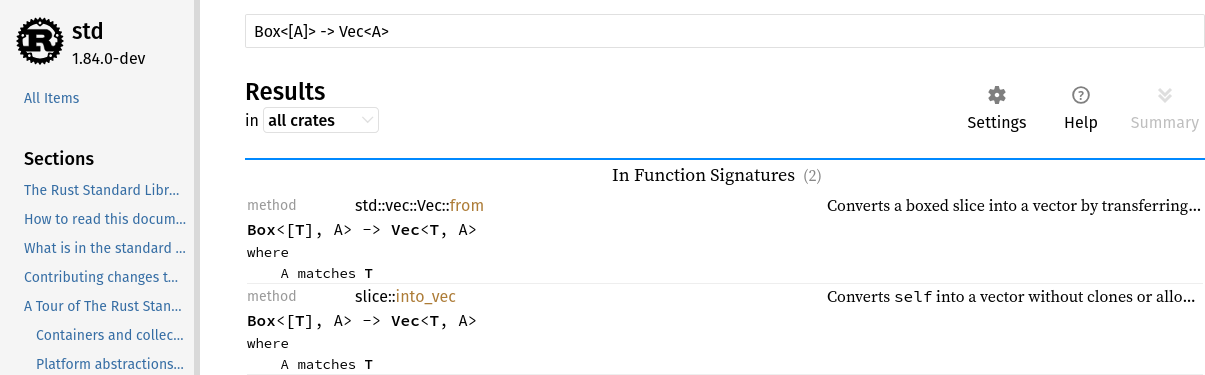
## Description
This commit is a response to feedback on the displayed type signatures results, by making generics act stricter.
- Order within generics is significant. This means `Vec<Allocator>` now matches only with a true vector of allocators, instead of matching the second type param. It also makes unboxing within generics stricter, so `Result<A, B>` only matches if `B` is in the error type and `A` is in the success type. The top level of the function search is unaffected.
- Generics are only "unboxed" if a type is explicitly opted into it. References and tuples are hardcoded to allow unboxing, and Box, Rc, Arc, Option, Result, and Future are opted in with an unstable attribute. Search result unboxing is the process that allows you to search for `i32 -> str` and get back a function with the type signature `&Future<i32> -> Box<str>`.
- Instead of ranking by set overlap, it ranks by the number of items in the type signature. This makes it easier to find single type signatures like transmute.
## Find the discussion on
* <https://rust-lang.zulipchat.com/#narrow/stream/393423-t-rustdoc.2Fmeetings/topic/meeting.202024-07-08/near/449965149>
* <https://github.com/rust-lang/rust/pull/124544#issuecomment-2204272265>
* <https://rust-lang.zulipchat.com/#narrow/channel/266220-t-rustdoc/topic/deciding.20on.20semantics.20of.20generics.20in.20rustdoc.20search>
|
|
functions instead
|
|
AddressSanitizer adds instrumentation to global variables unless the
[`no_sanitize_address`](https://llvm.org/docs/LangRef.html#global-attributes)
attribute is set on them.
This commit extends the existing `#[no_sanitize(address)]` attribute to
set this; previously it only had the desired effect on functions.
|
|
This commit is a response to feedback on the displayed type
signatures results, by making generics act stricter.
Generics are tightened by making order significant. This means
`Vec<Allocator>` now matches only with a true vector of allocators,
instead of matching the second type param. It also makes unboxing
within generics stricter, so `Result<A, B>` only matches if `B`
is in the error type and `A` is in the success type. The top level
of the function search is unaffected.
Find the discussion on:
* <https://rust-lang.zulipchat.com/#narrow/stream/393423-t-rustdoc.2Fmeetings/topic/meeting.202024-07-08/near/449965149>
* <https://github.com/rust-lang/rust/pull/124544#issuecomment-2204272265>
* <https://rust-lang.zulipchat.com/#narrow/channel/266220-t-rustdoc/topic/deciding.20on.20semantics.20of.20generics.20in.20rustdoc.20search/near/476841363>
|
|
Co-authored-by: Jieyou Xu <jieyouxu@outlook.com>
|
|
Fundamentally, we have *three* disjoint categories of functions:
1. const-stable functions
2. private/unstable functions that are meant to be callable from const-stable functions
3. functions that can make use of unstable const features
This PR implements the following system:
- `#[rustc_const_stable]` puts functions in the first category. It may only be applied to `#[stable]` functions.
- `#[rustc_const_unstable]` by default puts functions in the third category. The new attribute `#[rustc_const_stable_indirect]` can be added to such a function to move it into the second category.
- `const fn` without a const stability marker are in the second category if they are still unstable. They automatically inherit the feature gate for regular calls, it can now also be used for const-calls.
Also, several holes in recursive const stability checking are being closed.
There's still one potential hole that is hard to avoid, which is when MIR
building automatically inserts calls to a particular function in stable
functions -- which happens in the panic machinery. Those need to *not* be
`rustc_const_unstable` (or manually get a `rustc_const_stable_indirect`) to be
sure they follow recursive const stability. But that's a fairly rare and special
case so IMO it's fine.
The net effect of this is that a `#[unstable]` or unmarked function can be
constified simply by marking it as `const fn`, and it will then be
const-callable from stable `const fn` and subject to recursive const stability
requirements. If it is publicly reachable (which implies it cannot be unmarked),
it will be const-unstable under the same feature gate. Only if the function ever
becomes `#[stable]` does it need a `#[rustc_const_unstable]` or
`#[rustc_const_stable]` marker to decide if this should also imply
const-stability.
Adding `#[rustc_const_unstable]` is only needed for (a) functions that need to
use unstable const lang features (including intrinsics), or (b) `#[stable]`
functions that are not yet intended to be const-stable. Adding
`#[rustc_const_stable]` is only needed for functions that are actually meant to
be directly callable from stable const code. `#[rustc_const_stable_indirect]` is
used to mark intrinsics as const-callable and for `#[rustc_const_unstable]`
functions that are actually called from other, exposed-on-stable `const fn`. No
other attributes are required.
|
|
Add doc(plugins), doc(passes), etc. to INVALID_DOC_ATTRIBUTES
This fixes #82824.
|
|
|
|
|
|
Autodiff Upstreaming - enzyme frontend
This is an upstream PR for the `autodiff` rustc_builtin_macro that is part of the autodiff feature.
For the full implementation, see: https://github.com/rust-lang/rust/pull/129175
**Content:**
It contains a new `#[autodiff(<args>)]` rustc_builtin_macro, as well as a `#[rustc_autodiff]` builtin attribute.
The autodiff macro is applied on function `f` and will expand to a second function `df` (name given by user).
It will add a dummy body to `df` to make sure it type-checks. The body will later be replaced by enzyme on llvm-ir level,
we therefore don't really care about the content. Most of the changes (700 from 1.2k) are in `compiler/rustc_builtin_macros/src/autodiff.rs`, which expand the macro. Nothing except expansion is implemented for now.
I have a fallback implementation for relevant functions in case that rustc should be build without autodiff support. The default for now will be off, although we want to flip it later (once everything landed) to on for nightly. For the sake of CI, I have flipped the defaults, I'll revert this before merging.
**Dummy function Body:**
The first line is an `inline_asm` nop to make inlining less likely (I have additional checks to prevent this in the middle end of rustc. If `f` gets inlined too early, we can't pass it to enzyme and thus can't differentiate it.
If `df` gets inlined too early, the call site will just compute this dummy code instead of the derivatives, a correctness issue. The following black_box lines make sure that none of the input arguments is getting optimized away before we replace the body.
**Motivation:**
The user facing autodiff macro can verify the user input. Then I write it as args to the rustc_attribute, so from here on I can know that these values should be sensible. A rustc_attribute also turned out to be quite nice to attach this information to the corresponding function and carry it till the backend.
This is also just an experiment, I expect to adjust the user facing autodiff macro based on user feedback, to improve usability.
As a simple example of what this will do, we can see this expansion:
From:
```
#[autodiff(df, Reverse, Duplicated, Const, Active)]
pub fn f1(x: &[f64], y: f64) -> f64 {
unimplemented!()
}
```
to
```
#[rustc_autodiff]
#[inline(never)]
pub fn f1(x: &[f64], y: f64) -> f64 {
::core::panicking::panic("not implemented")
}
#[rustc_autodiff(Reverse, Duplicated, Const, Active,)]
#[inline(never)]
pub fn df(x: &[f64], dx: &mut [f64], y: f64, dret: f64) -> f64 {
unsafe { asm!("NOP"); };
::core::hint::black_box(f1(x, y));
::core::hint::black_box((dx, dret));
::core::hint::black_box(f1(x, y))
}
```
I will add a few more tests once I figured out why rustc rebuilds every time I touch a test.
Tracking:
- https://github.com/rust-lang/rust/issues/124509
try-job: dist-x86_64-msvc
|
|
CastilloDel:reject-unstable-with-accepted-features, r=jieyouxu
Emit an error for unstable attributes that reference already stable features
Closes https://github.com/rust-lang/rust/issues/129814
|
|
Add missing error annotations and .stderr file
Acknowledge comments
|
|
Co-authored-by: Lorenz Schmidt <bytesnake@mailbox.org>
|
|
- fix for divergence
- fix error message
- fix another cranelift test
- fix some cranelift things
- don't set the NORETURN option for naked asm
- fix use of naked_asm! in doc comment
- fix use of naked_asm! in run-make test
- use `span_bug` in unreachable branch
|
|
|
|
also disallow the `noreturn` option, and infer `naked_asm!` as `!`
|
|
|
|
|
|
|
|
This reverts commit acb4e8b6251f1d8da36f08e7a70fa23fc581839e, reversing
changes made to 100fde5246bf56f22fb5cc85374dd841296fce0e.
|
|
|
|
|
|
Removes dead code from the compiler
Detected by #128637
|
|
|
|
|
|
|
|
It's only valid when applied to a type or lifetime parameter
in `Drop` trait implementation.
|
|
|
|
aren't accidentally usable on completely unrelated HIR nodes
Co-authored-by: Jieyou Xu <jieyouxu@outlook.com>
|
|
|
|
The previous commit updated `rustfmt.toml` appropriately. This commit is
the outcome of running `x fmt --all` with the new formatting options.
|
|
- merge error codes
- use attribute name that is incompatible in error message
- add test for conditional incompatible attribute
- add `linkage` to the allowlist
|
|
`#[target-feature]``
|
|
|
|
|
|
Show `used attribute`'s kind for user when find it isn't applied to a `static` variable.
For example :
```rust
extern "C" {
#[used] //~ ERROR attribute must be applied to a `static` variable
static FOO: i32; // show the kind of this item to help user understand why the error is reported.
}
```
fixes #126789
|
|
`static` variable.
fixes #126789
|
|
This upgrades some warnings to errors, and also catches cases where the
attribute was silently ignored.
|
|
|
|
Suggest removing unused tuple fields if they are the last fields
Fixes #124556
We now check if dead/unused fields are the last fields of the tuple and suggest their removal instead of suggesting them to be changed to `()`.
|
|
This paves the way for tracking more state (e.g. error tainting) in the diagnostic context handle
|
|
|
|
Fix OutsideLoop's error suggestion: adding label `'block` for `if` block.
For OutsideLoop we should not suggest add `'block` label in `if` block, or we wiil get another err: block label not supported here.
fixes #123261
|
