| Age | Commit message (Collapse) | Author | Lines |
|---|
|
Fixed the `has_body()` function operator. Before that, this function was
returning false for all shims.
Change resolve_drop_in_place() to also return an instance for empty
shims, since they may still be required for vtable construction.
|
|
We were previously skipping it for non-generic functions, but this was
leaving some constants unevaluated.
|
|
|
|
Add more APIs to retrieve information about types, and add more instance
resolution options.
Make `Instance::body()` return an Option<Body>, since not every instance
might have an available body. For example, foreign instances, virtual
instances, dependencies.
|
|
In cases like Kani, we will invoke the rustc_internal run command
directly for now. It would be handly to be able to have a callback
that can return a value.
We also need extra methods to convert stable constructs into internal
ones, so we can break down the transition into finer grain commits.
|
|
|
|
finish `RegionKind` renaming
second step of https://github.com/rust-lang/types-team/issues/95
continues the work from #117876. While working on this and I encountered a bunch of further cleanup which I'll either open a tracking issue for or will do in a separate PR:
- rewrite the `RegionKind` docs, they still talk about `ReEmpty` and are generally out of date
- rename `DescriptionCtx` to `DescriptionCtxt`
- what is `CheckRegions::Bound`?
- `collect_late_bound_regions` et al
- `erase_late_bound_regions` -> `instantiate_bound_regions_with_erased`?
- `EraseEarlyRegions` visitor should be removed, feels duplicate
r? `@BoxyUwU`
|
|
Add richer structure for Stable MIR Projections
Resolves https://github.com/rust-lang/project-stable-mir/issues/49.
Projections in Stable MIR are currently just strings. This PR replaces that representation with a richer structure, namely projections become vectors of `ProjectionElem`s, just as in MIR. The `ProjectionElem` enum is heavily based off of the MIR `ProjectionElem`.
This PR is a draft since there are several outstanding issues to resolve, including:
- How should `UserTypeProjection`s be represented in Stable MIR? In MIR, the projections are just a vector of `ProjectionElem<(),()>`, meaning `ProjectionElem`s that don't have Local or Type arguments (for `Index`, `Field`, etc. objects). Should `UserTypeProjection`s be represented this way in Stable MIR as well? Or is there a more user-friendly representation that wouldn't drag along all the `ProjectionElem` variants that presumably can't appear?
- What is the expected behavior of a `Place`'s `ty` function? Should it resolve down the chain of projections so that something like `*_1.f` would return the type referenced by field `f`?
- Tests should be added for `UserTypeProjection`
|
|
Also shifts comments explaining why Stable MIR drops an optional variant
name field, for `Downcast` projection elements, to the `Place::stable`
function.
|
|
- `ReFree` -> `ReLateParam`
- `ReEarlyBound` -> `ReEarlyParam`
|
|
Add CoroutineWitness to covered types in smir
Previously we accepted `CouroutineWitness` as `unreachable!` but https://github.com/rust-lang/project-stable-mir/issues/50 shows it is indeed reachable, this pr fixes that and covers `CouroutineWitness`
|
|
other changes:
- `Region::new_late_bound` -> `Region::new_bound`
- `Region::is_late_bound` -> `Region::is_bound`
|
|
|
|
It's not clear to me (klinvill) that UserTypeProjections are produced
anymore with the removal of type ascriptions as per
https://github.com/rust-lang/rfcs/pull/3307. Furthermore, it's not clear
to me which variants of ProjectionElem could appear in such projections.
For these reasons, I'm reverting projections in UserTypeProjections to
simple strings until I can get more clarity on UserTypeProjections.
|
|
This commit includes richer projections for both Places and
UserTypeProjections. However, the tests only touch on Places. There are
also outstanding TODOs regarding how projections should be resolved to
produce Place types, and regarding if UserTypeProjections should just
contain ProjectionElem<(),()> objects as in MIR.
|
|
Fix typo in internal.rs
covert -> convert
|
|
covert -> convert
|
|
also adds some comments
|
|
Support enum variants in offset_of!
This MR implements support for navigating through enum variants in `offset_of!`, placing the enum variant name in the second argument to `offset_of!`. The RFC placed it in the first argument, but I think it interacts better with nested field access in the second, as you can then write things like
```rust
offset_of!(Type, field.Variant.field)
```
Alternatively, a syntactic distinction could be made between variants and fields (e.g. `field::Variant.field`) but I'm not convinced this would be helpful.
[RFC 3308 # Enum Support](https://rust-lang.github.io/rfcs/3308-offset_of.html#enum-support-offset_ofsomeenumstructvariant-field_on_variant)
Tracking Issue #106655.
|
|
|
|
|
|
Add a few utility functions as well and extend most `mir` and `ty`
ADTs to implement `PartialEq` and `Eq`.
|
|
Implement `gen` blocks in the 2024 edition
Coroutines tracking issue https://github.com/rust-lang/rust/issues/43122
`gen` block tracking issue https://github.com/rust-lang/rust/issues/117078
This PR implements `gen` blocks that implement `Iterator`. Most of the logic with `async` blocks is shared, and thus I renamed various types that were referring to `async` specifically.
An example usage of `gen` blocks is
```rust
fn foo() -> impl Iterator<Item = i32> {
gen {
yield 42;
for i in 5..18 {
if i.is_even() { continue }
yield i * 2;
}
}
}
```
The limitations (to be resolved) of the implementation are listed in the tracking issue
|
|
Create a new ConstantKind variant (ZeroSized) for StableMIR
ZeroSized constants can be represented as `mir::Const::Val` even if their layout is not yet known. In those cases, CrateItem::body() was crashing when trying to convert a `ConstValue::ZeroSized` into its stable counterpart `ConstantKind::Allocated`.
Instead, we now map `ConstValue::ZeroSized` into a new variant: `ConstantKind::ZeroSized`.
**Note:** I didn't add any new test here since we already have covering tests in our project repository which I manually confirmed that will fix the issue.
|
|
ZeroSized constants can be represented as `mir::Const::Val` even if
their layout is not yet known. In those cases, CrateItem::body() was
crashing when trying to convert a `ConstValue::ZeroSized` into its
stable counterpart `ConstantKind::Allocated`.
Instead, we now map `ConstValue::ZeroSized` into a new variant:
`ConstantKind::ZeroSized`.
|
|
Add way to differentiate argument locals from other locals in Stable MIR
This PR resolves rust-lang/project-stable-mir#47 which request a way to differentiate argument locals in a SMIR `Body` from other locals.
Specifically, this PR exposes the `arg_count` field from the MIR `Body`. However, I'm opening this as a draft PR because I think there are a few outstanding questions on how this information should be exposed and described. Namely:
- Is exposing `arg_count` the best way to surface this information to SMIR users? Would it be better to leave `arg_count` as a private field and add public methods (e.g. `fn arguments(&self) -> Iter<'_, LocalDecls>`) that may use the underlying `arg_count` info from the MIR body, but expose this information to users in a more convenient form? Or is it best to stick close to the current MIR convention?
- If the answer to the above point is to stick with the current MIR convention (`arg_count`), is it reasonable to also commit to sticking to the current MIR convention that the first local is always the return local, while the next `arg_count` locals are always the (in-order) argument locals?
- Should `Body` in SMIR only represent function bodies (as implied by the comment I added)? That seems to be the current case in MIR, but should this restriction always be the case for SMIR?
r? `@celinval`
r? `@oli-obk`
|
|
|
|
Rename AsyncCoroutineKind to CoroutineSource
pulled out of https://github.com/rust-lang/rust/pull/116447
Also refactors the printing infra of `CoroutineSource` to be ready for easily extending it with a `Gen` variant for `gen` blocks
|
|
This commit hides the arg_count field in Body and instead exposes more
stable and user-friendly methods to get the return and argument locals.
As a result, Body instances must now be constructed using the `new`
function.
|
|
This field allows SMIR consumers to identify which locals correspond to
argument locals. It simply exposes the arg_count field from the MIR
representation.
|
|
similar to how we have `MatchSource`, it explains where the desugaring came from.
|
|
Remove fold code and add `Const::internal()` to StableMIR
We are not planning to support user generated constant in the foreseeable future, so we are cleaning up the fold logic and user created type for now. Users should use `Instance::resolve` in order to trigger monomorphization.
The Instance::resolve was however incomplete, since we weren't handling internalizing constants yet. Thus, I added that.
I decided to keep the `Const` fields private in case we decide to translate them lazily.
|
|
Uplift `ClauseKind` and `PredicateKind` into `rustc_type_ir`
Uplift `ClauseKind` and `PredicateKind` into `rustc_type_ir`.
Blocked on #116951
r? `@ghost`
|
|
|
|
We are not planning to support user generated constant in the
foreseeable future, so we are removing the Fold logic for now in
favor of the Instance::resolve logic.
The Instance::resolve was however incomplete, since we weren't handling
internalizing constants yet. Thus, I added that.
I decided to keep the Const fields private in case we decide to
translate them lazily.
|
|
|
|
|
|
Note: We do not expect to provide internalizing methods for all
StableMIR constructs. They exist only to help migrating efforts to allow
users to mix StableMIR and internal constructs.
|
|
|
|
|
|
Add stable Instance::body() and RustcInternal trait
The `Instance::body()` returns a monomorphized body.
For that, we had to implement visitor that monomorphize types and constants. We are also introducing the RustcInternal trait that will allow us to convert back from Stable to Internal.
Note that this trait is not yet visible for our users as it depends on Tables. We should probably add a new trait that can be exposed.
The tests here are very simple, and I'm planning on creating more exhaustive tests in the project-mir repo. But I was hoping to get some feedback here first.
r? ```@oli-obk```
|
|
|
|
|
|
|
|
|
|
The `Instance::body()` returns a monomorphized body.
For that, we had to implement visitor that monomorphize types and
constants. We are also introducing the RustcInternal trait that will
allow us to convert back from Stable to Internal.
Note that this trait is not yet visible for our users as it depends on
Tables. We should probably add a new trait that can be exposed.
|
|
Also add a few methods to instantiate instances and get an instance
definition.
We're still missing support to actually monomorphize the instance body.
|
|
|
|
|
|
rustdoc: show crate name beside smaller logo
*Blocked on https://github.com/rust-lang/cargo/pull/12800*
## Summary
In this PR, the crate name and version are always shown in the sidebar, even in subpages, and the lateral navigation is always shown in the sidebar, even in modules.
Clicking the crate name does the same thing clicking the logo always did: take you to the crate root (the crate's home page, at least within Rustdoc).
The Rust logo is also no longer shown by default for non-Rust docs.
### Screenshots
<details><summary>Before</summary>
| | Macro | Module |
|--|-------|--------|
| In crate | 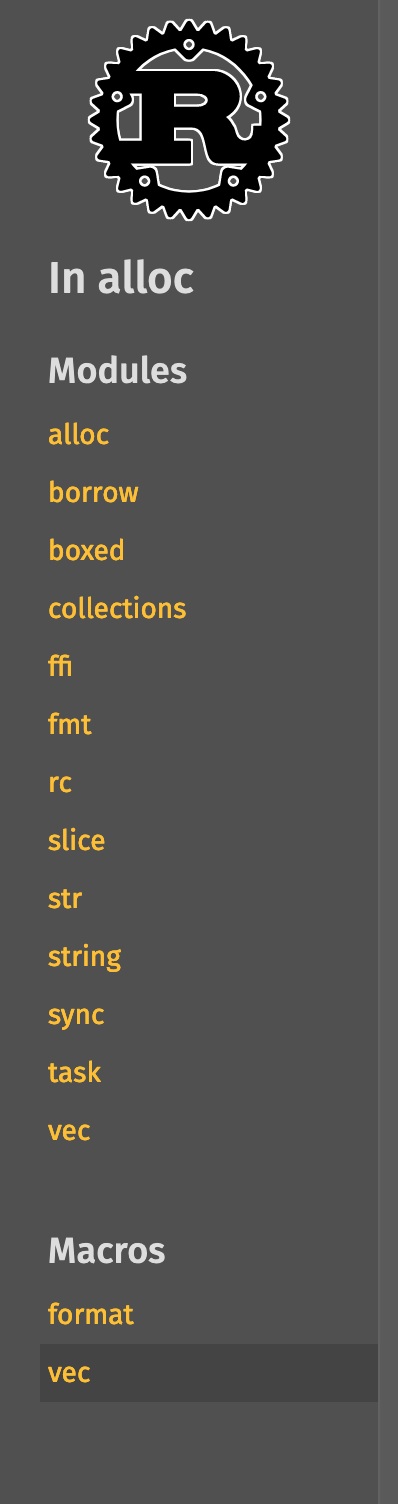 |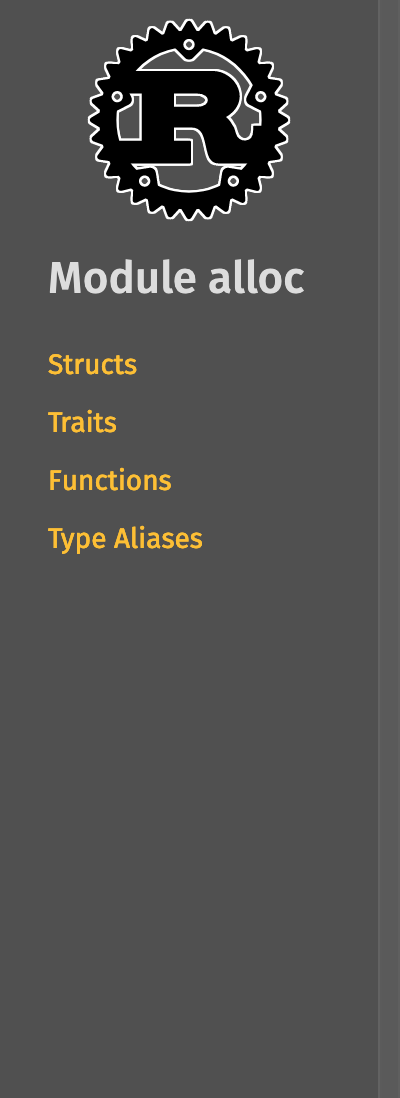
| In module[^1] |  | 
[^1]: This PR also includes a bug fix for derive macros not showing up in the lateral navigation part of the sidebar
</details>
#### Whole sidebar screenshots
| | Macro | Module |
|--|-------|--------|
| In crate | 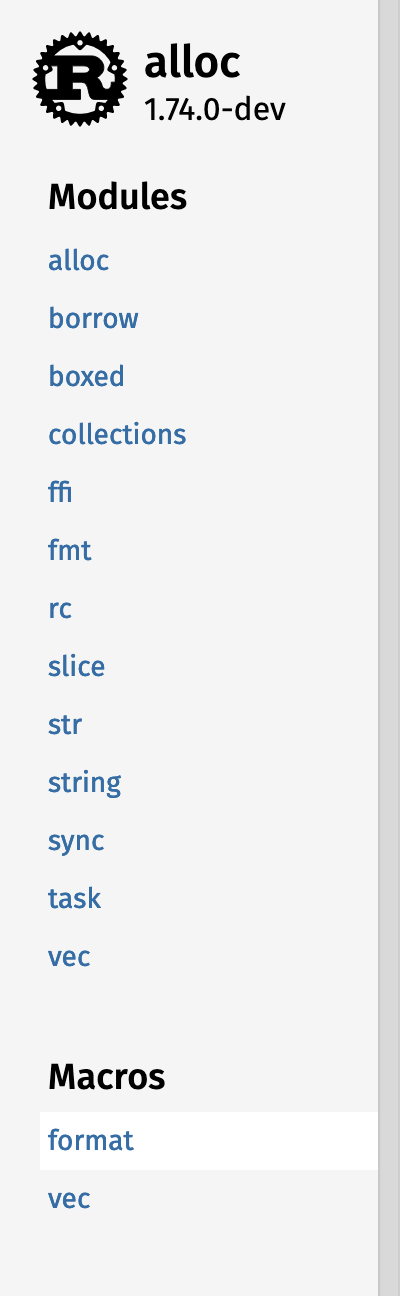 | 
| In module | 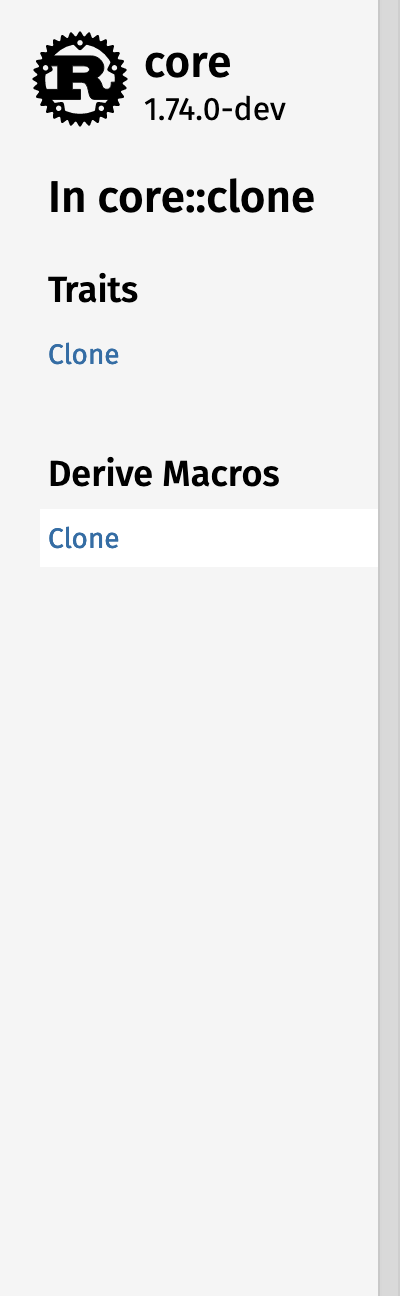 | 
#### Different logo configurations
| | Short crate name | Long crate name |
|---------|------------------|-----------------|
| Root | ![short-root] | ![long-root]
| Subpage | ![short-subpage] | ![long-subpage]
[short-root]: https://github.com/rust-lang/rust/assets/1593513/9e2b4fa8-f581-4106-b562-1e0372c13f79
[short-subpage]: https://github.com/rust-lang/rust/assets/1593513/8331cdb8-fa13-4671-a1e2-dcc1cdca7451
[long-root]: https://github.com/rust-lang/rust/assets/1593513/7d377fec-0f1d-4343-9f82-0e35a8f58056
[long-subpage]: https://github.com/rust-lang/rust/assets/1593513/3b3094a4-63c9-477c-8c15-b6075837df30
##### Without a logo

### Preview pages
https://notriddle.com/rustdoc-html-demo-5/sidebar-layout-rocket/rocket/index.html
https://notriddle.com/rustdoc-html-demo-5/sidebar-layout-rocket/rocket_sync_db_pools/index.html
https://notriddle.com/rustdoc-html-demo-5/sidebar-layout-rust-compiler/index.html
https://notriddle.com/rustdoc-html-demo-5/sidebar-layout-rust/std/index.html
https://notriddle.com/rustdoc-html-demo-5/sidebar-layout-rocket/tokio/index.html
## Motivation
This improves visual information density (the construct with the logo and crate name is *shorter* than the logo on its own, because it's not square) and navigation clarity (we can now see what clicking the Rust logo does, specifically).
Compare this with the layout at [Phoenix's Hexdocs] (which is what this proposal is closely based on), the old proposal on [Internals Discourse] (which always says "Rust standard library" in the sidebar, but doesn't do the side-by-side layout).
[Phoenix's Hexdocs]: https://hexdocs.pm/phoenix/1.7.7/overview.html
[Internals Discourse]: https://internals.rust-lang.org/t/poc-of-a-new-design-for-the-generated-rustdoc/11018
## Guide-level explanation
This PR cleans up some of the sidebar navigation.
It makes the logo in the desktop sidebar a bit smaller, and puts the crate name and version next to it (either beside it, or below it, depending on if there's space), making it clearer what clicking on it does: click the crate name to open the crate's home page. It also removes the Rust logo from non-official-Rust crates, again to make the navigation and supply chain clearer (since the crate name has been added, the logo is no longer necessary for navigation).
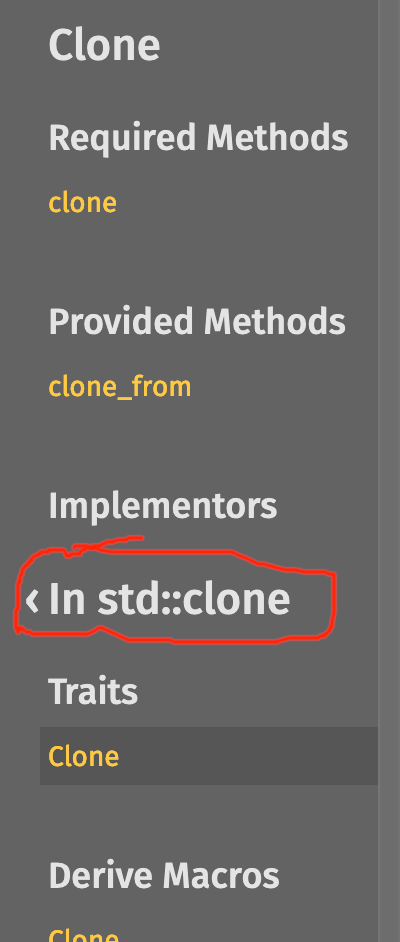
It adds a bit more clarifying information for lateral navigation. On items that don't add their own sidebar items, it just shows its siblings directly below the crate name and logo, but for other items, it shows "In crate alloc" instead of just "In alloc". It also shows the lateral navigation tools on module pages, making modules consistent with every other item.
## Drawbacks
While this actually takes up less screen real estate than the old layout on desktop, it takes up more HTML. It's also a bit more visually complex.
## Rationale and alternatives
I could do what the Internals POC did and keep the vertically stacked layout all the time, instead of doing a horizontal stack where possible. It would take up more screen real estate, though.
## Prior art
This design is lifted almost verbatim from Hexdocs. It seems to work for them. [`opentelemetry_process_propagator`], for example, has a long application name.
[`opentelemetry_process_propagator`]: https://hexdocs.pm/opentelemetry_process_propagator/OpentelemetryProcessPropagator.html
## Unresolved questions
Maybe we should encourage crate authors to include their own logo more often? It certainly helps give people a better sense of "place." This seems to be blocked on coming up with an API to do it without requiring them to host the file somewhere.
## Future possibilities
Beyond this, plenty of other changes could be made to improve the layout, like
* Fix things so that clicking an item in the sidebar doesn't cause it to scroll back to the top.
* The [Internals demo](https://utherii.github.io/new.html) does this right: clicking an item in the sidebar changes the content area, but the sidebar itself does not change. This is nice, because clicking is cheap and I can skim the opening few paragraphs while browsing.
* The layout of the docs sidebar causes trouble to implement this, because it's different on different pages, but at least fix this on the file browser.
* Come up with a less cluttered way to do disclosure. There's a lot of `[-]` on the page.
* We don't lack ideas to fix this one. We have *too many*.
* Do a better job of separating local navigation (vec::Vec links to vec::IntoIter) and the table of contents (vec::Vec links to vec::Vec::new).
* A possibility: add a Back arrow next to the "In [module]" header?
* Give readers more control of how much rustdoc shows them, and giving doc authors more control of how much it generates. Basically, https://github.com/rust-lang/rust/pull/115660 is great, let's do it too.
But those are mostly orthogonal, not future possibilities unlocked by this change.
|
