| Age | Commit message (Collapse) | Author | Lines |
|---|
|
Use attributes for `dangling_pointers_from_temporaries` lint
Checking for dangling pointers by function name isn't ideal, and leaves out certain pointer-returning methods that don't follow the `as_ptr` naming convention. Using an attribute for this lint cleans things up and allows more thorough coverage of other methods, such as `UnsafeCell::get()`.
|
|
|
|
Co-authored-by: Boxy UwU <rust@boxyuwu.dev>
Co-authored-by: León Orell Valerian Liehr <me@fmease.dev>
|
|
|
|
|
|
Skip locking span interner for some syntax context checks
- `from_expansion` now never needs to consult the interner
- `eq_ctxt` now only needs the interner when both spans are fully interned
|
|
Delete the `cfg(not(parallel))` serial compiler
Since it's inception a long time ago, the parallel compiler and its cfgs have been a maintenance burden. This was a necessary evil the allow iteration while not degrading performance because of synchronization overhead.
But this time is over. Thanks to the amazing work by the parallel working group (and the dyn sync crimes), the parallel compiler has now been fast enough to be shipped by default in nightly for quite a while now.
Stable and beta have still been on the serial compiler, because they can't use `-Zthreads` anyways.
But this is quite suboptimal:
- the maintenance burden still sucks
- we're not testing the serial compiler in nightly
Because of these reasons, it's time to end it. The serial compiler has served us well in the years since it was split from the parallel one, but it's over now.
Let the knight slay one head of the two-headed dragon!
#113349
Note that the default is still 1 thread, as more than 1 thread is still fairly broken.
cc `@onur-ozkan` to see if i did the bootstrap field removal correctly, `@SparrowLii` on the sync parts
|
|
Since it's inception a long time ago, the parallel compiler and its cfgs
have been a maintenance burden. This was a necessary evil the allow
iteration while not degrading performance because of synchronization
overhead.
But this time is over. Thanks to the amazing work by the parallel
working group (and the dyn sync crimes), the parallel compiler has now
been fast enough to be shipped by default in nightly for quite a while
now.
Stable and beta have still been on the serial compiler, because they
can't use `-Zthreads` anyways.
But this is quite suboptimal:
- the maintenance burden still sucks
- we're not testing the serial compiler in nightly
Because of these reasons, it's time to end it. The serial compiler has
served us well in the years since it was split from the parallel one,
but it's over now.
Let the knight slay one head of the two-headed dragon!
|
|
Arbitrary self types v2: (unused) Receiver trait
This commit contains a new `Receiver` trait, which is the basis for the Arbitrary Self Types v2 RFC. This allows smart pointers to be method receivers even if they're not Deref.
This is currently unused by the compiler - a subsequent PR will start to use this for method resolution if the `arbitrary_self_types` feature gate is enabled. This is being landed first simply to make review simpler: if people feel this should all be in an atomic PR let me know.
This is a part of the arbitrary self types v2 project, https://github.com/rust-lang/rfcs/pull/3519
https://github.com/rust-lang/rust/issues/44874
r? `@wesleywiser`
|
|
|
|
|
|
|
|
rustdoc-search: simplify rules for generics and type params
**Heads up!**: This PR is a follow-up that depends on #124544. It adds 12dc24f46007f82b93ed85614347a42d47580afa, a change to the filtering behavior, and 9900ea48b566656fb12b5fcbd0a1b20aaa96e5ca, a minor ranking tweak.
Part of https://github.com/rust-lang/rust-project-goals/issues/112
This PR overturns https://github.com/rust-lang/rust/pull/109802
## Preview
* no results: [`Box<[A]> -> Vec<B>`](http://notriddle.com/rustdoc-html-demo-12/search-sem-3/std/index.html?search=Box%3C%5BA%5D%3E%20-%3E%20Vec%3CB%3E)
* results: [`Box<[A]> -> Vec<A>`](http://notriddle.com/rustdoc-html-demo-12/search-sem-3/std/index.html?search=Box%3C%5BA%5D%3E%20-%3E%20Vec%3CA%3E)
* [`T -> U`](http://notriddle.com/rustdoc-html-demo-12/search-sem-3/std/index.html?search=T%20-%3E%20U)
* [`Cx -> TyCtxt`](http://notriddle.com/rustdoc-html-demo-12/search-sem-3-compiler/rustdoc/index.html?search=Cx%20-%3E%20TyCtxt)
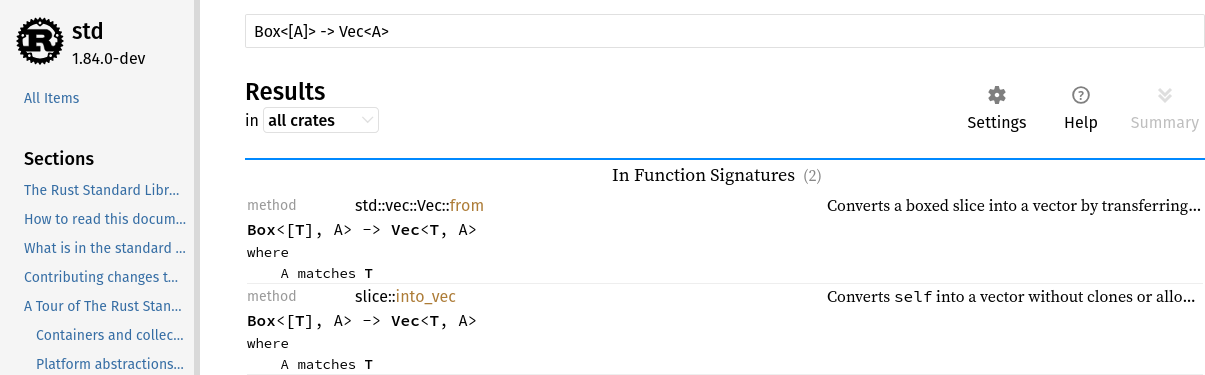
## Description
This commit is a response to feedback on the displayed type signatures results, by making generics act stricter.
- Order within generics is significant. This means `Vec<Allocator>` now matches only with a true vector of allocators, instead of matching the second type param. It also makes unboxing within generics stricter, so `Result<A, B>` only matches if `B` is in the error type and `A` is in the success type. The top level of the function search is unaffected.
- Generics are only "unboxed" if a type is explicitly opted into it. References and tuples are hardcoded to allow unboxing, and Box, Rc, Arc, Option, Result, and Future are opted in with an unstable attribute. Search result unboxing is the process that allows you to search for `i32 -> str` and get back a function with the type signature `&Future<i32> -> Box<str>`.
- Instead of ranking by set overlap, it ranks by the number of items in the type signature. This makes it easier to find single type signatures like transmute.
## Find the discussion on
* <https://rust-lang.zulipchat.com/#narrow/stream/393423-t-rustdoc.2Fmeetings/topic/meeting.202024-07-08/near/449965149>
* <https://github.com/rust-lang/rust/pull/124544#issuecomment-2204272265>
* <https://rust-lang.zulipchat.com/#narrow/channel/266220-t-rustdoc/topic/deciding.20on.20semantics.20of.20generics.20in.20rustdoc.20search>
|
|
Add Unicode block-drawing compiler output support
Add nightly-only theming support to rustc output using Unicode box
drawing characters instead of ASCII-art to draw the terminal UI.
In order to enable, the flags `-Zunstable-options=yes --error-format=human-unicode` must be passed in.
After:
```
error: foo
╭▸ test.rs:3:3
│
3 │ X0 Y0 Z0
│ ┌───╿──│──┘
│ ┌│───│──┘
│ ┏││━━━┙
│ ┃││
4 │ ┃││ X1 Y1 Z1
5 │ ┃││ X2 Y2 Z2
│ ┃│└────╿──│──┘ `Z` label
│ ┃└─────│──┤
│ ┗━━━━━━┥ `Y` is a good letter too
│ `X` is a good letter
╰╴
note: bar
╭▸ test.rs:4:3
│
4 │ ┏ X1 Y1 Z1
5 │ ┃ X2 Y2 Z2
6 │ ┃ X3 Y3 Z3
│ ┗━━━━━━━━━━┛
├ note: bar
╰ note: baz
note: qux
╭▸ test.rs:4:3
│
4 │ X1 Y1 Z1
╰╴ ━━━━━━━━
```
Before:
```
error: foo
--> test.rs:3:3
|
3 | X0 Y0 Z0
| ___^__-__-
| |___|__|
| ||___|
| |||
4 | ||| X1 Y1 Z1
5 | ||| X2 Y2 Z2
| |||____^__-__- `Z` label
| ||_____|__|
| |______| `Y` is a good letter too
| `X` is a good letter
|
note: bar
--> test.rs:4:3
|
4 | / X1 Y1 Z1
5 | | X2 Y2 Z2
6 | | X3 Y3 Z3
| |__________^
= note: bar
= note: baz
note: qux
--> test.rs:4:3
|
4 | X1 Y1 Z1
| ^^^^^^^^
```
After:

Before:

|
|
|
|
coverage: Restrict empty-span expansion to only cover `{` and `}`
Coverage instrumentation has some tricky code for converting a coverage-relevant `Span` into a set of start/end line/byte-column coordinates that will be embedded in the CGU's coverage metadata.
A big part of this complexity is special code for handling empty spans, which are expanded into non-empty spans (if possible) because LLVM's coverage reporter does not handle empty spans well.
This PR simplifies that code by restricting it to only apply in two specific situations: when the character after the empty span is `{`, or the character before the empty span is `}`.
(As an added benefit, this means that the expanded spans no longer extend awkwardly beyond the end of a physical line, which was common under the previous implementation.)
Along the way, this PR also removes some unhelpful code for dealing with function source code spread across multiple files. Functions currently can't have coverage spans in multiple files, and if that ever changes (e.g. to properly support expansion regions) then this code will need to be completely overhauled anyway.
|
|
Add v9, v8plus, and leoncasa target feature to sparc and use v8plus in create_object_file
This adds the following three unstable target features:
- `v9`: SPARC-V9 instructions ([LLVM definition][sparc-v9])
- Relevant to https://github.com/rust-lang/rust/pull/131222#issuecomment-2453310963
- Relevant to https://github.com/rust-lang/rust/pull/132472#discussion_r1832606081
- This is also needed to implement https://github.com/taiki-e/atomic-maybe-uninit/pull/31 (depends on inline assembly support) more robustly.
- `v8plus`: SPARC-V8+ ABI ([LLVM definition][sparc-v8plus])
- This is added in LLVM 20. In LLVM 19 and older, it is emulated to work the same way as LLVM in each LLVM version.
- See https://github.com/rust-lang/rust/issues/132585#issuecomment-2453926257 for more.
- `leoncasa`: CASA instruction[^1] of LEON3 and LEON4 processors ([LLVM definition][sparc-leoncasa], LLVM feature name: `hasleoncasa`)
- This is needed to implement https://github.com/taiki-e/atomic-maybe-uninit/pull/31 (depends on inline assembly support) more robustly.
[^1]: Atomic CAS instruction
[sparc-v9]: https://github.com/llvm/llvm-project/blob/f5e4ffaa49254706ad6fa209de8aec28e20f0041/llvm/lib/Target/Sparc/Sparc.td#L37-L39
[sparc-v8plus]: https://github.com/llvm/llvm-project/blob/f5e4ffaa49254706ad6fa209de8aec28e20f0041/llvm/lib/Target/Sparc/Sparc.td#L37-L39
[sparc-leoncasa]: https://github.com/llvm/llvm-project/blob/llvmorg-19.1.0/llvm/lib/Target/Sparc/LeonFeatures.td#L32-L37
|
|
|
|
|
|
|
|
functions instead
|
|
|
|
|
|
Operations like is_aligned would return actively wrong results at compile-time,
i.e. calling it on the same pointer at compiletime and runtime could yield
different results. That's no good.
Instead of having hacks to make align_offset kind-of work in const-eval, just
use const_eval_select in the few places where it makes sense, which also ensures
those places are all aware they need to make sure the fallback behavior is
consistent.
|
|
This commit is a response to feedback on the displayed type
signatures results, by making generics act stricter.
Generics are tightened by making order significant. This means
`Vec<Allocator>` now matches only with a true vector of allocators,
instead of matching the second type param. It also makes unboxing
within generics stricter, so `Result<A, B>` only matches if `B`
is in the error type and `A` is in the success type. The top level
of the function search is unaffected.
Find the discussion on:
* <https://rust-lang.zulipchat.com/#narrow/stream/393423-t-rustdoc.2Fmeetings/topic/meeting.202024-07-08/near/449965149>
* <https://github.com/rust-lang/rust/pull/124544#issuecomment-2204272265>
* <https://rust-lang.zulipchat.com/#narrow/channel/266220-t-rustdoc/topic/deciding.20on.20semantics.20of.20generics.20in.20rustdoc.20search/near/476841363>
|
|
compiler: apply clippy::clone_on_ref_ptr for CI
Apply lint https://rust-lang.github.io/rust-clippy/master/index.html#/clone_on_ref_ptr for compiler, also see https://github.com/rust-lang/rust/pull/131225#discussion_r1790109443.
Some Arc's can be misplaced with Lrc's, sorry.
https://rust-lang.zulipchat.com/#narrow/channel/131828-t-compiler/topic/enable.20more.20clippy.20lints.20for.20compiler.20.28and.5Cor.20std.29
|
|
|
|
|
|
dingxiangfei2009:rename-smart-ptr-to-coerce-referent, r=compiler-errors
Rename macro `SmartPointer` to `CoercePointee`
As per resolution #129104 we will rename the macro to better reflect the technical specification of the feature and clarify the communication.
- `SmartPointer` is renamed to `CoerceReferent`
- `#[pointee]` attribute is renamed to `#[referent]`
- `#![feature(derive_smart_pointer)]` gate is renamed to `#![feature(derive_coerce_referent)]`.
- Any mention of `SmartPointer` in the file names are renamed accordingly.
r? `@compiler-errors`
cc `@nikomatsakis` `@Darksonn`
|
|
Fundamentally, we have *three* disjoint categories of functions:
1. const-stable functions
2. private/unstable functions that are meant to be callable from const-stable functions
3. functions that can make use of unstable const features
This PR implements the following system:
- `#[rustc_const_stable]` puts functions in the first category. It may only be applied to `#[stable]` functions.
- `#[rustc_const_unstable]` by default puts functions in the third category. The new attribute `#[rustc_const_stable_indirect]` can be added to such a function to move it into the second category.
- `const fn` without a const stability marker are in the second category if they are still unstable. They automatically inherit the feature gate for regular calls, it can now also be used for const-calls.
Also, several holes in recursive const stability checking are being closed.
There's still one potential hole that is hard to avoid, which is when MIR
building automatically inserts calls to a particular function in stable
functions -- which happens in the panic machinery. Those need to *not* be
`rustc_const_unstable` (or manually get a `rustc_const_stable_indirect`) to be
sure they follow recursive const stability. But that's a fairly rare and special
case so IMO it's fine.
The net effect of this is that a `#[unstable]` or unmarked function can be
constified simply by marking it as `const fn`, and it will then be
const-callable from stable `const fn` and subject to recursive const stability
requirements. If it is publicly reachable (which implies it cannot be unmarked),
it will be const-unstable under the same feature gate. Only if the function ever
becomes `#[stable]` does it need a `#[rustc_const_unstable]` or
`#[rustc_const_stable]` marker to decide if this should also imply
const-stability.
Adding `#[rustc_const_unstable]` is only needed for (a) functions that need to
use unstable const lang features (including intrinsics), or (b) `#[stable]`
functions that are not yet intended to be const-stable. Adding
`#[rustc_const_stable]` is only needed for functions that are actually meant to
be directly callable from stable const code. `#[rustc_const_stable_indirect]` is
used to mark intrinsics as const-callable and for `#[rustc_const_unstable]`
functions that are actually called from other, exposed-on-stable `const fn`. No
other attributes are required.
|
|
This commit contains a new Receiver trait, which is the basis for the
Arbitrary Self Types v2 RFC. This allows smart pointers to be method
receivers even if they're not Deref.
This is currently unused by the compiler - a subsequent PR will start to
use this for method resolution if the arbitrary_self_types feature gate
is enabled. This is being landed first simply to make review
simpler: if people feel this should all be in an atomic PR let me know.
This is a part of the arbitrary self types v2 project,
https://github.com/rust-lang/rfcs/pull/3519
https://github.com/rust-lang/rust/issues/44874
r? @wesleywiser
|
|
|
|
move derive_smart_pointer into removed set
|
|
As part of the "arbitrary self types v2" project, we are going to
replace the current `Receiver` trait with a new mechanism based on a
new, different `Receiver` trait.
This PR renames the old trait to get it out the way. Naming is hard.
Options considered included:
* HardCodedReceiver (because it should only be used for things in the
standard library, and hence is sort-of hard coded)
* LegacyReceiver
* TargetLessReceiver
* OldReceiver
These are all bad names, but fortunately this will be temporary.
Assuming the new mechanism proceeds to stabilization as intended, the
legacy trait will be removed altogether.
Although we expect this trait to be used only in the standard library,
we suspect it may be in use elsehwere, so we're landing this change
separately to identify any surprising breakages.
It's known that this trait is used within the Rust for Linux project; a
patch is in progress to remove their dependency.
This is a part of the arbitrary self types v2 project,
https://github.com/rust-lang/rfcs/pull/3519
https://github.com/rust-lang/rust/issues/44874
r? @wesleywiser
|
|
|
|
Autodiff Upstreaming - enzyme frontend
This is an upstream PR for the `autodiff` rustc_builtin_macro that is part of the autodiff feature.
For the full implementation, see: https://github.com/rust-lang/rust/pull/129175
**Content:**
It contains a new `#[autodiff(<args>)]` rustc_builtin_macro, as well as a `#[rustc_autodiff]` builtin attribute.
The autodiff macro is applied on function `f` and will expand to a second function `df` (name given by user).
It will add a dummy body to `df` to make sure it type-checks. The body will later be replaced by enzyme on llvm-ir level,
we therefore don't really care about the content. Most of the changes (700 from 1.2k) are in `compiler/rustc_builtin_macros/src/autodiff.rs`, which expand the macro. Nothing except expansion is implemented for now.
I have a fallback implementation for relevant functions in case that rustc should be build without autodiff support. The default for now will be off, although we want to flip it later (once everything landed) to on for nightly. For the sake of CI, I have flipped the defaults, I'll revert this before merging.
**Dummy function Body:**
The first line is an `inline_asm` nop to make inlining less likely (I have additional checks to prevent this in the middle end of rustc. If `f` gets inlined too early, we can't pass it to enzyme and thus can't differentiate it.
If `df` gets inlined too early, the call site will just compute this dummy code instead of the derivatives, a correctness issue. The following black_box lines make sure that none of the input arguments is getting optimized away before we replace the body.
**Motivation:**
The user facing autodiff macro can verify the user input. Then I write it as args to the rustc_attribute, so from here on I can know that these values should be sensible. A rustc_attribute also turned out to be quite nice to attach this information to the corresponding function and carry it till the backend.
This is also just an experiment, I expect to adjust the user facing autodiff macro based on user feedback, to improve usability.
As a simple example of what this will do, we can see this expansion:
From:
```
#[autodiff(df, Reverse, Duplicated, Const, Active)]
pub fn f1(x: &[f64], y: f64) -> f64 {
unimplemented!()
}
```
to
```
#[rustc_autodiff]
#[inline(never)]
pub fn f1(x: &[f64], y: f64) -> f64 {
::core::panicking::panic("not implemented")
}
#[rustc_autodiff(Reverse, Duplicated, Const, Active,)]
#[inline(never)]
pub fn df(x: &[f64], dx: &mut [f64], y: f64, dret: f64) -> f64 {
unsafe { asm!("NOP"); };
::core::hint::black_box(f1(x, y));
::core::hint::black_box((dx, dret));
::core::hint::black_box(f1(x, y))
}
```
I will add a few more tests once I figured out why rustc rebuilds every time I touch a test.
Tracking:
- https://github.com/rust-lang/rust/issues/124509
try-job: dist-x86_64-msvc
|
|
Add intrinsics `fmuladd{f16,f32,f64,f128}`. This computes `(a * b) +
c`, to be fused if the code generator determines that (i) the target
instruction set has support for a fused operation, and (ii) that the
fused operation is more efficient than the equivalent, separate pair
of `mul` and `add` instructions.
https://llvm.org/docs/LangRef.html#llvm-fmuladd-intrinsic
MIRI support is included for f32 and f64.
The codegen_cranelift uses the `fma` function from libc, which is a
correct implementation, but without the desired performance semantic. I
think this requires an update to cranelift to expose a suitable
instruction in its IR.
I have not tested with codegen_gcc, but it should behave the same
way (using `fma` from libc).
|
|
Co-authored-by: Lorenz Schmidt <bytesnake@mailbox.org>
|
|
Compiler & its UI tests: Rename remaining occurrences of "object safe" to "dyn compatible"
Follow-up to #130826.
Part of #130852.
1. 1st commit: Fix stupid oversights. Should've been part of #130826.
2. 2nd commit: Rename the unstable feature `object_safe_for_dispatch` to `dyn_compatible_for_dispatch`. Might not be worth the churn, you decide.
3. 3rd commit: Apply the renaming to all UI tests (contents and paths).
|
|
|
|
|
|
|
|
Implement RFC3695 Allow boolean literals as cfg predicates
This PR implements https://github.com/rust-lang/rfcs/pull/3695: allow boolean literals as cfg predicates, i.e. `cfg(true)` and `cfg(false)`.
r? `@nnethercote` *(or anyone with parser knowledge)*
cc `@clubby789`
|
|
|
|
|
|
|
|
Support clobber_abi and vector/access registers (clobber-only) in s390x inline assembly
This supports `clobber_abi` which is one of the requirements of stabilization mentioned in #93335.
This also supports vector registers (as `vreg`) and access registers (as `areg`) as clobber-only, which need to support clobbering of them to implement clobber_abi.
Refs:
- "1.2.1.1. Register Preservation Rules" section in ELF Application Binary Interface s390x Supplement, Version 1.6.1 (lzsabi_s390x.pdf in https://github.com/IBM/s390x-abi/releases/tag/v1.6.1)
- Register definition in LLVM:
- Vector registers https://github.com/llvm/llvm-project/blob/llvmorg-19.1.0/llvm/lib/Target/SystemZ/SystemZRegisterInfo.td#L249
- Access registers https://github.com/llvm/llvm-project/blob/llvmorg-19.1.0/llvm/lib/Target/SystemZ/SystemZRegisterInfo.td#L332
I have three questions:
- ~~ELF Application Binary Interface s390x Supplement says that `cc` (condition code, bits 18-19 of PSW) is "Volatile".
However, we do not have a register class for `cc` and instead mark `cc` as clobbered unless `preserves_flags` is specified (https://github.com/rust-lang/rust/pull/111331).
Therefore, in the current implementation, if both `preserves_flags` and `clobber_abi` are specified, `cc` is not marked as clobbered. Is this okay? Or even if `preserves_flags` is used, should `cc` be marked as clobbered if `clobber_abi` is used?~~ UPDATE: resolved https://github.com/rust-lang/rust/pull/130630#issuecomment-2367923121
- ~~ELF Application Binary Interface s390x Supplement says that `pm` (program mask, bits 20-23 of PSW) is "Cleared".
There does not appear to be any registers associated with this in either [LLVM](https://github.com/llvm/llvm-project/blob/llvmorg-19.1.0/llvm/lib/Target/SystemZ/SystemZRegisterInfo.td) or [GCC](https://github.com/gcc-mirror/gcc/blob/33ccc1314dcdb0b988a9276ca6b6ce9b07bea21e/gcc/config/s390/s390.h#L407-L431), so at this point I don't see any way other than to just ignore it. Is this okay as-is?~~ UPDATE: resolved https://github.com/rust-lang/rust/pull/130630#issuecomment-2367923121
- Is "areg" a good name for register class name for access registers? It may be a bit confusing between that and `reg_addr`, which uses the “a” constraint (https://github.com/rust-lang/rust/pull/119431)...
Note:
- GCC seems to [recognize only `a0` and `a1`](https://github.com/gcc-mirror/gcc/blob/33ccc1314dcdb0b988a9276ca6b6ce9b07bea21e/gcc/config/s390/s390.h#L428-L429), and using `a[2-15]` [causes errors](https://godbolt.org/z/a46vx8jjn).
Given that cg_gcc has a similar problem with other architecture (https://github.com/rust-lang/rustc_codegen_gcc/issues/485), I don't feel this is a blocker for this PR, but it is worth mentioning here.
- `vreg` should be able to accept `#[repr(simd)]` types as input if the `vector` target feature added in https://github.com/rust-lang/rust/pull/127506 is enabled, but core_arch has no s390x vector type and both `#[repr(simd)]` and `core::simd` are unstable, so I have not implemented it in this PR. EDIT: And supporting it is probably more complex than doing the equivalent on other architectures... https://github.com/rust-lang/rust/pull/88245#issuecomment-905559591
cc `@uweigand`
r? `@Amanieu`
`@rustbot` label +O-SystemZ
|
|
|
|
|
|
Begin experimental support for pin reborrowing
This commit adds basic support for reborrowing `Pin` types in argument position. At the moment it only supports reborrowing `Pin<&mut T>` as `Pin<&mut T>` by inserting a call to `Pin::as_mut()`, and only in argument position (not as the receiver in a method call).
This PR makes the following example compile:
```rust
#![feature(pin_ergonomics)]
fn foo(_: Pin<&mut Foo>) {
}
fn bar(mut x: Pin<&mut Foo>) {
foo(x);
foo(x);
}
```
Previously, you would have had to write `bar` as:
```rust
fn bar(mut x: Pin<&mut Foo>) {
foo(x.as_mut());
foo(x);
}
```
Tracking:
- #130494
r? `@compiler-errors`
|
