| Age | Commit message (Collapse) | Author | Lines |
|---|
|
|
|
Update documentation for Arc::from_raw, Arc::increment_strong_count, and Arc::decrement_strong_count to clarify allocator requirement
### Related Issue:
This update addresses parts of the issue raised in [#134242](https://github.com/rust-lang/rust/issues/134242), where Arc's documentation lacks `Global Allocator` safety descriptions for three APIs. And this was confirmed by ```@workingjubilee``` :
> Wait, nevermind. I apparently forgot the `increment_strong_count` is implicitly A = Global. Ugh. Another reason these things are hard to track, unfortunately.
### PR Description
This PR updates the document for the following APIs:
- `Arc::from_raw`
- `Arc::increment_strong_count`
- `Arc::decrement_strong_count`
These APIs currently lack an important piece of documentation: **the raw pointer must point to a block of memory allocated by the global allocator**. This crucial detail is specified in the source code but is not reflected in the documentation, which could lead to confusion or incorrect usage by users.
### Problem:
The following example demonstrates the potential confusion caused by the lack of documentation:
```rust
#![feature(allocator_api)]
use std::alloc::{Allocator,AllocError, Layout};
use std::ptr::NonNull;
use std::sync::Arc;
struct LocalAllocator {
memory: NonNull<u8>,
size: usize,
}
impl LocalAllocator {
fn new(size: usize) -> Self {
Self {
memory: unsafe { NonNull::new_unchecked(&mut 0u8 as *mut u8) },
size,
}
}
}
unsafe impl Allocator for LocalAllocator {
fn allocate(&self, _layout: Layout) -> Result<NonNull<[u8]>, AllocError> {
Ok(NonNull::slice_from_raw_parts(self.memory, self.size))
}
unsafe fn deallocate(&self, _ptr: NonNull<u8>, _layout: Layout) {
}
}
fn main() {
let allocator = LocalAllocator::new(64);
let arc = Arc::new_in(5, &allocator); // Here, allocator could be any non-global allocator
let ptr = Arc::into_raw(arc);
unsafe {
Arc::increment_strong_count(ptr);
let arc = Arc::from_raw(ptr);
assert_eq!(2, Arc::strong_count(&arc)); // Failed here!
}
}
```
|
|
Co-authored-by: Ibraheem Ahmed <ibraheem@ibraheem.ca>
|
|
This API removes the need for several `unsafe` blocks, and leads to
clearer code.
|
|
|
|
Add `into_array` conversion destructors for `Box`, `Rc`, and `Arc`.
Tracking issue: #133508
This PR adds the `into_array` destructor for `alloc::boxed::Box<[T]>`, `alloc::rc::Rc<[T]>`, and `alloc::sync::Arc<[T]>`.
Note that this PR assumes the initial proposal of these functions returning `Option`. It is still an open question whether this should instead be `Result`. We can, however, easily change this in a follow-up PR with the necessary consensus.
|
|
'from_raw','increment_strong_count','decrement_strong_count'
|
|
|
|
Field init shorthand allows writing initializers like `tcx: tcx` as
`tcx`. The compiler already uses it extensively. Fix the last few places
where it isn't yet used.
|
|
Unit tests directly inside of standard library crates require a very
fragile way of building that is hard to reproduce outside of bootstrap.
|
|
|
|
|
|
|
|
lolbinarycat:library-fix-too_long_first_doc_paragraph, r=tgross35
split up the first paragraph of doc comments for better summaries
used `./x clippy -Aclippy::all '-Wclippy::too_long_first_doc_paragraph' library/core library/alloc` to find these issues.
|
|
rustdoc-search: simplify rules for generics and type params
**Heads up!**: This PR is a follow-up that depends on #124544. It adds 12dc24f46007f82b93ed85614347a42d47580afa, a change to the filtering behavior, and 9900ea48b566656fb12b5fcbd0a1b20aaa96e5ca, a minor ranking tweak.
Part of https://github.com/rust-lang/rust-project-goals/issues/112
This PR overturns https://github.com/rust-lang/rust/pull/109802
## Preview
* no results: [`Box<[A]> -> Vec<B>`](http://notriddle.com/rustdoc-html-demo-12/search-sem-3/std/index.html?search=Box%3C%5BA%5D%3E%20-%3E%20Vec%3CB%3E)
* results: [`Box<[A]> -> Vec<A>`](http://notriddle.com/rustdoc-html-demo-12/search-sem-3/std/index.html?search=Box%3C%5BA%5D%3E%20-%3E%20Vec%3CA%3E)
* [`T -> U`](http://notriddle.com/rustdoc-html-demo-12/search-sem-3/std/index.html?search=T%20-%3E%20U)
* [`Cx -> TyCtxt`](http://notriddle.com/rustdoc-html-demo-12/search-sem-3-compiler/rustdoc/index.html?search=Cx%20-%3E%20TyCtxt)
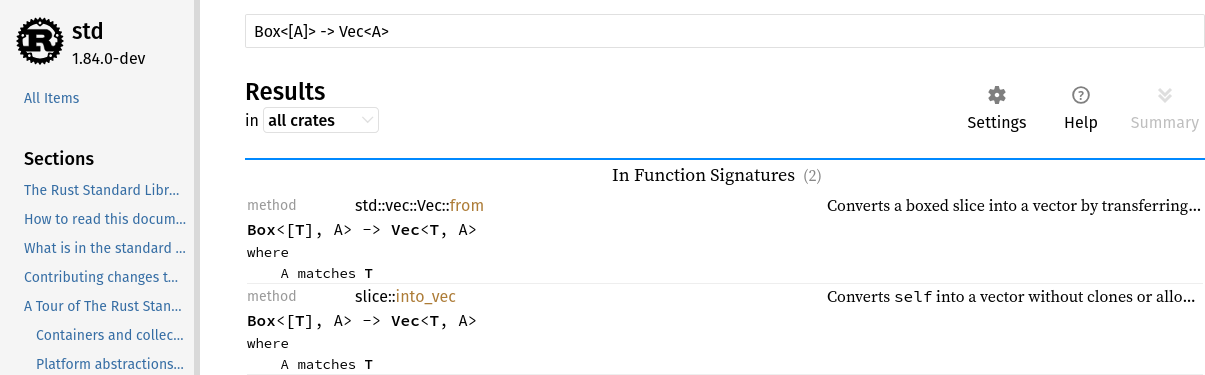
## Description
This commit is a response to feedback on the displayed type signatures results, by making generics act stricter.
- Order within generics is significant. This means `Vec<Allocator>` now matches only with a true vector of allocators, instead of matching the second type param. It also makes unboxing within generics stricter, so `Result<A, B>` only matches if `B` is in the error type and `A` is in the success type. The top level of the function search is unaffected.
- Generics are only "unboxed" if a type is explicitly opted into it. References and tuples are hardcoded to allow unboxing, and Box, Rc, Arc, Option, Result, and Future are opted in with an unstable attribute. Search result unboxing is the process that allows you to search for `i32 -> str` and get back a function with the type signature `&Future<i32> -> Box<str>`.
- Instead of ranking by set overlap, it ranks by the number of items in the type signature. This makes it easier to find single type signatures like transmute.
## Find the discussion on
* <https://rust-lang.zulipchat.com/#narrow/stream/393423-t-rustdoc.2Fmeetings/topic/meeting.202024-07-08/near/449965149>
* <https://github.com/rust-lang/rust/pull/124544#issuecomment-2204272265>
* <https://rust-lang.zulipchat.com/#narrow/channel/266220-t-rustdoc/topic/deciding.20on.20semantics.20of.20generics.20in.20rustdoc.20search>
|
|
|
|
Implement `From<&mut {slice}>` for `Box/Rc/Arc<{slice}>`
ACP: https://github.com/rust-lang/libs-team/issues/424
New API:
```rust
impl<T: Clone> From<&mut [T]> for Box<[T]>
impl From<&mut str> for Box<str>
impl From<&mut CStr> for Box<CStr>
impl From<&mut OsStr> for Box<OsStr>
impl From<&mut Path> for Box<Path>
impl<T: Clone> From<&mut [T]> for Rc<[T]>
impl From<&mut str> for Rc<str>
impl From<&mut CStr> for Rc<CStr>
impl From<&mut OsStr> for Rc<OsStr>
impl From<&mut Path> for Rc<Path>
impl<T: Clone> From<&mut [T]> for Arc<[T]>
impl From<&mut str> for Arc<str>
impl From<&mut CStr> for Arc<CStr>
impl From<&mut OsStr> for Arc<OsStr>
impl From<&mut Path> for Arc<Path>
```
Since they are trait implementations, I think these are insta-stable.
As mentioned in https://github.com/rust-lang/libs-team/issues/424#issuecomment-2299415749, a crater run might be needed.
|
|
This commit is a response to feedback on the displayed type
signatures results, by making generics act stricter.
Generics are tightened by making order significant. This means
`Vec<Allocator>` now matches only with a true vector of allocators,
instead of matching the second type param. It also makes unboxing
within generics stricter, so `Result<A, B>` only matches if `B`
is in the error type and `A` is in the success type. The top level
of the function search is unaffected.
Find the discussion on:
* <https://rust-lang.zulipchat.com/#narrow/stream/393423-t-rustdoc.2Fmeetings/topic/meeting.202024-07-08/near/449965149>
* <https://github.com/rust-lang/rust/pull/124544#issuecomment-2204272265>
* <https://rust-lang.zulipchat.com/#narrow/channel/266220-t-rustdoc/topic/deciding.20on.20semantics.20of.20generics.20in.20rustdoc.20search/near/476841363>
|
|
|
|
|
|
|
|
Rename Receiver -> LegacyReceiver
As part of the "arbitrary self types v2" project, we are going to replace the current `Receiver` trait with a new mechanism based on a new, different `Receiver` trait.
This PR renames the old trait to get it out the way. Naming is hard. Options considered included:
* HardCodedReceiver (because it should only be used for things in the standard library, and hence is sort-of hard coded)
* LegacyReceiver
* TargetLessReceiver
* OldReceiver
These are all bad names, but fortunately this will be temporary. Assuming the new mechanism proceeds to stabilization as intended, the legacy trait will be removed altogether.
Although we expect this trait to be used only in the standard library, we suspect it may be in use elsehwere, so we're landing this change separately to identify any surprising breakages.
It's known that this trait is used within the Rust for Linux project; a patch is in progress to remove their dependency.
This is a part of the arbitrary self types v2 project,
https://github.com/rust-lang/rfcs/pull/3519
https://github.com/rust-lang/rust/issues/44874
r? `@wesleywiser`
|
|
As part of the "arbitrary self types v2" project, we are going to
replace the current `Receiver` trait with a new mechanism based on a
new, different `Receiver` trait.
This PR renames the old trait to get it out the way. Naming is hard.
Options considered included:
* HardCodedReceiver (because it should only be used for things in the
standard library, and hence is sort-of hard coded)
* LegacyReceiver
* TargetLessReceiver
* OldReceiver
These are all bad names, but fortunately this will be temporary.
Assuming the new mechanism proceeds to stabilization as intended, the
legacy trait will be removed altogether.
Although we expect this trait to be used only in the standard library,
we suspect it may be in use elsehwere, so we're landing this change
separately to identify any surprising breakages.
It's known that this trait is used within the Rust for Linux project; a
patch is in progress to remove their dependency.
This is a part of the arbitrary self types v2 project,
https://github.com/rust-lang/rfcs/pull/3519
https://github.com/rust-lang/rust/issues/44874
r? @wesleywiser
|
|
|
|
Optimize `Box::default` and `Arc::default` to construct more types in place
Both the `Arc` and `Box` `Default` impls currently call `T::default()` before allocating, and then moving the resulting `T` into the allocation.
Most `Default` impls are trivial, which should in theory allow
LLVM to construct `T: Default` directly in the `Box` allocation when calling
`<Box<T>>::default()`.
However, the allocation may fail, which necessitates calling `T`'s destructor if it has one.
If the destructor is non-trivial, then LLVM has a hard time proving that it's
sound to elide, which makes it construct `T` on the stack first, and then copy it into the allocation.
Change both of these impls to allocate first, and then call `T::default` into the uninitialized allocation, so that LLVM doesn't have to prove that it's sound to elide the destructor/initial stack copy.
For example, given the following Rust code:
```rust
#[derive(Default, Clone)]
struct Foo {
x: Vec<u8>,
z: String,
y: Vec<u8>,
}
#[no_mangle]
pub fn src() -> Box<Foo> {
Box::default()
}
```
<details open>
<summary>Before this PR:</summary>
```llvm
`@__rust_no_alloc_shim_is_unstable` = external global i8
; drop_in_place() generated in case the allocation fails
; core::ptr::drop_in_place<playground::Foo>
; Function Attrs: nounwind nonlazybind uwtable
define internal fastcc void `@"_ZN4core3ptr36drop_in_place$LT$playground..Foo$GT$17hff376aece491233bE"(ptr` noalias nocapture noundef readonly align 8 dereferenceable(72) %_1) unnamed_addr #0 personality ptr `@rust_eh_personality` {
start:
%_1.val = load i64, ptr %_1, align 8
%0 = icmp eq i64 %_1.val, 0
br i1 %0, label %bb6, label %"_ZN63_$LT$alloc..alloc..Global$u20$as$u20$core..alloc..Allocator$GT$10deallocate17heaa87468709346b1E.exit.i.i.i4.i"
"_ZN63_$LT$alloc..alloc..Global$u20$as$u20$core..alloc..Allocator$GT$10deallocate17heaa87468709346b1E.exit.i.i.i4.i": ; preds = %start
%1 = getelementptr inbounds i8, ptr %_1, i64 8
%_1.val6 = load ptr, ptr %1, align 8, !nonnull !3, !noundef !3
tail call void `@__rust_dealloc(ptr` noundef nonnull %_1.val6, i64 noundef %_1.val, i64 noundef 1) #8
br label %bb6
bb6: ; preds = %"_ZN63_$LT$alloc..alloc..Global$u20$as$u20$core..alloc..Allocator$GT$10deallocate17heaa87468709346b1E.exit.i.i.i4.i", %start
%2 = getelementptr inbounds i8, ptr %_1, i64 24
%.val9 = load i64, ptr %2, align 8
%3 = icmp eq i64 %.val9, 0
br i1 %3, label %bb5, label %"_ZN63_$LT$alloc..alloc..Global$u20$as$u20$core..alloc..Allocator$GT$10deallocate17heaa87468709346b1E.exit.i.i.i4.i.i11"
"_ZN63_$LT$alloc..alloc..Global$u20$as$u20$core..alloc..Allocator$GT$10deallocate17heaa87468709346b1E.exit.i.i.i4.i.i11": ; preds = %bb6
%4 = getelementptr inbounds i8, ptr %_1, i64 32
%.val10 = load ptr, ptr %4, align 8, !nonnull !3, !noundef !3
tail call void `@__rust_dealloc(ptr` noundef nonnull %.val10, i64 noundef %.val9, i64 noundef 1) #8
br label %bb5
bb5: ; preds = %"_ZN63_$LT$alloc..alloc..Global$u20$as$u20$core..alloc..Allocator$GT$10deallocate17heaa87468709346b1E.exit.i.i.i4.i.i11", %bb6
%5 = getelementptr inbounds i8, ptr %_1, i64 48
%.val4 = load i64, ptr %5, align 8
%6 = icmp eq i64 %.val4, 0
br i1 %6, label %"_ZN4core3ptr46drop_in_place$LT$alloc..vec..Vec$LT$u8$GT$$GT$17hb5ca95423e113cf7E.exit16", label %"_ZN63_$LT$alloc..alloc..Global$u20$as$u20$core..alloc..Allocator$GT$10deallocate17heaa87468709346b1E.exit.i.i.i4.i15"
"_ZN63_$LT$alloc..alloc..Global$u20$as$u20$core..alloc..Allocator$GT$10deallocate17heaa87468709346b1E.exit.i.i.i4.i15": ; preds = %bb5
%7 = getelementptr inbounds i8, ptr %_1, i64 56
%.val5 = load ptr, ptr %7, align 8, !nonnull !3, !noundef !3
tail call void `@__rust_dealloc(ptr` noundef nonnull %.val5, i64 noundef %.val4, i64 noundef 1) #8
br label %"_ZN4core3ptr46drop_in_place$LT$alloc..vec..Vec$LT$u8$GT$$GT$17hb5ca95423e113cf7E.exit16"
"_ZN4core3ptr46drop_in_place$LT$alloc..vec..Vec$LT$u8$GT$$GT$17hb5ca95423e113cf7E.exit16": ; preds = %bb5, %"_ZN63_$LT$alloc..alloc..Global$u20$as$u20$core..alloc..Allocator$GT$10deallocate17heaa87468709346b1E.exit.i.i.i4.i15"
ret void
}
; Function Attrs: nonlazybind uwtable
define noalias noundef nonnull align 8 ptr `@src()` unnamed_addr #1 personality ptr `@rust_eh_personality` {
start:
; alloca to place `Foo` in.
%_1 = alloca [72 x i8], align 8
call void `@llvm.lifetime.start.p0(i64` 72, ptr nonnull %_1)
store i64 0, ptr %_1, align 8
%_2.sroa.4.0._1.sroa_idx = getelementptr inbounds i8, ptr %_1, i64 8
store ptr inttoptr (i64 1 to ptr), ptr %_2.sroa.4.0._1.sroa_idx, align 8
%_2.sroa.5.0._1.sroa_idx = getelementptr inbounds i8, ptr %_1, i64 16
%_3.sroa.4.0..sroa_idx = getelementptr inbounds i8, ptr %_1, i64 32
call void `@llvm.memset.p0.i64(ptr` noundef nonnull align 8 dereferenceable(16) %_2.sroa.5.0._1.sroa_idx, i8 0, i64 16, i1 false)
store ptr inttoptr (i64 1 to ptr), ptr %_3.sroa.4.0..sroa_idx, align 8
%_3.sroa.5.0..sroa_idx = getelementptr inbounds i8, ptr %_1, i64 40
%_4.sroa.4.0..sroa_idx = getelementptr inbounds i8, ptr %_1, i64 56
call void `@llvm.memset.p0.i64(ptr` noundef nonnull align 8 dereferenceable(16) %_3.sroa.5.0..sroa_idx, i8 0, i64 16, i1 false)
store ptr inttoptr (i64 1 to ptr), ptr %_4.sroa.4.0..sroa_idx, align 8
%_4.sroa.5.0..sroa_idx = getelementptr inbounds i8, ptr %_1, i64 64
store i64 0, ptr %_4.sroa.5.0..sroa_idx, align 8
%0 = load volatile i8, ptr `@__rust_no_alloc_shim_is_unstable,` align 1, !noalias !4
%_0.i.i.i = tail call noalias noundef align 8 dereferenceable_or_null(72) ptr `@__rust_alloc(i64` noundef 72, i64 noundef 8) #8, !noalias !4
%1 = icmp eq ptr %_0.i.i.i, null
br i1 %1, label %bb2.i, label %"_ZN5alloc5boxed12Box$LT$T$GT$3new17h0864de14f863a27aE.exit"
bb2.i: ; preds = %start
; invoke alloc::alloc::handle_alloc_error
invoke void `@_ZN5alloc5alloc18handle_alloc_error17h98142d0d8d74161bE(i64` noundef 8, i64 noundef 72) #9
to label %.noexc unwind label %cleanup.i
.noexc: ; preds = %bb2.i
unreachable
cleanup.i: ; preds = %bb2.i
%2 = landingpad { ptr, i32 }
cleanup
; call core::ptr::drop_in_place<playground::Foo>
call fastcc void `@"_ZN4core3ptr36drop_in_place$LT$playground..Foo$GT$17hff376aece491233bE"(ptr` noalias noundef nonnull align 8 dereferenceable(72) %_1) #10
resume { ptr, i32 } %2
"_ZN5alloc5boxed12Box$LT$T$GT$3new17h0864de14f863a27aE.exit": ; preds = %start
; Copy from stack to heap if allocation is successful
call void `@llvm.memcpy.p0.p0.i64(ptr` noundef nonnull align 8 dereferenceable(72) %_0.i.i.i, ptr noundef nonnull align 8 dereferenceable(72) %_1, i64 72, i1 false)
call void `@llvm.lifetime.end.p0(i64` 72, ptr nonnull %_1)
ret ptr %_0.i.i.i
}
```
</details>
<details>
<summary>After this PR</summary>
```llvm
; Notice how there's no `drop_in_place()` generated as well
define noalias noundef nonnull align 8 ptr `@src()` unnamed_addr #0 personality ptr `@rust_eh_personality` {
start:
; no stack allocation
%0 = load volatile i8, ptr `@__rust_no_alloc_shim_is_unstable,` align 1
%_0.i.i.i.i.i = tail call noalias noundef align 8 dereferenceable_or_null(72) ptr `@__rust_alloc(i64` noundef 72, i64 noundef 8) #5
%1 = icmp eq ptr %_0.i.i.i.i.i, null
br i1 %1, label %bb3.i, label %"_ZN5alloc5boxed16Box$LT$T$C$A$GT$13new_uninit_in17h80d6355ef4b73ea3E.exit"
bb3.i: ; preds = %start
; call alloc::alloc::handle_alloc_error
tail call void `@_ZN5alloc5alloc18handle_alloc_error17h98142d0d8d74161bE(i64` noundef 8, i64 noundef 72) #6
unreachable
"_ZN5alloc5boxed16Box$LT$T$C$A$GT$13new_uninit_in17h80d6355ef4b73ea3E.exit": ; preds = %start
; construct `Foo` directly into the allocation if successful
store i64 0, ptr %_0.i.i.i.i.i, align 8
%_8.sroa.4.0._1.sroa_idx = getelementptr inbounds i8, ptr %_0.i.i.i.i.i, i64 8
store ptr inttoptr (i64 1 to ptr), ptr %_8.sroa.4.0._1.sroa_idx, align 8
%_8.sroa.5.0._1.sroa_idx = getelementptr inbounds i8, ptr %_0.i.i.i.i.i, i64 16
%_8.sroa.7.0._1.sroa_idx = getelementptr inbounds i8, ptr %_0.i.i.i.i.i, i64 32
tail call void `@llvm.memset.p0.i64(ptr` noundef nonnull align 8 dereferenceable(16) %_8.sroa.5.0._1.sroa_idx, i8 0, i64 16, i1 false)
store ptr inttoptr (i64 1 to ptr), ptr %_8.sroa.7.0._1.sroa_idx, align 8
%_8.sroa.8.0._1.sroa_idx = getelementptr inbounds i8, ptr %_0.i.i.i.i.i, i64 40
%_8.sroa.10.0._1.sroa_idx = getelementptr inbounds i8, ptr %_0.i.i.i.i.i, i64 56
tail call void `@llvm.memset.p0.i64(ptr` noundef nonnull align 8 dereferenceable(16) %_8.sroa.8.0._1.sroa_idx, i8 0, i64 16, i1 false)
store ptr inttoptr (i64 1 to ptr), ptr %_8.sroa.10.0._1.sroa_idx, align 8
%_8.sroa.11.0._1.sroa_idx = getelementptr inbounds i8, ptr %_0.i.i.i.i.i, i64 64
store i64 0, ptr %_8.sroa.11.0._1.sroa_idx, align 8
ret ptr %_0.i.i.i.i.i
}
```
</details>
|
|
|
|
Same rationale as in the previous commit.
|
|
|
|
Since the stabilization in #127679 has reached stage0, 1.82-beta, we can
start using `&raw` freely, and even the soft-deprecated `ptr::addr_of!`
and `ptr::addr_of_mut!` can stop allowing the unstable feature.
I intentionally did not change any documentation or tests, but the rest
of those macro uses are all now using `&raw const` or `&raw mut` in the
standard library.
|
|
|
|
Add new_cyclic_in for Rc and Arc
Currently, new_cyclic_in does not exist for Rc and Arc. This is an oversight according to https://github.com/rust-lang/wg-allocators/issues/132.
This PR adds new_cyclic_in for Rc and Arc. The implementation is almost the exact same as new_cyclic with some small differences to make it allocator-specific. new_cyclic's implementation has been replaced with a call to `new_cyclic_in(data_fn, Global)`.
Remaining questions:
* ~~Is requiring Allocator to be Clone OK? According to https://github.com/rust-lang/wg-allocators/issues/88, Allocators should be cheap to clone. I'm just hesitant to add unnecessary constraints, though I don't see an obvious workaround for this function since many called functions in new_cyclic_in expect an owned Allocator. I see Allocator.by_ref() as an option, but that doesn't work on when creating Weak { ptr: init_ptr, alloc: alloc.clone() }, because the type of Weak then becomes Weak<T, &A> which is incompatible.~~ Fixed, thank you `@zakarumych!` This PR no longer requires the allocator to be Clone.
* Currently, new_cyclic_in's documentation is almost entirely copy-pasted from new_cyclic, with minor tweaks to make it more accurate (e.g. Rc<T> -> Rc<T, A>). The example section is removed to mitigate redundancy and instead redirects to cyclic_in. Is this appropriate?
* ~~The comments in new_cyclic_in (and much of the implementation) are also copy-pasted from new_cyclic. Would it be better to make a helper method new_cyclic_in_internal that both functions call, with either Global or the custom allocator? I'm not sure if that's even possible, since the internal method would have to return Arc<T, Global> and I don't know if it's possible to "downcast" that to an Arc<T>. Maybe transmute would work here?~~ Done, thanks `@zakarumych`
* Arc::new_cyclic is #[inline], but Rc::new_cyclic is not. Which is preferred?
* nit: does it matter where in the impl block new_cyclic_in is defined?
|
|
Co-authored-by: David Tolnay <dtolnay@gmail.com>
|
|
|
|
|
|
|
|
|
|
Add fmt::Debug to sync::Weak<T, A>
Currently, `sync::Weak<T>` implements `Debug`, but `sync::Weak<T, A>` does not. This appears to be an oversight, as `rc::Weak<T, A>` implements `Debug`. (Note: `sync::Weak` is the weak for `Arc`, and `rc::Weak` is the weak for `Rc`.)
This PR adds the Debug trait for `sync::Weak<T, A>`. The issue was initially brought up here: https://github.com/rust-lang/wg-allocators/issues/131
|
|
|
|
A partial stabilization that only affects:
- AllocType<T>::new_uninit
- AllocType<T>::assume_init
- AllocType<[T]>::new_uninit_slice
- AllocType<[T]>::assume_init
where "AllocType" is Box, Rc, or Arc
|
|
- `new_zeroed` variants move to `new_zeroed_alloc`
- the `write` fn moves to `box_uninit_write`
The remainder will be stabilized in upcoming patches, as
it was decided to only stabilize `uninit*` and `assume_init`.
|
|
|
|
The previous commit updated `rustfmt.toml` appropriately. This commit is
the outcome of running `x fmt --all` with the new formatting options.
|
|
Many tiny changes to stdlib doc comments to make them consistent (for example
"Returns foo", rather than "Return foo", per RFC1574), adding missing periods, paragraph
breaks, backticks for monospace style, and other minor nits.
https://github.com/rust-lang/rfcs/blob/master/text/1574-more-api-documentation-conventions.md#appendix-a-full-conventions-text
|
|
|
|
r=Mark-Simulacrum
Remove memory leaks in doctests in `core`, `alloc`, and `std`
cc `@RalfJung` https://github.com/rust-lang/rust/issues/126067 https://github.com/rust-lang/miri/issues/3670
Should be no actual *documentation* changes[^1], all added/modified lines in the doctests are hidden with `#`,
This PR splits the existing memory leaks in doctests in `core`, `alloc`, and `std` into two general categories:
1. "Non-focused" memory leaks that are incidental to the thing being documented, and/or are easy to remove, i.e. they are only there because preventing the leak would make the doctest less clear and/or concise.
- These doctests simply have a comment like `# // Prevent leaks for Miri.` above the added line that removes the memory leak.
- [^2]Some of these would perhaps be better as part of the public documentation part of the doctest, to clarify that a memory leak can happen if it is not otherwise mentioned explicitly in the documentation (specifically the ones in `(A)Rc::increment_strong_count(_in)`).
2. "Focused" memory leaks that are intentional and documented, and/or are possibly fragile to remove.
- These doctests have a `# // FIXME` comment above the line that removes the memory leak, with a note that once `-Zmiri-disable-leak-check` can be applied at test granularity, these tests should be "un-unleakified" and have `-Zmiri-disable-leak-check` enabled.
- Some of these are possibly fragile (e.g. unleaking the result of `Vec::leak`) and thus should definitely not be made part of the documentation.
This should be all of the leaks currently in `core` and `alloc`. I only found one leak in `std`, and it was in the first category (excluding the modules `@RalfJung` mentioned in https://github.com/rust-lang/rust/issues/126067 , and reducing the number of iterations of [one test](https://github.com/rust-lang/rust/blob/master/library/std/src/sync/once_lock.rs#L49-L94) from 1000 to 10)
[^1]: assuming [^2] is not added
[^2]: backlink
|
|
Generalize `fn allocator` for Rc/Arc.
Split out from #119761
- For `Rc`/`Arc`, the existing associated `fn`s are changed to allow unsized pointees.
- For `Weak`s, new methods are added.
`````@rustbot````` label +A-allocators
|
|
|
|
|
|
This requires introducing a new internal type `RcUninit` (and
`ArcUninit`), which can own an `RcBox<T>` without requiring it to be
initialized, sized, or a slice. This is similar to `UniqueRc`, but
`UniqueRc` doesn't support the allocator parameter, and there is no
`UniqueArc`.
|
|
|
