| Age | Commit message (Collapse) | Author | Lines |
|---|
|
* Support the same formatting as Rc
* Add explicit !Send and !Sync impls, to mirror Rc
* DispatchFromDyn
* borrowing traits and Unpin
|
|
They are unusual methods. The docs don't really describe the cases when
they might be useful (as opposed to just `get`), and the examples don't
demonstrate the interesting cases at all.
This commit improves the docs and the examples.
|
|
|
|
This matches the recently-stabilized methods on `HashMap` entries. I've
reused tracking issue #65225 for now, but we may want to split it.
|
|
btree: simplify the backdoor between set and map
The internal `btree::Recover` trait acted as a private API between
`BTreeSet` and `BTreeMap`, but we can use `pub(_)` restrictions these
days, and some of the methods don't need special handling anymore.
* `BTreeSet::get` can use `BTreeMap::get_key_value`
* `BTreeSet::take` can use `BTreeMap::remove_entry`
* `BTreeSet::replace` does need help, but this now uses a `pub(super)`
method on `BTreeMap` instead of the trait.
* `btree::Recover` is now removed.
|
|
The internal `btree::Recover` trait acted as a private API between
`BTreeSet` and `BTreeMap`, but we can use `pub(_)` restrictions these
days, and some of the methods don't need special handling anymore.
* `BTreeSet::get` can use `BTreeMap::get_key_value`
* `BTreeSet::take` can use `BTreeMap::remove_entry`
* `BTreeSet::replace` does need help, but this now uses a `pub(super)`
method on `BTreeMap` instead of the trait.
* `btree::Recover` is now removed.
|
|
|
|
Check for null in the `alloc_zeroed` example
We should demonstrate good behavior, just like #99198 did for `alloc`.
|
|
lolbinarycat:library-fix-too_long_first_doc_paragraph, r=tgross35
split up the first paragraph of doc comments for better summaries
used `./x clippy -Aclippy::all '-Wclippy::too_long_first_doc_paragraph' library/core library/alloc` to find these issues.
|
|
We should demonstrate good behavior, just like #99198 did for `alloc`.
|
|
|
|
rustdoc-search: simplify rules for generics and type params
**Heads up!**: This PR is a follow-up that depends on #124544. It adds 12dc24f46007f82b93ed85614347a42d47580afa, a change to the filtering behavior, and 9900ea48b566656fb12b5fcbd0a1b20aaa96e5ca, a minor ranking tweak.
Part of https://github.com/rust-lang/rust-project-goals/issues/112
This PR overturns https://github.com/rust-lang/rust/pull/109802
## Preview
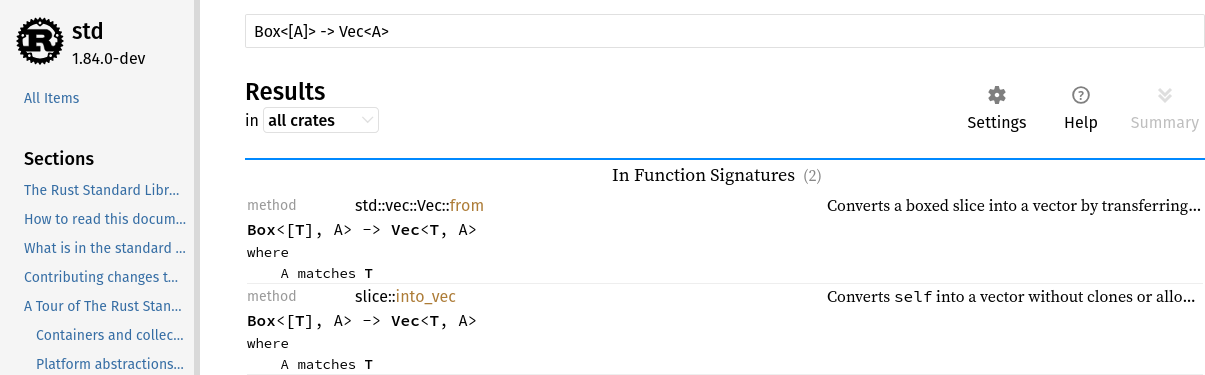
* no results: [`Box<[A]> -> Vec<B>`](http://notriddle.com/rustdoc-html-demo-12/search-sem-3/std/index.html?search=Box%3C%5BA%5D%3E%20-%3E%20Vec%3CB%3E)
* results: [`Box<[A]> -> Vec<A>`](http://notriddle.com/rustdoc-html-demo-12/search-sem-3/std/index.html?search=Box%3C%5BA%5D%3E%20-%3E%20Vec%3CA%3E)
* [`T -> U`](http://notriddle.com/rustdoc-html-demo-12/search-sem-3/std/index.html?search=T%20-%3E%20U)
* [`Cx -> TyCtxt`](http://notriddle.com/rustdoc-html-demo-12/search-sem-3-compiler/rustdoc/index.html?search=Cx%20-%3E%20TyCtxt)
## Description
This commit is a response to feedback on the displayed type signatures results, by making generics act stricter.
- Order within generics is significant. This means `Vec<Allocator>` now matches only with a true vector of allocators, instead of matching the second type param. It also makes unboxing within generics stricter, so `Result<A, B>` only matches if `B` is in the error type and `A` is in the success type. The top level of the function search is unaffected.
- Generics are only "unboxed" if a type is explicitly opted into it. References and tuples are hardcoded to allow unboxing, and Box, Rc, Arc, Option, Result, and Future are opted in with an unstable attribute. Search result unboxing is the process that allows you to search for `i32 -> str` and get back a function with the type signature `&Future<i32> -> Box<str>`.
- Instead of ranking by set overlap, it ranks by the number of items in the type signature. This makes it easier to find single type signatures like transmute.
## Find the discussion on
* <https://rust-lang.zulipchat.com/#narrow/stream/393423-t-rustdoc.2Fmeetings/topic/meeting.202024-07-08/near/449965149>
* <https://github.com/rust-lang/rust/pull/124544#issuecomment-2204272265>
* <https://rust-lang.zulipchat.com/#narrow/channel/266220-t-rustdoc/topic/deciding.20on.20semantics.20of.20generics.20in.20rustdoc.20search>
|
|
|
|
|
|
|
|
Docs: added brief colon explanation
https://github.com/rust-lang/rust/issues/131865
(this is my first attempt at contributing, feedback is welcome)
|
|
Implement `From<&mut {slice}>` for `Box/Rc/Arc<{slice}>`
ACP: https://github.com/rust-lang/libs-team/issues/424
New API:
```rust
impl<T: Clone> From<&mut [T]> for Box<[T]>
impl From<&mut str> for Box<str>
impl From<&mut CStr> for Box<CStr>
impl From<&mut OsStr> for Box<OsStr>
impl From<&mut Path> for Box<Path>
impl<T: Clone> From<&mut [T]> for Rc<[T]>
impl From<&mut str> for Rc<str>
impl From<&mut CStr> for Rc<CStr>
impl From<&mut OsStr> for Rc<OsStr>
impl From<&mut Path> for Rc<Path>
impl<T: Clone> From<&mut [T]> for Arc<[T]>
impl From<&mut str> for Arc<str>
impl From<&mut CStr> for Arc<CStr>
impl From<&mut OsStr> for Arc<OsStr>
impl From<&mut Path> for Arc<Path>
```
Since they are trait implementations, I think these are insta-stable.
As mentioned in https://github.com/rust-lang/libs-team/issues/424#issuecomment-2299415749, a crater run might be needed.
|
|
|
|
This commit is a response to feedback on the displayed type
signatures results, by making generics act stricter.
Generics are tightened by making order significant. This means
`Vec<Allocator>` now matches only with a true vector of allocators,
instead of matching the second type param. It also makes unboxing
within generics stricter, so `Result<A, B>` only matches if `B`
is in the error type and `A` is in the success type. The top level
of the function search is unaffected.
Find the discussion on:
* <https://rust-lang.zulipchat.com/#narrow/stream/393423-t-rustdoc.2Fmeetings/topic/meeting.202024-07-08/near/449965149>
* <https://github.com/rust-lang/rust/pull/124544#issuecomment-2204272265>
* <https://rust-lang.zulipchat.com/#narrow/channel/266220-t-rustdoc/topic/deciding.20on.20semantics.20of.20generics.20in.20rustdoc.20search/near/476841363>
|
|
|
|
Rc/Arc: don't leak the allocation if drop panics
Currently, when the last `Rc<T>` or `Arc<T>` is dropped and the destructor of `T` panics, the allocation will be leaked. This leak is unnecessary since the data cannot be (safely) accessed again and `Box` already deallocates in this case, so let's do the same for `Rc` and `Arc`, too.
|
|
|
|
+ some minor style changes
|
|
|
|
|
|
Const stability checks v2
The const stability system has served us well ever since `const fn` were first stabilized. It's main feature is that it enforces *recursive* validity -- a stable const fn cannot internally make use of unstable const features without an explicit marker in the form of `#[rustc_allow_const_fn_unstable]`. This is done to make sure that we don't accidentally expose unstable const features on stable in a way that would be hard to take back. As part of this, it is enforced that a `#[rustc_const_stable]` can only call `#[rustc_const_stable]` functions. However, some problems have been coming up with increased usage:
- It is baffling that we have to mark private or even unstable functions as `#[rustc_const_stable]` when they are used as helpers in regular stable `const fn`, and often people will rather add `#[rustc_allow_const_fn_unstable]` instead which was not our intention.
- The system has several gaping holes: a private `const fn` without stability attributes whose inherited stability (walking up parent modules) is `#[stable]` is allowed to call *arbitrary* unstable const operations, but can itself be called from stable `const fn`. Similarly, `#[allow_internal_unstable]` on a macro completely bypasses the recursive nature of the check.
Fundamentally, the problem is that we have *three* disjoint categories of functions, and not enough attributes to distinguish them:
1. const-stable functions
2. private/unstable functions that are meant to be callable from const-stable functions
3. functions that can make use of unstable const features
Functions in the first two categories cannot use unstable const features and they can only call functions from the first two categories.
This PR implements the following system:
- `#[rustc_const_stable]` puts functions in the first category. It may only be applied to `#[stable]` functions.
- `#[rustc_const_unstable]` by default puts functions in the third category. The new attribute `#[rustc_const_stable_indirect]` can be added to such a function to move it into the second category.
- `const fn` without a const stability marker are in the second category if they are still unstable. They automatically inherit the feature gate for regular calls, it can now also be used for const-calls.
Also, all the holes mentioned above have been closed. There's still one potential hole that is hard to avoid, which is when MIR building automatically inserts calls to a particular function in stable functions -- which happens in the panic machinery. Those need to be manually marked `#[rustc_const_stable_indirect]` to be sure they follow recursive const stability. But that's a fairly rare and special case so IMO it's fine.
The net effect of this is that a `#[unstable]` or unmarked function can be constified simply by marking it as `const fn`, and it will then be const-callable from stable `const fn` and subject to recursive const stability requirements. If it is publicly reachable (which implies it cannot be unmarked), it will be const-unstable under the same feature gate. Only if the function ever becomes `#[stable]` does it need a `#[rustc_const_unstable]` or `#[rustc_const_stable]` marker to decide if this should also imply const-stability.
Adding `#[rustc_const_unstable]` is only needed for (a) functions that need to use unstable const lang features (including intrinsics), or (b) `#[stable]` functions that are not yet intended to be const-stable. Adding `#[rustc_const_stable]` is only needed for functions that are actually meant to be directly callable from stable const code. `#[rustc_const_stable_indirect]` is used to mark intrinsics as const-callable and for `#[rustc_const_unstable]` functions that are actually called from other, exposed-on-stable `const fn`. No other attributes are required.
Also see the updated dev-guide at https://github.com/rust-lang/rustc-dev-guide/pull/2098.
I think in the future we may want to tweak this further, so that in the hopefully common case where a public function's const-stability just exactly mirrors its regular stability, we never have to add any attribute. But right now, once the function is stable this requires `#[rustc_const_stable]`.
### Open question
There is one point I could see we might want to do differently, and that is putting `#[rustc_const_unstable]` functions (but not intrinsics) in category 2 by default, and requiring an extra attribute for `#[rustc_const_not_exposed_on_stable]` or so. This would require a bunch of extra annotations, but would have the advantage that turning a `#[rustc_const_unstable]` into `#[rustc_const_stable]` will never change the way the function is const-checked. Currently, we often discover in the const stabilization PR that a function needs some other unstable const things, and then we rush to quickly deal with that. In this alternative universe, we'd work towards getting rid of the `rustc_const_not_exposed_on_stable` before stabilization, and once that is done stabilization becomes a trivial matter. `#[rustc_const_stable_indirect]` would then only be used for intrinsics.
I think I like this idea, but might want to do it in a follow-up PR, as it will need a whole bunch of annotations in the standard library. Also, we probably want to convert all const intrinsics to the "new" form (`#[rustc_intrinsic]` instead of an `extern` block) before doing this to avoid having to deal with two different ways of declaring intrinsics.
Cc `@rust-lang/wg-const-eval` `@rust-lang/libs-api`
Part of https://github.com/rust-lang/rust/issues/129815 (but not finished since this is not yet sufficient to safely let us expose `const fn` from hashbrown)
Fixes https://github.com/rust-lang/rust/issues/131073 by making it so that const-stable functions are always stable
try-job: test-various
|
|
Fundamentally, we have *three* disjoint categories of functions:
1. const-stable functions
2. private/unstable functions that are meant to be callable from const-stable functions
3. functions that can make use of unstable const features
This PR implements the following system:
- `#[rustc_const_stable]` puts functions in the first category. It may only be applied to `#[stable]` functions.
- `#[rustc_const_unstable]` by default puts functions in the third category. The new attribute `#[rustc_const_stable_indirect]` can be added to such a function to move it into the second category.
- `const fn` without a const stability marker are in the second category if they are still unstable. They automatically inherit the feature gate for regular calls, it can now also be used for const-calls.
Also, several holes in recursive const stability checking are being closed.
There's still one potential hole that is hard to avoid, which is when MIR
building automatically inserts calls to a particular function in stable
functions -- which happens in the panic machinery. Those need to *not* be
`rustc_const_unstable` (or manually get a `rustc_const_stable_indirect`) to be
sure they follow recursive const stability. But that's a fairly rare and special
case so IMO it's fine.
The net effect of this is that a `#[unstable]` or unmarked function can be
constified simply by marking it as `const fn`, and it will then be
const-callable from stable `const fn` and subject to recursive const stability
requirements. If it is publicly reachable (which implies it cannot be unmarked),
it will be const-unstable under the same feature gate. Only if the function ever
becomes `#[stable]` does it need a `#[rustc_const_unstable]` or
`#[rustc_const_stable]` marker to decide if this should also imply
const-stability.
Adding `#[rustc_const_unstable]` is only needed for (a) functions that need to
use unstable const lang features (including intrinsics), or (b) `#[stable]`
functions that are not yet intended to be const-stable. Adding
`#[rustc_const_stable]` is only needed for functions that are actually meant to
be directly callable from stable const code. `#[rustc_const_stable_indirect]` is
used to mark intrinsics as const-callable and for `#[rustc_const_unstable]`
functions that are actually called from other, exposed-on-stable `const fn`. No
other attributes are required.
|
|
|
|
Rename Receiver -> LegacyReceiver
As part of the "arbitrary self types v2" project, we are going to replace the current `Receiver` trait with a new mechanism based on a new, different `Receiver` trait.
This PR renames the old trait to get it out the way. Naming is hard. Options considered included:
* HardCodedReceiver (because it should only be used for things in the standard library, and hence is sort-of hard coded)
* LegacyReceiver
* TargetLessReceiver
* OldReceiver
These are all bad names, but fortunately this will be temporary. Assuming the new mechanism proceeds to stabilization as intended, the legacy trait will be removed altogether.
Although we expect this trait to be used only in the standard library, we suspect it may be in use elsehwere, so we're landing this change separately to identify any surprising breakages.
It's known that this trait is used within the Rust for Linux project; a patch is in progress to remove their dependency.
This is a part of the arbitrary self types v2 project,
https://github.com/rust-lang/rfcs/pull/3519
https://github.com/rust-lang/rust/issues/44874
r? `@wesleywiser`
|
|
These are all standard dictionary words and don't require hyphenation.
|
|
Optimize `Rc<T>::default`
The missing piece of https://github.com/rust-lang/rust/pull/131460.
Also refactored `Arc<T>::default` by using a safe `NonNull::from(Box::leak(_))` to replace the unnecessarily unsafe call to `NonNull::new_unchecked(Box::into_raw(_))`. The remaining unsafety is coming from `[Rc|Arc]::from_inner`, which is safe from the construction of `[Rc|Arc]Inner`.
|
|
better default capacity for str::replace
Adds smarter capacity for str::replace in cases where we know that the output will be at least as long as the original string.
|
|
|
|
As part of the "arbitrary self types v2" project, we are going to
replace the current `Receiver` trait with a new mechanism based on a
new, different `Receiver` trait.
This PR renames the old trait to get it out the way. Naming is hard.
Options considered included:
* HardCodedReceiver (because it should only be used for things in the
standard library, and hence is sort-of hard coded)
* LegacyReceiver
* TargetLessReceiver
* OldReceiver
These are all bad names, but fortunately this will be temporary.
Assuming the new mechanism proceeds to stabilization as intended, the
legacy trait will be removed altogether.
Although we expect this trait to be used only in the standard library,
we suspect it may be in use elsehwere, so we're landing this change
separately to identify any surprising breakages.
It's known that this trait is used within the Rust for Linux project; a
patch is in progress to remove their dependency.
This is a part of the arbitrary self types v2 project,
https://github.com/rust-lang/rfcs/pull/3519
https://github.com/rust-lang/rust/issues/44874
r? @wesleywiser
|
|
|
|
|
|
|
|
Fix predicate signatures in retain_mut docs
This is my first PR here so let me know if I'm doing anything wrong.
The docs for `retain_mut` in `LinkedList` and `VecDeque` say the predicate takes `&e`, but it should be `&mut e` to match the actual signature. `Vec` [has it documented](https://doc.rust-lang.org/std/vec/struct.Vec.html#method.retain_mut) correctly already.
|
|
Partially stabilize const_pin
Tracking issue #76654.
Eight of these methods can be made const-stable. The remainder are blocked on #73255.
|
|
optimize str.replace
Adds a fast path for str.replace for the ascii to ascii case. This allows for autovectorizing the code. Also should this instead be done with specialization? This way we could remove one branch. I think it is the kind of branch that is easy to predict though.
Benchmark for the fast path (replace all "a" with "b" in the rust wikipedia article, using criterion) :
| N | Speedup | Time New (ns) | Time Old (ns) |
|----------|---------|---------------|---------------|
| 2 | 2.03 | 13.567 | 27.576 |
| 8 | 1.73 | 17.478 | 30.259 |
| 11 | 2.46 | 18.296 | 45.055 |
| 16 | 2.71 | 17.181 | 46.526 |
| 37 | 4.43 | 18.526 | 81.997 |
| 64 | 8.54 | 18.670 | 159.470 |
| 200 | 9.82 | 29.634 | 291.010 |
| 2000 | 24.34 | 81.114 | 1974.300 |
| 20000 | 30.61 | 598.520 | 18318.000 |
| 1000000 | 29.31 | 33458.000 | 980540.000 |
|
|
|
|
|
|
Bump bootstrap compiler to 1.83.0-beta.1
https://forge.rust-lang.org/release/process.html#master-bootstrap-update-tuesday
|
|
Optimize `Box::default` and `Arc::default` to construct more types in place
Both the `Arc` and `Box` `Default` impls currently call `T::default()` before allocating, and then moving the resulting `T` into the allocation.
Most `Default` impls are trivial, which should in theory allow
LLVM to construct `T: Default` directly in the `Box` allocation when calling
`<Box<T>>::default()`.
However, the allocation may fail, which necessitates calling `T`'s destructor if it has one.
If the destructor is non-trivial, then LLVM has a hard time proving that it's
sound to elide, which makes it construct `T` on the stack first, and then copy it into the allocation.
Change both of these impls to allocate first, and then call `T::default` into the uninitialized allocation, so that LLVM doesn't have to prove that it's sound to elide the destructor/initial stack copy.
For example, given the following Rust code:
```rust
#[derive(Default, Clone)]
struct Foo {
x: Vec<u8>,
z: String,
y: Vec<u8>,
}
#[no_mangle]
pub fn src() -> Box<Foo> {
Box::default()
}
```
<details open>
<summary>Before this PR:</summary>
```llvm
`@__rust_no_alloc_shim_is_unstable` = external global i8
; drop_in_place() generated in case the allocation fails
; core::ptr::drop_in_place<playground::Foo>
; Function Attrs: nounwind nonlazybind uwtable
define internal fastcc void `@"_ZN4core3ptr36drop_in_place$LT$playground..Foo$GT$17hff376aece491233bE"(ptr` noalias nocapture noundef readonly align 8 dereferenceable(72) %_1) unnamed_addr #0 personality ptr `@rust_eh_personality` {
start:
%_1.val = load i64, ptr %_1, align 8
%0 = icmp eq i64 %_1.val, 0
br i1 %0, label %bb6, label %"_ZN63_$LT$alloc..alloc..Global$u20$as$u20$core..alloc..Allocator$GT$10deallocate17heaa87468709346b1E.exit.i.i.i4.i"
"_ZN63_$LT$alloc..alloc..Global$u20$as$u20$core..alloc..Allocator$GT$10deallocate17heaa87468709346b1E.exit.i.i.i4.i": ; preds = %start
%1 = getelementptr inbounds i8, ptr %_1, i64 8
%_1.val6 = load ptr, ptr %1, align 8, !nonnull !3, !noundef !3
tail call void `@__rust_dealloc(ptr` noundef nonnull %_1.val6, i64 noundef %_1.val, i64 noundef 1) #8
br label %bb6
bb6: ; preds = %"_ZN63_$LT$alloc..alloc..Global$u20$as$u20$core..alloc..Allocator$GT$10deallocate17heaa87468709346b1E.exit.i.i.i4.i", %start
%2 = getelementptr inbounds i8, ptr %_1, i64 24
%.val9 = load i64, ptr %2, align 8
%3 = icmp eq i64 %.val9, 0
br i1 %3, label %bb5, label %"_ZN63_$LT$alloc..alloc..Global$u20$as$u20$core..alloc..Allocator$GT$10deallocate17heaa87468709346b1E.exit.i.i.i4.i.i11"
"_ZN63_$LT$alloc..alloc..Global$u20$as$u20$core..alloc..Allocator$GT$10deallocate17heaa87468709346b1E.exit.i.i.i4.i.i11": ; preds = %bb6
%4 = getelementptr inbounds i8, ptr %_1, i64 32
%.val10 = load ptr, ptr %4, align 8, !nonnull !3, !noundef !3
tail call void `@__rust_dealloc(ptr` noundef nonnull %.val10, i64 noundef %.val9, i64 noundef 1) #8
br label %bb5
bb5: ; preds = %"_ZN63_$LT$alloc..alloc..Global$u20$as$u20$core..alloc..Allocator$GT$10deallocate17heaa87468709346b1E.exit.i.i.i4.i.i11", %bb6
%5 = getelementptr inbounds i8, ptr %_1, i64 48
%.val4 = load i64, ptr %5, align 8
%6 = icmp eq i64 %.val4, 0
br i1 %6, label %"_ZN4core3ptr46drop_in_place$LT$alloc..vec..Vec$LT$u8$GT$$GT$17hb5ca95423e113cf7E.exit16", label %"_ZN63_$LT$alloc..alloc..Global$u20$as$u20$core..alloc..Allocator$GT$10deallocate17heaa87468709346b1E.exit.i.i.i4.i15"
"_ZN63_$LT$alloc..alloc..Global$u20$as$u20$core..alloc..Allocator$GT$10deallocate17heaa87468709346b1E.exit.i.i.i4.i15": ; preds = %bb5
%7 = getelementptr inbounds i8, ptr %_1, i64 56
%.val5 = load ptr, ptr %7, align 8, !nonnull !3, !noundef !3
tail call void `@__rust_dealloc(ptr` noundef nonnull %.val5, i64 noundef %.val4, i64 noundef 1) #8
br label %"_ZN4core3ptr46drop_in_place$LT$alloc..vec..Vec$LT$u8$GT$$GT$17hb5ca95423e113cf7E.exit16"
"_ZN4core3ptr46drop_in_place$LT$alloc..vec..Vec$LT$u8$GT$$GT$17hb5ca95423e113cf7E.exit16": ; preds = %bb5, %"_ZN63_$LT$alloc..alloc..Global$u20$as$u20$core..alloc..Allocator$GT$10deallocate17heaa87468709346b1E.exit.i.i.i4.i15"
ret void
}
; Function Attrs: nonlazybind uwtable
define noalias noundef nonnull align 8 ptr `@src()` unnamed_addr #1 personality ptr `@rust_eh_personality` {
start:
; alloca to place `Foo` in.
%_1 = alloca [72 x i8], align 8
call void `@llvm.lifetime.start.p0(i64` 72, ptr nonnull %_1)
store i64 0, ptr %_1, align 8
%_2.sroa.4.0._1.sroa_idx = getelementptr inbounds i8, ptr %_1, i64 8
store ptr inttoptr (i64 1 to ptr), ptr %_2.sroa.4.0._1.sroa_idx, align 8
%_2.sroa.5.0._1.sroa_idx = getelementptr inbounds i8, ptr %_1, i64 16
%_3.sroa.4.0..sroa_idx = getelementptr inbounds i8, ptr %_1, i64 32
call void `@llvm.memset.p0.i64(ptr` noundef nonnull align 8 dereferenceable(16) %_2.sroa.5.0._1.sroa_idx, i8 0, i64 16, i1 false)
store ptr inttoptr (i64 1 to ptr), ptr %_3.sroa.4.0..sroa_idx, align 8
%_3.sroa.5.0..sroa_idx = getelementptr inbounds i8, ptr %_1, i64 40
%_4.sroa.4.0..sroa_idx = getelementptr inbounds i8, ptr %_1, i64 56
call void `@llvm.memset.p0.i64(ptr` noundef nonnull align 8 dereferenceable(16) %_3.sroa.5.0..sroa_idx, i8 0, i64 16, i1 false)
store ptr inttoptr (i64 1 to ptr), ptr %_4.sroa.4.0..sroa_idx, align 8
%_4.sroa.5.0..sroa_idx = getelementptr inbounds i8, ptr %_1, i64 64
store i64 0, ptr %_4.sroa.5.0..sroa_idx, align 8
%0 = load volatile i8, ptr `@__rust_no_alloc_shim_is_unstable,` align 1, !noalias !4
%_0.i.i.i = tail call noalias noundef align 8 dereferenceable_or_null(72) ptr `@__rust_alloc(i64` noundef 72, i64 noundef 8) #8, !noalias !4
%1 = icmp eq ptr %_0.i.i.i, null
br i1 %1, label %bb2.i, label %"_ZN5alloc5boxed12Box$LT$T$GT$3new17h0864de14f863a27aE.exit"
bb2.i: ; preds = %start
; invoke alloc::alloc::handle_alloc_error
invoke void `@_ZN5alloc5alloc18handle_alloc_error17h98142d0d8d74161bE(i64` noundef 8, i64 noundef 72) #9
to label %.noexc unwind label %cleanup.i
.noexc: ; preds = %bb2.i
unreachable
cleanup.i: ; preds = %bb2.i
%2 = landingpad { ptr, i32 }
cleanup
; call core::ptr::drop_in_place<playground::Foo>
call fastcc void `@"_ZN4core3ptr36drop_in_place$LT$playground..Foo$GT$17hff376aece491233bE"(ptr` noalias noundef nonnull align 8 dereferenceable(72) %_1) #10
resume { ptr, i32 } %2
"_ZN5alloc5boxed12Box$LT$T$GT$3new17h0864de14f863a27aE.exit": ; preds = %start
; Copy from stack to heap if allocation is successful
call void `@llvm.memcpy.p0.p0.i64(ptr` noundef nonnull align 8 dereferenceable(72) %_0.i.i.i, ptr noundef nonnull align 8 dereferenceable(72) %_1, i64 72, i1 false)
call void `@llvm.lifetime.end.p0(i64` 72, ptr nonnull %_1)
ret ptr %_0.i.i.i
}
```
</details>
<details>
<summary>After this PR</summary>
```llvm
; Notice how there's no `drop_in_place()` generated as well
define noalias noundef nonnull align 8 ptr `@src()` unnamed_addr #0 personality ptr `@rust_eh_personality` {
start:
; no stack allocation
%0 = load volatile i8, ptr `@__rust_no_alloc_shim_is_unstable,` align 1
%_0.i.i.i.i.i = tail call noalias noundef align 8 dereferenceable_or_null(72) ptr `@__rust_alloc(i64` noundef 72, i64 noundef 8) #5
%1 = icmp eq ptr %_0.i.i.i.i.i, null
br i1 %1, label %bb3.i, label %"_ZN5alloc5boxed16Box$LT$T$C$A$GT$13new_uninit_in17h80d6355ef4b73ea3E.exit"
bb3.i: ; preds = %start
; call alloc::alloc::handle_alloc_error
tail call void `@_ZN5alloc5alloc18handle_alloc_error17h98142d0d8d74161bE(i64` noundef 8, i64 noundef 72) #6
unreachable
"_ZN5alloc5boxed16Box$LT$T$C$A$GT$13new_uninit_in17h80d6355ef4b73ea3E.exit": ; preds = %start
; construct `Foo` directly into the allocation if successful
store i64 0, ptr %_0.i.i.i.i.i, align 8
%_8.sroa.4.0._1.sroa_idx = getelementptr inbounds i8, ptr %_0.i.i.i.i.i, i64 8
store ptr inttoptr (i64 1 to ptr), ptr %_8.sroa.4.0._1.sroa_idx, align 8
%_8.sroa.5.0._1.sroa_idx = getelementptr inbounds i8, ptr %_0.i.i.i.i.i, i64 16
%_8.sroa.7.0._1.sroa_idx = getelementptr inbounds i8, ptr %_0.i.i.i.i.i, i64 32
tail call void `@llvm.memset.p0.i64(ptr` noundef nonnull align 8 dereferenceable(16) %_8.sroa.5.0._1.sroa_idx, i8 0, i64 16, i1 false)
store ptr inttoptr (i64 1 to ptr), ptr %_8.sroa.7.0._1.sroa_idx, align 8
%_8.sroa.8.0._1.sroa_idx = getelementptr inbounds i8, ptr %_0.i.i.i.i.i, i64 40
%_8.sroa.10.0._1.sroa_idx = getelementptr inbounds i8, ptr %_0.i.i.i.i.i, i64 56
tail call void `@llvm.memset.p0.i64(ptr` noundef nonnull align 8 dereferenceable(16) %_8.sroa.8.0._1.sroa_idx, i8 0, i64 16, i1 false)
store ptr inttoptr (i64 1 to ptr), ptr %_8.sroa.10.0._1.sroa_idx, align 8
%_8.sroa.11.0._1.sroa_idx = getelementptr inbounds i8, ptr %_0.i.i.i.i.i, i64 64
store i64 0, ptr %_8.sroa.11.0._1.sroa_idx, align 8
ret ptr %_0.i.i.i.i.i
}
```
</details>
|
|
|
|
rename RcBox to RcInner for consistency
Arc uses ArcInner too (created in collaboration with `@aDotInTheVoid` and `@WaffleLapkin` )
|
|
Implemented `FromStr` for `CString` and `TryFrom<CString>` for `String`
The motivation of this change is making it possible to use `CString` in generic methods with `FromStr` and `TryInto<String>` trait bounds. The same traits are already implemented for `OsString` which is an FFI type too.
|
|
Add `#[track_caller]` to allocating methods of `Vec` & `VecDeque`
Part 4 in a lengthy saga.
r? `@joshtriplett` because they were the reviewer the last 3 times.
`@bors` rollup=never "[just in case this has perf effects, Vec is hot](https://github.com/rust-lang/rust/pull/79323#issuecomment-731866746)"
This was first attempted in #79323 by `@nvzqz.` It got approval from `@joshtriplett,` but rotted with merge conflicts and got closed.
Then it got picked up by `@Dylan-DPC-zz` in #83359. A benchmark was run[^perf], the results (after a bit of thinking[^thinking]) were deemed ok[^ok], but there was a typo[^typo] and the PR was made from a wrong remote in the first place[^remote], so #83909 was opened instead.
By the time #83909 rolled around, the methods in question had received some optimizations[^optimizations], so another perf run was conducted[^perf2]. The results were ok[^ok2]. There was a suggestion to add regression tests for panic behavior [^tests], but before it could be addressed, the PR fell victim to merge conflicts[^conflicts] and died again[^rip].
3 years have passed, and (from what I can tell) this has not been tried again, so here I am now, reviving this old effort.
Given how much time has passed and the fact that I've also touched `VecDeque` this time, it probably makes sense to
`@bors` try `@rust-timer`
[^perf]: https://github.com/rust-lang/rust/pull/83359#issuecomment-804450095
[^thinking]: https://github.com/rust-lang/rust/pull/83359#issuecomment-805286704
[^ok]: https://github.com/rust-lang/rust/pull/83359#issuecomment-812739031
[^typo]: https://github.com/rust-lang/rust/pull/83359#issuecomment-812750205
[^remote]: https://github.com/rust-lang/rust/pull/83359#issuecomment-814067119
[^optimizations]: https://github.com/rust-lang/rust/pull/83909#issuecomment-813736593
[^perf2]: https://github.com/rust-lang/rust/pull/83909#issuecomment-813825552
[^ok2]: https://github.com/rust-lang/rust/pull/83909#issuecomment-813831341
[^tests]: https://github.com/rust-lang/rust/pull/83909#issuecomment-825788964
[^conflicts]: https://github.com/rust-lang/rust/pull/83909#issuecomment-851173480
[^rip]: https://github.com/rust-lang/rust/pull/83909#issuecomment-873569771
|
|
|
|
Stabilize `const_option`
This makes the following API stable in const contexts:
```rust
impl<T> Option<T> {
pub const fn as_mut(&mut self) -> Option<&mut T>;
pub const fn expect(self, msg: &str) -> T;
pub const fn unwrap(self) -> T;
pub const unsafe fn unwrap_unchecked(self) -> T;
pub const fn take(&mut self) -> Option<T>;
pub const fn replace(&mut self, value: T) -> Option<T>;
}
impl<T> Option<&T> {
pub const fn copied(self) -> Option<T>
where T: Copy;
}
impl<T> Option<&mut T> {
pub const fn copied(self) -> Option<T>
where T: Copy;
}
impl<T, E> Option<Result<T, E>> {
pub const fn transpose(self) -> Result<Option<T>, E>
}
impl<T> Option<Option<T>> {
pub const fn flatten(self) -> Option<T>;
}
```
The following functions make use of the unstable `const_precise_live_drops` feature:
- `expect`
- `unwrap`
- `unwrap_unchecked`
- `transpose`
- `flatten`
Fixes: <https://github.com/rust-lang/rust/issues/67441>
|
