| Age | Commit message (Collapse) | Author | Lines |
|---|
|
|
|
SeqCst is unnecessary here.
|
|
|
|
implementing it
|
|
|
|
|
|
|
|
Makes the iterator 2*usize larger, but I doubt that matters much.
In exchange, we save a lot on instruction count.
In the absence of delegation syntax,
we must forward all the specialized impls manually…
|
|
Stabilize associated type bounds (RFC 2289)
This PR stabilizes associated type bounds, which were laid out in [RFC 2289]. This gives us a shorthand to express nested type bounds that would otherwise need to be expressed with nested `impl Trait` or broken into several `where` clauses.
### What are we stabilizing?
We're stabilizing the associated item bounds syntax, which allows us to put bounds in associated type position within other bounds, i.e. `T: Trait<Assoc: Bounds...>`. See [RFC 2289] for motivation.
In all position, the associated type bound syntax expands into a set of two (or more) bounds, and never anything else (see "How does this differ[...]" section for more info).
Associated type bounds are stabilized in four positions:
* **`where` clauses (and APIT)** - This is equivalent to breaking up the bound into two (or more) `where` clauses. For example, `where T: Trait<Assoc: Bound>` is equivalent to `where T: Trait, <T as Trait>::Assoc: Bound`.
* **Supertraits** - Similar to above, `trait CopyIterator: Iterator<Item: Copy> {}`. This is almost equivalent to breaking up the bound into two (or more) `where` clauses; however, the bound on the associated item is implied whenever the trait is used. See #112573/#112629.
* **Associated type item bounds** - This allows constraining the *nested* rigid projections that are associated with a trait's associated types. e.g. `trait Trait { type Assoc: Trait2<Assoc2: Copy>; }`.
* **opaque item bounds (RPIT, TAIT)** - This allows constraining associated types that are associated with the opaque without having to *name* the opaque. For example, `impl Iterator<Item: Copy>` defines an iterator whose item is `Copy` without having to actually name that item bound.
The latter three are not expressible in surface Rust (though for associated type item bounds, this will change in #120752, which I don't believe should block this PR), so this does represent a slight expansion of what can be expressed in trait bounds.
### How does this differ from the RFC?
Compared to the RFC, the current implementation *always* desugars associated type bounds to sets of `ty::Clause`s internally. Specifically, it does *not* introduce a position-dependent desugaring as laid out in [RFC 2289], and in particular:
* It does *not* desugar to anonymous associated items in associated type item bounds.
* It does *not* desugar to nested RPITs in RPIT bounds, nor nested TAITs in TAIT bounds.
This position-dependent desugaring laid out in the RFC existed simply to side-step limitations of the trait solver, which have mostly been fixed in #120584. The desugaring laid out in the RFC also added unnecessary complication to the design of the feature, and introduces its own limitations to, for example:
* Conditionally lowering to nested `impl Trait` in certain positions such as RPIT and TAIT means that we inherit the limitations of RPIT/TAIT, namely lack of support for higher-ranked opaque inference. See this code example: https://github.com/rust-lang/rust/pull/120752#issuecomment-1979412531.
* Introducing anonymous associated types makes traits no longer object safe, since anonymous associated types are not nameable, and all associated types must be named in `dyn` types.
This last point motivates why this PR is *not* stabilizing support for associated type bounds in `dyn` types, e.g, `dyn Assoc<Item: Bound>`. Why? Because `dyn` types need to have *concrete* types for all associated items, this would necessitate a distinct lowering for associated type bounds, which seems both complicated and unnecessary compared to just requiring the user to write `impl Trait` themselves. See #120719.
### Implementation history:
Limited to the significant behavioral changes and fixes and relevant PRs, ping me if I left something out--
* #57428
* #108063
* #110512
* #112629
* #120719
* #120584
Closes #52662
[RFC 2289]: https://rust-lang.github.io/rfcs/2289-associated-type-bounds.html
|
|
core: document default attribute stabilization
As of now, the first release which stabilized the `#[default]` macro for the deriving the `Default` trait for enus is not documented.
I have had to search the [`RELEASES.md`](https://github.com/rust-lang/rust/blob/master/RELEASES.md) when making sure my code would be accepted by an older Rust compiler.
I just added a line in the doc comment since, as far as I know, there's no option to pass to the `#[stable()]` attribute.
I am open to improvements in the wording.
|
|
|
|
Making `libcore` decide this is silly; the backend has so much better information about when it's a good idea.
So introduce a new `typed_swap` intrinsic with a fallback body, but replace that implementation for immediates and scalar pairs.
|
|
|
|
These were only relevant for the unsafe-containing implementations
Signed-off-by: Petr Portnov <me@progrm-jarvis.ru>
|
|
Signed-off-by: Petr Portnov <me@progrm-jarvis.ru>
|
|
Add as_(mut_)ptr and as_(mut_)slice to raw array pointers
Hey, first time contributing to the standard libraries so not completely sure about the process.
These functions are complementary to the ones being added in #74265 . I found them missing on array pointers.
See also:
- ACP: https://github.com/rust-lang/libs-team/issues/321
- Tracking issue: #119834
|
|
|
|
Godbolt says this saves a few instructions…
|
|
r=oli-obk,wesleywiser
Move generic `NonZero` `rustc_layout_scalar_valid_range_start` attribute to inner type.
Tracking issue: https://github.com/rust-lang/rust/issues/120257
r? `@dtolnay`
|
|
|
|
|
|
|
|
|
|
Implement `Duration::as_millis_{f64,f32}`
Implementation of #122451.
Linked const-unstability to #72440, so the post there should probably be updated to mentions the 2 new methods when/if this PR is merged.
|
|
|
|
|
|
fix unsoundness in Step::forward_unchecked for signed integers
Fixes #122420
```rust
pub fn foo(a: i8, b: u8) -> i8 {
unsafe { a.checked_add_unsigned(b).unwrap_unchecked() }
}
```
still compiles down to a single arithmetic instruction ([godbolt](https://rust.godbolt.org/z/qsd3xYWfE)).
But we may be losing some loop optimizations if llvm can no longer easily derive that it's a finite counted loop from the no-wrapping flags.
|
|
Improve `Step` docs
It [came up on urlo](https://users.rust-lang.org/t/implement-trait-step-in-1-76-0/108204?u=cad97) that the unstable reason string isn't helpful, so just remove it; there's nothing meaningful to add here.
Also makes a couple drive-by improvements to the method docs -- removes incorrect references, changes `forward_checked`'s invariant formulation to match `backward_checked`'s, and adds a helpful corollary that `step_unchecked(a, 0)` is always safe.
|
|
Add CStr::bytes iterator
See rust-lang/libs-team#135 for an ACP.
Since rust-lang/libs-team#134 was also accepted, this type is now `core::ffi::c_str::Bytes` instead of `core::ffi::CStrBytes`.
|
|
|
|
|
|
|
|
|
|
|
|
|
|
Expose the Freeze trait again (unstably) and forbid implementing it manually
non-emoji version of https://github.com/rust-lang/rust/pull/121501
cc #60715
This trait is useful for generic constants (associated consts of generic traits). See the test (`tests/ui/associated-consts/freeze.rs`) added in this PR for a usage example. The builtin `Freeze` trait is the only way to do it, users cannot work around this issue.
It's also a useful trait for building some very specific abstrations, as shown by the usage by the `zerocopy` crate: https://github.com/google/zerocopy/issues/941
cc ```@RalfJung```
T-lang signed off on reexposing this unstably: https://github.com/rust-lang/rust/pull/121501#issuecomment-1969827742
|
|
Add slice::try_range
This adds a fallible version of the unstable `slice::range` (tracking: #76393) which is highly requested in the tracking issue.
Hoping this can slide by without an ACP (since the feature is already being tracked), but let me know otherwise.
|
|
docs: Correct ptr/ref verbiage in SliceIndex docs.
Fixes #122234
|
|
BorrowedCursor docs clarification
If one reads the `BorrowedCursor` docs without having seen `BorrowedBuf` before, it is quite easy to assume that "unfilled" and "uninit" are synonyms.
|
|
|
|
Fixes #122234
|
|
|
|
inner type.
|
|
Fix legacy numeric constant diag items
- missed syms for usize/isize
- missed diag items on unsigned integers
For rust-lang/rust-clippy#12312
r? ```@Nilstrieb```
Follow-up to #121272, #121361, #121667
This should be the last one 🤞 Sorry!
|
|
fix: LocalWaker memory leak and some stability attributes
fixes #122180.
|
|
Add std::ffi::c_str module
ACP: rust-lang/libs-team#134
`std::ffi` docs before change:
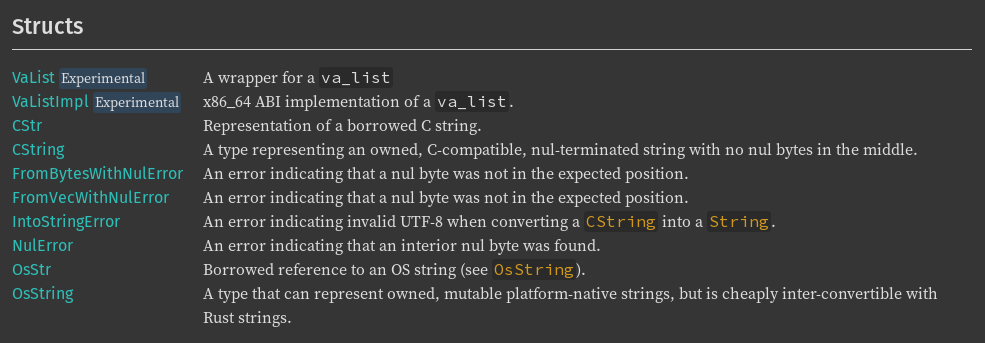
`std::ffi` docs after change:
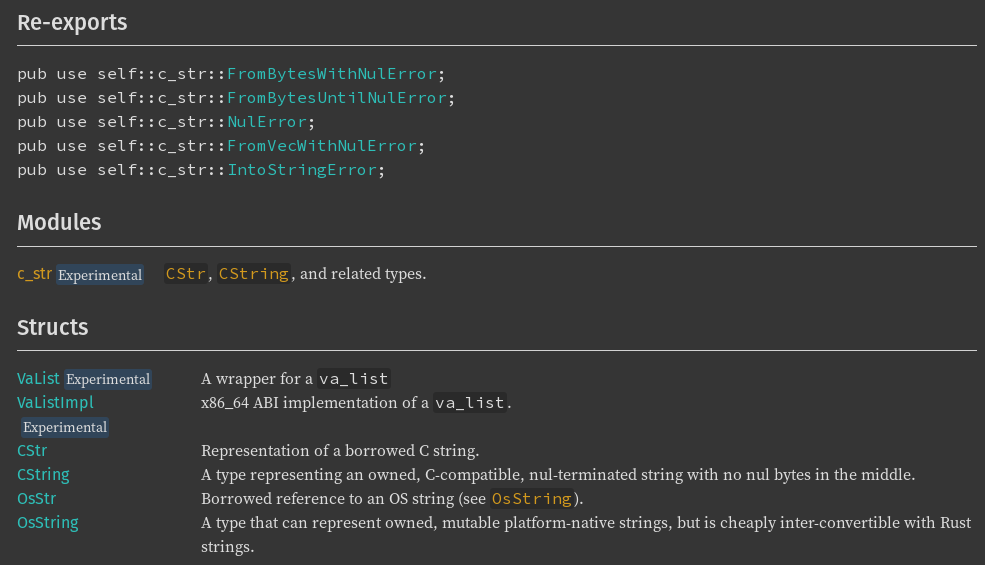
(note: I'm omitting the `c_int`, etc. stuff from the screenshots since it's the same in both. this doesn't just delete those types)
|
|
|
|
- missed syms for usize/isize
- missed diag items on unsigned integers
|
|
Distinguish between library and lang UB in assert_unsafe_precondition
As described in https://github.com/rust-lang/rust/pull/121583#issuecomment-1963168186, `assert_unsafe_precondition` now explicitly distinguishes between language UB (conditions we explicitly optimize on) and library UB (things we document you shouldn't do, and maybe some library internals assume you don't do).
`debug_assert_nounwind` was originally added to avoid the "only at runtime" aspect of `assert_unsafe_precondition`. Since then the difference between the macros has gotten muddied. This totally revamps the situation.
Now _all_ preconditions shall be checked with `assert_unsafe_precondition`. If you have a precondition that's only checkable at runtime, do a `const_eval_select` hack, as done in this PR.
r? RalfJung
|
|
Implement MaybeUninit::fill{,_with,_from}
ACP: rust-lang/libs-team#156
|
