| Age | Commit message (Collapse) | Author | Lines |
|---|
|
Stabilize the `Saturating` type
Closes #87920
Closes #92354
Stabilization report https://github.com/rust-lang/rust/issues/87920#issuecomment-1652346124
FCP https://github.com/rust-lang/rust/issues/87920#issuecomment-1676438885
|
|
make `Debug` impl for `ascii::Char` match that of `char`
# Objective
use a more recognisable format for the `Debug` impl on `ascii::Char` than the derived one based off the enum variants. The alogorithm used is the following:
- escape `ascii::Char::{Null, CharacterTabulation, CarraigeReturn, LineFeed, ReverseSolidus, Apostrophe}` to `'\0'`, `'\t'`, `'\r'`, `'\n'`, `'\\'` and `'\''` respectively. these are the same escape codes as `<char as Debug>::fmt` uses.
- if `u8::is_ascii_control` is false, print the character wrapped in single quotes.
- otherwise, print in the format `'\xAB'` where `A` and `B` are the hex nibbles of the byte. (`char` uses unicode escapes and this seems like the corresponding ascii format).
Tracking issue: https://github.com/rust-lang/rust/issues/110998
|
|
impl Step for IP addresses
ACP: rust-lang/libs-team#235
Note: since this is insta-stable, it requires an FCP.
Separating out from the bit operations PR since it feels logically disjoint, and so their FCPs can be separate.
|
|
Improve `PadAdapter::write_char`
Split from #108043
|
|
Update doc for `alloc::format!` and `core::concat!`
Closes #115551.
Used comments instead of `assert!`s as [`std::fmt`](https://doc.rust-lang.org/std/fmt/index.html#usage) uses comments.
Should all the str-related macros (`format!`, `format_args!`, `concat!`, `stringify!`, `println!`, `writeln!`, etc.) references each others? For instance, [`concat!`](https://doc.rust-lang.org/core/macro.concat.html) mentions that integers are stringified, but don't link to `stringify!`.
`@rustbot` label +A-docs +A-fmt
|
|
fix std::primitive doc: homogenous -> homogeneous
replace "homogenous" with the more commonly used "homogeneous".
|
|
Specialize count for range iterators
Since `size_hint` is already specialized, it feels apt to specialize `count` as well. Without any specialized version of `ExactSizeIterator::len` or `Step::steps_between`, this feels like a more reliable way of accessing this without having to rely on knowing that `size_hint` is correct.
In my case, this is particularly useful to access the `steps_between` implementation for `char` from the standard library without having to compute it manually.
I didn't think it was worth modifying the `Step` trait to add a version of `steps_between` that used native overflow checks since this is just doing one subtraction in most cases anyway, and so I decided to make the inclusive version use `checked_add` so it didn't have this lopsided overflow-checks-but-only-sometimes logic.
|
|
clarify that unsafe code must not rely on our safe traits
This adds a disclaimer to PartialEq, Eq, PartialOrd, Ord, Hash, Deref, DerefMut.
We already have a similar disclaimer in ExactSizeIterator (worded a bit differently):
```
/// Note that this trait is a safe trait and as such does *not* and *cannot*
/// guarantee that the returned length is correct. This means that `unsafe`
/// code **must not** rely on the correctness of [`Iterator::size_hint`]. The
/// unstable and unsafe [`TrustedLen`](super::marker::TrustedLen) trait gives
/// this additional guarantee.
```
If there are any other traits that should carry such a disclaimer, please let me know.
Fixes https://github.com/rust-lang/rust/issues/73682
|
|
|
|
|
|
|
|
Make useless_ptr_null_checks smarter about some std functions
This teaches the `useless_ptr_null_checks` lint that some std functions can't ever return null pointers, because they need to point to valid data, get references as input, etc.
This is achieved by introducing an `#[rustc_never_returns_null_ptr]` attribute and adding it to these std functions (gated behind bootstrap `cfg_attr`).
Later on, the attribute could maybe be used to tell LLVM that the returned pointer is never null. I don't expect much impact of that though, as the functions are pretty shallow and usually the input data is already never null.
Follow-up of PR #113657
Fixes #114442
|
|
Stabilize const_transmute_copy
Closes #83165
|
|
Rework `no_coverage` to `coverage(off)`
As discussed at the tail of https://github.com/rust-lang/rust/issues/84605 this replaces the `no_coverage` attribute with a `coverage` attribute that takes sub-parameters (currently `off` and `on`) to control the coverage instrumentation.
Allows future-proofing for things like `coverage(off, reason="Tested live", issue="#12345")` or similar.
|
|
|
|
r=GuillaumeGomez
rustdoc: list matching impls on type aliases
Fixes https://github.com/rust-lang/rust/issues/32077
Fixes #99952
Remake of https://github.com/rust-lang/rust/pull/112429
Partially reverts https://github.com/rust-lang/rust/pull/112543, but keeps the test case.
This version of the PR avoids the infinite loop by structurally matching types instead of using full unification. This version does not support type alias trait bounds, but the compiler does not enforce those anyway (https://github.com/rust-lang/rust/issues/21903).
r? `@GuillaumeGomez`
CC `@lcnr`
|
|
Clarify stability guarantee for lifetimes in enum discriminants
Since `std::mem::Discriminant` erases lifetimes, it should be clarified that changing the concrete value of a lifetime parameter does not change the value of an enum discriminant for a given variant. This is useful as it guarantees that it is safe to transmute `Discriminant<Foo<'a>>` to `Discriminant<Foo<'b>>` for any combination of `'a` and `'b`. This also holds for type-generics as long as the type parameters do not change, e.g. `Discriminant<Foo<T, 'a>>` can be transmuted to `Discriminant<Foo<T, 'b>>`.
Side note: Is what I've written actually enough to imply soundness (or rather codify it), or should it specifically be spelled out that it's OK to transmute in the above way?
|
|
|
|
|
|
|
|
Add char::MIN
ACP: rust-lang/libs-team#252
Tracking issue: #114298
r? `@rust-lang/libs-api`
|
|
|
|
r=est31
Lint on invalid usage of `UnsafeCell::raw_get` in reference casting
This PR proposes to take into account `UnsafeCell::raw_get` method call for non-Freeze types for the `invalid_reference_casting` lint.
The goal of this is to catch those kind of invalid reference casting:
```rust
fn as_mut<T>(x: &T) -> &mut T {
unsafe { &mut *std::cell::UnsafeCell::raw_get(x as *const _ as *const _) }
//~^ ERROR casting `&T` to `&mut T` is undefined behavior
}
```
r? `@est31`
|
|
|
|
|
|
|
|
clarify safety documentation of ptr::swap and ptr::copy
Closes https://github.com/rust-lang/rust/issues/81005
|
|
The `unfold` function have since been renamed to `from_fn`.
|
|
|
|
Support debuginfo for custom MIR.
|
|
explain why we can mutate the FPU control word
This is usually not allowed (see https://github.com/rust-lang/stdarch/pull/1454), but here we have a special case.
|
|
document our assumptions about symbols provided by the libc
LLVM makes assumptions about `memcmp`, `memmove`, and `memset` that go beyond what the C standard guarantees -- see https://reviews.llvm.org/D86993. Since we use LLVM, we are inheriting these assumptions.
With https://github.com/rust-lang/rust/pull/114382 we are also making a similar assumption about `memcmp`, so I added that to the list.
Fixes https://github.com/rust-lang/unsafe-code-guidelines/issues/426.
|
|
Document soundness of Integer -> Pointer -> Integer conversions in `const` contexts.
see this [zulip thread](https://rust-lang.zulipchat.com/#narrow/stream/146212-t-compiler.2Fconst-eval/topic/Soundness.20of.20Integer.20-.3E.20Pointer.20-.3E.20Integer.20conversions)
r? `@RalfJung`
With this slice `Iterator`'s should be able to be made const once the const Trait reimplementation is done.
|
|
|
|
Clarify that `ManuallyDrop<T>` has the same bit validity as `T`.
|
|
Outline panicking code for `RefCell::borrow` and `RefCell::borrow_mut`
This outlines panicking code for `RefCell::borrow` and `RefCell::borrow_mut` to reduce code size.
|
|
|
|
r=Mark-Simulacrum
RangeFull: Remove parens around .. in documentation snippet
I’ve removed unnecessary parentheses in a documentation snippet documenting `RangeFull`. It could’ve lead people to believe the parentheses were necessary.
|
|
|
|
|
|
|
|
Also stabilizes saturating_int_assign_impl, gh-92354.
And also make pub fns const where the underlying saturating_*
fns became const in the meantime since the Saturating type was
created.
|
|
|
|
Optimize Take::{fold, for_each} when wrapping TrustedRandomAccess iterators
|
|
Const-stabilize `is_ascii`
Resolves #111090
FCP completed in https://github.com/rust-lang/rust/issues/111090#issuecomment-1688490049
|
|
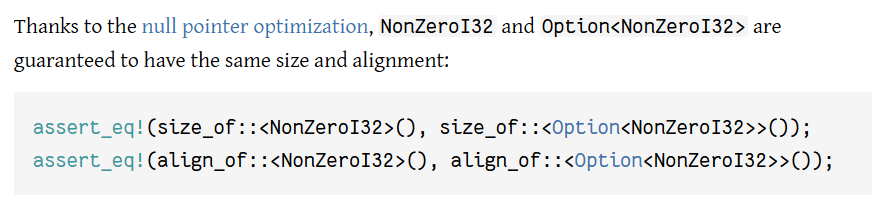
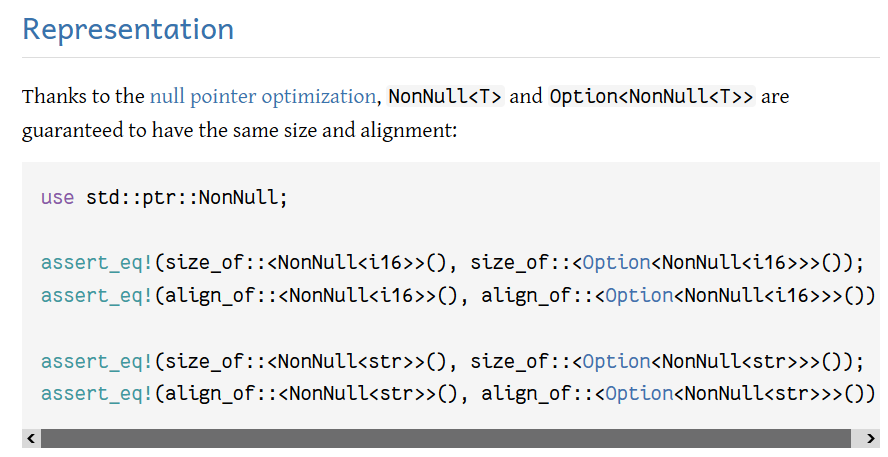
Add alignment to the NPO guarantee
This PR [changes](https://github.com/rust-lang/rust/pull/114845#discussion_r1294363357) "same size" to "same size and alignment" in the option module's null pointer optimization docs in <https://doc.rust-lang.org/std/option/#representation>.
As far as I know, this has been true for a long time in the actual rustc implementation, but it's not in the text of those docs, so I figured I'd bring this up to FCP it.
I also see no particular reason that we'd ever *want* to have higher alignment on these. In many of the cases it's impossible, as the minimum alignment is already the size of the type, but even if we *could* do things like on 32-bit we could say that `NonZeroU64` is 4-align but `Option<NonZeroU64>` is 8-align, I just don't see any value in doing that, so feel completely fine closing this door for the few things on which the NPO is already guaranteed. These are basically all primitives, and should end up with the same size & alignment as those primitives.
(There's no layout guarantee for something like `Option<[u8; 3]>`, where it'd be at least plausible to consider raising the alignment from 1 to 4 on, say, some hypothetical target that doesn't have efficient unaligned 4-byte load/stores. And even if we ever did start to offer some kind of guarantee around such a type, I doubt we'd put it under the "null pointer" optimization header.)
Screenshots for the new examples:
|
|
Implement Step for ascii::Char
This allows iterating over ranges of `ascii::Char`, similarly to ranges of `char`.
Note that `ascii::Char` is still unstable, tracked in #110998.
|
|
|
|
|
|
|
