| Age | Commit message (Collapse) | Author | Lines |
|---|
|
The ability to interoperate with C code via FFI is not limited to crates
using std; this allows using these types without std.
The existing types in `std::os::raw` become type aliases for the ones in
`core::ffi`. This uses type aliases rather than re-exports, to allow the
std types to remain stable while the core types are unstable.
This also moves the currently unstable `NonZero_` variants and
`c_size_t`/`c_ssize_t`/`c_ptrdiff_t` types to `core::ffi`, while leaving
them unstable.
|
|
|
|
Add implementations of `AsFd` for `&T` and `&mut T`, so that users can
write code like this:
```rust
pub fn fchown<F: AsFd>(fd: F, uid: Option<u32>, gid: Option<u32>) -> io::Result<()> {
```
with `fd: F` rather than `fd: &F`.
And similar for `AsHandle` and `AsSocket` on Windows.
Also, adjust the `fchown` example to pass the file by reference. The
code can work either way now, but passing by reference is more likely
to be what users will want to do.
This is an alternative to #93869, and is a simpler way to achieve the
same goals: users don't need to pass borrowed-`BorrowedFd` arguments,
and it prevents a pitfall in the case where users write `fd: F` instead
of `fd: &F`.
|
|
|
|
Add os::unix::net::SocketAddr::from_path
Creates a new SocketAddr from a path, supports both regular paths and
abstract namespaces.
Note that `SocketAddr::from_abstract_namespace` could be removed after this as `SocketAddr::unix` also supports abstract namespaces.
Updates #65275
Unblocks https://github.com/tokio-rs/mio/issues/1527
r? `@m-ou-se`
|
|
|
|
With the addition of `sock_accept()` to snapshot1, simple networking via
a passed `TcpListener` is possible. This patch implements the basics to
make a simple server work.
Signed-off-by: Harald Hoyer <harald@profian.com>
|
|
To make use of `sock_accept()`, update the wasi crate to `0.11.0`.
Signed-off-by: Harald Hoyer <harald@profian.com>
|
|
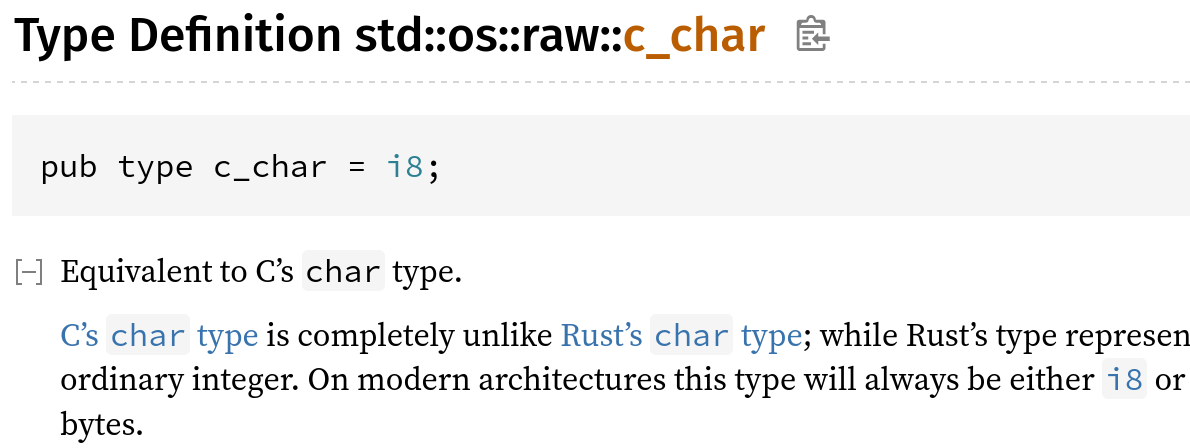
Define c_char using cfg_if rather than repeating 40-line cfg
Libstd has a 40-line cfg that defines the targets on which `c_char` is unsigned, and then repeats the same cfg with `not(…)` for the targets on which `c_char` is signed.
This PR replaces it with a `cfg_if!` in which an `else` takes care of the signed case.
I confirmed that `x.py doc library/std` inlines the type alias because c_char_definition is not a publicly accessible path:
|
|
|
|
The creation of libc::sockaddr_un is a safe operation, no need for it to
be unsafe.
This also uses the more performant copy_nonoverlapping instead of an
iterator.
|
|
Add a `try_clone()` function to `OwnedFd`.
As suggested in #88564. This adds a `try_clone()` to `OwnedFd` by
refactoring the code out of the existing `File`/`Socket` code.
r? ``@joshtriplett``
|
|
And change it to disallow NULL bytes.
|
|
Creates a new SocketAddr from a path, supports both regular paths and
abstract namespaces.
|
|
Inline std::os::unix::ffi::OsStringExt methods
Those methods essentially do nothing at assembly level. On Unix systems, `OsString` is represented as a `Vec` without performing any transformations.
|
|
`WSADuplicateSocketW` returns 0 on success, which differs from
handle-oriented functions which return 0 on error. Use `sys::net::cvt`
to handle its return value, which handles the socket convention of
returning 0 on success, rather than `sys::cvt`, which handles the
handle-oriented convention of returning 0 on failure.
|
|
|
|
Mak DefId to AccessLevel map in resolve for export
hir_id to accesslevel in resolve and applied in privacy
using local def id
removing tracing probes
making function not recursive and adding comments
Move most of Exported/Public res to rustc_resolve
moving public/export res to resolve
fix missing stability attributes in core, std and alloc
move code to access_levels.rs
return for some kinds instead of going through them
Export correctness, macro changes, comments
add comment for import binding
add comment for import binding
renmae to access level visitor, remove comments, move fn as closure, remove new_key
fmt
fix rebase
fix rebase
fmt
fmt
fix: move macro def to rustc_resolve
fix: reachable AccessLevel for enum variants
fmt
fix: missing stability attributes for other architectures
allow unreachable pub in rustfmt
fix: missing impl access level + renaming export to reexport
Missing impl access level was found thanks to a test in clippy
|
|
|
|
They are also removed from the prelude as per the decision in
https://github.com/rust-lang/rust/issues/87228.
stdarch and compiler-builtins are updated to work with the new, stable
asm! and global_asm! macros.
|
|
socket ancillary data implementation for dragonflybsd.
|
|
Implement most of RFC 2930, providing the ReadBuf abstraction
This replaces the `Initializer` abstraction for permitting reading into uninitialized buffers, closing #42788.
This leaves several APIs described in the RFC out of scope for the initial implementation:
* read_buf_vectored
* `ReadBufs`
Closes #42788, by removing the relevant APIs.
|
|
|
|
|
|
Add support for riscv64gc-unknown-freebsd
For https://doc.rust-lang.org/nightly/rustc/target-tier-policy.html#tier-3-target-policy:
* A tier 3 target must have a designated developer or developers (the "target maintainers") on record to be CCed when issues arise regarding the target. (The mechanism to track and CC such developers may evolve over time.)
For all Rust targets on FreeBSD, it's [rust@FreeBSD.org](mailto:rust@FreeBSD.org).
* Targets must use naming consistent with any existing targets; for instance, a target for the same CPU or OS as an existing Rust target should use the same name for that CPU or OS. Targets should normally use the same names and naming conventions as used elsewhere in the broader ecosystem beyond Rust (such as in other toolchains), unless they have a very good reason to diverge. Changing the name of a target can be highly disruptive, especially once the target reaches a higher tier, so getting the name right is important even for a tier 3 target.
Done.
* Target names should not introduce undue confusion or ambiguity unless absolutely necessary to maintain ecosystem compatibility. For example, if the name of the target makes people extremely likely to form incorrect beliefs about what it targets, the name should be changed or augmented to disambiguate it.
Done
* Tier 3 targets may have unusual requirements to build or use, but must not create legal issues or impose onerous legal terms for the Rust project or for Rust developers or users.
Done.
* The target must not introduce license incompatibilities.
Done.
* Anything added to the Rust repository must be under the standard Rust license (MIT OR Apache-2.0).
Fine with me.
* The target must not cause the Rust tools or libraries built for any other host (even when supporting cross-compilation to the target) to depend on any new dependency less permissive than the Rust licensing policy. This applies whether the dependency is a Rust crate that would require adding new license exceptions (as specified by the tidy tool in the rust-lang/rust repository), or whether the dependency is a native library or binary. In other words, the introduction of the target must not cause a user installing or running a version of Rust or the Rust tools to be subject to any new license requirements.
Done.
* If the target supports building host tools (such as rustc or cargo), those host tools must not depend on proprietary (non-FOSS) libraries, other than ordinary runtime libraries supplied by the platform and commonly used by other binaries built for the target. For instance, rustc built for the target may depend on a common proprietary C runtime library or console output library, but must not depend on a proprietary code generation library or code optimization library. Rust's license permits such combinations, but the Rust project has no interest in maintaining such combinations within the scope of Rust itself, even at tier 3.
Done.
* Targets should not require proprietary (non-FOSS) components to link a functional binary or library.
Done.
* "onerous" here is an intentionally subjective term. At a minimum, "onerous" legal/licensing terms include but are not limited to: non-disclosure requirements, non-compete requirements, contributor license agreements (CLAs) or equivalent, "non-commercial"/"research-only"/etc terms, requirements conditional on the employer or employment of any particular Rust developers, revocable terms, any requirements that create liability for the Rust project or its developers or users, or any requirements that adversely affect the livelihood or prospects of the Rust project or its developers or users.
Fine with me.
* Neither this policy nor any decisions made regarding targets shall create any binding agreement or estoppel by any party. If any member of an approving Rust team serves as one of the maintainers of a target, or has any legal or employment requirement (explicit or implicit) that might affect their decisions regarding a target, they must recuse themselves from any approval decisions regarding the target's tier status, though they may otherwise participate in discussions.
Ok.
* This requirement does not prevent part or all of this policy from being cited in an explicit contract or work agreement (e.g. to implement or maintain support for a target). This requirement exists to ensure that a developer or team responsible for reviewing and approving a target does not face any legal threats or obligations that would prevent them from freely exercising their judgment in such approval, even if such judgment involves subjective matters or goes beyond the letter of these requirements.
Ok.
* Tier 3 targets should attempt to implement as much of the standard libraries as possible and appropriate (core for most targets, alloc for targets that can support dynamic memory allocation, std for targets with an operating system or equivalent layer of system-provided functionality), but may leave some code unimplemented (either unavailable or stubbed out as appropriate), whether because the target makes it impossible to implement or challenging to implement. The authors of pull requests are not obligated to avoid calling any portions of the standard library on the basis of a tier 3 target not implementing those portions.
std is implemented.
* The target must provide documentation for the Rust community explaining how to build for the target, using cross-compilation if possible. If the target supports running tests (even if they do not pass), the documentation must explain how to run tests for the target, using emulation if possible or dedicated hardware if necessary.
Building is possible the same way as other Rust on FreeBSD targets.
* Tier 3 targets must not impose burden on the authors of pull requests, or other developers in the community, to maintain the target. In particular, do not post comments (automated or manual) on a PR that derail or suggest a block on the PR based on a tier 3 target. Do not send automated messages or notifications (via any medium, including via `@)` to a PR author or others involved with a PR regarding a tier 3 target, unless they have opted into such messages.
Ok.
* Backlinks such as those generated by the issue/PR tracker when linking to an issue or PR are not considered a violation of this policy, within reason. However, such messages (even on a separate repository) must not generate notifications to anyone involved with a PR who has not requested such notifications.
Ok.
* Patches adding or updating tier 3 targets must not break any existing tier 2 or tier 1 target, and must not knowingly break another tier 3 target without approval of either the compiler team or the maintainers of the other tier 3 target.
Ok.
* In particular, this may come up when working on closely related targets, such as variations of the same architecture with different features. Avoid introducing unconditional uses of features that another variation of the target may not have; use conditional compilation or runtime detection, as appropriate, to let each target run code supported by that target.
Ok.
|
|
|
|
|
|
This is similar to the note on [Python's `os.symlink()`](https://docs.python.org/3/library/os.html#os.symlink). Some additional notes in https://github.com/dimo414/bkt/issues/3.
|
|
r=alexcrichton
Rename WASI's `is_character_device` to `is_char_device`.
Rename WASI's `FileTypeExt::is_character_device` to
`FileTypeExt::is_char_device`, for consistency with the Unix
`FileTypeExt::is_char_device`.
Also, add a `FileTypeExt::is_socket` function, for consistency with the
Unix `FileTypeExt::is_socket` function.
r? `@alexcrichton`
|
|
Unix ExitStatus comments and a tiny docs fix
Some nits left over from #88300
|
|
Rename WASI's `FileTypeExt::is_character_device` to
`FileTypeExt::is_char_device`, for consistency with the Unix
`FileTypeExt::is_char_device`.
Also, add a `FileTypeExt::is_socket` function, for consistency with the
Unix `FileTypeExt::is_socket` function.
|
|
As discussed here
https://github.com/rust-lang/rust/pull/88300#issuecomment-936085371
exit is (conventionally) a library function, with _exit being the
actual system call.
I have checked the other references and they say "if the process
terminated by calling `exti`". I think despite the slight
imprecision (strictly, it should read iff ... `_exit`), this is
clearer. Anyone who knows about the distinction between `exit` and
`_exit` will not be confused.
`_exit` is the correct traditional name for the system call, despite
Linux calling it `exit_group` or `exit`:
https://www.freebsd.org/cgi/man.cgi?query=_exit&sektion=2&n=1
Signed-off-by: Ian Jackson <ijackson@chiark.greenend.org.uk>
|
|
r=joshtriplett
Fix assertion failures in `OwnedHandle` with `windows_subsystem`.
As discussed in #88576, raw handle values in Windows can be null, such
as in `windows_subsystem` mode, or when consoles are detached from a
process. So, don't use `NonNull` to hold them, don't assert that they're
not null, and remove `OwnedHandle`'s `repr(transparent)`. Introduce a
new `HandleOrNull` type, similar to `HandleOrInvalid`, to cover the FFI
use case.
r? `@joshtriplett`
|
|
|
|
|
|
|
|
thomcc:friendship-ended-with-ssize_t-now-ptrdiff_t-is-my-best-friend, r=joshtriplett
Replace `std::os::raw::c_ssize_t` with `std::os::raw::c_ptrdiff_t`
The discussions in #88345 brought up that `ssize_t` is not actually the signed index type defined in stddef.h, but instead it's `ptrdiff_t`. It seems pretty clear that the use of `ssize_t` here was a mistake on my part, and that if we're going to bother having a isize-alike for FFI in `std::os::raw`, it should be `ptrdiff_t` and not `ssize_t`.
Anyway, both this and `c_size_t` are dubious in the face of the discussion in https://internals.rust-lang.org/t/pre-rfc-usize-is-not-size-t/15369, and any RFC/project-group/etc that handles those issues there should contend with these types in some manner, but that doesn't mean we shouldn't fix something wrong like this, even if it is unstable.
All that said, `size_t` is *vastly* more common in function signatures than either `ssize_t` or `ptrdiff_t`, so I'm going to update the tracking issue's list of unresolved questions to note that perhaps we only want `c_size_t` — I mostly added the signed version for symmetry, rather than to meet a need. (Given this, I'm also fine with modifying this patch to instead remove `c_ssize_t` without a replacement)
CC `@magicant` (who brought the issue up)
CC `@chorman0773` (who has a significantly firmer grasp on the minutae of the C standard than I do)
r? `@joshtriplett` (original reviewer, active in the discussions around this)
|
|
|
|
Add #[must_use] to remaining std functions (O-Z)
I've run out of compelling reasons to group functions together across crates so I'm just going to go module-by-module. This is half of the remaining items from the `std` crate, from O-Z.
`panicking::take_hook` has a side effect: it unregisters the current panic hook, returning it. I almost ignored it, but the documentation example shows `let _ = panic::take_hook();`, so following suit I went ahead and added a `#[must_use]`.
```rust
std::panicking fn take_hook() -> Box<dyn Fn(&PanicInfo<'_>) + 'static + Sync + Send>;
```
I added these functions that clippy did not flag:
```rust
std::path::Path fn starts_with<P: AsRef<Path>>(&self, base: P) -> bool;
std::path::Path fn ends_with<P: AsRef<Path>>(&self, child: P) -> bool;
std::path::Path fn with_file_name<S: AsRef<OsStr>>(&self, file_name: S) -> PathBuf;
std::path::Path fn with_extension<S: AsRef<OsStr>>(&self, extension: S) -> PathBuf;
```
Parent issue: #89692
r? `@joshtriplett`
|
|
Add #[must_use] to len and is_empty
Parent issue: #89692
r? `@joshtriplett`
|
|
|
|
|
|
|
|
Stabilise unix_process_wait_more, extra ExitStatusExt methods
This stabilises the feature `unix_process_wait_more`. Tracking issue #80695, FCP needed.
This was implemented in #79982 and merged in January.
|
|
|
|
Add abstract namespace support for Unix domain sockets
Hello! The other day I wanted to mess around with UDS in Rust and found that abstract namespaces ([unix(7)](https://man7.org/linux/man-pages/man7/unix.7.html)) on Linux still needed development. I took the approach of adding `_addr` specific public functions to reduce conflicts.
Feature name: `unix_socket_abstract`
Tracking issue: #85410
Further context: #42048
## Non-platform specific additions
`UnixListener::bind_addr(&SocketAddr) -> Result<UnixListener>`
`UnixStream::connect_addr(&SocketAddr) -> Result<()>`
`UnixDatagram::bind_addr(&SocketAddr) -> Result<UnixDatagram>`
`UnixDatagram::connect_addr(&SocketAddr) -> Result<()>`
`UnixDatagram::send_to_addr(&self, &[u8], &SocketAddr) -> Result<usize>`
## Platform-specific (Linux) additions
`SocketAddr::from_abstract_namespace(&[u8]) -> SocketAddr`
`SockerAddr::as_abstract_namespace() -> Option<&[u8]>`
## Example
```rust
#![feature(unix_socket_abstract)]
use std::os::unix::net::{UnixListener, SocketAddr};
fn main() -> std::io::Result<()> {
let addr = SocketAddr::from_abstract_namespace(b"namespace")?; // Linux only
let listener = match UnixListener::bind_addr(&addr) {
Ok(sock) => sock,
Err(err) => {
println!("Couldn't bind: {:?}", err);
return Err(err);
}
};
Ok(())
}
```
## Further Details
The main inspiration for the implementation came from the [nix-rust](https://github.com/nix-rust/nix/blob/master/src/sys/socket/addr.rs#L558) crate but there are also other [historical](https://github.com/rust-lang/rust/commit/c4db0685b181f12c4285dac3d932f1859bba74f5) [attempts](https://github.com/tormol/uds/blob/master/src/addr.rs#L324) with similar approaches.
A comment I did have was with this change, we now allow a `SocketAddr` to be constructed explicitly rather than just used almost as a handle for the return of `peer_addr` and `local_addr`. We could consider adding other explicit constructors (e.g. `SocketAddr::from_pathname`, `SockerAddr::from_unnamed`).
Cheers!
|
|
Add #[must_use] to is_condition tests
I threw in `std::path::Path::has_root` for funsies.
A continuation of #89718.
Parent issue: #89692
r? ```@joshtriplett```
|
|
Add #[must_use] to as_type conversions
Clippy missed these:
```rust
alloc::string::String fn as_mut_str(&mut self) -> &mut str;
core::mem::NonNull<T> unsafe fn as_uninit_mut<'a>(&mut self) -> &'a MaybeUninit<T>;
str unsafe fn as_bytes_mut(&mut self) -> &mut [u8];
str fn as_mut_ptr(&mut self) -> *mut u8;
```
Parent issue: #89692
r? ````@joshtriplett````
|
|
A continuation of #89718.
|
|
|
