| Age | Commit message (Collapse) | Author | Lines |
|---|
|
This allows moving a lot of run-make-fulldeps tests to just run-make
tests, and allows running those on target-only platforms
|
|
Modify executable checking to be more universal
This uses a dummy file to check if the filesystem being used supports the executable bit in general.
Supersedes #74753.
|
|
|
|
|
|
|
|
The Rust version number is currently embedded in bootstrap's source
code, which makes it hard to update it automatically or access it
outside of ./x.py (as you'd have to parse the source code).
This commit moves the version number to a standalone plaintext file,
which makes accessing or updating it trivial.
|
|
This uses a dummy file to check if the filesystem being used supports the
executable bit in general.
|
|
|
|
rustc is a natively cross-compiling compiler, and generally none of our steps
should care whether they are using a compiler built of triple A or B, just the
--target directive being passed to the running compiler. e.g., when building for
some target C, you don't generally want to build two stds: one with a host A
compiler and the other with a host B compiler. Just one std is sufficient.
|
|
|
|
|
|
|
|
|
|
|
|
See #75773 and #75775
|
|
Snapshot testing is a technique for writing maintainable unit tests.
Unlike usual `assert_eq!` tests, snapshot tests allow
to *automatically* upgrade expected values on test failure.
In a sense, snapshot tests are inline-version of our beloved
UI-tests.
Example:
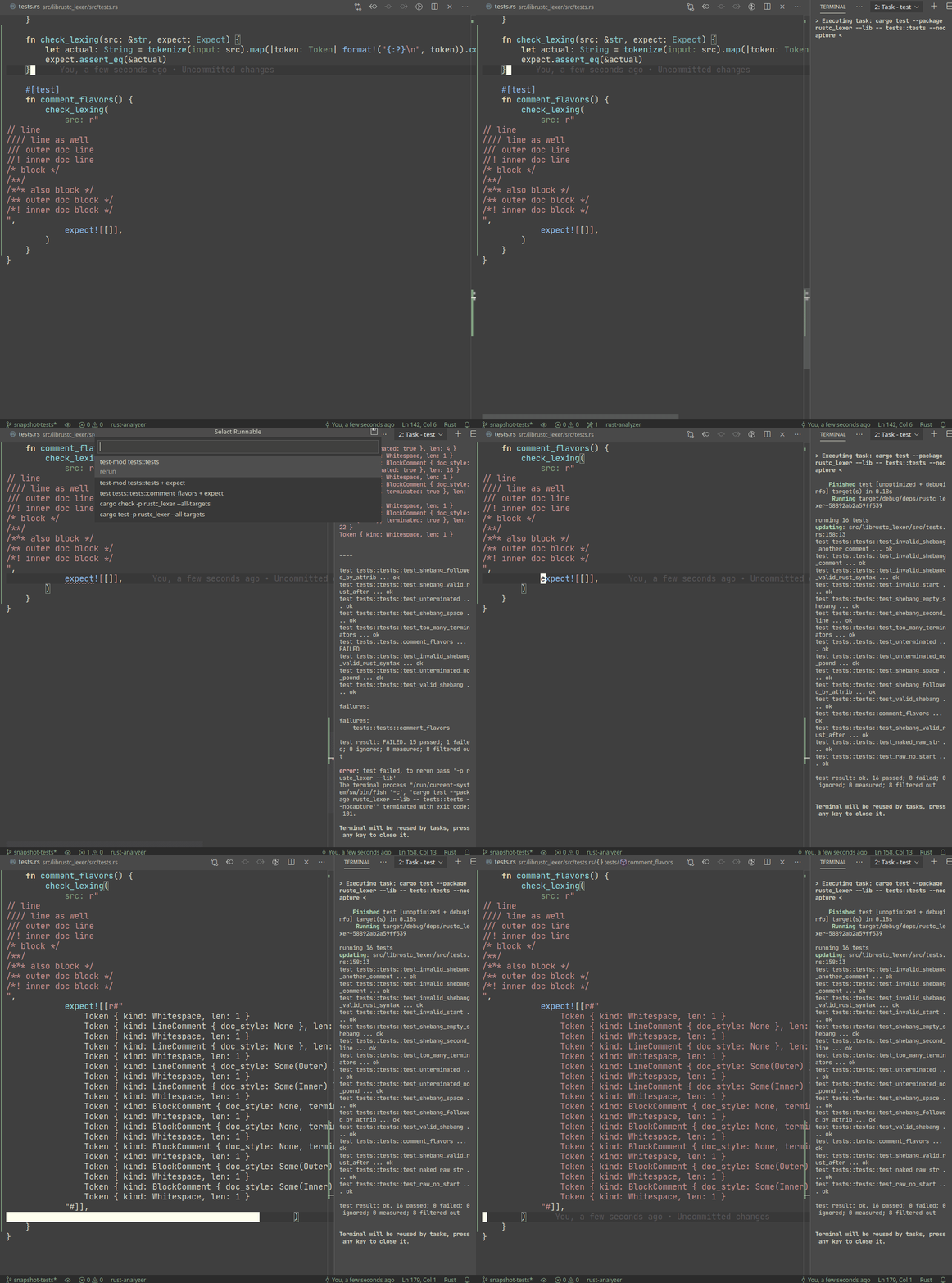
A particular library we use, `expect_test` provides an `expect!`
macro, which creates a sort of self-updating string literal (by using
`file!` macro). Self-update is triggered by setting `UPDATE_EXPECT`
environmental variable (this info is printed during the test failure).
This library was extracted from rust-analyzer, where we use it for
most of our tests.
There are some other, more popular snapshot testing libraries:
* https://github.com/mitsuhiko/insta
* https://github.com/aaronabramov/k9
The main differences of `expect` are:
* first-class snapshot objects (so, tests can be written as functions,
rather than as macros)
* focus on inline-snapshots (but file snapshots are also supported)
* restricted feature set (only `assert_eq` and `assert_debug_eq`)
* no extra runtime (ie, no `cargo insta`)
See https://github.com/rust-analyzer/rust-analyzer/pull/5101 for a
an extended comparison.
It is unclear if this testing style will stick with rustc in the long
run. At the moment, rustc is mainly tested via integrated UI tests.
But in the library-ified world, unit-tests will become somewhat more
important (that's why use use `rustc_lexer` library-ified library as
an example in this PR). Given that the cost of removal shouldn't be
too high, it probably makes sense to just see if this flies!
|
|
|
|
|
|
|
|
|
|
|
|
|
|
Generating the coverage map
@tmandry @wesleywiser
rustc now generates the coverage map and can support (limited)
coverage report generation, at the function level.
Example commands to generate a coverage report:
```shell
$ BUILD=$HOME/rust/build/x86_64-unknown-linux-gnu
$ $BUILD/stage1/bin/rustc -Zinstrument-coverage \
$HOME/rust/src/test/run-make-fulldeps/instrument-coverage/main.rs
$ LLVM_PROFILE_FILE="main.profraw" ./main
called
$ $BUILD/llvm/bin/llvm-profdata merge -sparse main.profraw -o main.profdata
$ $BUILD/llvm/bin/llvm-cov show --instr-profile=main.profdata main
```
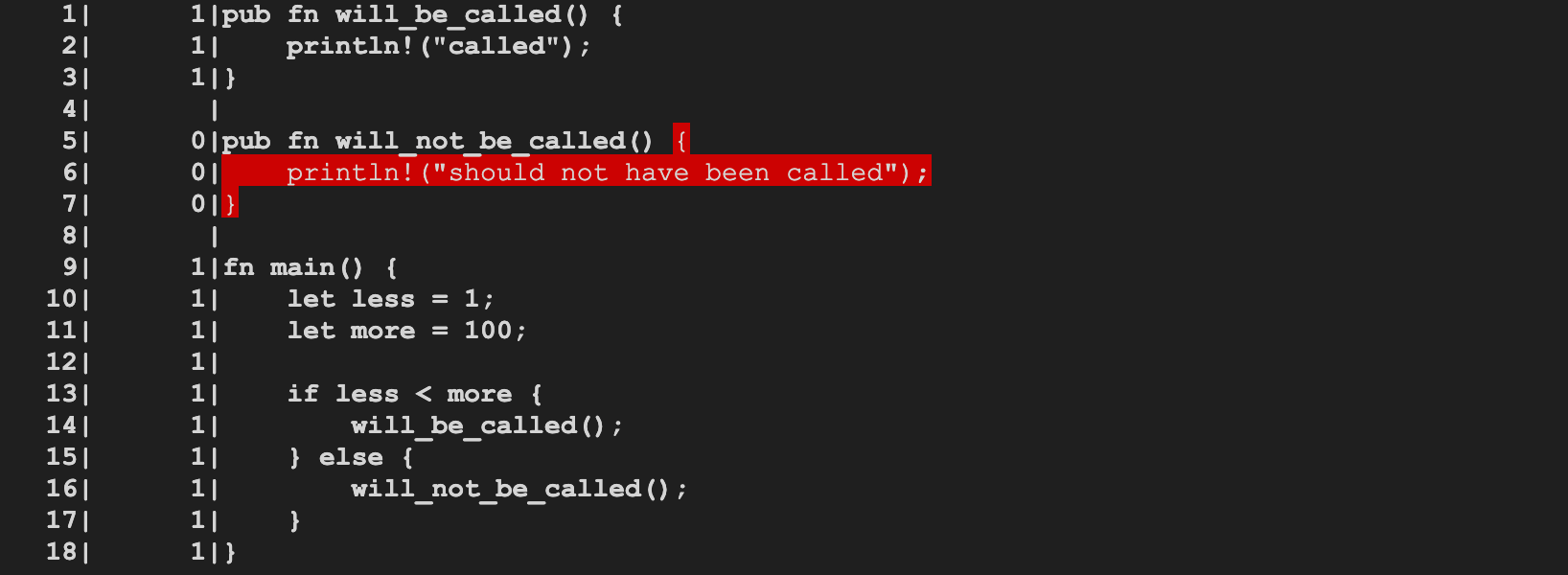
r? @wesleywiser
Rust compiler MCP rust-lang/compiler-team#278
Relevant issue: #34701 - Implement support for LLVMs code coverage instrumentation
|
|
rustc now generates the coverage map and can support (limited)
coverage report generation, at the function level.
Example:
$ BUILD=$HOME/rust/build/x86_64-unknown-linux-gnu
$ $BUILD/stage1/bin/rustc -Zinstrument-coverage \
$HOME/rust/src/test/run-make-fulldeps/instrument-coverage/main.rs
$ LLVM_PROFILE_FILE="main.profraw" ./main
called
$ $BUILD/llvm/bin/llvm-profdata merge -sparse main.profraw -o main.profdata
$ $BUILD/llvm/bin/llvm-cov show --instr-profile=main.profdata main
1| 1|pub fn will_be_called() {
2| 1| println!("called");
3| 1|}
4| |
5| 0|pub fn will_not_be_called() {
6| 0| println!("should not have been called");
7| 0|}
8| |
9| 1|fn main() {
10| 1| let less = 1;
11| 1| let more = 100;
12| 1|
13| 1| if less < more {
14| 1| will_be_called();
15| 1| } else {
16| 1| will_not_be_called();
17| 1| }
18| 1|}
|
|
`rustc` allows passing in predefined target triples as well as JSON
target specification files. This change allows bootstrap to have the
first inkling about those differences. This allows building a
cross-compiler for an out-of-tree architecture (even though that
compiler won't work for other reasons).
Even if no one ever uses this functionality, I think the newtype
around the `Interned<String>` improves the readability of the code.
|
|
|
|
Since #73374 the rustc wrapper no longer configures debug assertions
based on RUSTC_DEBUG_ASSERTIONS environment variable.
|
|
|
|
|
|
|
|
Speed up bootstrap a little.
The bootstrap script was calling `cargo metadata` 3 times (or 6 with `-v`). This is a very expensive operation, and this attempts to avoid the extra calls. On my system, a simple command like `./x.py test -h -v` goes from about 3 seconds to 0.4.
An overview of the changes:
- Call `cargo metadata` only once with `--no-deps`. Optional dependencies are filtered in `in_tree_crates` (handling `profiler_builtins` and `rustc_codegen_llvm` which are driven by the config).
- Remove a duplicate call to `metadata::build` when using `-v`. I'm not sure why it was there, it looks like a mistake or vestigial from previous behavior.
- Remove check for `_shim`, I believe all the `_shim` crates are now gone.
- Remove check for `rustc_` and `*san` for `test::Crate::should_run`, these are no longer dependencies in the `test` tree.
- Use relative paths in `./x.py test -h -v` output.
- Some code cleanup (remove unnecessary `find_compiler_crates`, etc.).
- Show suite paths (`src/test/ui/...`) in `./x.py test -h -v` output.
- Some doc comments.
|
|
|
|
Remove vestigial CI job msvc-aux.
This CI job isn't really doing anything, so it seems prudent to remove it.
For some history:
* This was introduced in #48809 when the msvc job was split in two to keep it under 2 hours (oh the good old days). At the time, this check-aux job did a bunch of things:
* tidy
* src/test/pretty
* src/test/run-pass/pretty
* src/test/run-fail/pretty
* src/test/run-pass-valgrind/pretty
* src/test/run-pass-fulldeps/pretty
* src/test/run-fail-fulldeps/pretty
* Tidy was removed in #60777.
* run-pass and run-pass-fulldeps moved to UI in #63029
* src/test/pretty removed in #58140
* src/test/run-fail moved to UI in #71185
* run-fail-fulldeps removed in #51285
Over time through attrition, the job was left with one lonely thing: `src/test/run-pass-valgrind/pretty`. And of course, this wasn't actually running the "pretty" tests. The normal `run-pass-valgrind` tests ran, and then when it tried to run in "pretty" mode, all the tests were ignored because compiletest thought nothing had changed (apparently compiletest isn't fingerprinting the mode? Needs more investigation…). `run-pass-valgrind` is already being run as part of `x86_64-msvc-1`, so there's no need to run it here.
I've taken the liberty of removing `src/test/run-pass-valgrind/pretty` as a distinct test. I'm guessing from the other PR's that the pretty tests should now live in `src/test/pretty`, and that the team has moved away from doing pretty tests on other parts of the `src/test` tree.
|
|
This should run much faster.
There are also some drive-by cleanups here to try to simplify things.
Also, the paths for in-tree crates are now displayed as relative
in `x.py test -h -v`.
|
|
|
|
|
|
|
|
Clippy's tests were failing the build, but that failure was ignored in favor of
checking toolstate. This is the correct behavior for toolstate-checked tools,
but Clippy no longer updates its toolstate status as it should always build.
|
|
Make remote-test-client and remote-test-server compatible with windows
`compiletest` and `remote-test-client`:
The command line for `remote-test-client` was changed slightly to allow cross-platform compatible paths. The old way of supplying the support libs was by joining their paths with the executable path
with `:`. This caused Windows-style paths to be split after the directory letter. Now, the number of support libs is provided as a parameter as well, and the support lib paths are split off from the regular args in the client.
`remote-test-server`:
- Marked Unix-only parts as such and implemented Windows alternatives
- On Windows `LD_LIBRARY_PATH` doesn't exist. Libraries are loaded from `PATH` though, so that's the way around it.
- Tiny cleanup: `Command::args`/`envs` instead of manually looping over them
- The temp path for Windows has to be set via environment variable, since there isn't a global temp directory that would work on every machine (as a static string)
|
|
|
|
Since cargo appends executable/args, the support_lib count
parameter has to come first.
|
|
This just unwraps clippy's build step instead of skipping tests if clippy didn't
build. This matches e.g. cargo's behavior and seems more correct, as we always
expect clippy to successfully build.
|
|
|
|
bootstrap: remove lldb dist packaging
The lldb-preview rustup package is missing on every single target, and has never been shipped beyond x86_64-apple-darwin. It was removed in #62592 which landed around a year ago, and there's not been demand that we re-enable it since, so we're now removing support entirely to cleanup the code a bit.
The hope is that this will also kill the useless "lldb-preview" row on https://rust-lang.github.io/rustup-components-history/.
|
|
|
|
it's not been built since a long time ago
|
|
|
|
|
|
|
|
So that the rlibs will work with both LTO and non-LTO builds.
|
