| Age | Commit message (Collapse) | Author | Lines |
|---|
|
Builder: Warn if test file does not exist
Running `./x.py test` with a file that does not exists (but where the path belongs to a test suite) silently ignores the missing file and runs the whole test suite. This PR prints a warning to reduce the potential surprise factor.
Closes #80621
|
|
bootstrap: clippy fixes
addresses:
clippy::or_fun_call
clippy::single_char_add_str
clippy::comparison_to_empty
clippy::or_fun_call
|
|
|
|
The struct will allow to store more context on the generated tarballs.
|
|
Only produce .xz tarballs on CI
This PR adds a `./configure` option to choose which tarball compression formats to produce, and changes our CI configuration to only produce `.xz` tarballs. The release process will then recompress everything into `.gz` when producing a release.
This will drastically reduce our storage costs for CI artifacts, as we'd stop storing the same data twice. **Stable, beta and nightly releases will not be affected by this at all.**
Before landing this we'll need to increase the VM size of our release process, to recompress everything in a reasonable amount of time.
r? `@Mark-Simulacrum`
|
|
addresses:
clippy::or_fun_call
clippy::single_char_add_str
clippy::comparison_to_empty
clippy::or_fun_call
|
|
|
|
|
|
This commit adds a Split DWARF compare mode to compiletest so that
debuginfo tests are also tested using Split DWARF in split mode (and
manually in single mode).
Signed-off-by: David Wood <david@davidtw.co>
|
|
Move rustdoc/rustdoc-json to rustdoc-json
Scaffold rustdoc-json test mode
Implement run_rustdoc_json_test
Fix up python
Make tidy happy
|
|
Move intra-doc link tests into a subdirectory
They were starting to get unwieldy.
r? ``@Manishearth``
|
|
This also changes the builder to allow using
`x.py test src/test/rustdoc-ui/intra-doc`; before, it would panic that
no paths were found.
|
|
|
|
We already set `compiletest` to use the local sysroot in #68019, but
that missed the configuration for testing `compiletest` itself.
|
|
Support enable/disable sanitizers/profiler per target
This PR add options under `[target.*]` of `config.toml` which can enable or disable sanitizers/profiler runtime for corresponding target.
If these options are empty, the global options under `[build]` will take effect.
Fix #78329
|
|
Fix run-make tests running when LLVM is disabled
The `--cc`, `--cxx`, `--cflags` and `--ar` flags were only passed to compiletest when `builder.config.llvm_enabled()` returned true. This is preventing me from running the tests on cg_clif.
|
|
Print a summary of which test suite failed
Especially on CI, where cross-compiling is common and single builder may end up
with multiple hosts and multiple targets, it can be annoying to scroll back to
the nearest start of test marker. This prints out a summary of the test suite
being run directly in compiletest.
For example, on a mir-opt failure, this would show something like this:
```
failures:
[mir-opt] mir-opt/while-storage.rs
test result: FAILED. 140 passed; 1 failed; 2 ignored; 0 measured; 0 filtered out
Some tests failed in compiletest suite=mir-opt mode=mir-opt host=x86_64-unknown-linux-gnu target=x86_64-unknown-linux-gnu
```
Fixes #78517
|
|
Especially on CI, where cross-compiling is common and single builder may end up
with multiple hosts and multiple targets, it can be annoying to scroll back to
the nearest start of test marker. This prints out a summary of the test suite
being run directly in compiletest.
|
|
|
|
|
|
|
|
This allows moving a lot of run-make-fulldeps tests to just run-make
tests, and allows running those on target-only platforms
|
|
Modify executable checking to be more universal
This uses a dummy file to check if the filesystem being used supports the executable bit in general.
Supersedes #74753.
|
|
|
|
|
|
|
|
The Rust version number is currently embedded in bootstrap's source
code, which makes it hard to update it automatically or access it
outside of ./x.py (as you'd have to parse the source code).
This commit moves the version number to a standalone plaintext file,
which makes accessing or updating it trivial.
|
|
This uses a dummy file to check if the filesystem being used supports the
executable bit in general.
|
|
|
|
rustc is a natively cross-compiling compiler, and generally none of our steps
should care whether they are using a compiler built of triple A or B, just the
--target directive being passed to the running compiler. e.g., when building for
some target C, you don't generally want to build two stds: one with a host A
compiler and the other with a host B compiler. Just one std is sufficient.
|
|
|
|
|
|
|
|
|
|
|
|
See #75773 and #75775
|
|
Snapshot testing is a technique for writing maintainable unit tests.
Unlike usual `assert_eq!` tests, snapshot tests allow
to *automatically* upgrade expected values on test failure.
In a sense, snapshot tests are inline-version of our beloved
UI-tests.
Example:
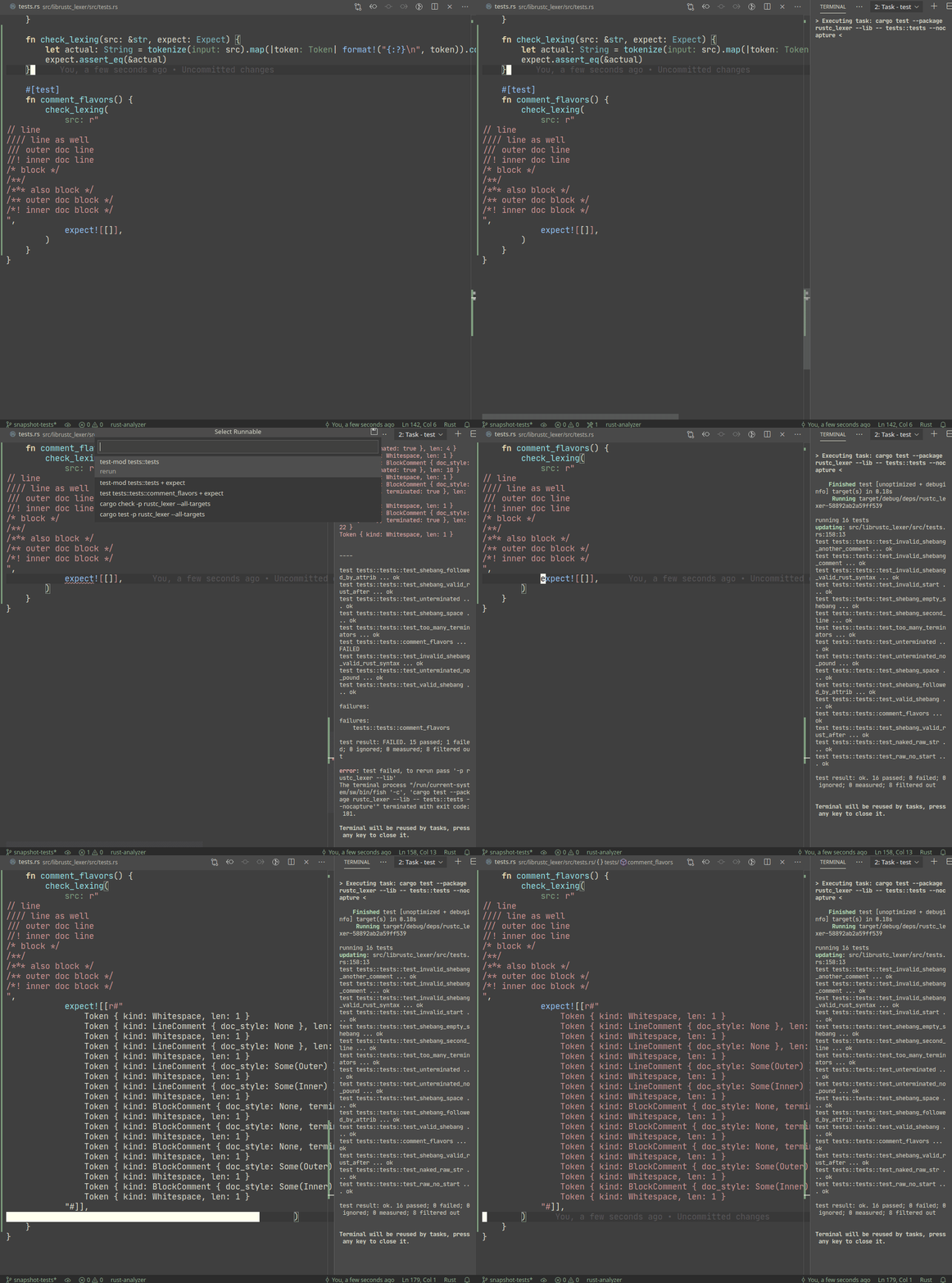
A particular library we use, `expect_test` provides an `expect!`
macro, which creates a sort of self-updating string literal (by using
`file!` macro). Self-update is triggered by setting `UPDATE_EXPECT`
environmental variable (this info is printed during the test failure).
This library was extracted from rust-analyzer, where we use it for
most of our tests.
There are some other, more popular snapshot testing libraries:
* https://github.com/mitsuhiko/insta
* https://github.com/aaronabramov/k9
The main differences of `expect` are:
* first-class snapshot objects (so, tests can be written as functions,
rather than as macros)
* focus on inline-snapshots (but file snapshots are also supported)
* restricted feature set (only `assert_eq` and `assert_debug_eq`)
* no extra runtime (ie, no `cargo insta`)
See https://github.com/rust-analyzer/rust-analyzer/pull/5101 for a
an extended comparison.
It is unclear if this testing style will stick with rustc in the long
run. At the moment, rustc is mainly tested via integrated UI tests.
But in the library-ified world, unit-tests will become somewhat more
important (that's why use use `rustc_lexer` library-ified library as
an example in this PR). Given that the cost of removal shouldn't be
too high, it probably makes sense to just see if this flies!
|
|
|
|
|
|
|
|
|
|
|
|
|
|
Generating the coverage map
@tmandry @wesleywiser
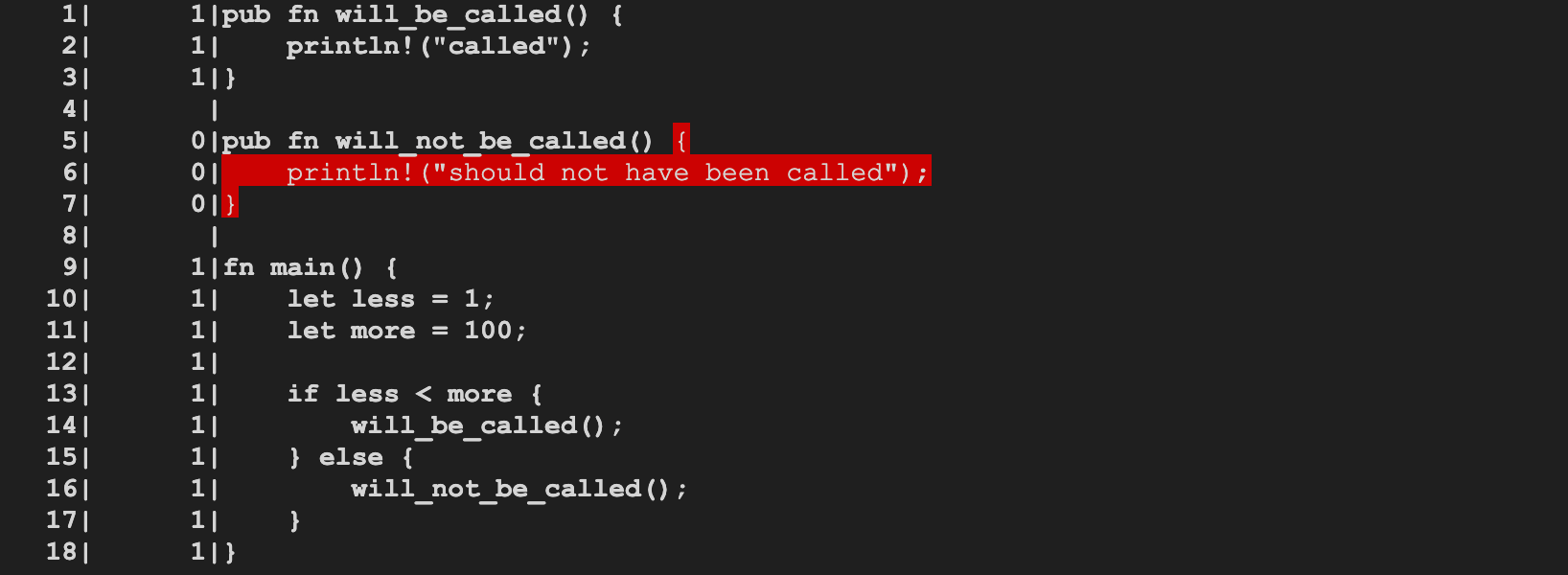
rustc now generates the coverage map and can support (limited)
coverage report generation, at the function level.
Example commands to generate a coverage report:
```shell
$ BUILD=$HOME/rust/build/x86_64-unknown-linux-gnu
$ $BUILD/stage1/bin/rustc -Zinstrument-coverage \
$HOME/rust/src/test/run-make-fulldeps/instrument-coverage/main.rs
$ LLVM_PROFILE_FILE="main.profraw" ./main
called
$ $BUILD/llvm/bin/llvm-profdata merge -sparse main.profraw -o main.profdata
$ $BUILD/llvm/bin/llvm-cov show --instr-profile=main.profdata main
```
r? @wesleywiser
Rust compiler MCP rust-lang/compiler-team#278
Relevant issue: #34701 - Implement support for LLVMs code coverage instrumentation
|
|
rustc now generates the coverage map and can support (limited)
coverage report generation, at the function level.
Example:
$ BUILD=$HOME/rust/build/x86_64-unknown-linux-gnu
$ $BUILD/stage1/bin/rustc -Zinstrument-coverage \
$HOME/rust/src/test/run-make-fulldeps/instrument-coverage/main.rs
$ LLVM_PROFILE_FILE="main.profraw" ./main
called
$ $BUILD/llvm/bin/llvm-profdata merge -sparse main.profraw -o main.profdata
$ $BUILD/llvm/bin/llvm-cov show --instr-profile=main.profdata main
1| 1|pub fn will_be_called() {
2| 1| println!("called");
3| 1|}
4| |
5| 0|pub fn will_not_be_called() {
6| 0| println!("should not have been called");
7| 0|}
8| |
9| 1|fn main() {
10| 1| let less = 1;
11| 1| let more = 100;
12| 1|
13| 1| if less < more {
14| 1| will_be_called();
15| 1| } else {
16| 1| will_not_be_called();
17| 1| }
18| 1|}
|
|
`rustc` allows passing in predefined target triples as well as JSON
target specification files. This change allows bootstrap to have the
first inkling about those differences. This allows building a
cross-compiler for an out-of-tree architecture (even though that
compiler won't work for other reasons).
Even if no one ever uses this functionality, I think the newtype
around the `Interned<String>` improves the readability of the code.
|
|
|
|
Since #73374 the rustc wrapper no longer configures debug assertions
based on RUSTC_DEBUG_ASSERTIONS environment variable.
|
|
|
|
|
