| Age | Commit message (Collapse) | Author | Lines |
|---|
|
|
|
rustc is a natively cross-compiling compiler, and generally none of our steps
should care whether they are using a compiler built of triple A or B, just the
--target directive being passed to the running compiler. e.g., when building for
some target C, you don't generally want to build two stds: one with a host A
compiler and the other with a host B compiler. Just one std is sufficient.
|
|
r=alexcrichton
Only copy LLVM into rust-dev with internal LLVM
This avoids needing to figure out where to locate each of the components with an
external LLVM. This component isn't manifested for rustup consumption and
generally shouldn't matter for anyone except Rust's CI, so it is fine for it to not be
complete elsewhere.
Fixes #76572.
r? `@alexcrichton`
|
|
rustbuild: Do not use `rust-mingw` component when bootstrapping windows-gnu targets
Addresses https://github.com/rust-lang/rust/pull/76326#issuecomment-687273473 (ancient `x86_64-w64-mingw32-gcc` is selected as a linker wrapper, which is not usable in `use_lld=true` mode).
Perhaps the comment about incompatible mingw was true in the past, but many things changed since then.
With this change I was able to build everything successfully locally using a newer mingw toolchain, if it passes through the older toolchain on CI, then it should be good, I think.
|
|
|
|
This avoids needing to figure out where to locate each of the components with an
external LLVM.
|
|
rustbuild: Build tests with LLD if `use-lld = true` was passed
Addresses https://github.com/rust-lang/rust/pull/76127#discussion_r479932392.
Our test suite is generally ready to run with an explicitly specified linker (https://github.com/rust-lang/rust/pull/45191),
so LLD specified with `use-lld = true` works as well.
Only 4 tests fail (on `x86_64-pc-windows-msvc`):
```
ui/panic-runtime/lto-unwind.rs
run-make-fulldeps/debug-assertions
run-make-fulldeps/foreign-exceptions
run-make-fulldeps/test-harness
```
All of them are legitimate issues with LLD (or at least with combination Rust+LLD) and manifest in segfaults on access to TLS (https://github.com/rust-lang/rust/pull/76127#issuecomment-683473325). UPD: These issues are caused by https://github.com/rust-lang/rust/issues/72145 and appear because I had `-Ctarget-cpu=native` set.
UPD: Further commits build tests with LLD for non-MSVC targets and propagate LLD to more places when `use-lld` is enabled.
|
|
rustbuild: don't set PYTHON_EXECUTABLE and WITH_POLLY cmake vars since they are no longer supported by llvm
This resolves
CMake Warning:
Manually-specified variables were not used by the project:
PYTHON_EXECUTABLE
WITH_POLLY
|
|
Move `rustllvm` into `compiler/rustc_llvm`
The `rustllvm` directory is not self-contained, it contains C++ code built by a build script of the `rustc_llvm` crate which is then linked into that crate.
So it makes sense to make `rustllvm` a part of `rustc_llvm` and move it into its directory.
I replaced `rustllvm` with more obvious `llvm-wrapper` as the subdirectory name, but something like `llvm-adapter` would work as well, other suggestions are welcome.
To make things more confusing, the Rust side of FFI functions defined in `rustllvm` can be found in `rustc_codegen_llvm` rather than in `rustc_llvm`. Perhaps they need to be moved as well, but this PR doesn't do that.
The presence of multiple LLVM-related directories in `src` (`llvm-project`, `rustllvm`, `librustc_llvm`, `librustc_codegen_llvm` and their predecessors) historically confused me and made me wonder about their purpose.
With this PR we will have LLVM itself (`llvm-project`), a FFI crate (`rustc_llvm`, kind of `llvm-sys`) and a codegen backend crate using LLVM through the FFI crate (`rustc_codegen_llvm`).
|
|
Add missed spaces to GCC-WARNING.txt
|
|
|
|
rustbuild: Remove `Mode::Codegen`
It's no longer used.
|
|
Add rust-dev component to support rustc development
This is preparatory work for permitting rustc developers to use CI-built LLVM rather than building it locally. Unlike distro-built LLVM, CI built LLVM is essentially guaranteed to behave perfectly for local development -- it is fully up to date, and carries all necessary patches.
This is a separate PR from #76349 because it needs to land before that one, since we want a master build with the full CI LLVM to be available for easier testing.
|
|
are no longer supported by llvm
CMake Warning:
Manually-specified variables were not used by the project:
PYTHON_EXECUTABLE
WITH_POLLY
|
|
|
|
This currently includes libLLVM, llvm-config, and FileCheck, but will perhaps
expand to more tooling overtime. It should be considered entirely unstable and
may change at any time.
|
|
This is generally a good idea, and will help with being able to build bootstrap
without Python over time as it means we can "just" build with cargo +beta build
rather than needing the user to set environment variables. This is a minor step,
but a necessary one on that road.
|
|
|
|
|
|
|
|
|
|
Fix rust.use-lld when linker is not set
Fixes https://github.com/rust-lang/rust/pull/76127#issuecomment-685419195
Previously when `[<target>].linker` was not configured `rust.use-lld` would set it to `rust-lld` on platforms where it should not.
|
|
targets
|
|
|
|
|
|
|
|
Often when modifying compiler code you'll miss that you've changed an API used
by unit tests, since x.py check didn't previously catch that.
It's also useful to have this for editing with rust-analyzer and similar tooling
where editing tests previously didn't notify you of errors in test files.
|
|
|
|
It isn't practical to determine whether we'll build LLVM very early in the
pipeline, so move the ninja checking to a dynamic check.
|
|
rustbuild: Remove one LLD workaround
The version of LLD shipped with Rust no longer have this issue.
Closes https://github.com/rust-lang/rust/issues/68647
|
|
|
|
|
|
|
|
Fix loading pretty-printers in rust-lldb script
Pretty-printers loading in `rust-lldb` script was broken in https://github.com/rust-lang/rust/pull/72357
This fixes https://github.com/rust-lang/rust/issues/76006
|
|
Allow --bess ing expect-tests in tools
I haven't tried this, but I think this should do the trick, as `RustdocCrate` is a special step in bootstrap, which uses `tool_caro`
r? @ghost
|
|
Enable zlib for NetBSD
NetBSD Docker dist job passed locally.
|
|
See #75773 and #75775
|
|
Set ninja=true by default
Ninja substantially improves LLVM build time. On a 96-way system, using
Make took 248s, and using Ninja took 161s, a 35% improvement.
We already require a variety of tools to build Rust. If someone wants to
build without Ninja (for instance, to minimize the set of packages
required to bootstrap a new target), they can easily set `ninja=false`
in `config.toml`. Our defaults should help people build Rust (and LLVM)
faster, to speed up development.
|
|
|
|
|
|
Bump version to 1.48 and update cfg(bootstrap)s
r? @Mark-Simulacrum
|
|
Fixes for VxWorks
r? @alexcrichton
|
|
Let people know that they can set ninja=false if they don't want to
install ninja.
|
|
Ninja substantially improves LLVM build time. On a 96-way system, using
Make took 248s, and using Ninja took 161s, a 35% improvement.
We already require a variety of tools to build Rust. If someone wants to
build without Ninja (for instance, to minimize the set of packages
required to bootstrap a new target), they can easily set `ninja=false`
in `config.toml`. Our defaults should help people build Rust (and LLVM)
faster, to speed up development.
|
|
|
|
fix building errors
use wr-c++ as linker
|
|
Introduce expect snapshot testing library into rustc
Snapshot testing is a technique for writing maintainable unit tests.
Unlike usual `assert_eq!` tests, snapshot tests allow
to *automatically* upgrade expected values on test failure.
In a sense, snapshot tests are inline-version of our beloved
UI-tests.
Example:
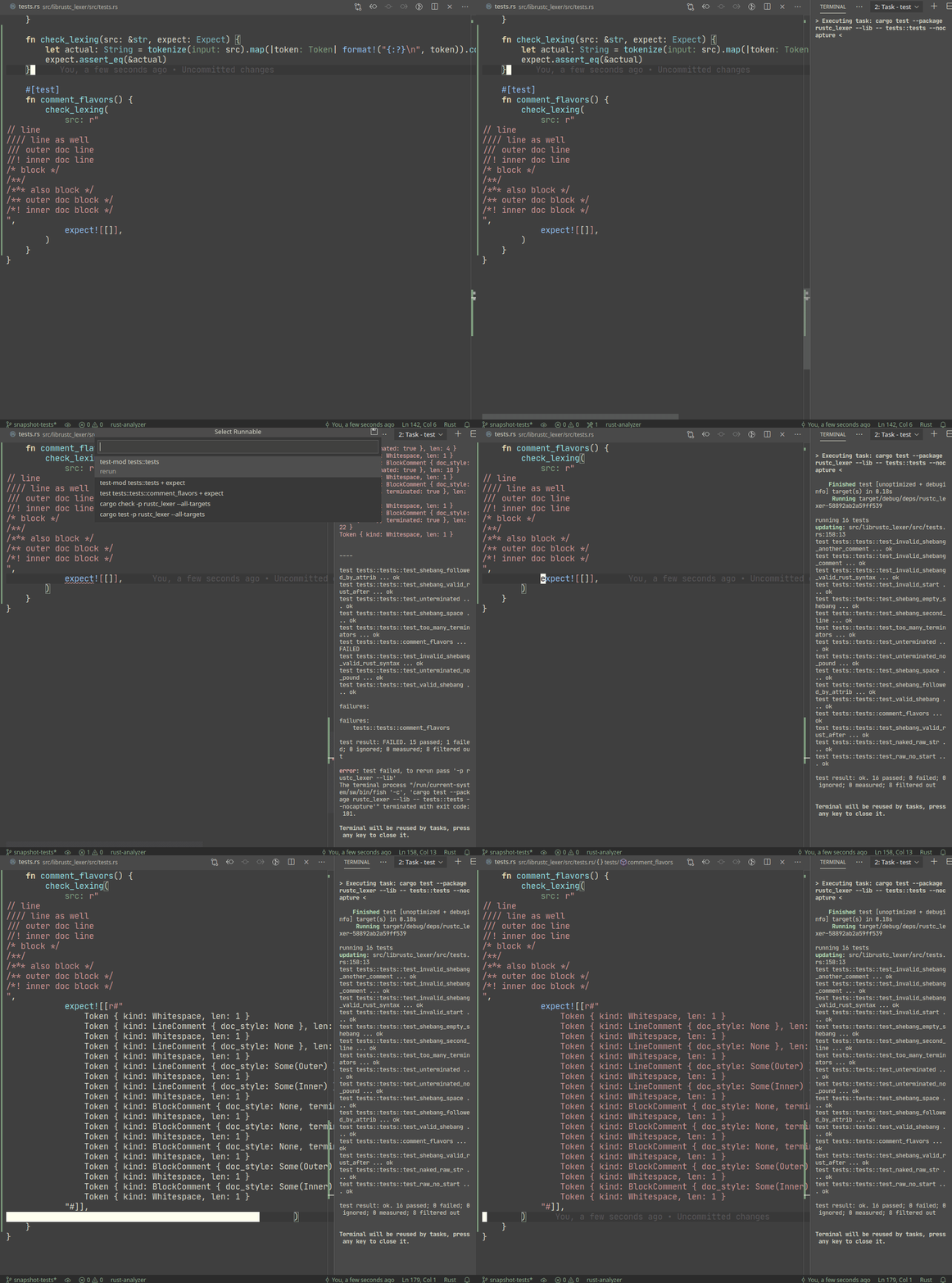
A particular library we use, `expect_test` provides an `expect!`
macro, which creates a sort of self-updating string literal (by using
`file!` macro). Self-update is triggered by setting `UPDATE_EXPECT`
environmental variable (this info is printed during the test failure).
This library was extracted from rust-analyzer, where we use it for
most of our tests.
There are some other, more popular snapshot testing libraries:
* https://github.com/mitsuhiko/insta
* https://github.com/aaronabramov/k9
The main differences of `expect` are:
* first-class snapshot objects (so, tests can be written as functions,
rather than as macros)
* focus on inline-snapshots (but file snapshots are also supported)
* restricted feature set (only `assert_eq` and `assert_debug_eq`)
* no extra runtime (ie, no `cargo insta`)
See rust-analyzer/rust-analyzer#5101 for a
an extended comparison.
It is unclear if this testing style will stick with rustc in the long
run. At the moment, rustc is mainly tested via integrated UI tests.
But in the library-ified world, unit-tests will become somewhat more
important (that's why use use `rustc_lexer` library-ified library as
an example in this PR). Given that the cost of removal shouldn't be
too high, it probably makes sense to just see if this flies!
|
|
|
|
Fix windows-gnu host cross-compilation
Fixes https://github.com/rust-lang/rust/issues/64218
Also turns out it's faster to run Linux virtual machine on Windows and cross-compile `./x.py dist` than doing it on Windows directly...
|
|
Snapshot testing is a technique for writing maintainable unit tests.
Unlike usual `assert_eq!` tests, snapshot tests allow
to *automatically* upgrade expected values on test failure.
In a sense, snapshot tests are inline-version of our beloved
UI-tests.
Example:

A particular library we use, `expect_test` provides an `expect!`
macro, which creates a sort of self-updating string literal (by using
`file!` macro). Self-update is triggered by setting `UPDATE_EXPECT`
environmental variable (this info is printed during the test failure).
This library was extracted from rust-analyzer, where we use it for
most of our tests.
There are some other, more popular snapshot testing libraries:
* https://github.com/mitsuhiko/insta
* https://github.com/aaronabramov/k9
The main differences of `expect` are:
* first-class snapshot objects (so, tests can be written as functions,
rather than as macros)
* focus on inline-snapshots (but file snapshots are also supported)
* restricted feature set (only `assert_eq` and `assert_debug_eq`)
* no extra runtime (ie, no `cargo insta`)
See https://github.com/rust-analyzer/rust-analyzer/pull/5101 for a
an extended comparison.
It is unclear if this testing style will stick with rustc in the long
run. At the moment, rustc is mainly tested via integrated UI tests.
But in the library-ified world, unit-tests will become somewhat more
important (that's why use use `rustc_lexer` library-ified library as
an example in this PR). Given that the cost of removal shouldn't be
too high, it probably makes sense to just see if this flies!
|
