| Age | Commit message (Collapse) | Author | Lines |
|---|
|
rustdoc book
|
|
|
|
|
|
rustdoc-search: simplify rules for generics and type params
**Heads up!**: This PR is a follow-up that depends on #124544. It adds 12dc24f46007f82b93ed85614347a42d47580afa, a change to the filtering behavior, and 9900ea48b566656fb12b5fcbd0a1b20aaa96e5ca, a minor ranking tweak.
Part of https://github.com/rust-lang/rust-project-goals/issues/112
This PR overturns https://github.com/rust-lang/rust/pull/109802
## Preview
* no results: [`Box<[A]> -> Vec<B>`](http://notriddle.com/rustdoc-html-demo-12/search-sem-3/std/index.html?search=Box%3C%5BA%5D%3E%20-%3E%20Vec%3CB%3E)
* results: [`Box<[A]> -> Vec<A>`](http://notriddle.com/rustdoc-html-demo-12/search-sem-3/std/index.html?search=Box%3C%5BA%5D%3E%20-%3E%20Vec%3CA%3E)
* [`T -> U`](http://notriddle.com/rustdoc-html-demo-12/search-sem-3/std/index.html?search=T%20-%3E%20U)
* [`Cx -> TyCtxt`](http://notriddle.com/rustdoc-html-demo-12/search-sem-3-compiler/rustdoc/index.html?search=Cx%20-%3E%20TyCtxt)
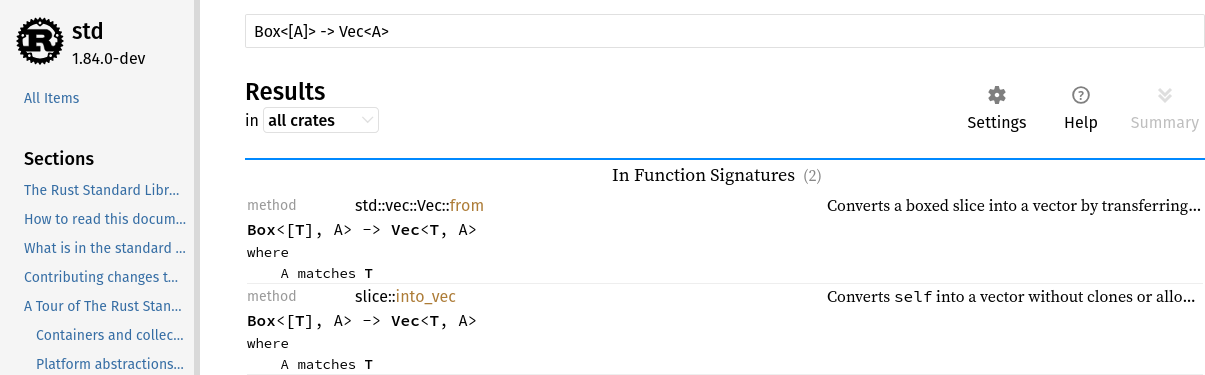
## Description
This commit is a response to feedback on the displayed type signatures results, by making generics act stricter.
- Order within generics is significant. This means `Vec<Allocator>` now matches only with a true vector of allocators, instead of matching the second type param. It also makes unboxing within generics stricter, so `Result<A, B>` only matches if `B` is in the error type and `A` is in the success type. The top level of the function search is unaffected.
- Generics are only "unboxed" if a type is explicitly opted into it. References and tuples are hardcoded to allow unboxing, and Box, Rc, Arc, Option, Result, and Future are opted in with an unstable attribute. Search result unboxing is the process that allows you to search for `i32 -> str` and get back a function with the type signature `&Future<i32> -> Box<str>`.
- Instead of ranking by set overlap, it ranks by the number of items in the type signature. This makes it easier to find single type signatures like transmute.
## Find the discussion on
* <https://rust-lang.zulipchat.com/#narrow/stream/393423-t-rustdoc.2Fmeetings/topic/meeting.202024-07-08/near/449965149>
* <https://github.com/rust-lang/rust/pull/124544#issuecomment-2204272265>
* <https://rust-lang.zulipchat.com/#narrow/channel/266220-t-rustdoc/topic/deciding.20on.20semantics.20of.20generics.20in.20rustdoc.20search>
|
|
This changes the naming to the new naming, used by `--print
target-tuple`.
It does not change all locations, but many.
|
|
This commit is a response to feedback on the displayed type
signatures results, by making generics act stricter.
Generics are tightened by making order significant. This means
`Vec<Allocator>` now matches only with a true vector of allocators,
instead of matching the second type param. It also makes unboxing
within generics stricter, so `Result<A, B>` only matches if `B`
is in the error type and `A` is in the success type. The top level
of the function search is unaffected.
Find the discussion on:
* <https://rust-lang.zulipchat.com/#narrow/stream/393423-t-rustdoc.2Fmeetings/topic/meeting.202024-07-08/near/449965149>
* <https://github.com/rust-lang/rust/pull/124544#issuecomment-2204272265>
* <https://rust-lang.zulipchat.com/#narrow/channel/266220-t-rustdoc/topic/deciding.20on.20semantics.20of.20generics.20in.20rustdoc.20search/near/476841363>
|
|
r=notriddle,jyn514
Add `field@` and `variant@` doc-link disambiguators
I'm not sure if this is big enough to need an fcp or not, but this is something I found missing when trying to refer to a field in macro-generated docs, not knowing if a method might be defined as well. Obviously, there are definitely other uses.
In the case where it's not disambiguated, methods (and I suppose other associated items in the value namespace) still take priority, which `@jyn514` said was an oversight but I think is probably the desired behavior 99% of the time anyway - shadowing a field with an accessor method is a very common pattern. If fields and methods with the same name started conflicting, it would be a breaking change. Though, to quote them:
> jyn: maybe you can break this only if both [the method and the field] are public
> jyn: rustc has some future-incompat warning level
> jyn: that gets through -A warnings and --cap-lints from cargo
That'd be out of scope of this PR, though.
Fixes #80283
|
|
coherency
|
|
|
|
|
|
Add possibility to generate rustdoc JSON output to stdout
Fixes #127165.
I think it's likely common to want to get rustdoc json output directly instead of reading it from a file so I added this option to allow it. It's unstable and only works with `--output-format=json`.
r? `@aDotInTheVoid`
|
|
|
|
|
|
Correct rustdoc section where we talk about rustdoc emitting errors on invalid code
As discussed on [zulip](https://rust-lang.zulipchat.com/#narrow/stream/266220-t-rustdoc/topic/stop.20accepting.20broken.20code/near/401760318).
r? `@notriddle`
|
|
|
|
|
|
GuillaumeGomez:stabilize-custom_code_classes_in_docs, r=rustdoc
Stabilize `custom_code_classes_in_docs` feature
Fixes #79483.
This feature has been around for quite some time now, I think it's fine to stabilize it now.
## Summary
## What is the feature about?
In short, this PR changes two things, both related to codeblocks in doc comments in Rust documentation:
* Allow to disable generation of `language-*` CSS classes with the `custom` attribute.
* Add your own CSS classes to a code block so that you can use other tools to highlight them.
#### The `custom` attribute
Let's start with the new `custom` attribute: it will disable the generation of the `language-*` CSS class on the generated HTML code block. For example:
```rust
/// ```custom,c
/// int main(void) {
/// return 0;
/// }
/// ```
```
The generated HTML code block will not have `class="language-c"` because the `custom` attribute has been set. The `custom` attribute becomes especially useful with the other thing added by this feature: adding your own CSS classes.
#### Adding your own CSS classes
The second part of this feature is to allow users to add CSS classes themselves so that they can then add a JS library which will do it (like `highlight.js` or `prism.js`), allowing to support highlighting for other languages than Rust without increasing burden on rustdoc. To disable the automatic `language-*` CSS class generation, you need to use the `custom` attribute as well.
This allow users to write the following:
```rust
/// Some code block with `{class=language-c}` as the language string.
///
/// ```custom,{class=language-c}
/// int main(void) {
/// return 0;
/// }
/// ```
fn main() {}
```
This will notably produce the following HTML:
```html
<pre class="language-c">
int main(void) {
return 0;
}</pre>
```
Instead of:
```html
<pre class="rust rust-example-rendered">
<span class="ident">int</span> <span class="ident">main</span>(<span class="ident">void</span>) {
<span class="kw">return</span> <span class="number">0</span>;
}
</pre>
```
To be noted, we could have written `{.language-c}` to achieve the same result. `.` and `class=` have the same effect.
One last syntax point: content between parens (`(like this)`) is now considered as comment and is not taken into account at all.
In addition to this, I added an `unknown` field into `LangString` (the parsed code block "attribute") because of cases like this:
```rust
/// ```custom,class:language-c
/// main;
/// ```
pub fn foo() {}
```
Without this `unknown` field, it would generate in the DOM: `<pre class="language-class:language-c language-c">`, which is quite bad. So instead, it now stores all unknown tags into the `unknown` field and use the first one as "language". So in this case, since there is no unknown tag, it'll simply generate `<pre class="language-c">`. I added tests to cover this.
EDIT(camelid): This description is out-of-date. Using `custom,class:language-c` will generate the output `<pre class="language-class:language-c">` as would be expected; it treats `class:language-c` as just the name of a language (similar to the langstring `c` or `js` or what have you) since it does not use the designed class syntax.
Finally, I added a parser for the codeblock attributes to make it much easier to maintain. It'll be pretty easy to extend.
As to why this syntax for adding attributes was picked: it's [Pandoc's syntax](https://pandoc.org/MANUAL.html#extension-fenced_code_attributes). Even if it seems clunkier in some cases, it's extensible, and most third-party Markdown renderers are smart enough to ignore Pandoc's brace-delimited attributes (from [this comment](https://github.com/rust-lang/rust/pull/110800#issuecomment-1522044456)).
r? `@notriddle`
|
|
Add `-` (stdin) support in rustdoc
This PR adds support for the special `-` input which threats the input as coming from *stdin* instead of being a filepath.
Doing this also makes `rustdoc` consistent with `rustc` and ~~every~~ other tools. Full [motivation](https://github.com/rust-lang/rust/pull/124611#issuecomment-2094234876).
Fixes https://github.com/rust-lang/rust/issues/123671
r? `@fmease`
|
|
|
|
rustdoc-search: search for references
This feature extends rustdoc with syntax and search index information for searching borrow references. Part of https://github.com/rust-lang/rust/issues/60485
## Preview
- [`&mut`](https://notriddle.com/rustdoc-html-demo-11/reference/std/index.html?search=%26mut)
- [`&Option<T> -> Option<&T>`](https://notriddle.com/rustdoc-html-demo-11/reference/std/index.html?search=%26Option%3CT%3E%20-%3E%20Option%3C%26T%3E)
- [`&mut Option<T> -> Option<&mut T>`](https://notriddle.com/rustdoc-html-demo-11/reference/std/index.html?search=%26mut%20Option%3CT%3E%20-%3E%20Option%3C%26mut%20T%3E)
Updated chapter of the book: https://notriddle.com/rustdoc-html-demo-11/reference/rustdoc/read-documentation/search.html
## Motivation
See https://github.com/rust-lang/rust/pull/119676
## Guide-level explanation
You can't search by lifetimes, but other than that it's the same syntax references normally use.
## Reference-level description
<table>
<thead>
<tr>
<th>Shorthand</th>
<th>Explicit names</th>
</tr>
</thead>
<tbody>
<tr><td colspan="2">Before this PR</td></tr>
<tr>
<td><code>[]</code></td>
<td><code>primitive:slice</code> and/or <code>primitive:array</code></td>
</tr>
<tr>
<td><code>[T]</code></td>
<td><code>primitive:slice<T></code> and/or <code>primitive:array<T></code></td>
</tr>
<tr>
<td><code>!</code></td>
<td><code>primitive:never</code></td>
</tr>
<tr>
<td><code>()</code></td>
<td><code>primitive:unit</code> and/or <code>primitive:tuple</code></td>
</tr>
<tr>
<td><code>(T)</code></td>
<td><code>T</code></td>
</tr>
<tr>
<td><code>(T,)</code></td>
<td><code>primitive:tuple<T></code></td>
</tr>
<tr>
<td><code>(T, U -> V, W)</code></td>
<td><code>fn(T, U) -> (V, W)</code>, Fn, FnMut, and FnOnce</td>
</tr>
<tr><td colspan="2">New additions with this PR</td></tr>
<tr>
<td><code>&</code></td>
<td><code>primitive:reference</td>
</tr>
<tr>
<td><code>&mut</code></td>
<td><code>primitive:reference<keyword:mut></td>
</tr>
<tr>
<td><code>&T</code></td>
<td><code>primitive:reference<T></td>
</tr>
<tr>
<td><code>&mut T</code></td>
<td><code>primitive:reference<keyword:mut, T></td>
</tr>
</tbody>
</table>
### Search query grammar
<code><pre><strong>borrow-ref = AMP *WS [MUT] *WS [arg]</strong>
arg = [type-filter *WS COLON *WS] (path [generics] / slice-like / tuple-like / <strong>borrow-ref</strong>)</pre></code>
```
AMP = "&"
MUT = "mut"
```
## Future direction
As described in https://github.com/rust-lang/rust/pull/118194 and https://github.com/rust-lang/rust/pull/119676
* The remaining type expression grammar (this is another step in the type expression grammar: `ReferenceType` is now supported)
* Search subtyping and traits
|
|
|
|
|
|
Signed-off-by: whosehang <whosehang@outlook.com>
|
|
|
|
|
|
|
|
|
|
This is implemented, in addition to the ML-style one,
because Rust does it. If we don't, we'll never hear the end of it.
This commit also refactors some duplicate parts of the parser
into a dedicated function.
|
|
Option::map, for example, looks like this:
option<t>, (t -> u) -> option<u>
This syntax searches all of the HOFs in Rust: traits Fn, FnOnce,
and FnMut, and bare fn primitives.
|
|
Signed-off-by: cui fliter <imcusg@gmail.com>
|
|
r=notriddle
Extend intra-doc link chapter in the rustdoc book
Linked to #117178.
r? `@notriddle`
|
|
|
|
|
|
|
|
|
|
Improve documentation for using warning blocks in documentation
From [this comment](https://github.com/rust-lang/rust/issues/79710#issuecomment-1868225357), I think markdown can be surprising sometimes so better explain a bit better how to use it correctly.
r? `@notriddle`
|
|
|
|
|
|
|
|
I guess that `Bar` in the section I changed should be `bar` because when I run the program it has its page under struct but bar doesn't have any page.
|
|
|
|
invalid code
|
|
Fixes the second example in the Examples section of what-to-include.md by marking main as a function.
|
|
|
|
Add new simpler and more explicit syntax for check-cfg
<details>
<summary>
Old proposition (before the MCP)
</summary>
This PR adds a new simpler and more explicit syntax for check-cfg. It consist of two new form:
- `exhaustive(names, values)`
- `configure(name, "value1", "value2", ... "valueN")`
The preview forms `names(...)` and `values(...)` have implicit meaning that are not strait-forward. In particular `values(foo)`&`values(bar)` and `names(foo, bar)` are not equivalent which has created [some confusions](https://github.com/rust-lang/rust/pull/98080).
Also the `names()` and `values()` form are not clear either and again created some confusions where peoples believed that `values()`&`values(foo)` could be reduced to just `values(foo)`.
To fix that the two new forms are made to be explicit and simpler. See the table of correspondence:
- `names()` -> `exhaustive(names)`
- `values()` -> `exhaustive(values)`
- `names(foo)` -> `exhaustive(names)`&`configure(foo)`
- `values(foo)` -> `configure(foo)`
- `values(feat, "foo", "bar")` -> `configure(feat, "foo", "bar")`
- `values(foo)`&`values(bar)` -> `configure(foo, bar)`
- `names()`&`values()`&`values(my_cfg)` -> `exhaustive(names, values)`&`configure(my_cfg)`
Another benefits of the new syntax is that it allow for further options (like conditional checking for --cfg, currently always on) without syntax change.
The two previous forms are deprecated and will be removed once cargo and beta rustc have the necessary support.
</details>
This PR is the first part of the implementation of [MCP636 - Simplify and improve explicitness of the check-cfg syntax](https://github.com/rust-lang/compiler-team/issues/636).
## New `cfg` form
It introduces the new [`cfg` form](https://github.com/rust-lang/compiler-team/issues/636) and deprecate the other two:
```
rustc --check-cfg 'cfg(name1, ..., nameN, values("value1", "value2", ... "valueN"))'
```
## Default built-in names and values
It also changes the default for the built-in names and values checking.
- Built-in values checking would always be activated as long as a `--check-cfg` argument is present
- Built-in names checking would always be activated as long as a `--check-cfg` argument is present **unless** if any `cfg(any())` arg is passed
~~**Note: depends on https://github.com/rust-lang/rust/pull/111068 but is reviewable (last two commits)!**~~
Resolve https://github.com/rust-lang/compiler-team/issues/636
r? `@petrochenkov`
|
|
r=GuillaumeGomez
rustdoc: hide `#[repr(transparent)]` if it isn't part of the public ABI
Fixes #90435.
This hides `#[repr(transparent)]` when the non-1-ZST field the struct is "transparent" over is private.
CC `@RalfJung`
Tentatively nominating it for the release notes, feel free to remove the nomination.
`@rustbot` label needs-fcp relnotes A-rustdoc-ui
|
|
This add a new form and deprecated the other ones:
- cfg(name1, ..., nameN, values("value1", "value2", ... "valueN"))
- cfg(name1, ..., nameN) or cfg(name1, ..., nameN, values())
- cfg(any())
It also changes the default exhaustiveness to be enable-by-default in
the presence of any --check-cfg arguments.
|
|
|
|
|
|
rustdoc-search: add support for type parameters
r? `@GuillaumeGomez`
## Preview
* https://notriddle.com/rustdoc-html-demo-4/advanced-search/rustdoc/read-documentation/search.html
* https://notriddle.com/rustdoc-html-demo-4/advanced-search/std/index.html?search=option%3Coption%3CT%3E%3E%20-%3E%20option%3CT%3E
* https://notriddle.com/rustdoc-html-demo-4/advanced-search/std/index.html?search=option%3CT%3E,%20E%20-%3E%20result%3CT,%20E%3E
* https://notriddle.com/rustdoc-html-demo-4/advanced-search/std/index.html?search=-%3E%20option%3CT%3E
## Description
When writing a type-driven search query in rustdoc, specifically one with more than one query element, non-existent types become generic parameters instead of auto-correcting (which is currently only done for single-element queries) or giving no result. You can also force a generic type parameter by writing `generic:T` (and can force it to not use a generic type parameter with something like `struct:T` or whatever, though if this happens it means the thing you're looking for doesn't exist and will give you no results).
There is no syntax provided for specifying type constraints for generic type parameters.
When you have a generic type parameter in a search query, it will only match up with generic type parameters in the actual function, not concrete types that match, not concrete types that implement a trait. It also strictly matches based on when they're the same or different, so `option<T>, option<U> -> option<U>` matches `Option::and`, but not `Option::or`. Similarly, `option<T>, option<T> -> option<T>` matches `Option::or`, but not `Option::and`.
## Motivation
This feature is motivated by the many "combinitor"-type functions found in generic libraries, such as Option, Future, Iterator, and Entry. These highly-generic functions have names that are almost completely arbitrary, and a type signature that tells you what it actually does.
This PR is a major step towards[^closure] being able to easily search for generic functions by their type signature instead of by name. Some examples of combinators that can be found using this PR (try them out in the preview):
* `option<option<T>> -> option<T>` returns Option::flatten
* `option<T> -> result<T>` returns Option::ok_or
* `option<result<T>> -> result<option<T>>` returns Option::transpose
* `entry<K, V>, FnOnce -> V` returns `Entry::or_insert_with` (and `or_insert_with_key`, since there's no way to specify the generics on FnOnce)
[^closure]:
For this feature to be as useful as it ought to be, you should be able to search for *trait-associated types* and *closures*. This PR does not implement either of these: they are **Future possibilities**.
Trait-associated types would allow queries like `option<T> -> iterator<item=T>` to return `Option::iter`. We should also allow `option<T> -> iterator<T>` to match the associated type version.
Closures would make a good way to query for things like `Option::map`. Closure support needs associated types to be represented in the search index, since `FnOnce() -> i32` desugars to `FnOnce<Output=i32, ()>`, so associated trait types should be implemented first. Also, we'd want to expose an easy way to query closures without specifying which of the three traits you want.
|
