| Age | Commit message (Collapse) | Author | Lines |
|---|
|
|
|
|
|
libstd/libcore: fix various typos
|
|
Generating the coverage map
@tmandry @wesleywiser
rustc now generates the coverage map and can support (limited)
coverage report generation, at the function level.
Example commands to generate a coverage report:
```shell
$ BUILD=$HOME/rust/build/x86_64-unknown-linux-gnu
$ $BUILD/stage1/bin/rustc -Zinstrument-coverage \
$HOME/rust/src/test/run-make-fulldeps/instrument-coverage/main.rs
$ LLVM_PROFILE_FILE="main.profraw" ./main
called
$ $BUILD/llvm/bin/llvm-profdata merge -sparse main.profraw -o main.profdata
$ $BUILD/llvm/bin/llvm-cov show --instr-profile=main.profdata main
```
r? @wesleywiser
Rust compiler MCP rust-lang/compiler-team#278
Relevant issue: #34701 - Implement support for LLVMs code coverage instrumentation
|
|
|
|
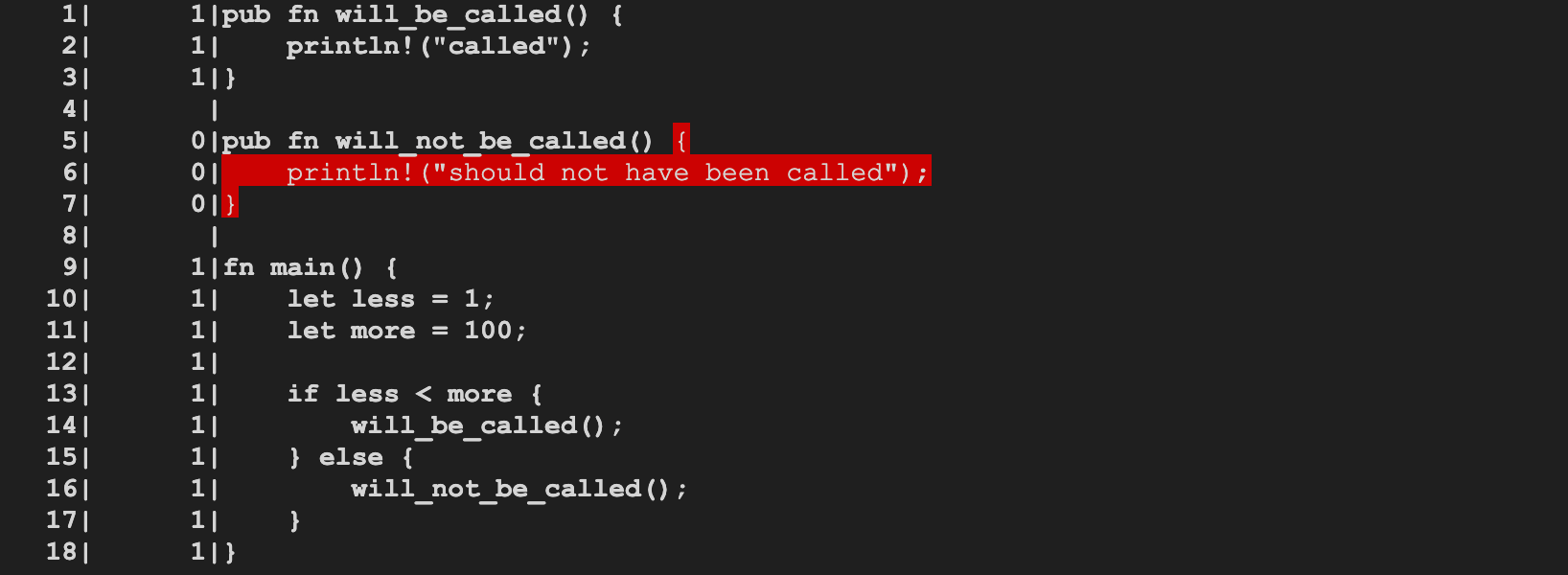
rustc now generates the coverage map and can support (limited)
coverage report generation, at the function level.
Example:
$ BUILD=$HOME/rust/build/x86_64-unknown-linux-gnu
$ $BUILD/stage1/bin/rustc -Zinstrument-coverage \
$HOME/rust/src/test/run-make-fulldeps/instrument-coverage/main.rs
$ LLVM_PROFILE_FILE="main.profraw" ./main
called
$ $BUILD/llvm/bin/llvm-profdata merge -sparse main.profraw -o main.profdata
$ $BUILD/llvm/bin/llvm-cov show --instr-profile=main.profdata main
1| 1|pub fn will_be_called() {
2| 1| println!("called");
3| 1|}
4| |
5| 0|pub fn will_not_be_called() {
6| 0| println!("should not have been called");
7| 0|}
8| |
9| 1|fn main() {
10| 1| let less = 1;
11| 1| let more = 100;
12| 1|
13| 1| if less < more {
14| 1| will_be_called();
15| 1| } else {
16| 1| will_not_be_called();
17| 1| }
18| 1|}
|
|
Bump version to 1.47
This also bumps to a more recent rustfmt version, just to keep us relatively up to date (though almost nothing has changed in rustfmt we use beyond bumps to the parser infra). No formatting changes as a result of this.
r? @pietroalbini
|
|
|
|
u32::from_ge_bytes method does not exist; replace with u32::from_be_bytes
|
|
|
|
|
|
|
|
add spans to injected coverage counters, extract with CoverageData query
This is the next iteration on the Rust Coverage implementation, and follows PR #73488
@tmandry @wesleywiser
I came up with an approach for coverage spans, pushing them through the Call terminator as additional args so they can be extracted by the CoverageData query.
I'm using an IndexVec to store them in CoverageData such that there can be only one per index (even if parts of the MIR get duplicated during optimization).
If this approach works for you, I can quickly expand on this to build a separate IndexVec for counter expressions, using a separate call that will be ignored during code generation, but from which I can extract the counter expression values.
Let me know your thoughts. Thanks!
r? @tmandry
Rust compiler MCP rust-lang/compiler-team#278
Relevant issue: #34701 - Implement support for LLVMs code coverage instrumentation
|
|
Deny unsafe ops in unsafe fns in libcore
After `liballoc`, It's time for `libcore` :D
I planned to do this bit by bit to avoid having a big chunk of diffs, so to make reviews easier, and to make the unsafe blocks narrower and take the time to document them properly.
r? @nikomatsakis cc @RalfJung
|
|
Make `likely` and `unlikely` const, gated by feature `const_unlikely`
This PR also contains a fix to allow `#[allow_internal_unstable]` to work properly with `#[rustc_const_unstable]`.
cc @RalfJung @nagisa
r? @oli-obk
|
|
And final part!!!
|
|
|
|
added regions with counter expressions and counters.
Added codegen_llvm/coverageinfo mod for upcoming coverage map
Move coverage region collection to CodegenCx finalization
Moved from `query coverageinfo` (renamed from `query coverage_data`),
as discussed in the PR at:
https://github.com/rust-lang/rust/pull/73684#issuecomment-649882503
Address merge conflict in MIR instrument_coverage test
The MIR test output format changed for int types.
moved debug messages out of block.rs
This makes the block.rs calls to add coverage mapping data to the
CodegenCx much more concise and readable.
move coverage intrinsic handling into llvm impl
I realized that having half of the coverage intrinsic handling in
`rustc_codegen_ssa` and half in `rustc_codegen_llvm` meant that any
non-llvm backend would be bound to the same decisions about how the
coverage-related MIR terminators should be handled.
To fix this, I moved the non-codegen portion of coverage intrinsic
handling into its own trait, and implemented it in `rustc_codegen_llvm`
alongside `codegen_intrinsic_call`.
I also added the (required?) stubs for the new intrinsics to
`IntrepretCx::emulate_intrinsic()`, to ensure calls to this function do
not fail if called with these new but known intrinsics.
address PR Feedback on 28 June 2020 2:48pm PDT
|
|
They are gated by internal feature gate const_likely
|
|
Add unstable `core::mem::variant_count` intrinsic
Adds a new `const fn` intrinsic which can be used to determine the number of variants in an `enum`.
I've shown this to a couple of people and they invariably ask 'why on earth?', but there's actually a very neat use case:
At the moment, if you want to create an opaque array type that's indexed by an `enum` with one element for each variant, you either have to hard-code the number of variants, add a `LENGTH` variant or use a `Vec`, none of which are suitable in general (number of variants could change; pattern matching `LENGTH` becomes frustrating; might not have `alloc`). By including this intrinsic, it becomes possible to write the following:
```rust
#[derive(Copy, Clone)]
enum OpaqueIndex {
A = 0,
B,
C,
}
struct OpaqueVec<T>(Box<[T; std::mem::num_variants::<OpaqueIndex>()]>);
impl<T> std::ops::Index<OpaqueIndex> for OpaqueVec<T> {
type Output = T;
fn index(&self, idx: OpaqueIndex) -> &Self::Output {
&self.0[idx as usize]
}
}
```
(We even have a use cases for this in `rustc` and I plan to use it to re-implement the lang-items table.)
|
|
|
|
fix `intrinsics::needs_drop` docs
|
|
|
|
|
|
|
|
|
|
memory access sanity checks: abort instead of panic
Suggested by @Mark-Simulacrum, this should help reduce the performance impact of these checks.
|
|
Co-authored-by: bjorn3 <bjorn3@users.noreply.github.com>
|
|
|
|
Co-authored-by: bjorn3 <bjorn3@users.noreply.github.com>
|
|
As suggested in PR feedback:
https://github.com/rust-lang/rust/pull/73011#discussion_r435728923
This allows count_code_region() to be handled like a normal intrinsic so
the InstanceDef::InjectedCode variant is no longer needed.
|
|
|
|
|
|
This initial version only injects counters at the top of each function.
Rust Coverage will require injecting additional counters at each
conditional code branch.
|
|
|
|
Signed-off-by: Joe Richey <joerichey@google.com>
|
|
|
|
make offset must_use
https://djugei.github.io/bad-at-unsafe/ describes an error a user had when trying to use offset:
> At first I just assumed that the .add() and .offset() methods on pointers would mutate the pointer. They do not. Instead they return a new pointer, which gets dropped silently if you don't use it. Unlike for example Result, which is must_use annotated.
This PR only adds `offset`, because I wanted to float the idea; I'm imagining that there's more than just `add` and `offset` that could use this. I am also very open to re-wording the warning.
r? @rust-lang/libs
|
|
https://djugei.github.io/bad-at-unsafe/ describes an error a user had when trying to use offset:
> At first I just assumed that the .add() and .offset() methods on pointers would mutate the pointer. They do not. Instead they return a new pointer, which gets dropped silently if you don't use it. Unlike for example Result, which is must_use annotated.
|
|
|
|
|
|
|
|
It is safer to use `from_ne_bytes` to convert raw bytes to type like u32.
|
|
|
|
This renames and stabilizes unsafe floating point to integer casts, which are
intended to be the substitute for the currently unsound `as` behavior, once that
changes to safe-but-slower saturating casts.
|
|
Add copy bound to atomic & numeric intrinsics
|
|
Allow calculating the layout behind a pointer
There was some discussion around allowing this previously.
This does make the requirement for raw pointers to have valid metadata exposed as part of the std API (as a safety invariant, not validity invariant), though I think this is not strictly necessarily required as of current. cc @rust-lang/wg-unsafe-code-guidelines
Naming is hard; I picked the best "obvious" name I could come up with.
If it's agreed that this is actually a desired API surface, I'll file a tracking issue and update the attributes.
|
|
Let align/size_of_of_val intrinsics work on ptrs
|
|
|
|
|
