| Age | Commit message (Collapse) | Author | Lines |
|---|
|
|
|
namespace as well
|
|
Technically, there are requirements imposed by the LLVM
`AMDGPUTargetMachine` on functions with this ABI (eg, the return type
must be void), but I'm unsure exactly where this should be enforced.
|
|
improve error message shown for unsafe operations
Add a short explanation saying why undefined behavior could arise. In particular, the error many people got for "creating a pointer to a packed field requires unsafe block" was not worded great -- it lead to people just adding the unsafe block without considering if what they are doing follows the rules.
I am not sure if a "note" is the right thing, but that was the easiest thing to add...
Inspired by @gnzlbg at https://github.com/rust-lang/rust/issues/46043#issuecomment-381544673
|
|
Infinite loop detection for const evaluation
Resolves #50637.
An `EvalContext` stores the transient state (stack, heap, etc.) of the MIRI virtual machine while it executing code. As long as MIRI only executes pure functions, we can detect if a program is in a state where it will never terminate by periodically taking a "snapshot" of this transient state and comparing it to previous ones. If any two states are exactly equal, the machine must be in an infinite loop.
Instead of fully cloning a snapshot every time the detector is run, we store a snapshot's hash. Only when a hash collision occurs do we fully clone the interpreter state. Future snapshots which cause a collision will be compared against this clone, causing the interpreter to abort if they are equal.
At the moment, snapshots are not taken until MIRI has progressed a certain amount. After this threshold, snapshots are taken every `DETECTOR_SNAPSHOT_PERIOD` steps. This means that an infinite loop with period `P` will be detected after a maximum of `2 * P * DETECTOR_SNAPSHOT_PERIOD` interpreter steps. The factor of 2 arises because we only clone a snapshot after it causes a hash collision.
|
|
This commit upgrades the main LLVM submodule to LLVM's current master branch.
The LLD submodule is updated in tandem as well as compiler-builtins.
Along the way support was also added for LLVM 7's new features. This primarily
includes the support for custom section concatenation natively in LLD so we now
add wasm custom sections in LLVM IR rather than having custom support in rustc
itself for doing so.
Some other miscellaneous changes are:
* We now pass `--gc-sections` to `wasm-ld`
* The optimization level is now passed to `wasm-ld`
* A `--stack-first` option is passed to LLD to have stack overflow always cause
a trap instead of corrupting static data
* The wasm target for LLVM switched to `wasm32-unknown-unknown`.
* The syntax for aligned pointers has changed in LLVM IR and tests are updated
to reflect this.
* The `thumbv6m-none-eabi` target is disabled due to an [LLVM bug][llbug]
Nowadays we've been mostly only upgrading whenever there's a major release of
LLVM but enough changes have been happening on the wasm target that there's been
growing motivation for quite some time now to upgrade out version of LLD. To
upgrade LLD, however, we need to upgrade LLVM to avoid needing to build yet
another version of LLVM on the builders.
The revision of LLVM in use here is arbitrarily chosen. We will likely need to
continue to update it over time if and when we discover bugs. Once LLVM 7 is
fully released we can switch to that channel as well.
[llbug]: https://bugs.llvm.org/show_bug.cgi?id=37382
|
|
behavior could arise
Inspired by @gnzlbg at https://github.com/rust-lang/rust/issues/46043#issuecomment-381544673
|
|
|
|
|
|
incr.comp.: Take names of children into account when computing the ICH of a module's HIR.
Fixes #40876. Red-green tracking does not make this a problem anymore. We should verify this via a perf-run though.
r? @nikomatsakis
|
|
|
|
module's HIR.
|
|
|
|
r=petrochenkov
add modifier keyword spans to hir::Visibility; improve unreachable-pub, private-no-mangle lint suggestions
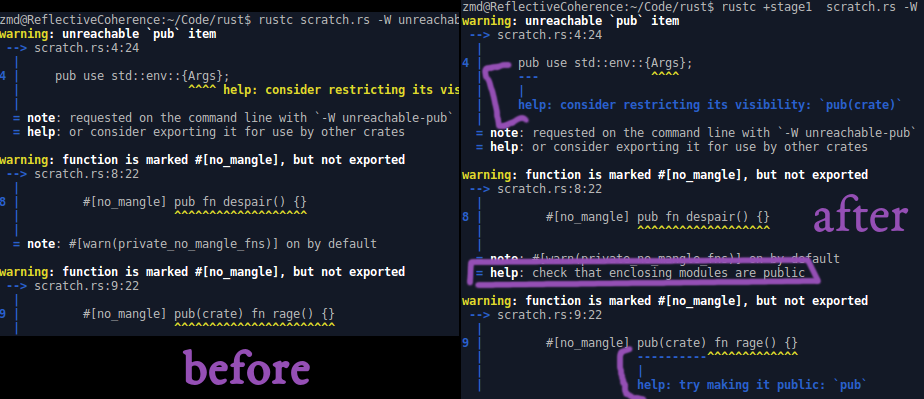
#50455 pointed out that the unreachable-pub suggestion for brace-grouped `use`s was bogus; #50476 partially ameliorated this by marking the suggestion as `Applicability::MaybeIncorrect`, but this is the actual fix.
Meanwhile, another application of having spans available in `hir::Visibility` is found in the private-no-mangle lints, where we can now issue a suggestion to use `pub` if the item has a more restricted visibility marker (this seems much less likely to come up in practice than not having any visibility keyword at all, but thoroughness is a virtue). While we're there, we can also add a helpful note if the item does have a `pub` (but triggered the lint presumably because enclosing modules were private).
r? @nrc
cc @Manishearth
|
|
It was pointed out in review that the glob-exported
underscore-suffixed convention for `Spanned` HIR nodes is no longer
preferred: see February 2016's #31487 for AST's migration away from
this style towards properly namespaced NodeKind enums.
This concerns #51968.
|
|
There are at least a couple (and plausibly even three) diagnostics that
could use the spans of visibility modifiers in order to be reliably
correct (rather than hacking and munging surrounding spans to try to
infer where the visibility keyword must have been).
We follow the naming convention established by the other `Spanned` HIR
nodes: the "outer" type alias gets the "prime" node-type name, the
"inner" enum gets the name suffixed with an underscore, and the variant
names are prefixed with the prime name and `pub use` exported from here
(from HIR).
Thanks to veteran reviewer Vadim Petrochenkov for suggesting this
uniform approach. (A previous draft, based on the reasoning that
`Visibility::Inherited` should not have a span, tried to hack in a named
`span` field on `Visibility::Restricted` and a positional field on
`Public` and `Crate`. This was ... not so uniform.)
|
|
Updated tests accordingly.
|
|
Refactor error reporting of constants
cc @eddyb
This PR should not change any behaviour. It solely simplifies the internal handling of the errors
|
|
Make FileMap::{lines, multibyte_chars, non_narrow_chars} non-mutable.
This PR removes most of the interior mutability from `FileMap`, which should be beneficial, especially in a multithreaded setting. This is achieved by initializing the state in question when the filemap is constructed instead of during lexing. Hopefully this doesn't degrade performance.
cc @wesleywiser
|
|
|
|
|
|
|
|
|
|
|
|
|
|
|
|
|
|
Remove emulation of hygiene with gensyms
|
|
Namely: labels, type parameters, bindings in patterns, parameter names in functions without body.
All of these do not need hygiene after lowering to HIR, only span locations.
|
|
|
|
|
|
Make opaque::Encoder append-only and make it infallible
|
|
|
|
|
|
|
|
|
|
Rename hir::ExprAgain to hir::ExprContinue
The current name is confusing and historical.
I also used this PR to clean up the annoying indentation in `check/mod.rs`. If that's viewed as too tangential a change, I'll split it up, but it seemed reasonable to slip it in to reduce @bors's work. It's easy to compare for the two commits individually.
r? @petrochenkov
|
|
|
|
|
|
This is gated on edition 2018 & the `async_await` feature gate.
The parser will accept `async fn` and `async unsafe fn` as fn
items. Along the same lines as `const fn`, only `async unsafe fn`
is permitted, not `unsafe async fn`.The parser will not accept
`async` functions as trait methods.
To do a little code clean up, four fields of the function type
struct have been merged into the new `FnHeader` struct: constness,
asyncness, unsafety, and ABI.
Also, a small bug in HIR printing is fixed: it previously printed
`const unsafe fn` as `unsafe const fn`, which is grammatically
incorrect.
|
|
[chalkify] Small refactoring and WF/FromEnv rules for types
r? @nikomatsakis
|
|
|
|
|
|
|
|
|
|
|
|
|
|
|
|
|
|
|
