| Age | Commit message (Collapse) | Author | Lines |
|---|
|
Also slightly refactor pointer bounds checks to avoid creating unnecessary temporary Errors
|
|
|
|
In CTFE heavy code, checking the env var everytime is inefficient. We
can do a lot better by using a `Session` variable instead.
|
|
|
|
|
|
|
|
Make PlaceRef take just one lifetime
r? @eddyb
|
|
Ensure that validity only raises validity errors
For now, only as a debug-assertion (similar to const-prop detecting errors that allocate).
Now includes https://github.com/rust-lang/rust/pull/69646.
[Relative diff](https://github.com/RalfJung/rust/compare/layout-visitor...RalfJung:validity-errors).
r? @oli-obk
|
|
|
|
Co-Authored-By: bjorn3 <bjorn3@users.noreply.github.com>
|
|
|
|
|
|
mir-interpret: add method to read wide strings from Memory
Implemented *step2* from [instructions](https://github.com/rust-lang/miri/issues/707#issuecomment-561564057) laid out in rust-lang/miri#707.
Added 2 new methods to struct `rustc_mir::interpret::InterpCx`.
* `read_os_str_from_wide_str` (src/librustc_mir/interpret/operand.rs)
* `write_os_str_to_wide_str` (src/librustc_mir/interpret/place.rs)
- used existing logic implemented in [MIRI/src/eval.rs](https://github.com/rust-lang/miri/blob/94732aaf7bf79fd01a4a48d11155c6586b937514/src/eval.rs#L132-L141)
These methods are intended to be used for environment variable emulation in Windows.
|
|
mir::Local is Copy we can pass it by value in these cases
r? @oli-obk
|
|
fix various typos
|
|
Don't redundantly repeat field names (clippy::redundant_field_names)
|
|
Use .next() instead of .nth(0) on iterators.
|
|
|
|
|
|
|
|
|
|
even more clippy cleanups
* Don't pass &mut where immutable reference (&) is sufficient (clippy::unnecessary_mut_passed)
* Use more efficient &&str to String conversion (clippy::inefficient_to_string)
* Don't always eval arguments inside .expect(), use unwrap_or_else and closure. (clippy::expect_fun_call)
* Use righthand '&' instead of lefthand "ref". (clippy::toplevel_ref_arg)
* Use simple 'for i in x' loops instead of 'while let Some(i) = x.next()' loops on iterators. (clippy::while_let_on_iterator)
* Const items have by default a static lifetime, there's no need to annotate it. (clippy::redundant_static_lifetimes)
* Remove redundant patterns when matching ( x @ _ to x) (clippy::redundant_pattern)
|
|
it. (clippy::redundant_static_lifetimes)
|
|
|
|
|
|
interpret engine: Scalar cleanup
* Remove `to_ptr`
* Make `to_bits` private
r? @oli-obk
|
|
|
|
|
|
|
|
|
|
|
|
|
|
|
|
|
|
|
|
|
|
Canonicalize inputs to const eval where needed
Canonicalize inputs to const eval, so that they can contain inference variables. Which enables invoking const eval queries even if the current param env has inference variable within it, which can occur during trait selection.
This is a reattempt of #67717, in a far less invasive way.
Fixes #68477
r? @nikomatsakis
cc @eddyb
|
|
example:
let s: String = format!("hello").into();
|
|
Mark other variants as uninitialized after switch on discriminant
During drop elaboration, which builds the drop ladder that handles destruction during stack unwinding, we attempt to remove MIR `Drop` terminators that will never be reached in practice. This reduces the number of basic blocks that are passed to LLVM, which should improve performance. In #66753, a user pointed out that unreachable `Drop` terminators are common in functions like `Option::unwrap`, which move out of an `enum`. While discussing possible remedies for that issue, @eddyb suggested moving const-checking after drop elaboration. This would allow the former, which looks for `Drop` terminators and replicates a small amount of drop elaboration to determine whether a dropped local has been moved out, leverage the work done by the latter.
However, it turns out that drop elaboration is not as precise as it could be when it comes to eliminating useless drop terminators. For example, let's look at the code for `unwrap_or`.
```rust
fn unwrap_or<T>(opt: Option<T>, default: T) -> T {
match opt {
Some(inner) => inner,
None => default,
}
}
```
`opt` never needs to be dropped, since it is either moved out of (if it is `Some`) or has no drop glue (if it is `None`), and `default` only needs to be dropped if `opt` is `Some`. This is not reflected in the MIR we currently pass to codegen.
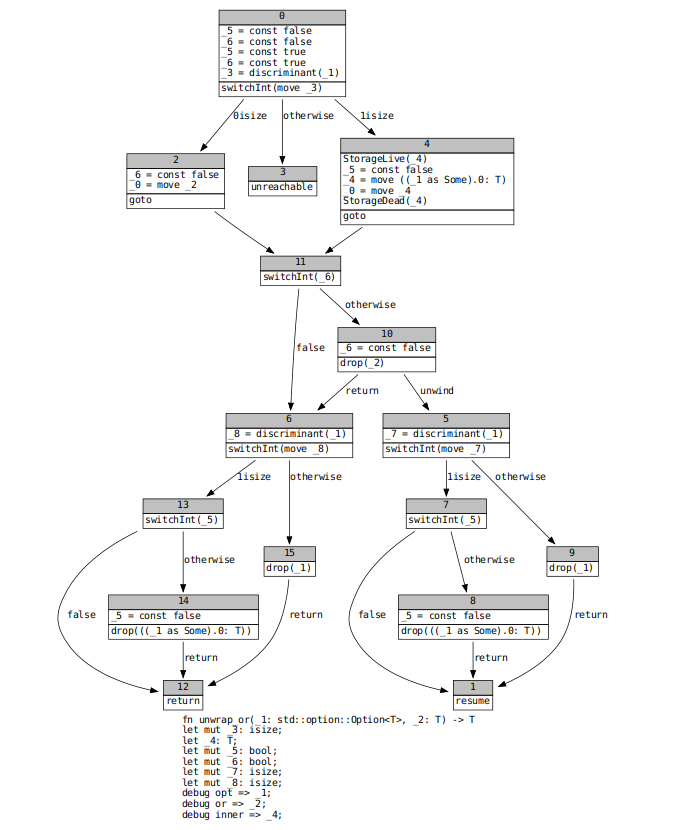
@eddyb also suggested the solution to this problem. When we switch on an enum discriminant, we should be marking all fields in other variants as definitely uninitialized. I implemented this on top of alongside a small optimization (split out into #68943) that suppresses drop terminators for enum variants with no fields (e.g. `Option::None`). This is the resulting MIR for `unwrap_or`.
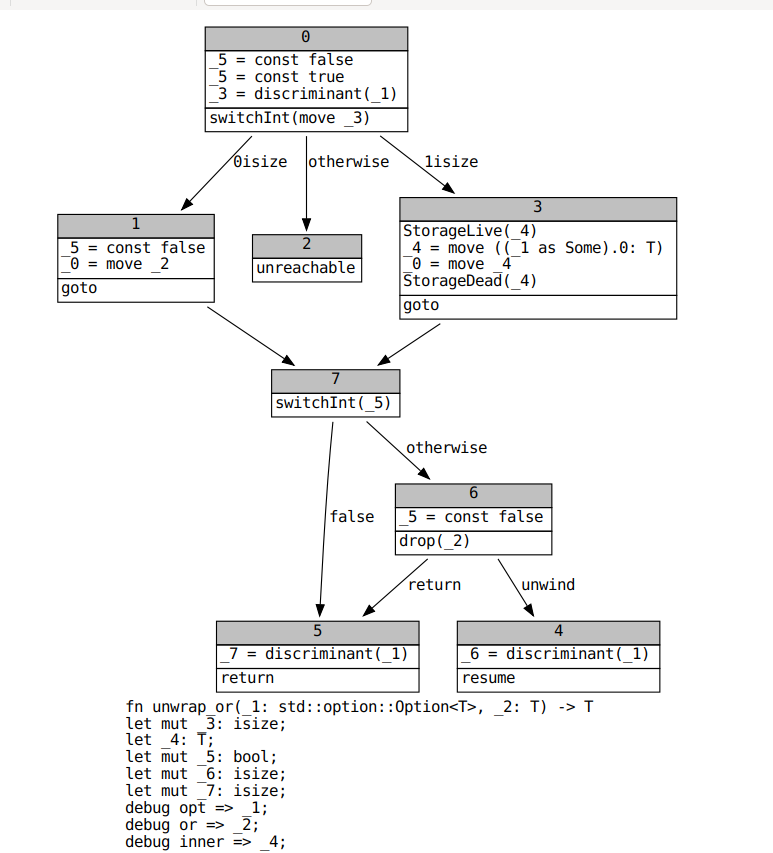
In concert with #68943, this change speeds up many [optimized and debug builds](https://perf.rust-lang.org/compare.html?start=d55f3e9f1da631c636b54a7c22c1caccbe4bf0db&end=0077a7aa11ebc2462851676f9f464d5221b17d6a). We need to carefully investigate whether I have introduced any miscompilations before merging this. Code that never drops anything would be very fast indeed until memory is exhausted.
|
|
|
|
Fix generator miscompilations
Fixes https://github.com/rust-lang/rust/issues/69039
r? @Zoxc
|
|
|
|
|
|
|
|
|
|
Fix printing of `Yield` terminator
Addresses the bug found in https://github.com/rust-lang/rust/issues/69039#issuecomment-586633495
|
|
Change const eval to just return the value
As discussed in https://github.com/rust-lang/rust/pull/68505#discussion_r370956535, the type of consts shouldn't be returned from const eval queries.
r? @eddyb
cc @nikomatsakis
|
|
|
|
|
|
|
