| Age | Commit message (Collapse) | Author | Lines |
|---|
|
|
|
Fixed a known issue in the coverage map where some regions had
nonsensical source code locations. External crate functions are already
included in their own coverage maps, per library, and don't need to also
be added to the importing crate's coverage map. (In fact, their source
start and end byte positions are not relevant to the importing crate's
SourceMap.)
The fix was to simply skip trying to add imported coverage info to the
coverage map if the instrumented function is not "local".
The injected counters are still relevant, however, and the LLVM
`instrprof.increment` intrinsic call parameters will map those counters
to the external crates' coverage maps, when generating runtime coverage
data.
|
|
Fixed coverage map issues; better aligned with LLVM APIs
Found some problems with the coverage map encoding when testing with more than one counter per function.
While debugging, I realized some better ways to structure the Rust implementation of the coverage mapping generator. I refactored somewhat, resulting in less code overall, expanded coverage of LLVM Coverage Map capabilities, and much closer alignment with LLVM data structures, APIs, and naming.
This should be easier to follow and easier to maintain.
r? @tmandry
Rust compiler MCP rust-lang/compiler-team#278
Relevant issue: #34701 - Implement support for LLVMs code coverage instrumentation
|
|
Some were in librustc_codegen_llvm, but others are not tied to LLVM, so
I put them in a new crate: librustc_codegen_ssa/coverageinfo/ffi.rs
|
|
MinGW: enable dllexport/dllimport
Fixes (only when using LLD) https://github.com/rust-lang/rust/issues/50176
Fixes https://github.com/rust-lang/rust/issues/72319
This makes `windows-gnu` on pair with `windows-msvc` when it comes to symbol exporting.
For MinGW it means both good things like correctly working dllimport/dllexport, ability to link with LLD and bad things like https://github.com/rust-lang/rust/issues/27438.
Not sure but maybe this should land behind unstable compiler option (`-Z`) or environment variable?
|
|
This fixes various cases where LD could not guess dllexport correctly and greatly improves compatibility with LLD which is not going to support linker scripts anytime soon
|
|
|
|
Lays a better foundation for injecting more counters in each function.
|
|
Miri rename undef uninit
Renamed parts of code within the `librustc_middle/mir/interpret/` directory.
Related issue [#71193](https://github.com/rust-lang/rust/issues/71193)
|
|
Found some problems with the coverage map encoding when testing with
more than one counter per function.
While debugging, I realized some better ways to structure the Rust
implementation of the coverage mapping generator. I refactored somewhat,
resulting in less code overall, expanded coverage of LLVM Coverage Map
capabilities, and much closer alignment with LLVM data structures, APIs,
and naming.
This should be easier to follow and easier to maintain.
|
|
|
|
Renamed the function ScalarMaybeUninit::not_undef to ScalarMaybeUninit::check_init in the file src/librustc_middle/mir/interpret/value.rs, to reflect changes in terminology used.
Related issue rust-lang#71193
|
|
build: Remove unnecessary `cargo:rerun-if-env-changed` annotations
... and a couple of related cleanups.
rustc and cargo now track the majority of env var dependencies automatically (https://github.com/rust-lang/cargo/pull/8421), so the annotations are no longer necessary.
|
|
rustc_target: Add a target spec option for disabling `--eh-frame-hdr`
Disable `--eh-frame-hdr` for targets that use an `ld`-like linker, but don't support that option.
Do it through a target spec option rather than through hard-coding in `linker.rs`.
The option is still enabled by default though.
cc https://github.com/rust-lang/rust/pull/73564
Fixes https://github.com/rust-lang/rust/pull/73564#issuecomment-657011004
Fixes https://github.com/rust-lang/rust/pull/74625
Fixes https://github.com/rust-embedded/msp430-rt/issues/12
|
|
Stabilize control-flow-guard codegen option
This is the stabilization PR discussed in #68793. It converts the `-Z control-flow-guard` debugging option into a codegen option (`-C control-flow-guard`), and changes the associated tests.
|
|
|
|
|
|
functions
This patch extends the existing `type_i8p` method so that it requires an
explicit address space to be specified. Before this patch, the
`type_i8p` method implcitily assumed the default address space, which is
not a safe transformation on all targets, namely AVR.
The Rust compiler already has support for tracking the "instruction
address space" on a per-target basis. This patch extends the code
generation routines so that an address space must always be specified.
In my estimation, around 15% of the callers of `type_i8p` produced
invalid code on AVR due to the loss of address space prior to LLVM final
code generation. This would lead to unavoidable assertion errors
relating to invalid bitcasts.
With this patch, the address space is always either 1) explicitly set to
the instruction address space because the logic is dealing with functions
which must be placed there, or 2) explicitly set to the default address
space 0 because the logic can only operate on data space pointers and thus
we keep the existing semantics of assuming the default, "data" address space.
|
|
This commit implements the `unused_generic_params` query, an initial
version of polymorphization which detects when an item does not use
generic parameters and is being needlessly monomorphized as a result.
Signed-off-by: David Wood <david@davidtw.co>
|
|
This commit adds type metadata for generic parameters (that arise from
polymorphization). Generic parameter metadata is considered zero-sized
and named after the generic parameter.
Signed-off-by: David Wood <david@davidtw.co>
|
|
This commit avoids a natural, free-range double substitution error by
monomorphizing the projection element before getting the type.
Signed-off-by: David Wood <david@davidtw.co>
|
|
Generating the coverage map
@tmandry @wesleywiser
rustc now generates the coverage map and can support (limited)
coverage report generation, at the function level.
Example commands to generate a coverage report:
```shell
$ BUILD=$HOME/rust/build/x86_64-unknown-linux-gnu
$ $BUILD/stage1/bin/rustc -Zinstrument-coverage \
$HOME/rust/src/test/run-make-fulldeps/instrument-coverage/main.rs
$ LLVM_PROFILE_FILE="main.profraw" ./main
called
$ $BUILD/llvm/bin/llvm-profdata merge -sparse main.profraw -o main.profdata
$ $BUILD/llvm/bin/llvm-cov show --instr-profile=main.profdata main
```
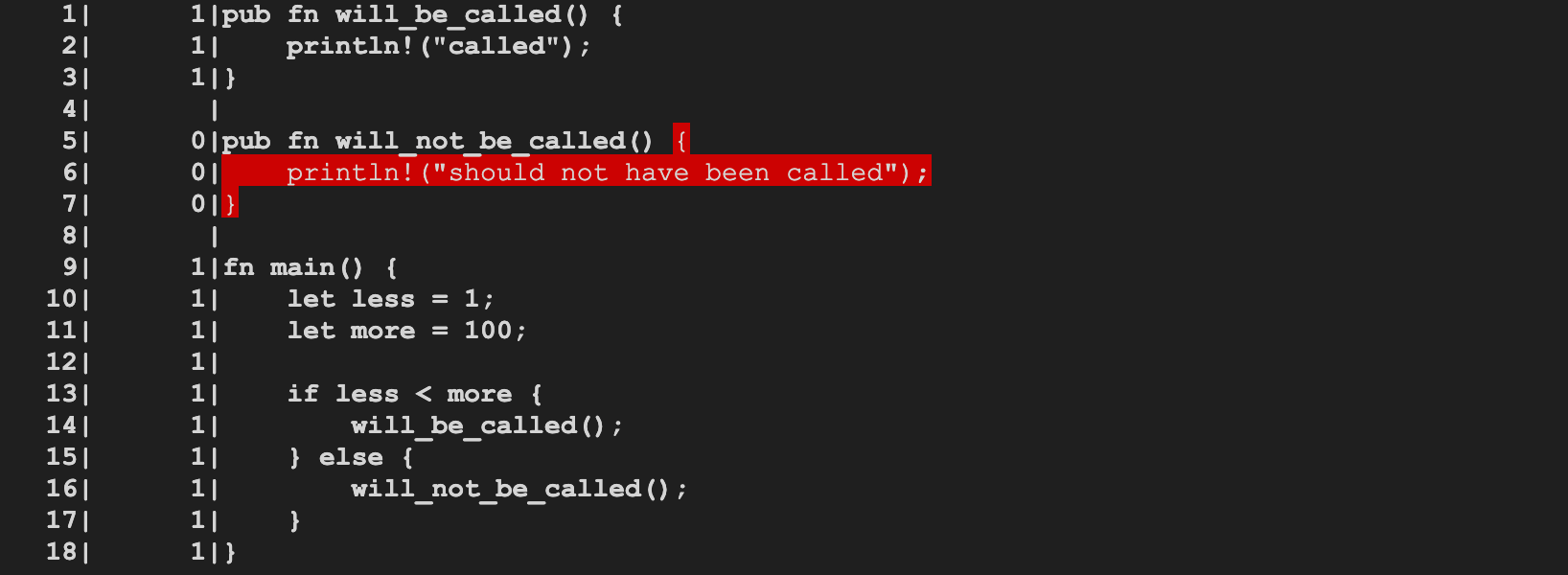
r? @wesleywiser
Rust compiler MCP rust-lang/compiler-team#278
Relevant issue: #34701 - Implement support for LLVMs code coverage instrumentation
|
|
r=Mark-Simulacrum
Revert "Use an UTF-8 locale for the linker."
Reverts rust-lang/rust#74416
This is suspected to have caused significant compile time regressions: https://perf.rust-lang.org/compare.html?start=39d5a61f2e4e237123837f5162cc275c2fd7e625&end=d3df8512d2c2afc6d2e7d8b5b951dd7f2ad77b02&stat=instructions:u
|
|
|
|
Use pathdiff crate
I wanted to tackle a simple issue, and stumbled upon #67108: this pr removes the function which was exported to the external crate as required in the todo/issue.
I've tested it with:
```
./x.py build --stage 1 --keep-stage 1 src/librustc_codegen_ssa
```
And it looks like it's compiling
|
|
|
|
|
|
rustc now generates the coverage map and can support (limited)
coverage report generation, at the function level.
Example:
$ BUILD=$HOME/rust/build/x86_64-unknown-linux-gnu
$ $BUILD/stage1/bin/rustc -Zinstrument-coverage \
$HOME/rust/src/test/run-make-fulldeps/instrument-coverage/main.rs
$ LLVM_PROFILE_FILE="main.profraw" ./main
called
$ $BUILD/llvm/bin/llvm-profdata merge -sparse main.profraw -o main.profdata
$ $BUILD/llvm/bin/llvm-cov show --instr-profile=main.profdata main
1| 1|pub fn will_be_called() {
2| 1| println!("called");
3| 1|}
4| |
5| 0|pub fn will_not_be_called() {
6| 0| println!("should not have been called");
7| 0|}
8| |
9| 1|fn main() {
10| 1| let less = 1;
11| 1| let more = 100;
12| 1|
13| 1| if less < more {
14| 1| will_be_called();
15| 1| } else {
16| 1| will_not_be_called();
17| 1| }
18| 1|}
|
|
|
|
Support const args in type dependent paths (Take 2)
once more, except it is sound this time :smiling_face_with_three_hearts: previously #71154
-----
```rust
#![feature(const_generics)]
struct A;
impl A {
fn foo<const N: usize>(&self) -> usize { N }
}
struct B;
impl B {
fn foo<const N: usize>(&self) -> usize { 42 }
}
fn main() {
let a = A;
a.foo::<7>();
}
```
When calling `type_of` for generic const arguments, we now use the `TypeckTables` of the surrounding body to get the expected type.
This alone causes cycle errors though, as we now have `typeck_tables_of(main)` -> `...` ->
`type_of(main_ANON0 := 7)` -> `typeck_tables_of(main)` :zap: (see https://github.com/rust-lang/rust/issues/68400#issuecomment-611760290)
To prevent this we must not call `type_of(const_arg)` during `typeck_tables_of`. This is achieved by
calling `type_of(param_def_id)` instead.
We have to somehow remember the `DefId` of the param through all of typeck, which is done using the
struct `ty::WithOptConstParam<DefId>`, which replaces `DefId` where needed and contains an `Option<DefId>` to
be able to store the const parameter in case it exists.
Queries which are currently cached on disk are split into two variants: `query_name`(cached) and `query_name_(of|for)_const_arg`(not cached), with `query_name_of_const_arg` taking a pair `(did, param_did): (LocalDefId, DefId)`.
For some queries a method `query_name_of_opt_const_arg` is added to `TyCtxt` which takes a `ty::WithOptConstParam` and either calls `query_name` or `query_name_of_const_arg` depending on the value of `const_param_did`.
r? @eddyb @varkor
|
|
|
|
|
|
|
|
|
|
This eliminates a bunch of `Symbol::intern()` and `Symbol::as_str()`
calls, which is good, because they require locking the interner.
Note that the unsafety in `from_cycle_error()` is identical to the
unsafety on other adjacent impls.
|
|
Note that the output of `unpretty-debug.stdout` has changed. In that
test the hash values are normalized from a symbol numbers to small
numbers like "0#0" and "0#1". The increase in the number of static
symbols must have caused the original numbers to contain more digits,
resulting in different pretty-printing prior to normalization.
|
|
|
|
linker: illumos ld does not support --eh-frame-hdr
As of rust-lang/rust#73564, the --eh-frame-hdr flag is unconditionally
passed to linkers on many platforms. The illumos link editor does not
currently support this flag.
The linker machinery in the Rust toolchain currently seems to use the
(potentially cross-compiled) target to choose linker flags, rather than
looking at what might be running on the build system. Disabling the
flag for all illumos/Solaris targets seems like the best we can do for
now without more serious surgery.
|
|
debuginfo: Mangle tuples to be natvis friendly, typedef basic types
These changes are meant to unblock rust-lang/rust#70052 "Update hashbrown to 0.8.0" by allowing the use of `tuple<u64, u64>` as a .natvis expression in MSVC style debuggers (MSVC, WinDbg, CDB, etc.)
* f8eb81b does the actual mangling of `(u64, u64)` -> `tuple<u64, 64>`
* 24a728a allows `u64` to resolve (fixing `$T1` / `$T2` when used to visualize `HashMap<u64, u64, ...>`)
|
|
Avoid "whitelist"
Other terms are more inclusive and precise.
|
|
Only add CFGuard on `windows-msvc` targets
As @ollie27 pointed out in #73893, the `cfguard` module flag causes incorrect behavior on `windows-gnu` targets. This patch restricts rustc to only add this flag for `windows-msvc` targets (this may need to be changed if other linkers gain support for CFGuard).
|
|
Other terms are more inclusive and precise.
|
|
|
|
As of rust-lang/rust#73564, the --eh-frame-hdr flag is unconditionally
passed to linkers on many platforms. The illumos link editor does not
currently support this flag.
The linker machinery in the Rust toolchain currently seems to use the
(potentially cross-compiled) target to choose linker flags, rather than
looking at what might be running on the build system. Disabling the
flag for all illumos/Solaris targets seems like the best we can do for
now without more serious surgery.
|
|
|
|
Use WASM's saturating casts if they are available
WebAssembly supports saturating floating point to integer casts behind a target feature. The feature is already available on many browsers. Beginning with 1.45 Rust will start defining the behavior of floating point to integer casts to be saturating as well. For this Rust constructs additional checks on top of the `fptoui` / `fptosi` instructions it emits. Here we introduce the possibility for the codegen backend to construct saturating casts itself and only fall back to constructing the checks ourselves if that is not possible.
Resolves part of #73591
|
|
WebAssembly supports saturating floating point to integer casts behind a
target feature. The feature is already available on many browsers.
Beginning with 1.45 Rust will start defining the behavior of floating
point to integer casts to be saturating as well. For this Rust
constructs additional checks on top of the `fptoui` / `fptosi`
instructions it emits. Here we introduce the possibility for the codegen
backend to construct saturating casts itself and only fall back to
constructing the checks ourselves if that is not possible.
|
|
add spans to injected coverage counters, extract with CoverageData query
This is the next iteration on the Rust Coverage implementation, and follows PR #73488
@tmandry @wesleywiser
I came up with an approach for coverage spans, pushing them through the Call terminator as additional args so they can be extracted by the CoverageData query.
I'm using an IndexVec to store them in CoverageData such that there can be only one per index (even if parts of the MIR get duplicated during optimization).
If this approach works for you, I can quickly expand on this to build a separate IndexVec for counter expressions, using a separate call that will be ignored during code generation, but from which I can extract the counter expression values.
Let me know your thoughts. Thanks!
r? @tmandry
Rust compiler MCP rust-lang/compiler-team#278
Relevant issue: #34701 - Implement support for LLVMs code coverage instrumentation
|
|
linker: Create GNU_EH_FRAME header by default when producing ELFs
Do it in a centralized way in `link.rs` instead of individual target specs.
The opt-out is `-Clink-arg=(-Wl,)--no-eh-frame-hdr` if necessary.
Fixes https://github.com/rust-lang/rust/issues/73451
cc https://github.com/rust-lang/rust/pull/73483
|
|
added regions with counter expressions and counters.
Added codegen_llvm/coverageinfo mod for upcoming coverage map
Move coverage region collection to CodegenCx finalization
Moved from `query coverageinfo` (renamed from `query coverage_data`),
as discussed in the PR at:
https://github.com/rust-lang/rust/pull/73684#issuecomment-649882503
Address merge conflict in MIR instrument_coverage test
The MIR test output format changed for int types.
moved debug messages out of block.rs
This makes the block.rs calls to add coverage mapping data to the
CodegenCx much more concise and readable.
move coverage intrinsic handling into llvm impl
I realized that having half of the coverage intrinsic handling in
`rustc_codegen_ssa` and half in `rustc_codegen_llvm` meant that any
non-llvm backend would be bound to the same decisions about how the
coverage-related MIR terminators should be handled.
To fix this, I moved the non-codegen portion of coverage intrinsic
handling into its own trait, and implemented it in `rustc_codegen_llvm`
alongside `codegen_intrinsic_call`.
I also added the (required?) stubs for the new intrinsics to
`IntrepretCx::emulate_intrinsic()`, to ensure calls to this function do
not fail if called with these new but known intrinsics.
address PR Feedback on 28 June 2020 2:48pm PDT
|
