| Age | Commit message (Collapse) | Author | Lines |
|---|
|
Use new dataflow framework for generators
#65672 introduced a new dataflow framework that can handle arbitrarily complex transfer functions as well as ones expressed as a series of gen/kill operations. This PR ports the analyses used to implement generators to the new framework so that we can remove the old one. See #68241 for a prior example of this. The new framework has some superficial API changes, but this shouldn't alter the generator passes in any way.
r? @tmandry
|
|
|
|
...to be consistent with the naming of other dataflow analyses.
|
|
|
|
|
|
Mark other variants as uninitialized after switch on discriminant
During drop elaboration, which builds the drop ladder that handles destruction during stack unwinding, we attempt to remove MIR `Drop` terminators that will never be reached in practice. This reduces the number of basic blocks that are passed to LLVM, which should improve performance. In #66753, a user pointed out that unreachable `Drop` terminators are common in functions like `Option::unwrap`, which move out of an `enum`. While discussing possible remedies for that issue, @eddyb suggested moving const-checking after drop elaboration. This would allow the former, which looks for `Drop` terminators and replicates a small amount of drop elaboration to determine whether a dropped local has been moved out, leverage the work done by the latter.
However, it turns out that drop elaboration is not as precise as it could be when it comes to eliminating useless drop terminators. For example, let's look at the code for `unwrap_or`.
```rust
fn unwrap_or<T>(opt: Option<T>, default: T) -> T {
match opt {
Some(inner) => inner,
None => default,
}
}
```
`opt` never needs to be dropped, since it is either moved out of (if it is `Some`) or has no drop glue (if it is `None`), and `default` only needs to be dropped if `opt` is `Some`. This is not reflected in the MIR we currently pass to codegen.
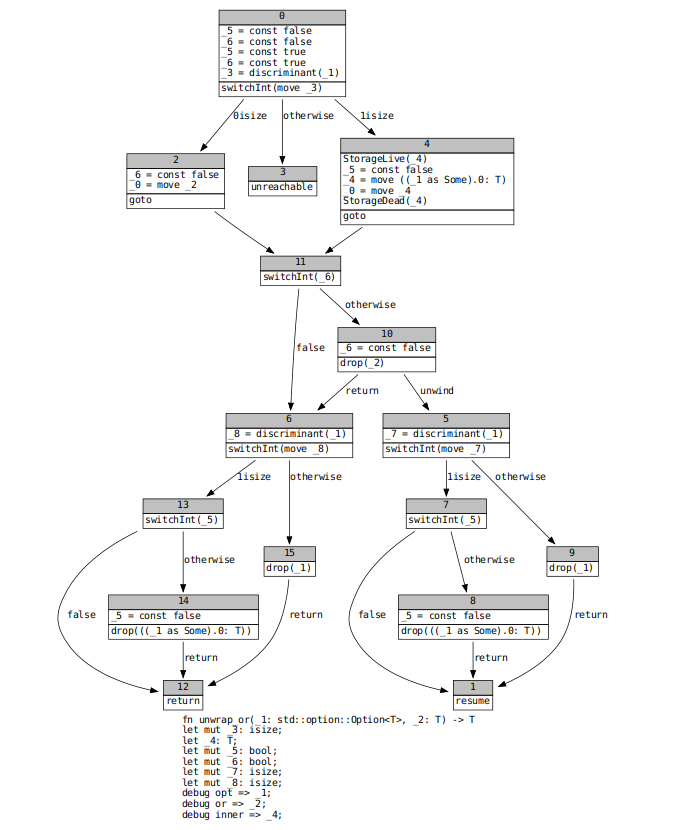
@eddyb also suggested the solution to this problem. When we switch on an enum discriminant, we should be marking all fields in other variants as definitely uninitialized. I implemented this on top of alongside a small optimization (split out into #68943) that suppresses drop terminators for enum variants with no fields (e.g. `Option::None`). This is the resulting MIR for `unwrap_or`.
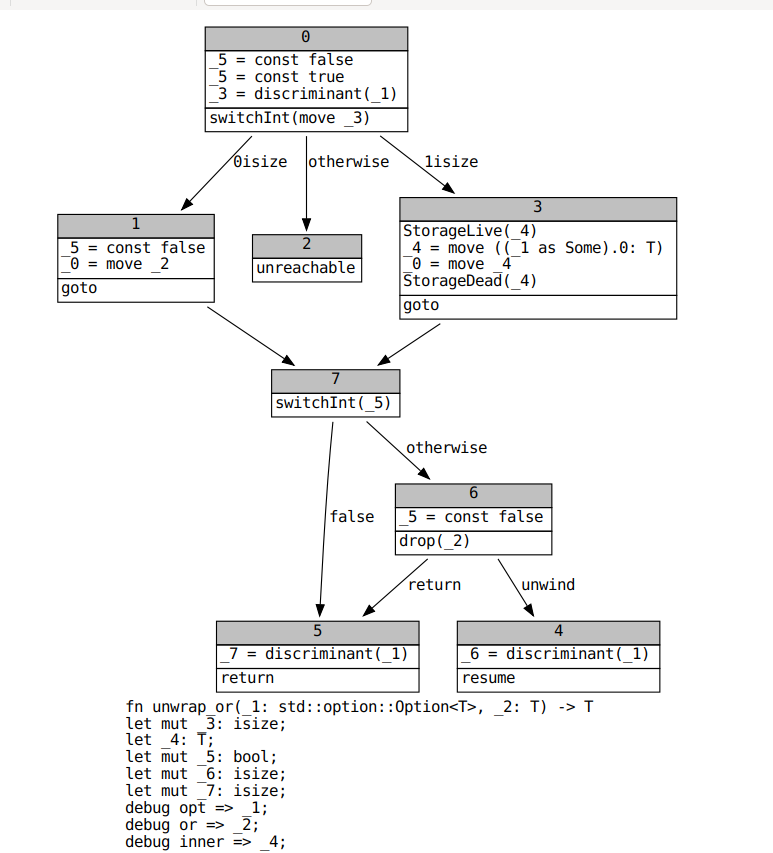
In concert with #68943, this change speeds up many [optimized and debug builds](https://perf.rust-lang.org/compare.html?start=d55f3e9f1da631c636b54a7c22c1caccbe4bf0db&end=0077a7aa11ebc2462851676f9f464d5221b17d6a). We need to carefully investigate whether I have introduced any miscompilations before merging this. Code that never drops anything would be very fast indeed until memory is exhausted.
|
|
|
|
|
|
|
|
|
|
|
|
|
|
|
|
|
|
It should have the same semantics as `HaveBeenBorrowedLocals`
|
|
`MaybeMutBorrowedLocals` serves the same purpose and has a better name.
|
|
|
|
|
|
|
|
|
|
|
|
|
|
|
|
Also add unit tests
|
|
|
|
|
|
|
|
|
|
Index impl, remove body fn
rustc_codegen_ssa: Fix BodyAndCache reborrow to Body and change instances of body() call to derefence
rustc_mir: Fix BodyAndCache reborrow to Body and change intances of body() call to derefence
|
|
rename all body_cache back to body
|
|
|
|
(lifetime errors still exist)
|
|
(ReadOnly)BodyCache type errors
|
|
invalidate cache when accessing unique terminator
|
|
|
|
This prepares the code base for when projection is interned. Place's
projection field is going to be `&List<PlaceElem<'tcx>>` so we won't be
able to pattern match against it.
|
|
|
|
Make `into` schedule drop for the destination
closes #47949
|
|
|
|
|
|
|
|
|
|
|
|
|
|
|
|
|
|
This adds a dataflow analysis that determines if a reference to a given
`Local` or part of a `Local` that would allow mutation exists before a
point in the CFG. If no such reference exists, we know for sure that
that `Local` cannot have been mutated via an indirect assignment or
function call.
|
|
|
|
|
|
Add a `Place::is_indirect` method to determine whether a `Place` contains a `Deref` projection
Working on #63860 requires tracking some property about each local. This requires differentiating `Place`s like `x` and `x.field[index]` from ones like `*x` and `*x.field`, since the first two will always access the same region of memory as `x` while the latter two may access any region of memory. This functionality is duplicated in various places across the compiler. This PR adds a helper method to `Place` which determines whether that `Place` has a `Deref` projection at any point and changes some existing code to use the new method.
I've not converted `qualify_consts.rs` to use the new method, since it's not a trivial conversion and it will get replaced anyway by #63860. There may be other potential uses besides the two I change in this PR.
r? @oli-obk
|
