| Age | Commit message (Collapse) | Author | Lines |
|---|
|
Make PlaceRef take just one lifetime
r? @eddyb
|
|
Pass correct place to `discriminant_switch_effect`
PR #69562, which fixed a bug that was causing clippy to ICE, mistakenly passed the place holding the *result* of `Rvalue::Discriminant` instead of the place holding its *operand* to `apply_discriminant_switch_effect` as the enum place. As a result, no effect was applied at all, and we lost the perf benefits from marking inactive enum variants as uninitialized.
**edit:** The regression test has been split into #69744.
r? @oli-obk
|
|
|
|
even more clippy cleanups
* Don't pass &mut where immutable reference (&) is sufficient (clippy::unnecessary_mut_passed)
* Use more efficient &&str to String conversion (clippy::inefficient_to_string)
* Don't always eval arguments inside .expect(), use unwrap_or_else and closure. (clippy::expect_fun_call)
* Use righthand '&' instead of lefthand "ref". (clippy::toplevel_ref_arg)
* Use simple 'for i in x' loops instead of 'while let Some(i) = x.next()' loops on iterators. (clippy::while_let_on_iterator)
* Const items have by default a static lifetime, there's no need to annotate it. (clippy::redundant_static_lifetimes)
* Remove redundant patterns when matching ( x @ _ to x) (clippy::redundant_pattern)
|
|
(clippy::unnecessary_mut_passed)
|
|
it. (clippy::redundant_static_lifetimes)
|
|
|
|
|
|
|
|
PR #69562, which fixed a bug that was causing clippy to ICE, passed the
place for the *result* of `Rvalue::Discriminant` instead of the
*operand* to `apply_discriminant_switch_effect`. As a result, no effect
was applied at all, and we lost the perf benefits from marking
inactive enum variants as uninitialized.
|
|
Rollup of 7 pull requests
Successful merges:
- #69397 (bootstrap: Remove commit hash from LLVM version suffix to avoid rebuilds)
- #69549 (Improve MinGW detection when cross compiling )
- #69562 (Don't `bug` when taking discriminant of generator during dataflow)
- #69579 (parser: Remove `Parser::prev_span`)
- #69580 (use .copied() instead of .map(|x| *x) on iterators)
- #69583 (Do not ICE on invalid type node after parse recovery)
- #69605 (Use `opt_def_id()` over `def_id()`)
Failed merges:
r? @ghost
|
|
r=oli-obk
Don't `bug` when taking discriminant of generator during dataflow
The proper fix for rust-lang/rust-clippy#5239. `Rvalue::Discriminant` is used on generators as well as `enum`s. This didn't cause a test failure in `rustc` since we don't need to do any dataflow passes until after the generator transform that adds the `Rvalue::Discriminant`.
This required a small refactoring. `diff -w` is beneficial.
r? @oli-obk
cc @JohnTitor
|
|
Use new dataflow framework for generators
#65672 introduced a new dataflow framework that can handle arbitrarily complex transfer functions as well as ones expressed as a series of gen/kill operations. This PR ports the analyses used to implement generators to the new framework so that we can remove the old one. See #68241 for a prior example of this. The new framework has some superficial API changes, but this shouldn't alter the generator passes in any way.
r? @tmandry
|
|
Rename `libsyntax` to `librustc_ast`
This was the last rustc crate that wasn't following the `rustc_*` naming convention.
Follow-up to https://github.com/rust-lang/rust/pull/67763.
|
|
|
|
|
|
|
|
comparisons and filter(x).next() calls.
|
|
|
|
...to be consistent with the naming of other dataflow analyses.
|
|
|
|
This is more ergonomic than importing `dataflow::visit_results`
|
|
|
|
Mark other variants as uninitialized after switch on discriminant
During drop elaboration, which builds the drop ladder that handles destruction during stack unwinding, we attempt to remove MIR `Drop` terminators that will never be reached in practice. This reduces the number of basic blocks that are passed to LLVM, which should improve performance. In #66753, a user pointed out that unreachable `Drop` terminators are common in functions like `Option::unwrap`, which move out of an `enum`. While discussing possible remedies for that issue, @eddyb suggested moving const-checking after drop elaboration. This would allow the former, which looks for `Drop` terminators and replicates a small amount of drop elaboration to determine whether a dropped local has been moved out, leverage the work done by the latter.
However, it turns out that drop elaboration is not as precise as it could be when it comes to eliminating useless drop terminators. For example, let's look at the code for `unwrap_or`.
```rust
fn unwrap_or<T>(opt: Option<T>, default: T) -> T {
match opt {
Some(inner) => inner,
None => default,
}
}
```
`opt` never needs to be dropped, since it is either moved out of (if it is `Some`) or has no drop glue (if it is `None`), and `default` only needs to be dropped if `opt` is `Some`. This is not reflected in the MIR we currently pass to codegen.
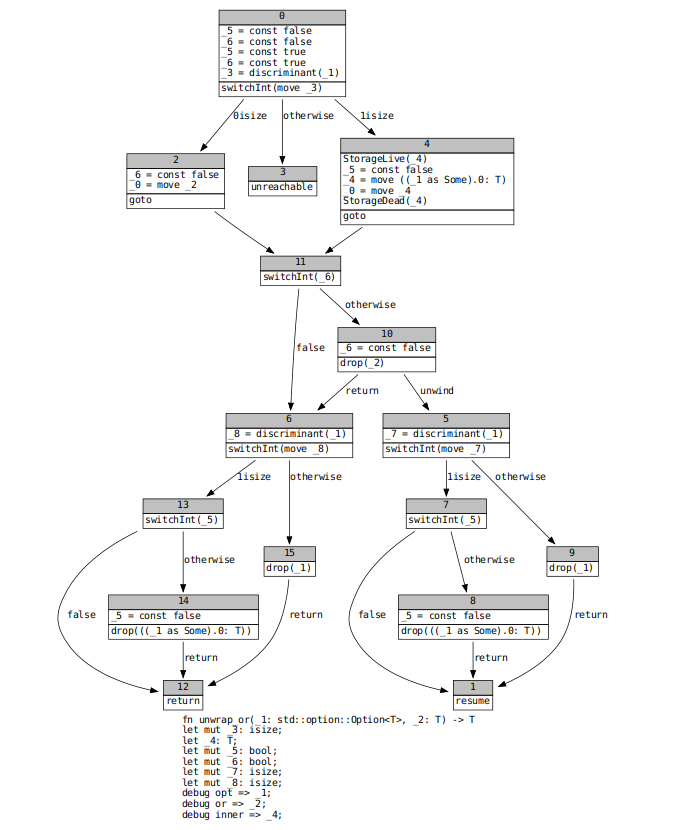
@eddyb also suggested the solution to this problem. When we switch on an enum discriminant, we should be marking all fields in other variants as definitely uninitialized. I implemented this on top of alongside a small optimization (split out into #68943) that suppresses drop terminators for enum variants with no fields (e.g. `Option::None`). This is the resulting MIR for `unwrap_or`.
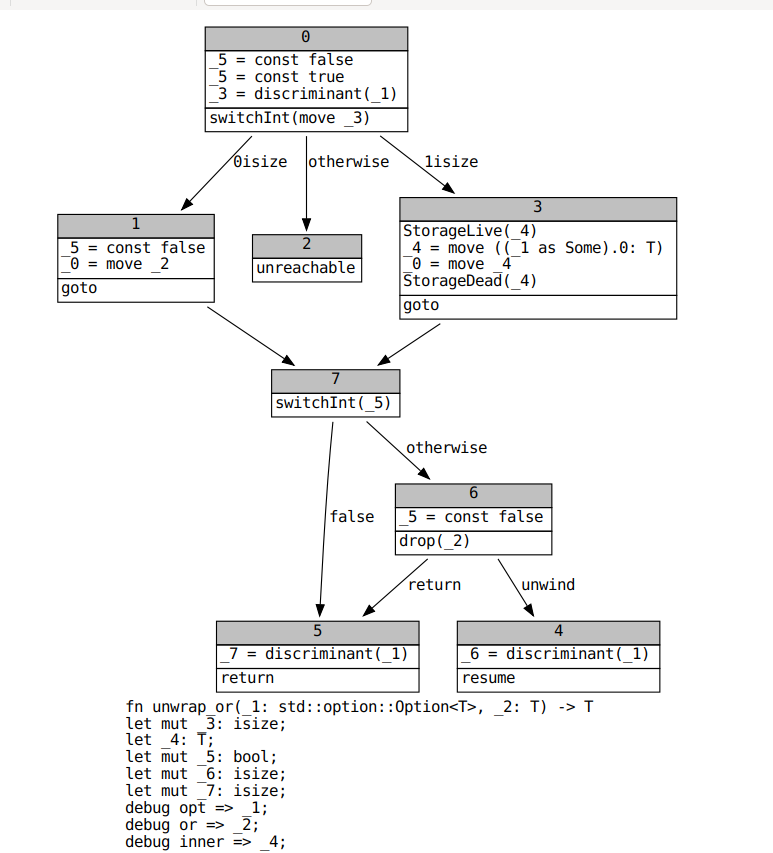
In concert with #68943, this change speeds up many [optimized and debug builds](https://perf.rust-lang.org/compare.html?start=d55f3e9f1da631c636b54a7c22c1caccbe4bf0db&end=0077a7aa11ebc2462851676f9f464d5221b17d6a). We need to carefully investigate whether I have introduced any miscompilations before merging this. Code that never drops anything would be very fast indeed until memory is exhausted.
|
|
|
|
|
|
|
|
|
|
|
|
Combine `HaveBeenBorrowedLocals` and `IndirectlyMutableLocals` into one dataflow analysis
This PR began as an attempt to port `HaveBeenBorrowedLocals` to the new dataflow framework (see #68241 for prior art). Along the way, I noticed that it could share most of its code with `IndirectlyMutableLocals` and then found a few bugs in the two analyses:
- Neither one marked locals as borrowed after an `Rvalue::AddressOf`.
- `IndirectlyMutableLocals` was missing a minor fix that `HaveBeenBorrowedLocals` got in #61069. This is not a problem today since it is only used during const-checking, where custom drop glue is forbidden. However, this may change some day.
I decided to combine the two analyses so that they wouldn't diverge in the future while ensuring that they remain distinct types (called `MaybeBorrowedLocals` and `MaybeMutBorrowedLocals` to be consistent with the `Maybe{Un,}InitializedPlaces` naming scheme). I fixed the bugs and switched to exhaustive matching where possible to make them less likely in the future. Finally, I added comments explaining some of the finer points of the transfer function for these analyses (see #61069 and #65006).
|
|
|
|
|
|
|
|
|
|
|
|
|
|
|
|
|
|
It should have the same semantics as `HaveBeenBorrowedLocals`
|
|
`MaybeMutBorrowedLocals` serves the same purpose and has a better name.
|
|
|
|
This impl is temporary and will be removed along with the old dataflow
framework. It allows us to reuse the transfer function of new dataflow
analyses when defining old ones
|
|
|
|
|
|
|
|
|
|
|
|
|
|
This makes it more ergonomic to create a dataflow engine and obviates
the need to pick between `new_gen_kill` and `new_generic`.
|
|
|
