| Age | Commit message (Collapse) | Author | Lines |
|---|
|
Completes support for coverage in external crates
Follow-up to #74959 :
The prior PR corrected for errors encountered when trying to generate
the coverage map on source code inlined from external crates (including
macros and generics) by avoiding adding external DefIds to the coverage
map.
This made it possible to generate a coverage report including external
crates, but the external crate coverage was incomplete (did not include
coverage for the DefIds that were eliminated.
The root issue was that the coverage map was converting Span locations
to source file and locations, using the SourceMap for the current crate,
and this would not work for spans from external crates (compliled with a
different SourceMap).
The solution was to convert the Spans to filename and location during
MIR generation instead, so precompiled external crates would already
have the correct source code locations embedded in their MIR, when
imported into another crate.
@wesleywiser FYI
r? @tmandry
|
|
The prior PR corrected for errors encountered when trying to generate
the coverage map on source code inlined from external crates (including
macros and generics) by avoiding adding external DefIds to the coverage
map.
This made it possible to generate a coverage report including external
crates, but the external crate coverage was incomplete (did not include
coverage for the DefIds that were eliminated.
The root issue was that the coverage map was converting Span locations
to source file and locations, using the SourceMap for the current crate,
and this would not work for spans from external crates (compliled with a
different SourceMap).
The solution was to convert the Spans to filename and location during
MIR generation instead, so precompiled external crates would already
have the correct source code locations embedded in their MIR, when
imported into another crate.
|
|
|
|
Fix change detection in CfgSimplifier::collapse_goto_chain
Check that the old target is different from the new collapsed one, before concluding that anything changed.
Fixes #75074
Fixes #75051
|
|
|
|
Check that the old target is different from the new collapsed one,
before concluding that anything changed.
|
|
|
|
Replace a recursive algorithm with an iterative one and a stack.
fixes #74931
|
|
|
|
[mir] Special treatment for dereferencing a borrow to a static definition
Fix #70584.
As suggested by @oli-obk in this [comment](https://github.com/rust-lang/rust/issues/70584#issuecomment-626009260), one can chase the definition of the local variable being de-referenced and check if it is a true static variable. If that is the case, `validate_place` will admit the promotion.
This is my first time to contribute to `rustc`, and I have two questions.
1. A generalization to some extent is applied to decide if the promotion is possible in the static context. In case that there are more projection operations preceding the de-referencing, `validate_place` recursively decent into inner projection operations. I have put thoughts into its correctness but I am not totally sure about it.
2. I have a hard time to find a good place for the test case. This patch has to do with MIR, but this test case would look out of place compared to other tests in `src/test/ui/mir` or `src/test/ui/borrowck` because it does not generate errors while others do. It is tentatively placed in `src/test/ui/statics` for now.
Thank you for any comments and suggestions!
|
|
Normalize all opaque types when converting ParamEnv to Reveal::All
When we normalize a type using a ParamEnv with a reveal mode of
RevealMode::All, we will normalize opaque types to their underlying
types (e.g. `type MyOpaque = impl Foo` -> `StructThatImplsFoo`).
However, the ParamEnv may still have predicates referring to the
un-normalized opaque type (e.g. `<T as MyTrait<MyOpaque>>`). This can
cause trait projection to fail, since a type containing normalized
opaque types will not match up with the un-normalized type in the
`ParamEnv`.
To fix this, we now explicitly normalize all opaque types in
caller_bounds of a `ParamEnv` when changing its mode to
`RevealMode::All`. This ensures that all predicatse will refer to the
underlying types of any opaque types involved, allowing them to be
matched up properly during projection. To reflect the fact that
normalization is occuring, `ParamEnv::with_reveal_all` is renamed to
`ParamEnv::with_reveal_all_normalized`
Fixes #65918
|
|
|
|
|
|
|
|
|
|
Fixed coverage map issues; better aligned with LLVM APIs
Found some problems with the coverage map encoding when testing with more than one counter per function.
While debugging, I realized some better ways to structure the Rust implementation of the coverage mapping generator. I refactored somewhat, resulting in less code overall, expanded coverage of LLVM Coverage Map capabilities, and much closer alignment with LLVM data structures, APIs, and naming.
This should be easier to follow and easier to maintain.
r? @tmandry
Rust compiler MCP rust-lang/compiler-team#278
Relevant issue: #34701 - Implement support for LLVMs code coverage instrumentation
|
|
We used to erase these values immediately after propagation, but some
things slipped through and it caused us to still initialize huge locals.
|
|
too large
|
|
Lays a better foundation for injecting more counters in each function.
|
|
convert higher ranked `Predicate`s to `PredicateKind::ForAll`
implements step 2 of https://github.com/rust-lang/compiler-team/issues/285
r? @nikomatsakis
|
|
|
|
|
|
|
|
|
|
|
|
Miri: replace canonical_alloc_id mechanism by extern_static_alloc_id
We only have to call `extern_static_alloc_id` when a `Pointer` is "imported" from the `tcx` to the machine, not on each access. Also drop the old hook for TLS handling, it is not needed any more.
The Miri side of this is at https://github.com/rust-lang/miri/pull/1489.
Fixes https://github.com/rust-lang/rust/issues/71194
r? @oli-obk
|
|
|
|
Found some problems with the coverage map encoding when testing with
more than one counter per function.
While debugging, I realized some better ways to structure the Rust
implementation of the coverage mapping generator. I refactored somewhat,
resulting in less code overall, expanded coverage of LLVM Coverage Map
capabilities, and much closer alignment with LLVM data structures, APIs,
and naming.
This should be easier to follow and easier to maintain.
|
|
add `visit_operand` to const prop
r? @oli-obk
|
|
Optimize away BitAnd and BitOr when possible
This PR lets `const_prop` optimize away `a | true == true` , `a & false == false` and `a * 0 = 0`. While I was writing this I've realized that constant propagation misses a lot of opportunities. For example: https://play.rust-lang.org/?version=stable&mode=debug&edition=2018&gist=2a4b45e772f214210a36749b27223bb0
Constant propagation doesn't seem to... propagate constants, additionally the way constant propagation is currently setup makes it tricky to add cases like `a | false == a`.
I tried to organize `eval_rvalue_with_identities` to make the pattern of the optimizations easier to see but it still obscurs what should be a simple peephole optmization.
cc @oli-obk
|
|
|
|
|
|
|
|
|
|
|
|
Fixes #65918
|
|
|
|
|
|
|
|
This commit modifies the `substitute_normalize_and_test_predicates`
query, renaming it to `impossible_predicates` and only checking
predicates which do not require substs. By making this change,
polymorphization doesn't have to explicitly support vtables.
Signed-off-by: David Wood <david@davidtw.co>
|
|
Generating the coverage map
@tmandry @wesleywiser
rustc now generates the coverage map and can support (limited)
coverage report generation, at the function level.
Example commands to generate a coverage report:
```shell
$ BUILD=$HOME/rust/build/x86_64-unknown-linux-gnu
$ $BUILD/stage1/bin/rustc -Zinstrument-coverage \
$HOME/rust/src/test/run-make-fulldeps/instrument-coverage/main.rs
$ LLVM_PROFILE_FILE="main.profraw" ./main
called
$ $BUILD/llvm/bin/llvm-profdata merge -sparse main.profraw -o main.profdata
$ $BUILD/llvm/bin/llvm-cov show --instr-profile=main.profdata main
```
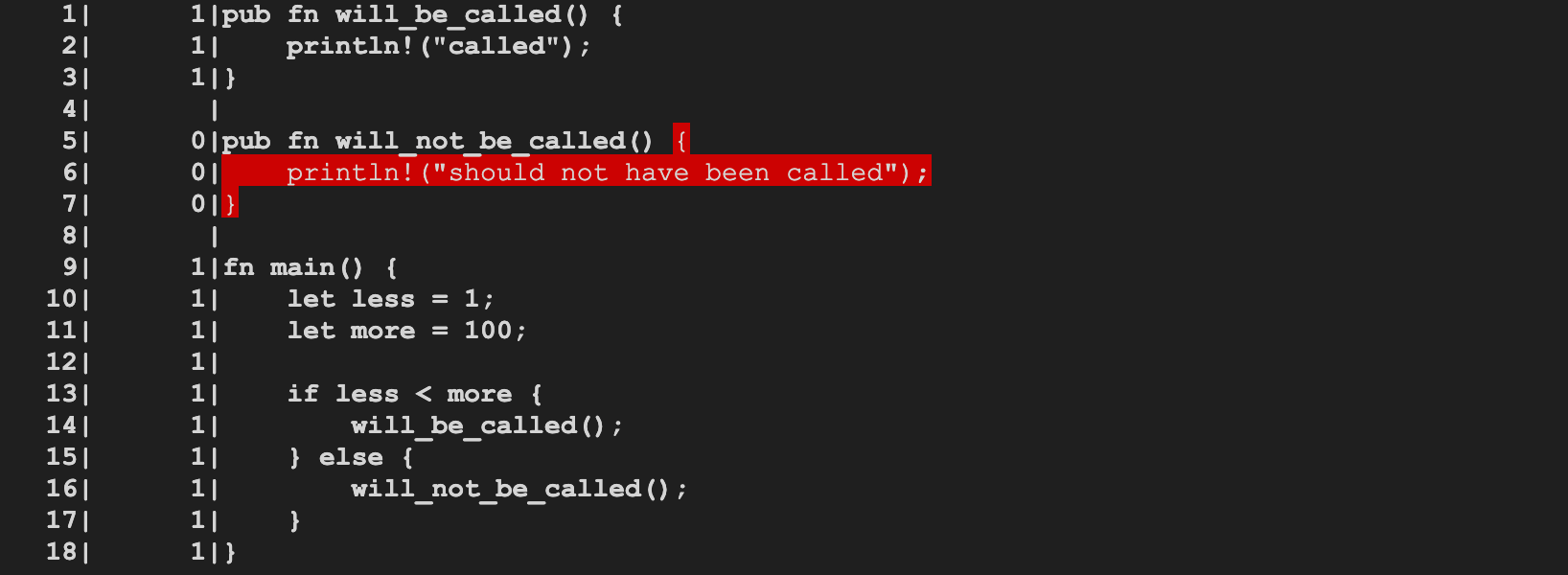
r? @wesleywiser
Rust compiler MCP rust-lang/compiler-team#278
Relevant issue: #34701 - Implement support for LLVMs code coverage instrumentation
|
|
Stop processing unreachable blocks when solving dataflow
...instead we `debug_assert` that the user is not checking the dataflow state for an unreachable block. This resolves a FIXME in the dataflow engine. The old behavior was an artifact of the previous dataflow framework. Things should run a tiny bit faster now, but I suspect not enough to show up in benchmarks. AFAIK, only the generator transform runs dataflow on MIR with unreachable basic blocks.
This PR also adds some utility methods to `mir::traversal`.
r? @pnkfelix
|
|
rustc now generates the coverage map and can support (limited)
coverage report generation, at the function level.
Example:
$ BUILD=$HOME/rust/build/x86_64-unknown-linux-gnu
$ $BUILD/stage1/bin/rustc -Zinstrument-coverage \
$HOME/rust/src/test/run-make-fulldeps/instrument-coverage/main.rs
$ LLVM_PROFILE_FILE="main.profraw" ./main
called
$ $BUILD/llvm/bin/llvm-profdata merge -sparse main.profraw -o main.profdata
$ $BUILD/llvm/bin/llvm-cov show --instr-profile=main.profdata main
1| 1|pub fn will_be_called() {
2| 1| println!("called");
3| 1|}
4| |
5| 0|pub fn will_not_be_called() {
6| 0| println!("should not have been called");
7| 0|}
8| |
9| 1|fn main() {
10| 1| let less = 1;
11| 1| let more = 100;
12| 1|
13| 1| if less < more {
14| 1| will_be_called();
15| 1| } else {
16| 1| will_not_be_called();
17| 1| }
18| 1|}
|
|
Some `Symbol` related improvements
These commits make things nicer and avoid some `Symbol::as_str()` calls.
r? @oli-obk
|
|
This replaces the need for the `description` and `details` symbols in
`UnsafetyViolation`, which are static. As a result some
`Symbol::as_str()` calls are no longer necessary, which is nice.
|
|
Don't panic if the lhs of a div by zero is not statically known
Fixes #73993 for real this time
r? @wesleywiser
|
|
|
|
|
|
|
|
|
