| Age | Commit message (Collapse) | Author | Lines |
|---|
|
|
|
Normalize all opaque types when converting ParamEnv to Reveal::All
When we normalize a type using a ParamEnv with a reveal mode of
RevealMode::All, we will normalize opaque types to their underlying
types (e.g. `type MyOpaque = impl Foo` -> `StructThatImplsFoo`).
However, the ParamEnv may still have predicates referring to the
un-normalized opaque type (e.g. `<T as MyTrait<MyOpaque>>`). This can
cause trait projection to fail, since a type containing normalized
opaque types will not match up with the un-normalized type in the
`ParamEnv`.
To fix this, we now explicitly normalize all opaque types in
caller_bounds of a `ParamEnv` when changing its mode to
`RevealMode::All`. This ensures that all predicatse will refer to the
underlying types of any opaque types involved, allowing them to be
matched up properly during projection. To reflect the fact that
normalization is occuring, `ParamEnv::with_reveal_all` is renamed to
`ParamEnv::with_reveal_all_normalized`
Fixes #65918
|
|
|
|
This should not be a change in behavior.
|
|
Generating the coverage map
@tmandry @wesleywiser
rustc now generates the coverage map and can support (limited)
coverage report generation, at the function level.
Example commands to generate a coverage report:
```shell
$ BUILD=$HOME/rust/build/x86_64-unknown-linux-gnu
$ $BUILD/stage1/bin/rustc -Zinstrument-coverage \
$HOME/rust/src/test/run-make-fulldeps/instrument-coverage/main.rs
$ LLVM_PROFILE_FILE="main.profraw" ./main
called
$ $BUILD/llvm/bin/llvm-profdata merge -sparse main.profraw -o main.profdata
$ $BUILD/llvm/bin/llvm-cov show --instr-profile=main.profdata main
```
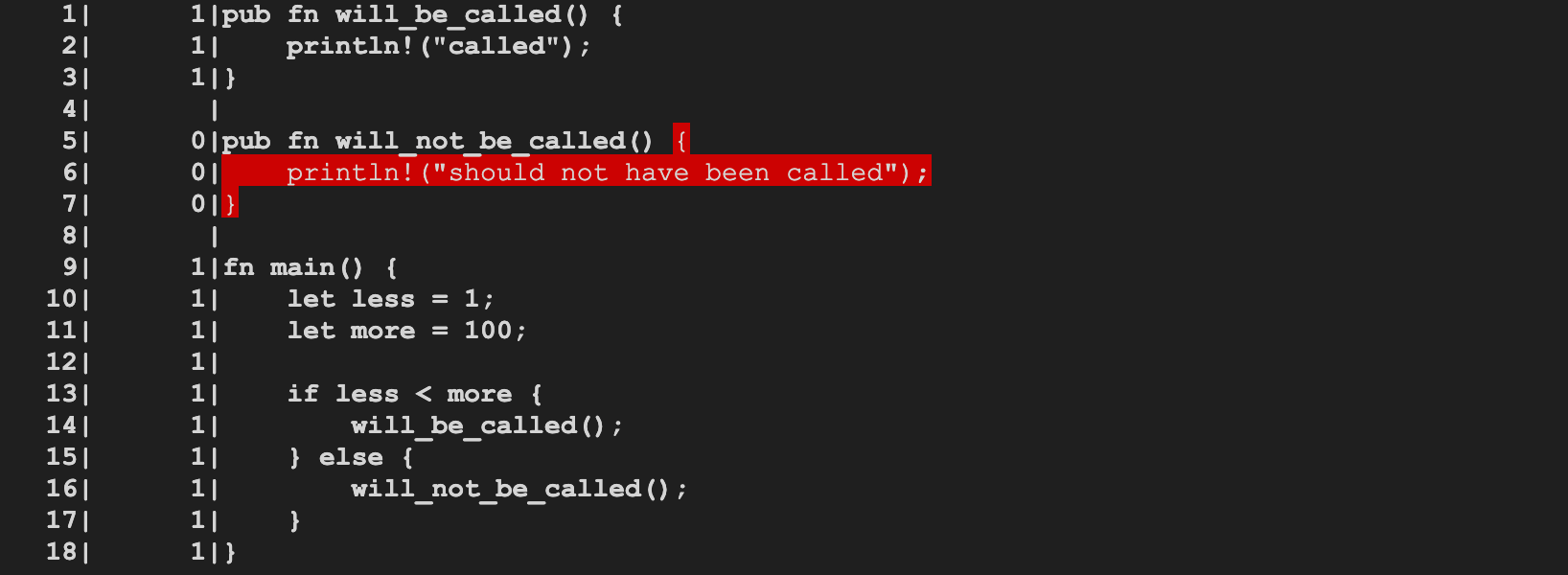
r? @wesleywiser
Rust compiler MCP rust-lang/compiler-team#278
Relevant issue: #34701 - Implement support for LLVMs code coverage instrumentation
|
|
rustc now generates the coverage map and can support (limited)
coverage report generation, at the function level.
Example:
$ BUILD=$HOME/rust/build/x86_64-unknown-linux-gnu
$ $BUILD/stage1/bin/rustc -Zinstrument-coverage \
$HOME/rust/src/test/run-make-fulldeps/instrument-coverage/main.rs
$ LLVM_PROFILE_FILE="main.profraw" ./main
called
$ $BUILD/llvm/bin/llvm-profdata merge -sparse main.profraw -o main.profdata
$ $BUILD/llvm/bin/llvm-cov show --instr-profile=main.profdata main
1| 1|pub fn will_be_called() {
2| 1| println!("called");
3| 1|}
4| |
5| 0|pub fn will_not_be_called() {
6| 0| println!("should not have been called");
7| 0|}
8| |
9| 1|fn main() {
10| 1| let less = 1;
11| 1| let more = 100;
12| 1|
13| 1| if less < more {
14| 1| will_be_called();
15| 1| } else {
16| 1| will_not_be_called();
17| 1| }
18| 1|}
|
|
Rename TypeckTables to TypeckResults.
Originally suggested by @eddyb.
|
|
|
|
Bump version to 1.47
This also bumps to a more recent rustfmt version, just to keep us relatively up to date (though almost nothing has changed in rustfmt we use beyond bumps to the parser infra). No formatting changes as a result of this.
r? @pietroalbini
|
|
Add build support for Cargo's build-std feature.
This makes some changes to the standard library to make it easier to use with Cargo's build-std feature. The primary goal is to make it so that Cargo and its users do not need to know which crates to build and which features to use for every platform.
Conditional cfgs are adjusted so that there is usually a fall-through for unsupported platforms. Additionally, there is a "restricted-std" feature to mark `std` as unstable when used with build-std on no_std platforms. There is no intent to stabilize this feature for the foreseeable future.
This borrows some of the implementation for wasm which already does what this needs. More code sharing can be done with some other platforms (there is a lot of duplication with cloudabi, hermit, and sgx), but I figure that can be done in a future PR.
There are some small changes to stable behavior in this PR:
- `std::env::consts::ARCH` on asmjs now reports "wasm32", to match its actual architecture.
- Some of the wasm error messages for unsupported features report a slightly different error message so that the code can be reused.
There should otherwise not be any changes to how std is built for distribution via bootstrap.
This does not yet support all platforms when used with build-std.
- It doesn't work with 16-bit targets (hashbrown does not support that).
- It does not work with JSON spec targets.
- In particular, all target triple snooping will need to be replaced with appropriate target option checking.
- Switching to gimli (#73441) will make cross-building *much* easier.
- There are still a ton of issues on the Cargo side to resolve. A big one is panic strategy support.
Future PRs are intended to address some of these issues.
|
|
|
|
Move #[doc(alias)] check in rustc
Part of #73721.
r? @ollie27
|
|
|
|
Note that the output of `unpretty-debug.stdout` has changed. In that
test the hash values are normalized from a symbol numbers to small
numbers like "0#0" and "0#1". The increase in the number of static
symbols must have caused the original numbers to contain more digits,
resulting in different pretty-printing prior to normalization.
|
|
Avoid "whitelist"
Other terms are more inclusive and precise.
|
|
Only allow `repr(i128/u128)` on enum
Fixes #74082
|
|
Other terms are more inclusive and precise.
|
|
|
|
|
|
|
|
Use 'tcx for references to AccessLevels wherever possible.
Most of the changes are just fallout from removing a lifetime parameter from structs, and mostly in clippy.
r? @Manishearth
|
|
davidtwco:issue-73541-labelled-break-through-closure-async, r=petrochenkov
resolve: disallow labelled breaks/continues through closures/async blocks
Fixes #73541.
This PR modifies name resolution to prohibit labelled breaks/continues through closures or async blocks, fixing an ICE. In addition, it improves the diagnostics surrounding labelled breaks/continues through closures or async blocks by informing the user if the label exists in an parent scope and telling them that won't work.
r? @petrochenkov (resolve)
cc @estebank (diagnostic changes) @tmandry (issue is from `wg-async-foundations`)
|
|
|
|
Remove `TypeckTables::empty(None)` and make hir_owner non-optional.
Each commit before the last one removes uses of `TypeckTables::empty(None)`, replacing the empty tables with having `Option` around the `&'tcx TypeckTables<'tcx>` that HIR visitors kept track of.
The last commit removes the concept of "empty `TypeckTables`" altogether, guaranteeing that every `TypeckTables` corresponds to a HIR body owner.
r? @nikomatsakis
|
|
|
|
|
|
This commit modifies resolve to disallow `break`/`continue` to labels
through closures or async blocks. This doesn't make sense and should
have been prohibited anyway.
Signed-off-by: David Wood <david@davidtw.co>
|
|
Provide more information on duplicate lang item error.
This gives some notes on the location of the files where the lang items were loaded from. Some duplicate lang item errors can be a little confusing, and this might help in diagnosing what has happened.
Here's an example when hitting a bug with Cargo's build-std:
```
error: duplicate lang item in crate `core` (which `rustc_std_workspace_core` depends on): `try`.
|
= note: the lang item is first defined in crate `core` (which `z10` depends on)
= note: first definition in `core` loaded from /Users/eric/Proj/rust/cargo/scratch/z10/target/target/debug/deps/libcore-a764da499c7385f4.rmeta
= note: second definition in `core` loaded from /Users/eric/Proj/rust/cargo/scratch/z10/target/target/debug/deps/libcore-5b082675aea34986.rmeta
```
|
|
|
|
|
|
|
|
|
|
|
|
|
|
|
|
replace more `DefId`s with `LocalDefId`
part of https://github.com/rust-lang/rust/issues/70853
|
|
|
|
This is a re-attempt of #72389 (which was reverted in #73594)
Instead of using `ExpnKind::Desugaring` to represent operators, this PR
checks the lang item directly.
|
|
Fixes #70718
This commit allows making associated items (e.g. associated functions
and types) into lang items via the `#[lang]` attribute. This allows such
items to be accessed directly, rather than by iterating over the parent
item's associated items.
I've added `FnOnce::Output` as a lang item, and updated one old usage to
use the new lang item. The remaining uses can be updated separately.
|
|
|
|
first stage of implementing LLVM code coverage
This PR replaces #70680 (WIP toward LLVM Code Coverage for Rust) since I am re-implementing the Rust LLVM code coverage feature in a different part of the compiler (in MIR pass(es) vs AST).
This PR updates rustc with `-Zinstrument-coverage` option that injects the llvm intrinsic `instrprof.increment()` for code generation.
This initial version only injects counters at the top of each function, and does not yet implement the required coverage map.
Upcoming PRs will add the coverage map, and add more counters and/or counter expressions for each conditional code branch.
Rust compiler MCP https://github.com/rust-lang/compiler-team/issues/278
Relevant issue: #34701 - Implement support for LLVMs code coverage instrumentation
***[I put together some development notes here, under a separate branch.](https://github.com/richkadel/rust/blob/cfa0b21d34ee64e4ebee226101bd2ef0c6757865/src/test/codegen/coverage-experiments/README-THIS-IS-TEMPORARY.md)***
|
|
As suggested in PR feedback:
https://github.com/rust-lang/rust/pull/73011#discussion_r435728923
This allows count_code_region() to be handled like a normal intrinsic so
the InstanceDef::InjectedCode variant is no longer needed.
|
|
|
|
Clean up type alias impl trait implementation
- Removes special case for top-level impl trait
- Removes associated opaque types
- Forbid lifetime elision in let position impl trait. This is consistent with the behavior for inferred types.
- Handle lifetimes in type alias impl trait more uniformly with other parameters
cc #69323
cc #63063
Closes #57188
Closes #62988
Closes #69136
Closes #73061
|
|
Track span of function in method calls, and use this in #[track_caller]
Fixes #69977
When we parse a chain of method calls like `foo.a().b().c()`, each
`MethodCallExpr` gets assigned a span that starts at the beginning of
the call chain (`foo`). While this is useful for diagnostics, it means
that `Location::caller` will return the same location for every call
in a call chain.
This PR makes us separately record the span of the function name and
arguments for a method call (e.g. `b()` in `foo.a().b().c()`). This
`Span` is passed through HIR lowering and MIR building to
`TerminatorKind::Call`, where it is used in preference to
`Terminator.source_info.span` when determining `Location::caller`.
This new span is also useful for diagnostics where we want to emphasize
a particular method call - for an example, see
https://github.com/rust-lang/rust/pull/72389#discussion_r436035990
|
|
|
|
They're unused now.
|
|
|
|
Fixes #69977
When we parse a chain of method calls like `foo.a().b().c()`, each
`MethodCallExpr` gets assigned a span that starts at the beginning of
the call chain (`foo`). While this is useful for diagnostics, it means
that `Location::caller` will return the same location for every call
in a call chain.
This PR makes us separately record the span of the function name and
arguments for a method call (e.g. `b()` in `foo.a().b().c()`). This
`Span` is passed through HIR lowering and MIR building to
`TerminatorKind::Call`, where it is used in preference to
`Terminator.source_info.span` when determining `Location::caller`.
This new span is also useful for diagnostics where we want to emphasize
a particular method call - for an example, see
https://github.com/rust-lang/rust/pull/72389#discussion_r436035990
|
|
Fixes more of:
clippy::unused_unit
clippy::op_ref
clippy::useless_format
clippy::needless_return
clippy::useless_conversion
clippy::bind_instead_of_map
clippy::into_iter_on_ref
clippy::redundant_clone
clippy::nonminimal_bool
clippy::redundant_closure
clippy::option_as_ref_deref
clippy::len_zero
clippy::iter_cloned_collect
clippy::filter_next
|
