| Age | Commit message (Collapse) | Author | Lines |
|---|
|
|
|
|
|
|
|
|
|
rustdoc: Optimize IdMap
Slightly optimizes `IdMap`, which is hot in `markdown_links` (context [here](https://github.com/rust-lang/rust/pull/96135#issuecomment-1103539052)). There are more improvements that can be made near this place, but this seemed like an easy win locally (although I tried it on top of https://github.com/rust-lang/rust/pull/94857, so let's see what happens without that PR).
r? `@petrochenkov`
|
|
|
|
|
|
|
|
|
|
|
|
r=Mark-Simulacrum
Use modern formatting for format! macros
This updates the standard library's documentation to use the new format_args syntax.
The documentation is worthwhile to update as it should be more idiomatic
(particularly for features like this, which are nice for users to get acquainted
with). The general codebase is likely more hassle than benefit to update: it'll
hurt git blame, and generally updates can be done by folks updating the code if
(and when) that makes things more readable with the new format.
A few places in the compiler and library code are updated (mostly just due to
already having been done when this commit was first authored).
`eprintln!("{}", e)` becomes `eprintln!("{e}")`, but `eprintln!("{}", e.kind())` remains untouched.
|
|
This updates the standard library's documentation to use the new syntax. The
documentation is worthwhile to update as it should be more idiomatic
(particularly for features like this, which are nice for users to get acquainted
with). The general codebase is likely more hassle than benefit to update: it'll
hurt git blame, and generally updates can be done by folks updating the code if
(and when) that makes things more readable with the new format.
A few places in the compiler and library code are updated (mostly just due to
already having been done when this commit was first authored).
|
|
|
|
|
|
|
|
|
|
|
|
|
|
|
|
`count()` iterates over the whole collection. Using `len()` instead, or
`.next().is_none()` when comparing to zero, should be faster.
|
|
|
|
Scrape code examples from examples/ directory for Rustdoc
Adds support for the functionality described in https://github.com/rust-lang/rfcs/pull/3123
Matching changes to Cargo are here: https://github.com/rust-lang/cargo/pull/9525
Live demo here: https://willcrichton.net/example-analyzer/warp/trait.Filter.html#method.and
|
|
|
|
Continue migrating JS functionality
Cleanup
Fix compile error
Clean up the diff
Set toggle font to sans-serif
|
|
|
|
|
|
|
|
- Avoid multiple <h1>s on a page.
- The <h#> tags should follow a semantic hierarchy.
- Cap at h6 (no h7)
|
|
Previously, only the raw string and the `is_ignore` field were
preserved, which made it hard to recover anything else.
|
|
Fix table in docblocks
"Overwrite" of #88702.
Instead of adding a z-index to the sidebar (which only hides the issue, doesn't fix it), I wrap `<table>` elements inside a `<div>` and limit all chidren of `.docblock` elements' width to prevent having the scrollbar on the whole doc block.

Thanks `@nbdd0121` for `overflow-x: auto;`. ;)
r? `@notriddle`
|
|
Fix issues with Markdown summary options
- Use `summary_opts()` for Markdown summaries
- Enable all main body Markdown options for summaries
|
|
|
|
`rustdoc`: compute correct line number for indented rust code blocks.
This PR fixes a bug in `rustdoc` where it computes the wrong line number for indented rust code blocks (and subsequent blocks) it finds in markdown strings. To fix this issue, we decrement the line number if we find characters between the code block and the preceding line ending. I noticed this issue as I was trying to use `rustdoc` to extract examples from The Rust Reference and run them through the [Rust Model Checker](https://github.com/model-checking/rmc).
|
|
This fixes odd renderings when these features are used in the first
paragraph of documentation for an item. This is an extension of #87270.
|
|
It was accidentally changed to use `opts()` in #86451.
I also renamed `opts()` to `main_body_opts()` to make this kind of
accidental change less likely.
|
|
r=GuillaumeGomez
Refactor Markdown length-limited summary implementation
This PR is a new approach to #79749.
This PR refactors the implementation of `markdown_summary_with_limit()`,
separating the logic of determining when the limit has been reached from
the actual rendering process.
The main advantage of the new approach is that it guarantees that all
HTML tags are closed, whereas the previous implementation could generate
tags that were never closed. It also ensures that no empty tags are
generated (e.g., `<em></em>`).
The new implementation consists of a general-purpose struct
`HtmlWithLimit` that manages the length-limiting logic and a function
`markdown_summary_with_limit()` that renders Markdown to HTML using the
struct.
r? `@GuillaumeGomez`
|
|
The length limit turns out to be a surprisingly good heuristic for
initial allocation size. See here for more details [1].
[1]: https://github.com/rust-lang/rust/pull/88173#discussion_r692531631
|
|
This commit refactors the implementation of
`markdown_summary_with_limit()`, separating the logic of determining
when the limit has been reached from the actual rendering process.
The main advantage of the new approach is that it guarantees that all
HTML tags are closed, whereas the previous implementation could generate
tags that were never closed. It also ensures that no empty tags are
generated (e.g., `<em></em>`).
The new implementation consists of a general-purpose struct
`HtmlWithLimit` that manages the length-limiting logic and a function
`markdown_summary_with_limit()` that renders Markdown to HTML using the
struct.
|
|
|
|
struct for better readability
|
|
|
|
|
|
Flatten nested `format!` calls
|
|
|
|
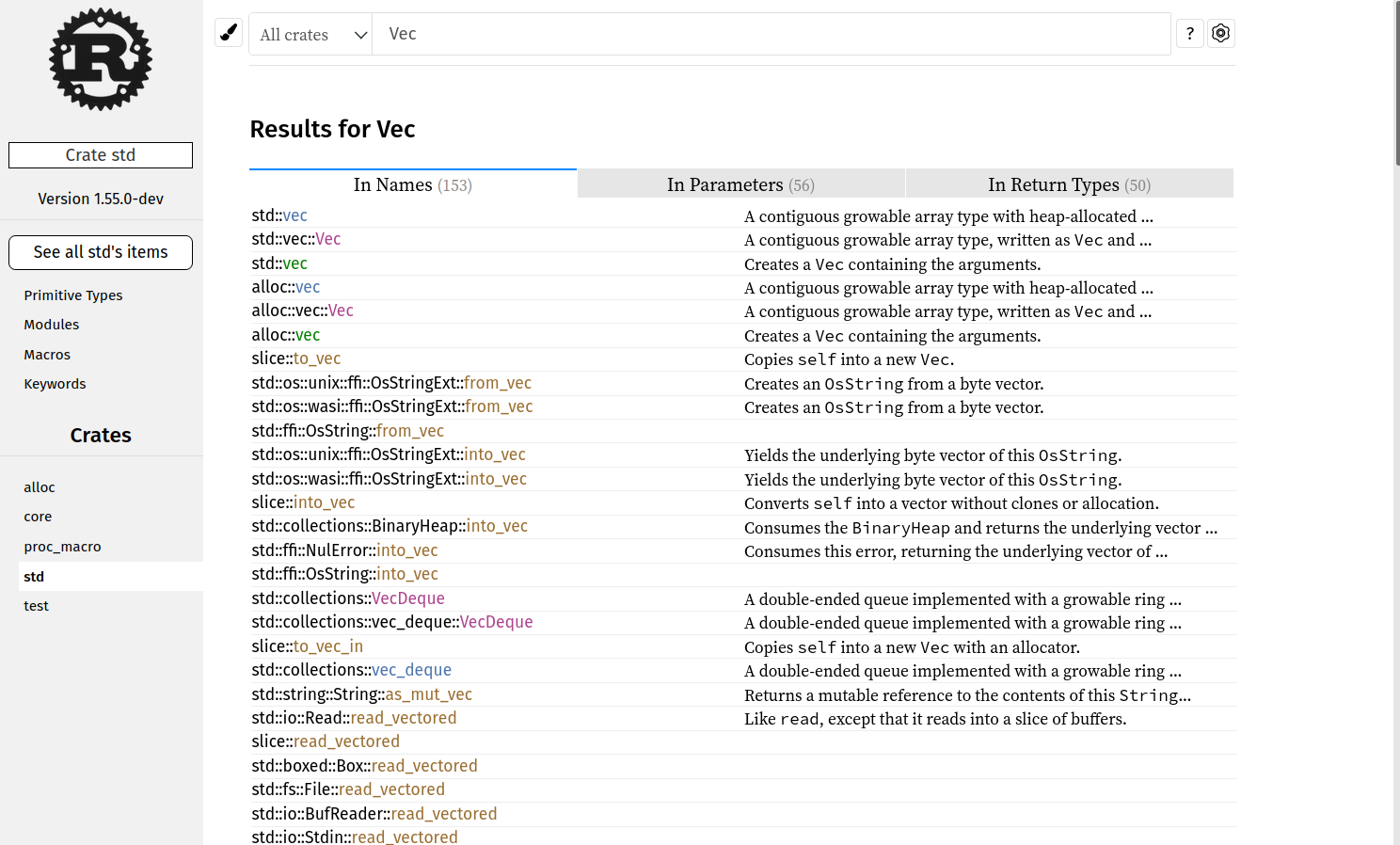
I noticed that `Pin::new()`'s search summary looked off, and I realized
that the reason is that it has inline code containing `Pin<P>`, which is
not escaped and thus renders as a paragraph tag!
|
|
|
|
|
|
|
|
|
|
Before:

After:
|
