| Age | Commit message (Collapse) | Author | Lines |
|---|
|
|
|
|
|
|
|
[rustdoc] Fix items with generics not having their jump to def link generated
Because the span originally included the generics, during the highlighting, it was not retrieved and therefore its jump to def link was not generated.
r? ``@notriddle``
|
|
|
|
|
|
the behavior of the type system not only depends on the current
assumptions, but also the currentnphase of the compiler. This is
mostly necessary as we need to decide whether and how to reveal
opaque types. We track this via the `TypingMode`.
|
|
[rustdoc] Fix duplicated footnote IDs
Fixes https://github.com/rust-lang/rust/issues/131901.
Footnote IDs were increased locally (ie, on the docblock) and not globally (ie, on the whole item page).
cc `@aDotInTheVoid`
r? `@notriddle`
|
|
rustdoc: Treat declarative macros more like other item kinds
Apparently at some time in the past we were unable to generate an href for the module path inside the visibility of decl macros 2.0 (`pub(in ...)`). As a result of this, a whole separate function was introduced specifically for printing the visibility of decl macros that didn't attempt to generate any links. The description of PR https://github.com/rust-lang/rust/pull/84074 states:
> This fixes the overly-complex invariant mentioned in https://github.com/rust-lang/rust/pull/83237#issuecomment-815346570, where the macro source can't have any links in it only because the cache hasn't been populated yet.
I can no longer reproduce the original issue. Reusing the existing visibility rendering logic *seems* to work just fine (I couldn't come up with any counterexamples, though I invite you to prove me wrong).
* Fixes #83000
* Fixes the visibility showing up "twice" in rustdoc-JSON output: Once as the `visibility` field, once baked into the source[^1]
* Fixes `#[doc(hidden)]` not getting rendered on doc(hidden) decl macros 2.0 under `--document-hiden-items` (for decl macros 1.2 the issue remains; I will address this separately when fixing #132304).
---
<details><summary>Outdated Section</summary>
NOTE: The current version of this PR is committing a UI crime, I'd like to receive feedback on that. Maybe you have a satisfactory solution for how to remedy it. Namely, as you know we have two different ways of / modes for highlighting code with color:
1. Only highlighting links / item paths and avoiding to highlight tokens by kind like keywords (to reduce visual noise and maybe also artifact size). Used for item declarations(\*).
2. Highlighting tokens by kind. Used for code blocks written by the user.
(\*): With the notable exception being macro declarations! Well, since this PR reuses the same function for rendering the item visibility (which only makes sense), we have a clash of modes: We now use both ways of highlighting code for decl macros: №1 for the visibility, №2 for the rest. This awkward. See for yourself:
* On master: 
* On this branch: 
</details>
Furthermore, we now no longer syntax-highlight declarative macros (be it `macro_rules!` or `macro`) since that was inconsistent with the way we render all other item kinds. See (collapsed) *Outdated Section* above. See also https://github.com/rust-lang/rust/pull/132302#discussion_r1821310783.
| On master | On this branch |
|---|---|
|  |  |
[^1]: E.g., `"visibility":{"restricted":{"parent":1,"path":"::a"}},/*OMITTED*/,"inner":{"macro":"pub(in a) macro by_example_vis_named($foo:expr) {\n ...\n}"}`
|
|
|
|
|
|
Proper support for cross-crate recursive const stability checks
~~Stacked on top of https://github.com/rust-lang/rust/pull/132492; only the last three commits are new.~~
In a crate without `staged_api` but with `-Zforce-unstable-if-unmarked`, we now subject all functions marked with `#[rustc_const_stable_indirect]` to recursive const stability checks. We require an opt-in so that by default, a crate can be built with `-Zforce-unstable-if-unmarked` and use nightly features as usual. This property is recorded in the crate metadata so when a `staged_api` crate calls such a function, it sees the `#[rustc_const_stable_indirect]` and allows it to be exposed on stable. This, finally, will let us expose `const fn` from hashbrown on stable.
The second commit makes const stability more like regular stability: via `check_missing_const_stability`, we ensure that all publicly reachable functions have a const stability attribute -- both in `staged_api` crates and `-Zforce-unstable-if-unmarked` crates. To achieve this, we move around the stability computation so that const stability is computed after regular stability is done. This lets us access the final result of the regular stability computation, which we use so that `const fn` can inherit the regular stability (but only if that is "unstable"). Fortunately, this lets us get rid of an `Option` in `ConstStability`.
This is the last PR that I have planned in this series.
r? `@compiler-errors`
|
|
rustdoc-search: simplify rules for generics and type params
**Heads up!**: This PR is a follow-up that depends on #124544. It adds 12dc24f46007f82b93ed85614347a42d47580afa, a change to the filtering behavior, and 9900ea48b566656fb12b5fcbd0a1b20aaa96e5ca, a minor ranking tweak.
Part of https://github.com/rust-lang/rust-project-goals/issues/112
This PR overturns https://github.com/rust-lang/rust/pull/109802
## Preview
* no results: [`Box<[A]> -> Vec<B>`](http://notriddle.com/rustdoc-html-demo-12/search-sem-3/std/index.html?search=Box%3C%5BA%5D%3E%20-%3E%20Vec%3CB%3E)
* results: [`Box<[A]> -> Vec<A>`](http://notriddle.com/rustdoc-html-demo-12/search-sem-3/std/index.html?search=Box%3C%5BA%5D%3E%20-%3E%20Vec%3CA%3E)
* [`T -> U`](http://notriddle.com/rustdoc-html-demo-12/search-sem-3/std/index.html?search=T%20-%3E%20U)
* [`Cx -> TyCtxt`](http://notriddle.com/rustdoc-html-demo-12/search-sem-3-compiler/rustdoc/index.html?search=Cx%20-%3E%20TyCtxt)
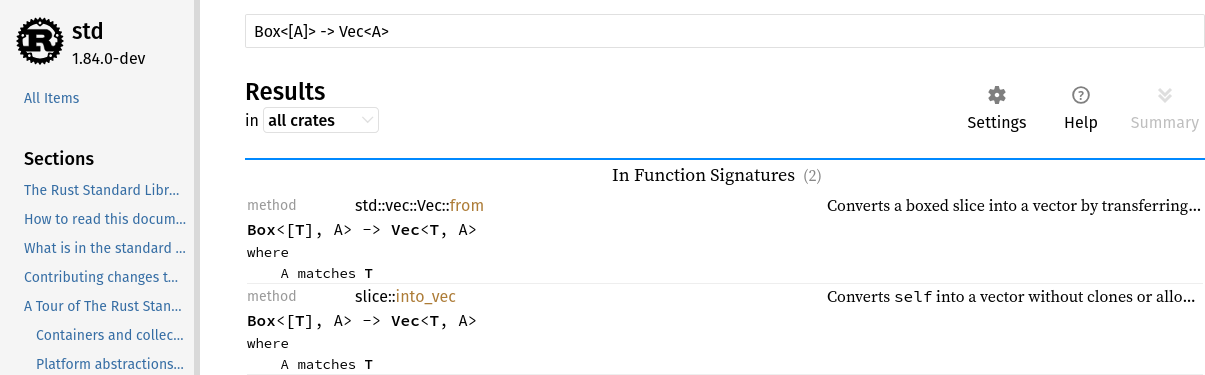
## Description
This commit is a response to feedback on the displayed type signatures results, by making generics act stricter.
- Order within generics is significant. This means `Vec<Allocator>` now matches only with a true vector of allocators, instead of matching the second type param. It also makes unboxing within generics stricter, so `Result<A, B>` only matches if `B` is in the error type and `A` is in the success type. The top level of the function search is unaffected.
- Generics are only "unboxed" if a type is explicitly opted into it. References and tuples are hardcoded to allow unboxing, and Box, Rc, Arc, Option, Result, and Future are opted in with an unstable attribute. Search result unboxing is the process that allows you to search for `i32 -> str` and get back a function with the type signature `&Future<i32> -> Box<str>`.
- Instead of ranking by set overlap, it ranks by the number of items in the type signature. This makes it easier to find single type signatures like transmute.
## Find the discussion on
* <https://rust-lang.zulipchat.com/#narrow/stream/393423-t-rustdoc.2Fmeetings/topic/meeting.202024-07-08/near/449965149>
* <https://github.com/rust-lang/rust/pull/124544#issuecomment-2204272265>
* <https://rust-lang.zulipchat.com/#narrow/channel/266220-t-rustdoc/topic/deciding.20on.20semantics.20of.20generics.20in.20rustdoc.20search>
|
|
|
|
rustc_target reexports a lot of things that are in rustc_abi, but
that will be over soon and now is probably a good time to switch.
Uses of rustc_target remain where they inquire about the target tuple.
|
|
This commit is a response to feedback on the displayed type
signatures results, by making generics act stricter.
Generics are tightened by making order significant. This means
`Vec<Allocator>` now matches only with a true vector of allocators,
instead of matching the second type param. It also makes unboxing
within generics stricter, so `Result<A, B>` only matches if `B`
is in the error type and `A` is in the success type. The top level
of the function search is unaffected.
Find the discussion on:
* <https://rust-lang.zulipchat.com/#narrow/stream/393423-t-rustdoc.2Fmeetings/topic/meeting.202024-07-08/near/449965149>
* <https://github.com/rust-lang/rust/pull/124544#issuecomment-2204272265>
* <https://rust-lang.zulipchat.com/#narrow/channel/266220-t-rustdoc/topic/deciding.20on.20semantics.20of.20generics.20in.20rustdoc.20search/near/476841363>
|
|
|
|
|
|
allow type-based search on foreign functions
fixes https://github.com/rust-lang/rust/issues/131804
preferably will be merged after #129708, but that may take a while to be approved due to being a new feature, whereas this is definitely a bug, and should be fixed.
|
|
Fundamentally, we have *three* disjoint categories of functions:
1. const-stable functions
2. private/unstable functions that are meant to be callable from const-stable functions
3. functions that can make use of unstable const features
This PR implements the following system:
- `#[rustc_const_stable]` puts functions in the first category. It may only be applied to `#[stable]` functions.
- `#[rustc_const_unstable]` by default puts functions in the third category. The new attribute `#[rustc_const_stable_indirect]` can be added to such a function to move it into the second category.
- `const fn` without a const stability marker are in the second category if they are still unstable. They automatically inherit the feature gate for regular calls, it can now also be used for const-calls.
Also, several holes in recursive const stability checking are being closed.
There's still one potential hole that is hard to avoid, which is when MIR
building automatically inserts calls to a particular function in stable
functions -- which happens in the panic machinery. Those need to *not* be
`rustc_const_unstable` (or manually get a `rustc_const_stable_indirect`) to be
sure they follow recursive const stability. But that's a fairly rare and special
case so IMO it's fine.
The net effect of this is that a `#[unstable]` or unmarked function can be
constified simply by marking it as `const fn`, and it will then be
const-callable from stable `const fn` and subject to recursive const stability
requirements. If it is publicly reachable (which implies it cannot be unmarked),
it will be const-unstable under the same feature gate. Only if the function ever
becomes `#[stable]` does it need a `#[rustc_const_unstable]` or
`#[rustc_const_stable]` marker to decide if this should also imply
const-stability.
Adding `#[rustc_const_unstable]` is only needed for (a) functions that need to
use unstable const lang features (including intrinsics), or (b) `#[stable]`
functions that are not yet intended to be const-stable. Adding
`#[rustc_const_stable]` is only needed for functions that are actually meant to
be directly callable from stable const code. `#[rustc_const_stable_indirect]` is
used to mark intrinsics as const-callable and for `#[rustc_const_unstable]`
functions that are actually called from other, exposed-on-stable `const fn`. No
other attributes are required.
|
|
fixes https://github.com/rust-lang/rust/issues/131804
|
|
rustdoc: adjust spacing and typography in header
Fixes #131589
Preview: https://notriddle.com/rustdoc-html-demo-12/spacing/std/index.html
| Before | After |
|--|--|
|  | 
|  | 
|  | 
|  | 
First of all, we put 4px additional margin below the search box, and 4px margin below the header to balance it out.
The bigger problem we have to solve is making the lines look logically spaced. This is troublesome, because Fira Sans (the typeface we use here) wants to look good on average, and to avoid breaking, with text that uses [ascenders and descenders](https://www.w3.org/TR/css-inline-3/images/text-edge.png). If the text we're putting in happens to not have any, things look weird (strictly speaking, there’s hand-tuning here, because the Copy Path button messes with stuff, but the overall point is that there is no true, one perfect layout).
In order to play nicely with the font, I've tweaked the text to use that space. The word "Source" for the link is now capitalized, and the Since version number now uses oldstyle nums with descenders.
|
|
|
|
Rustdoc markdown handling is currently split between:
- html::markdown, which contains all the meaty login
- markdown, which is only used for when rustdoc renders a standalone
markdown file
Adds module-level doc-comment to markdown, and rename the function so
it's clear that it's doing IO (instead of just rendering to a string).
|
|
|
|
|
|
This introduce an additional collection of opaques on HIR, as they can no
longer be listed using the free item list.
|
|
|
|
|
|
This allows the visitor to borrow from the visitees.
|
|
|
|
|
|
Generate scraped examples buttons in JS
Follow-up of https://github.com/rust-lang/rust/pull/129796.
To reduce the page size when there are scraped examples, we can generate their buttons in JS since they require JS to work in any case. There should be no changes in display or in functionality.
You can test it [here](https://rustdoc.crud.net/imperio/gen-scraped-buttons/doc/scrape_examples/fn.test.html).
cc `@willcrichton`
r? `@notriddle`
|
|
- Replace non-standard names like 's, 'p, 'rg, 'ck, 'parent, 'this, and
'me with vanilla 'a. These are cases where the original name isn't
really any more informative than 'a.
- Replace names like 'cx, 'mir, and 'body with vanilla 'a when the lifetime
applies to multiple fields and so the original lifetime name isn't
really accurate.
- Put 'tcx last in lifetime lists, and 'a before 'b.
|
|
rustdoc rfc#3662 changes under unstable flags
* All new functionality is under unstable options
* Adds `--merge=shared|none|finalize` flags
* Adds `--parts-out-dir=<crate specific directory>` for `--merge=none`
to write cross-crate info file for a single crate
* Adds `--include-parts-dir=<previously specified directory>` for
`--merge=finalize` to write cross-crate info files
* `tests/rustdoc/` tests for the new flags
|
|
|
|
* All new functionality is under unstable options
* Adds `--merge=shared|none|finalize` flags
* Adds `--parts-out-dir=<crate specific directory>` for `--merge=none`
to write cross-crate info file for a single crate
* Adds `--include-parts-dir=<previously specified directory>` for
`--merge=finalize` to write cross-crate info files
* update tests/run-make/rustdoc-default-output/rmake.rs golden
|
|
|
|
Use `DeepRejectCtxt` to quickly reject `ParamEnv` candidates
The description is on the [zulip thread](https://rust-lang.zulipchat.com/#narrow/stream/144729-t-types/topic/.5Basking.20for.20help.5D.20.60DeepRejectCtxt.60.20for.20param.20env.20candidates)
r? `@lcnr`
|
|
Unify scraped examples with other code examples
Fixes #129763.
This first PR both fixes #129763 but also unifies buttons display for code examples:

You can test it [here](https://rustdoc.crud.net/imperio/unify-code-examples/doc/scrape_examples/fn.test.html) and [here](https://rustdoc.crud.net/imperio/unify-code-examples/doc/scrape_examples/fn.test_many.html).
I'm planning to send a follow-up to make the buttons generated in JS directly (or I can do it in this PR directly if you prefer).
cc ```@willcrichton```
r? ```@notriddle```
|
|
|
|
|
|
|
|
|
|
rustdoc: add header map to the table of contents
## Summary
Add header sections to the sidebar TOC.
### Preview

* http://notriddle.com/rustdoc-html-demo-9/toc/rust/std/index.html
* http://notriddle.com/rustdoc-html-demo-9/toc/rust-derive-builder/derive_builder/index.html
## Motivation
Some pages are very wordy, like these.
| crate | word count |
|--|--|
| [std::option](https://doc.rust-lang.org/stable/std/option/index.html) | 2,138
| [derive_builder](https://docs.rs/derive_builder/0.13.0/derive_builder/index.html) | 2,403
| [tracing](https://docs.rs/tracing/0.1.40/tracing/index.html) | 3,912
| [regex](https://docs.rs/regex/1.10.3/regex/index.html) | 8,412
This kind of very long document is more navigable with a table of contents, like Wikipedia's or the one [GitHub recently added](https://github.blog/changelog/2021-04-13-table-of-contents-support-in-markdown-files/) for READMEs.
In fact, the use case is so compelling, that it's been requested multiple times and implemented in an extension:
* https://github.com/rust-lang/rust/issues/80858
* https://github.com/rust-lang/rust/issues/28056
* https://github.com/rust-lang/rust/issues/14475
* https://rust.extension.sh/#show-table-of-content
(Some of these issues ask for more than this, so don’t close them.)
It's also been implemented by hand in some crates, because the author really thought it was needed. Protip: for a more exhaustive list, run [`site:docs.rs table of contents`](https://duckduckgo.com/?t=ffab&q=site%3Adocs.rs+table+of+contents&ia=web), though some of them are false positives.
* https://docs.rs/figment/0.10.14/figment/index.html#table-of-contents
* https://docs.rs/csv/1.3.0/csv/tutorial/index.html#table-of-contents
* https://docs.rs/axum/0.7.4/axum/response/index.html#table-of-contents
* https://docs.rs/regex-automata/0.4.5/regex_automata/index.html#table-of-contents
Unfortunately for these hand-built ToCs, because they're just part of the docs, there's no consistent way to turn them off if the reader doesn't want them. It's also more complicated to ensure they stay in sync with the docs they're supposed to describe, and they don't stay with you when you scroll like Wikipedia's [does now](https://uxdesign.cc/design-notes-on-the-2023-wikipedia-redesign-d6573b9af28d).
## Guide-level explanation
When writing docs for a top-level item, the first and second level of headers will be shown in an outline in the sidebar. In this context, "top level" means "not associated".
This means, if you're writing very long guides or explanations, and you want it to have a table of contents in the sidebar for its headings, the ideal place to attach it is usually the *module* or *crate*, because this page has fewer other things on it (and is the ideal place to describe "cross-cutting concerns" for its child items).
If you're reading documentation, and want to get rid of the table of contents, open the  Settings panel and checkmark "Hide table of contents."
## Reference-level explanation
Top-level items have an outline generated. This works for potentially-malformed header trees by pairing a header with the nearest header with a higher level. For example:
```markdown
## A
# B
# C
## D
## E
```
A, B, and C are all siblings, and D and E are children of C.
Rustdoc only presents two layers of tree, but it tracks up to the full depth of 6 while preparing it.
That means that these two doc comment both generate the same outline:
```rust
/// # First
/// ## Second
struct One;
/// ## First
/// ### Second
struct Two;
```
## Drawbacks
The biggest drawback is adding more stuff to the sidebar.
My crawl through docs.rs shows this to, surprisingly, be less of a problem than I thought. The manually-built tables of contents, and the pages with dozens of headers, usually seem to be modules or crates, not types (where extreme scrolling would become a problem, since they already have methods to deal with).
The best example of a type with many headers is [vec::Vec](https://doc.rust-lang.org/1.75.0/std/vec/struct.Vec.html), which still only has five headers, not dozens like [axum::extract](https://docs.rs/axum/0.7.4/axum/extract/index.html).
## Rationale and alternatives
### Why in the existing sidebar?
The method links and the top-doc header links have more in common with each other than either of them do with the "In [parent module]" links, and should go together.
### Why limited to two levels?
The sidebar is pretty narrow, and I don't want too much space used by indentation. Making the sidebar wider, while it has some upsides, also takes up more space on middling-sized screens or tiled WMs.
### Why not line wrap?
That behaves strangely when resizing.
## Prior art
### Doc generators that have TOC for headers
https://hexdocs.pm/phoenix/Phoenix.Controller.html is very close, in the sense that it also has header sections directly alongside functions and types.
Another example, referenced as part of the [early sidebar discussion](https://github.com/rust-lang/rust/issues/37856) that added methods, Ruby will show a table of contents in the sidebar (for example, on the [ARGF](https://docs.ruby-lang.org/en/master/ARGF.html) class). According to their changelog, [they added it in 2013](https://github.com/ruby/rdoc/blob/06137bde8ccc48cd502bc28178bcd8f2dfe37624/History.rdoc#400--2013-02-24-).
Haskell seems to mix text and functions even more freely than Elixir. For example, this [Naming conventions](https://hackage.haskell.org/package/base-4.19.0.0/docs/Control-Monad.html#g:3) is plain text, and is immediately followed by functions. And the [Pandoc top level](https://hackage.haskell.org/package/pandoc-3.1.11.1/docs/Text-Pandoc.html) has items split up by function, rather than by kind. Their TOC matches exactly with the contents of the page.
### Doc generators that don't have header TOC, but still have headers
Elm, interestingly enough, seems to have the same setup that Rust used to have: sibling navigation between modules, and no index within a single page. [They keep Haskell's habit of named sections with machine-generated type signatures](https://package.elm-lang.org/packages/elm/browser/latest/Browser-Dom), though.
[PHP](https://www.php.net/manual/en/book.datetime.php), like elm, also has a right-hand sidebar with sibling navigation. However, PHP has a single page for a single method, unlike Rust's page for an entire "class." So even though these pages have headers, it's never more than ten at most. And when they have guides, those guides are also multi-page.
## Unresolved questions
* Writing recommendations for anyone who wants to take advantage of this.
* Right now, it does not line wrap. That might be a bad idea: a lot of these are getting truncated.
* Split sidebars, which I [tried implementing](https://rust-lang.zulipchat.com/#narrow/stream/266220-t-rustdoc/topic/Table.20of.20contents), are not required. The TOC can be turned off, if it's really a problem. Implemented in https://github.com/rust-lang/rust/pull/120818, but needs more, separate, discussion.
## Future possibilities
I would like to do a better job of distinguishing global navigation from local navigation. Rustdoc has a pretty reasonable information architecture, if only we did a better job of communicating it.
This PR aims, mostly, to help doc authors help their users by writing docs that can be more effectively skimmed. But it doesn't do anything to make it easier to tell the TOC and the Module Nav apart.
|
|
|
|
doc: Make block of inline Deref methods foldable
After:

Before:

Fix #127470.
Current status:
- [x] Bug when hovering over title "Methods from ...": The anchor sign $ overlaps with `[-]`: https://github.com/rust-lang/rust/pull/127474#issuecomment-2222930038
=> Fixed by https://github.com/rust-lang/rust/pull/127474#issuecomment-2228886292
|
|
r=GuillaumeGomez
Remove `#[macro_use] extern crate tracing` from rustdoc and rustfmt
A follow-up to #129767 and earlier PRs doing this for `rustc_*` crates.
r? ```@GuillaumeGomez```
|
|
|
|
|
