| Age | Commit message (Collapse) | Author | Lines |
|---|
|
|
|
rustdoc: show crate name beside smaller logo
*Blocked on https://github.com/rust-lang/cargo/pull/12800*
## Summary
In this PR, the crate name and version are always shown in the sidebar, even in subpages, and the lateral navigation is always shown in the sidebar, even in modules.
Clicking the crate name does the same thing clicking the logo always did: take you to the crate root (the crate's home page, at least within Rustdoc).
The Rust logo is also no longer shown by default for non-Rust docs.
### Screenshots
<details><summary>Before</summary>
| | Macro | Module |
|--|-------|--------|
| In crate | 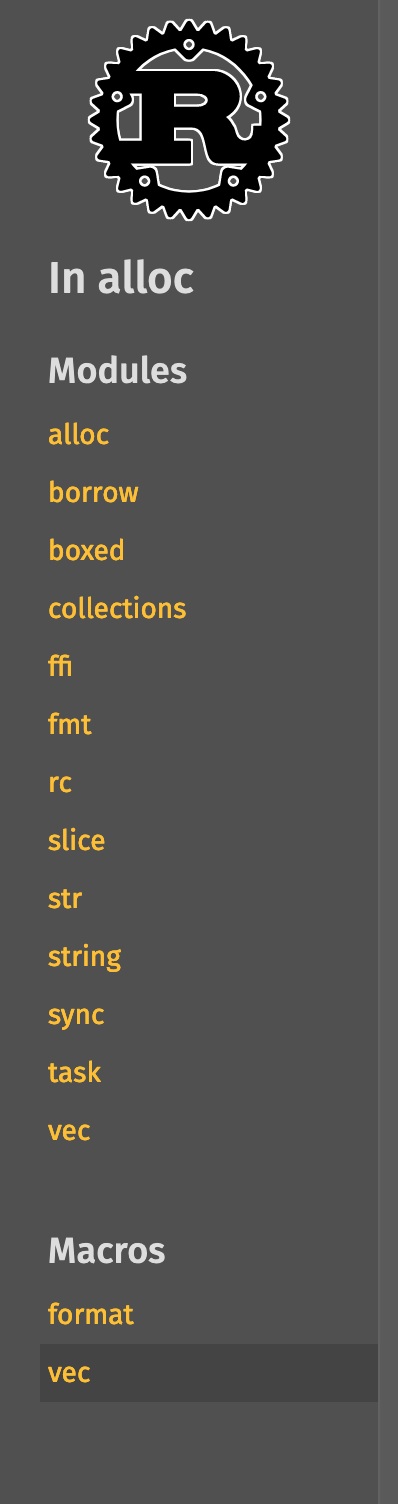 |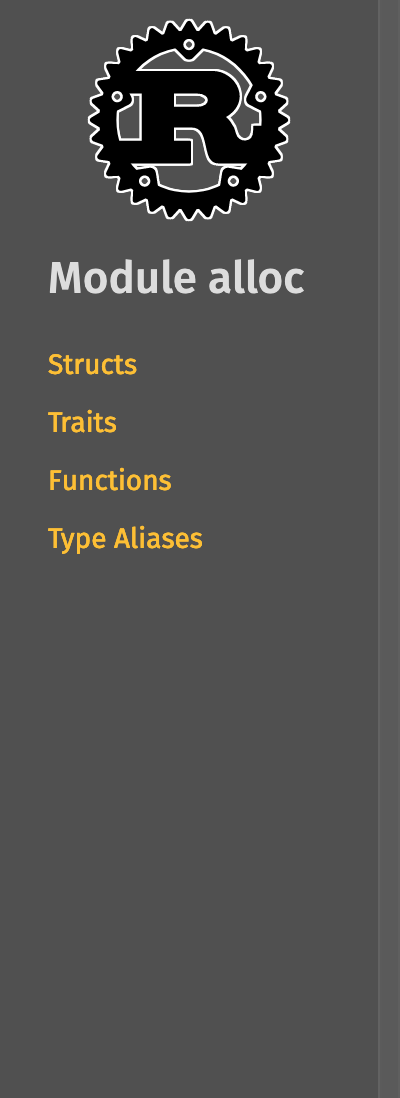
| In module[^1] |  | 
[^1]: This PR also includes a bug fix for derive macros not showing up in the lateral navigation part of the sidebar
</details>
#### Whole sidebar screenshots
| | Macro | Module |
|--|-------|--------|
| In crate | 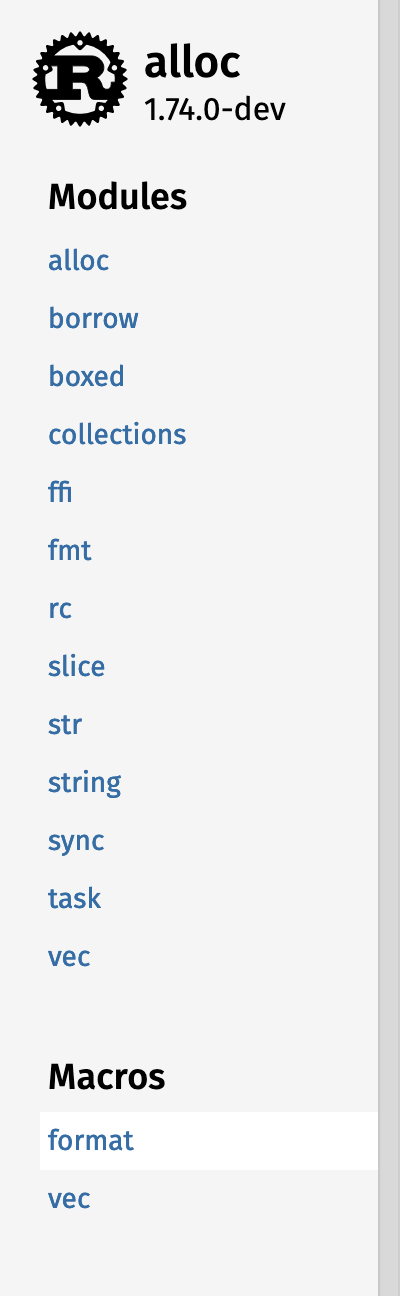 | 
| In module | 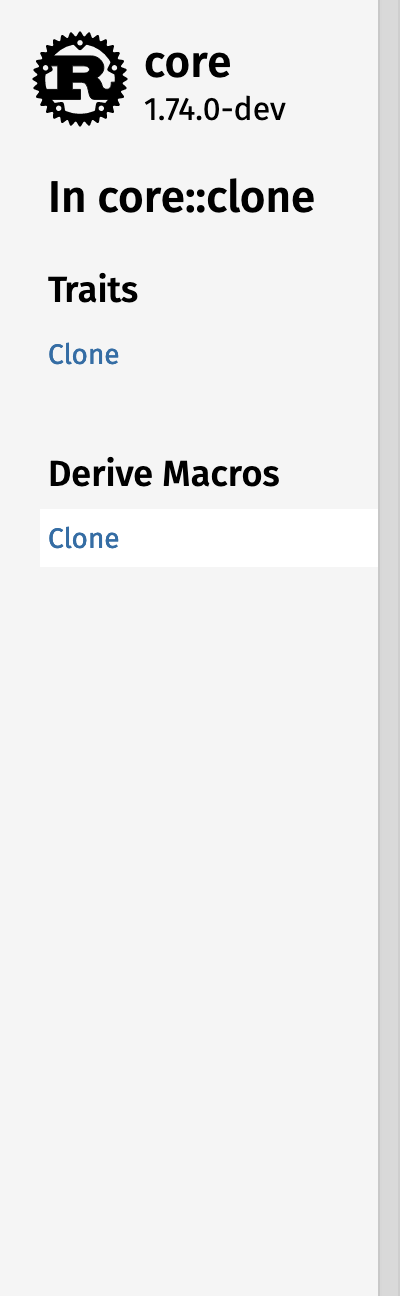 | 
#### Different logo configurations
| | Short crate name | Long crate name |
|---------|------------------|-----------------|
| Root | ![short-root] | ![long-root]
| Subpage | ![short-subpage] | ![long-subpage]
[short-root]: https://github.com/rust-lang/rust/assets/1593513/9e2b4fa8-f581-4106-b562-1e0372c13f79
[short-subpage]: https://github.com/rust-lang/rust/assets/1593513/8331cdb8-fa13-4671-a1e2-dcc1cdca7451
[long-root]: https://github.com/rust-lang/rust/assets/1593513/7d377fec-0f1d-4343-9f82-0e35a8f58056
[long-subpage]: https://github.com/rust-lang/rust/assets/1593513/3b3094a4-63c9-477c-8c15-b6075837df30
##### Without a logo

### Preview pages
https://notriddle.com/rustdoc-html-demo-5/sidebar-layout-rocket/rocket/index.html
https://notriddle.com/rustdoc-html-demo-5/sidebar-layout-rocket/rocket_sync_db_pools/index.html
https://notriddle.com/rustdoc-html-demo-5/sidebar-layout-rust-compiler/index.html
https://notriddle.com/rustdoc-html-demo-5/sidebar-layout-rust/std/index.html
https://notriddle.com/rustdoc-html-demo-5/sidebar-layout-rocket/tokio/index.html
## Motivation
This improves visual information density (the construct with the logo and crate name is *shorter* than the logo on its own, because it's not square) and navigation clarity (we can now see what clicking the Rust logo does, specifically).
Compare this with the layout at [Phoenix's Hexdocs] (which is what this proposal is closely based on), the old proposal on [Internals Discourse] (which always says "Rust standard library" in the sidebar, but doesn't do the side-by-side layout).
[Phoenix's Hexdocs]: https://hexdocs.pm/phoenix/1.7.7/overview.html
[Internals Discourse]: https://internals.rust-lang.org/t/poc-of-a-new-design-for-the-generated-rustdoc/11018
## Guide-level explanation
This PR cleans up some of the sidebar navigation.
It makes the logo in the desktop sidebar a bit smaller, and puts the crate name and version next to it (either beside it, or below it, depending on if there's space), making it clearer what clicking on it does: click the crate name to open the crate's home page. It also removes the Rust logo from non-official-Rust crates, again to make the navigation and supply chain clearer (since the crate name has been added, the logo is no longer necessary for navigation).
It adds a bit more clarifying information for lateral navigation. On items that don't add their own sidebar items, it just shows its siblings directly below the crate name and logo, but for other items, it shows "In crate alloc" instead of just "In alloc". It also shows the lateral navigation tools on module pages, making modules consistent with every other item.
## Drawbacks
While this actually takes up less screen real estate than the old layout on desktop, it takes up more HTML. It's also a bit more visually complex.
## Rationale and alternatives
I could do what the Internals POC did and keep the vertically stacked layout all the time, instead of doing a horizontal stack where possible. It would take up more screen real estate, though.
## Prior art
This design is lifted almost verbatim from Hexdocs. It seems to work for them. [`opentelemetry_process_propagator`], for example, has a long application name.
[`opentelemetry_process_propagator`]: https://hexdocs.pm/opentelemetry_process_propagator/OpentelemetryProcessPropagator.html
## Unresolved questions
Maybe we should encourage crate authors to include their own logo more often? It certainly helps give people a better sense of "place." This seems to be blocked on coming up with an API to do it without requiring them to host the file somewhere.
## Future possibilities
Beyond this, plenty of other changes could be made to improve the layout, like
* Fix things so that clicking an item in the sidebar doesn't cause it to scroll back to the top.
* The [Internals demo](https://utherii.github.io/new.html) does this right: clicking an item in the sidebar changes the content area, but the sidebar itself does not change. This is nice, because clicking is cheap and I can skim the opening few paragraphs while browsing.
* The layout of the docs sidebar causes trouble to implement this, because it's different on different pages, but at least fix this on the file browser.
* Come up with a less cluttered way to do disclosure. There's a lot of `[-]` on the page.
* We don't lack ideas to fix this one. We have *too many*.
* Do a better job of separating local navigation (vec::Vec links to vec::IntoIter) and the table of contents (vec::Vec links to vec::Vec::new).
* A possibility: add a Back arrow next to the "In [module]" header?
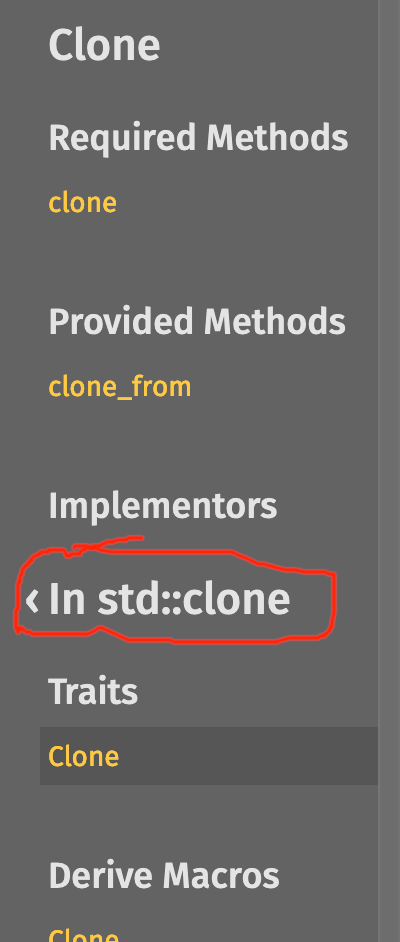
* Give readers more control of how much rustdoc shows them, and giving doc authors more control of how much it generates. Basically, https://github.com/rust-lang/rust/pull/115660 is great, let's do it too.
But those are mostly orthogonal, not future possibilities unlocked by this change.
|
|
r=GuillaumeGomez
rustdoc-search: add impl disambiguator to duplicate assoc items
Preview (to see the difference, click the link and pay attention to the specific function that comes up):
| Before | After |
|--|--|
| [`simd<i64>, simd<i64> -> simd<i64>`](https://doc.rust-lang.org/nightly/std/?search=simd%3Ci64%3E%2C%20simd%3Ci64%3E%20-%3E%20simd%3Ci64%3E) | [`simd<i64>, simd<i64> -> simd<i64>`](https://notriddle.com/rustdoc-demo-html-3/impl-disambiguate-search/std/index.html?search=simd%3Ci64%3E%2C%20simd%3Ci64%3E%20-%3E%20simd%3Ci64%3E) |
| [`cow, vec -> bool`](https://doc.rust-lang.org/nightly/std/?search=cow%2C%20vec%20-%3E%20bool) | [`cow, vec -> bool`](https://notriddle.com/rustdoc-demo-html-3/impl-disambiguate-search/std/index.html?search=cow%2C%20vec%20-%3E%20bool)
Helps with #90929
This changes the search results, specifically, when there's more than one impl with an associated item with the same name. For example, the search queries `simd<i8> -> simd<i8>` and `simd<i64> -> simd<i64>` don't link to the same function, but most of the functions have the same names.
This change should probably be FCP-ed, especially since it adds a new anchor link format for `main.js` to handle, so that URLs like `struct.Vec.html#impl-AsMut<[T]>-for-Vec<T,+A>/method.as_mut` redirect to `struct.Vec.html#method.as_mut-2`. It's a strange design, but there are a few reasons for it:
* I'd like to avoid making the HTML bigger. Obviously, fixing this bug is going to add at least a little more data to the search index, but adding more HTML penalises viewers for the benefit of searchers.
* Breaking `struct.Vec.html#method.len` would also be a disappointment.
On the other hand:
* The path-style anchors might be less prone to link rot than the numbered anchors. It's definitely less likely to have URLs that appear to "work", but silently point at the wrong thing.
* This commit arranges the path-style anchor to redirect to the numbered anchor. Nothing stops rustdoc from doing the opposite, making path-style anchors the default and redirecting the "legacy" numbered ones.
### The bug
On the "Before" links, this example search calls for `i64`:

But if I click any of the results, I get `f64` instead.

The PR fixes this problem by adding enough information to the search result `href` to disambiguate methods with different types but the same name.
More detailed description of the problem at:
https://github.com/rust-lang/rust/pull/109422#issuecomment-1491089293
> When a struct/enum/union has multiple impls with different type parameters, it can have multiple methods that have the same name, but which are on different impls. Besides Simd, [Any](https://doc.rust-lang.org/nightly/std/any/trait.Any.html?search=any%3A%3Adowncast) also demonstrates this pattern. It has three methods named `downcast`, on three different impls.
>
> When that happens, it presents a challenge in linking to the method. Normally we link like `#method.foo`. When there are multiple `foo`, we number them like `#method.foo`, `#method.foo-1`, `#method.foo-2`, etc.
>
> It also presents a challenge for our search code. Currently we store all the variants in the index, but don’t have any way to generate unambiguous URLs in the results page, or to distinguish them in the SERP.
>
> To fix this, we need three things:
>
> 1. A fragment format that fully specifies the impl type parameters when needed to disambiguate (`#impl-SimdOrd-for-Simd<i64,+LANES>/method.simd_max`)
> 2. A search index that stores methods with enough information to disambiguate the impl they were on.
> 3. A search results interface that can display multiple methods on the same type with the same name, when appropriate OR a disambiguation landing section on item pages?
>
> For reviewers: it can be hard to see the new fragment format in action since it immediately gets rewritten to the numbered form.
|
|
|
|
|
|
This commit makes three changes for consistency and readability:
- It shows the sibling navigation on module pages. It's weird
that it didn't work before, and is inconsistent with everything
else (even Crates have sibling navigation with other Crates).
- It hides the "In [parent]" header if it's the same as the
current crate, and if there's no other header between them.
We need to keep it on modules and types, since they have
their own header and data between them, and we don't want
to show siblings under a header implying that they're children.
- It adds a margin to deal with the headers butting directly into
the branding lockup.
|
|
|
|
This should result in a layout for the actual standard library,
when built on CI, that looks like this:
_____
/ \ std
| R | 1.74.0-nightly
\_____/
(203c57dbe 2023-09-17)
Having the whole version as one string caused it to flex wrap,
because the sidebar isn't wide enough to fit the whole thing.
|
|
This commit changes the layout to something a bit less "look at my logo!!!111"
gigantic, and makes it clearer where clicking the logo will actually take you.
It also means the crate name is persistently at the top of the sidebar, even
when in a sub-item page, and clicking that name takes you back to the root.
| | Short crate name | Long crate name |
|---------|------------------|-----------------|
| Root | ![short-root] | ![long-root]
| Subpage | ![short-subpage] | ![long-subpage]
[short-root]: https://github.com/rust-lang/rust/assets/1593513/fe2ce102-d4b8-44e6-9f7b-68636a907f56
[short-subpage]: https://github.com/rust-lang/rust/assets/1593513/29501663-56c0-4151-b7de-d2637e167125
[long-root]: https://github.com/rust-lang/rust/assets/1593513/f6a385c0-b4c5-4a9c-954b-21b38de4192f
[long-subpage]: https://github.com/rust-lang/rust/assets/1593513/97ec47b4-61bf-4ebe-b461-0d2187b8c6ca
https://notriddle.com/rustdoc-html-demo-4/logo-lockup/image/index.html
https://notriddle.com/rustdoc-html-demo-4/logo-lockup/crossbeam_channel/index.html
https://notriddle.com/rustdoc-html-demo-4/logo-lockup/adler/struct.Adler32.html
https://notriddle.com/rustdoc-html-demo-4/logo-lockup/crossbeam_channel/struct.Sender.html
This improves visual information density (the construct with the logo and
crate name is *shorter* than the logo on its own, because it's not
square) and navigation clarity (we can now see what clicking the Rust logo
does, specifically).
Compare this with the layout at [Phoenix's Hexdocs] (which is what this
proposal is closely based on), the old proposal on [Internals Discourse]
(which always says "Rust standard library" in the sidebar, but doesn't do the
side-by-side layout).
[Phoenix's Hexdocs]: https://hexdocs.pm/phoenix/1.7.7/overview.html
[Internals Discourse]: https://internals.rust-lang.org/t/poc-of-a-new-design-for-the-generated-rustdoc/11018
In newer versions of rustdoc, the crate name and version are always shown in
the sidebar, even in subpages. Clicking the crate name does the same thing
clicking the logo always did: return you to the crate root.
While this actually takes up less screen real estate than the old layout on
desktop, it takes up more HTML. It's also a bit more visually complex.
I could do what the Internals POC did and keep the vertically stacked layout
all the time, instead of doing a horizontal stack where possible. It would
take up more screen real estate, though.
This design is lifted almost verbatim from Hexdocs. It seems to work for them.
[`opentelemetry_process_propagator`], for example, has a long application name.
[`opentelemetry_process_propagator`]: https://hexdocs.pm/opentelemetry_process_propagator/OpentelemetryProcessPropagator.html
Has anyone written the rationale on why the Rust logo shows up on projects that
aren't the standard library? If we turned it off on non-standard crates by
default, it would line wrap crate names a lot less often.
Or maybe we should encourage crate authors to include their own logo more
often? It certainly helps give people a better sense of "place."
I'm not sure of anything that directly follows up this one. Plenty of other
changes could be made to improve the layout, like
* coming up with a less cluttered way to do disclosure (there's a lot of `[-]`
on the page)
* doing a better job of separating lateral navigation (vec::Vec links to
vec::IntoIter) and the table of contents (vec::Vec links to vec::Vec::new)
* giving readers more control of how much rustdoc hows them, and giving doc
authors more control of how much it generates
* better search that reduces the need to browse
But those are mostly orthogonal, not future possibilities unlocked by this change.
|
|
|
|
|
|
|
|
|
|
Helps with #90929
This changes the search results, specifically, when there's more than
one impl with an associated item with the same name. For example,
the search queries `simd<i8> -> simd<i8>` and `simd<i64> -> simd<i64>`
don't link to the same function, but most of the functions have the
same names.
This change should probably be FCP-ed, especially since it adds a new
anchor link format for `main.js` to handle, so that URLs like
`struct.Vec.html#impl-AsMut<[T]>-for-Vec<T,+A>/method.as_mut` redirect
to `struct.Vec.html#method.as_mut-2`. It's a strange design, but there
are a few reasons for it:
* I'd like to avoid making the HTML bigger. Obviously, fixing this bug
is going to add at least a little more data to the search index, but
adding more HTML penalises viewers for the benefit of searchers.
* Breaking `struct.Vec.html#method.len` would also be a disappointment.
On the other hand:
* The path-style anchors might be less prone to link rot than the numbered
anchors. It's definitely less likely to have URLs that appear to "work",
but silently point at the wrong thing.
* This commit arranges the path-style anchor to redirect to the numbered
anchor. Nothing stops rustdoc from doing the opposite, making path-style
anchors the default and redirecting the "legacy" numbered ones.
|
|
rustdoc-search: add support for type parameters
r? `@GuillaumeGomez`
## Preview
* https://notriddle.com/rustdoc-html-demo-4/advanced-search/rustdoc/read-documentation/search.html
* https://notriddle.com/rustdoc-html-demo-4/advanced-search/std/index.html?search=option%3Coption%3CT%3E%3E%20-%3E%20option%3CT%3E
* https://notriddle.com/rustdoc-html-demo-4/advanced-search/std/index.html?search=option%3CT%3E,%20E%20-%3E%20result%3CT,%20E%3E
* https://notriddle.com/rustdoc-html-demo-4/advanced-search/std/index.html?search=-%3E%20option%3CT%3E
## Description
When writing a type-driven search query in rustdoc, specifically one with more than one query element, non-existent types become generic parameters instead of auto-correcting (which is currently only done for single-element queries) or giving no result. You can also force a generic type parameter by writing `generic:T` (and can force it to not use a generic type parameter with something like `struct:T` or whatever, though if this happens it means the thing you're looking for doesn't exist and will give you no results).
There is no syntax provided for specifying type constraints for generic type parameters.
When you have a generic type parameter in a search query, it will only match up with generic type parameters in the actual function, not concrete types that match, not concrete types that implement a trait. It also strictly matches based on when they're the same or different, so `option<T>, option<U> -> option<U>` matches `Option::and`, but not `Option::or`. Similarly, `option<T>, option<T> -> option<T>` matches `Option::or`, but not `Option::and`.
## Motivation
This feature is motivated by the many "combinitor"-type functions found in generic libraries, such as Option, Future, Iterator, and Entry. These highly-generic functions have names that are almost completely arbitrary, and a type signature that tells you what it actually does.
This PR is a major step towards[^closure] being able to easily search for generic functions by their type signature instead of by name. Some examples of combinators that can be found using this PR (try them out in the preview):
* `option<option<T>> -> option<T>` returns Option::flatten
* `option<T> -> result<T>` returns Option::ok_or
* `option<result<T>> -> result<option<T>>` returns Option::transpose
* `entry<K, V>, FnOnce -> V` returns `Entry::or_insert_with` (and `or_insert_with_key`, since there's no way to specify the generics on FnOnce)
[^closure]:
For this feature to be as useful as it ought to be, you should be able to search for *trait-associated types* and *closures*. This PR does not implement either of these: they are **Future possibilities**.
Trait-associated types would allow queries like `option<T> -> iterator<item=T>` to return `Option::iter`. We should also allow `option<T> -> iterator<T>` to match the associated type version.
Closures would make a good way to query for things like `Option::map`. Closure support needs associated types to be represented in the search index, since `FnOnce() -> i32` desugars to `FnOnce<Output=i32, ()>`, so associated trait types should be implemented first. Also, we'd want to expose an easy way to query closures without specifying which of the three traits you want.
|
|
|
|
when its syntax is used.
|
|
Based on
https://github.com/rust-lang/rust/pull/115812#issuecomment-1717960119
Having them in separate files used to make more sense, before the
migration to CSS variables made the theme files as small as they are
nowadays. This is already how docs.rs and mdBook do it.
|
|
r=notriddle
Merge settings.css into rustdoc.css
There aren't that many CSS rules in `settings.css`, however quite some code is needed around it, making it more costly than useful. I think it's better to merge into `rustdoc.css` to simplify this.
r? `@notriddle`
|
|
|
|
|
|
|
|
|
|
|
|
r=GuillaumeGomez
rustdoc: list matching impls on type aliases
Fixes https://github.com/rust-lang/rust/issues/32077
Fixes #99952
Remake of https://github.com/rust-lang/rust/pull/112429
Partially reverts https://github.com/rust-lang/rust/pull/112543, but keeps the test case.
This version of the PR avoids the infinite loop by structurally matching types instead of using full unification. This version does not support type alias trait bounds, but the compiler does not enforce those anyway (https://github.com/rust-lang/rust/issues/21903).
r? `@GuillaumeGomez`
CC `@lcnr`
|
|
r=notriddle
rustdoc: Render private fields in tuple struct as `/* private fields */`
Reopening of https://github.com/rust-lang/rust/pull/110552. All that was missing was a test for the different cases so I added it into the second commit.
Description from the original PR:
> I've gotten some feedback that the current rustdoc rendering of...
>
> ```
> struct HasPrivateFields(_);
> ```
>
> ...is confusing, and I agree with that feedback, especially compared to the field struct case:
>
> ```
> struct HasPrivateFields { /* private fields */ }
> ```
>
> So this PR makes it so that when all of the fields of a tuple variant are private, just render it with the `/* private fields */` comment. We can't *always* render it like that, for example when there's a mix of private and public fields.
cc ````@jsha````
r? ````@notriddle````
|
|
rustdoc: show inner enum and struct in type definition for concrete type
This PR implements the [Display enum variants for generic enum in type def page](https://rust-lang.zulipchat.com/#narrow/stream/266220-rustdoc/topic/Display.20enum.20variants.20for.20generic.20enum.20in.20type.20def.20page) #rustdoc/zulip proposal.
This proposal comes from looking at [`TyKind`](https://doc.rust-lang.org/nightly/nightly-rustc/rustc_middle/ty/sty/type.TyKind.html) typedef from the compiler. On that page, the documentation is able to show the layout for each variant, but not the variants themselves. This proposal suggests showing the fields and variants for those "concrete type". This would mean that instead of having many unresolved generics, like in `IrTyKind`:
```rust
Array(I::Ty, I::Const),
Slice(I::Ty),
RawPtr(I::TypeAndMut),
Ref(I::Region, I::Ty, I::Mutability),
FnDef(I::DefId, I::GenericArgsRef),
```
those would be resolved with direct links to the proper types in the `TyKind` typedef page:
```rust
Array(Ty<'tcx>, Const<'tcx>),
Slice(Ty<'tcx>),
RawPtr(TypeAndMut<'tcx>),
Ref(Region<'tcx>, Ty<'tcx>, Mutability<'tcx>),
FnDef(DefId<'tcx>, GenericArgsRef<'tcx>),
```
Saving both time and confusion.
-----
<details>
<summary>Old description</summary>
I've chosen to add the enums and structs under the "Show Aliased Type" details, as well as showing the variants and fields under the usual "Variants" and "Fields" sections. ~~*under new the `Inner Variants` and `Inner Fields` sections (except for their names, they are identical to the one found in the enum, struct and union pages). Those sections are complementary and do not replace anything else.*~~
This PR proposes the following condition for showing the aliased type (basically, has the aliased type some generics that are all of them resolved):
- the typedef does NOT have any generics (modulo lifetimes)
- AND the aliased type has some generics
</details>
### Examples
```rust
pub enum IrTyKind<'a, I: Interner> {
/// Doc comment for AdtKind
AdtKind(&'a I::Adt),
/// and another one for TyKind
TyKind(I::Adt, I::Ty),
// no comment
StructKind { a: I::Adt, },
}
pub type TyKind<'a> = IrTyKind<'a, TyCtxt>;
```

<details>
<summary>Old</summary>


</details>
```rust
pub struct One<T> {
pub val: T,
#[doc(hidden)]
pub inner_tag: u64,
__hidden: T,
}
/// `One` with `u64` as payload
pub type OneU64 = One<u64>;
```

<details>
<summary>Old</summary>


</details>
r? `@GuillaumeGomez`
|
|
|
|
When writing a type-driven search query in rustdoc, specifically one
with more than one query element, non-existent types become generic
parameters instead of auto-correcting (which is currently only done
for single-element queries) or giving no result. You can also force a
generic type parameter by writing `generic:T` (and can force it to not
use a generic type parameter with something like `struct:T` or whatever,
though if this happens it means the thing you're looking for doesn't
exist and will give you no results).
There is no syntax provided for specifying type constraints
for generic type parameters.
When you have a generic type parameter in a search query, it will only
match up with generic type parameters in the actual function, not
concrete types that match, not concrete types that implement a trait.
It also strictly matches based on when they're the same or different,
so `option<T>, option<U> -> option<U>` matches `Option::and`, but not
`Option::or`. Similarly, `option<T>, option<T> -> option<T>`` matches
`Option::or`, but not `Option::and`.
|
|
|
|
|
|
|
|
|
|
Co-authored-by: León Orell Valerian Liehr <me@fmease.dev>
|
|
|
|
This let's us handle a multitude of things for free:
- #[doc(hidden)]
- private fields/variants
- --document-private-items
- --document-hidden-items
And correct in the process the determination of "has stripped items" by
doing the same logic done by other ones.
|
|
|
|
Remake of "List matching impls on type aliases"
* 4b1d13d9841c815915433ca2a3088a8e3e97ad96
* 6f552c800b38b3e71c5e33a295e8b490d2018c71
* 2ce7cd906bde70d8cbd9b07b31c6a7bf1131c345
Partially reverts "Fix infinite loop when retrieving impls for
type alias", but keeps the test case.
This version of the PR avoids the infinite loop by structurally
matching types instead of using full unification. This version
does not support type alias trait bounds, but the compiler does
not enforce those anyway
(https://github.com/rust-lang/rust/issues/21903).
|
|
|
|
rustdoc: Rename typedef to type alias
This matches the name used by the [Rust Reference][1], which is also what
people usually call these items.
[1]: https://doc.rust-lang.org/reference/items/type-aliases.html
r? `@GuillaumeGomez`
|
|
|
|
|
|
|
|
This matches the name used by the Rust Reference [1], which is also what
people usually call these items.
[1]: https://doc.rust-lang.org/reference/items/type-aliases.html
|
|
|
|
|
|
|
|
|
|
|
|
|
