| Age | Commit message (Collapse) | Author | Lines |
|---|
|
r=compiler-errors
Remove `TokenKind::InvalidPrefix`
It's not needed. Best reviewed one commit at a time.
r? `@estebank`
|
|
It was added in #123752 to handle some cases involving emoji, but it
isn't necessary because it's always treated the same as
`TokenKind::InvalidIdent`. This commit removes it, which makes things a
little simpler.
|
|
rustdoc-search: use smart binary search in bitmaps
Addresses a comment from [jsha's benchmarking], where the `contains` function showed up in the profiler. This commit pulls it from about 5% of the runtime to about 0.5%.
Before: https://share.firefox.dev/3ANVjon
After: https://share.firefox.dev/3OeM3gk
[jsha's benchmarking]: https://rust-lang.zulipchat.com/#narrow/channel/266220-t-rustdoc/topic/search.20profiling/near/481868761
|
|
[rustdoc] Fix items with generics not having their jump to def link generated
Because the span originally included the generics, during the highlighting, it was not retrieved and therefore its jump to def link was not generated.
r? ``@notriddle``
|
|
|
|
Addresses a comment from [jsha's benchmarking], where the `contains`
function showed up in the profiler. This commit pulls it from about
5% of the runtime to about 0.5%.
[jsha's benchmarking]: https://rust-lang.zulipchat.com/#narrow/channel/266220-t-rustdoc/topic/search.20profiling/near/481868761
|
|
|
|
|
|
the behavior of the type system not only depends on the current
assumptions, but also the currentnphase of the compiler. This is
mostly necessary as we need to decide whether and how to reveal
opaque types. We track this via the `TypingMode`.
|
|
fixes https://github.com/rust-lang/rust/issues/129707
this can be used to show all items in a module,
or all associated items for a type.
currently sufferes slightly due to case insensitivity,
so `Option::` will also show items in the `option::` module.
it disables the checking of the last path element,
otherwise only items with short names will be shown
|
|
Rollup of 4 pull requests
Successful merges:
- #128197 (Skip locking span interner for some syntax context checks)
- #133040 ([rustdoc] Fix handling of footnote reference in footnote definition)
- #133043 (rustdoc-search: case-sensitive only when capitals are used)
- #133046 (Clippy subtree update)
r? `@ghost`
`@rustbot` modify labels: rollup
|
|
rustdoc-search: case-sensitive only when capitals are used
This is the "smartcase" behavior, described by vim and dtolnay.
Fixes https://github.com/rust-lang/rust/issues/133017
|
|
This is the "smartcase" behavior, described by vim and dtolnay.
|
|
|
|
rustdoc: use a trie for name-based search
Potentially https://github.com/rust-lang/rust/issues/131156 — need to try reproducing the problem with `windows`
Preview and profiler results
----------------------------
Here's some quick profiling in Firefox done on the rust compiler docs:
- Before: https://share.firefox.dev/3UPm3M8
- After: https://share.firefox.dev/40LXvYb
Here's the results for the node.js profiler:
- https://notriddle.com/rustdoc-html-demo-15/trie-perf/index.html
Here's a copy that you can use to try it out. Compare it with [the nightly]. Try typing `typecheckercontext` one character at a time, slowly.
- https://notriddle.com/rustdoc-html-demo-15/compiler-doc-trie/index.html
[the nightly]: https://doc.rust-lang.org/nightly/nightly-rustc/
The fuzzy match algo is based on [Fast String Correction with Levenshtein-Automata] and the corresponding implementation code in [moman] and [Lucene]; the bit-packing representation comes from Lucene, but the actual matcher is more based on `fsc.py`. As suggested in the paper, a trie is used to represent the FSA dictionary.
The same trie is used for prefix matching. Substring matching is done with a side table of three-character[^1] windows that point into the trie.
[Fast String Correction with Levenshtein-Automata]: https://github.com/tpn/pdfs/blob/master/Fast%20String%20Correction%20with%20Levenshtein-Automata%20(2002)%20(10.1.1.16.652).pdf
[Lucene]: https://fossies.org/linux/lucene/lucene/core/src/java/org/apache/lucene/util/automaton/Lev1TParametricDescription.java
[moman]: https://gitlab.com/notriddle/moman-rustdoc
User-visible changes
--------------------
I don't expect anybody to notice anything, but it does cause two changes:
- Substring matches, in the middle of a name, only apply if there's three or more characters in the search query.
- Levenshtein distance limit now maxes out at two. In the old version, the limit was w/3, so you could get looser matches for queries with 9 or more characters[^1] in them.
- It uses more RAM.
- It's faster (assuming you don't swap thrash).
[^1]: technically utf-16 code units
|
|
|
|
|
|
[rustdoc] Fix duplicated footnote IDs
Fixes https://github.com/rust-lang/rust/issues/131901.
Footnote IDs were increased locally (ie, on the docblock) and not globally (ie, on the whole item page).
cc `@aDotInTheVoid`
r? `@notriddle`
|
|
rustdoc: Treat declarative macros more like other item kinds
Apparently at some time in the past we were unable to generate an href for the module path inside the visibility of decl macros 2.0 (`pub(in ...)`). As a result of this, a whole separate function was introduced specifically for printing the visibility of decl macros that didn't attempt to generate any links. The description of PR https://github.com/rust-lang/rust/pull/84074 states:
> This fixes the overly-complex invariant mentioned in https://github.com/rust-lang/rust/pull/83237#issuecomment-815346570, where the macro source can't have any links in it only because the cache hasn't been populated yet.
I can no longer reproduce the original issue. Reusing the existing visibility rendering logic *seems* to work just fine (I couldn't come up with any counterexamples, though I invite you to prove me wrong).
* Fixes #83000
* Fixes the visibility showing up "twice" in rustdoc-JSON output: Once as the `visibility` field, once baked into the source[^1]
* Fixes `#[doc(hidden)]` not getting rendered on doc(hidden) decl macros 2.0 under `--document-hiden-items` (for decl macros 1.2 the issue remains; I will address this separately when fixing #132304).
---
<details><summary>Outdated Section</summary>
NOTE: The current version of this PR is committing a UI crime, I'd like to receive feedback on that. Maybe you have a satisfactory solution for how to remedy it. Namely, as you know we have two different ways of / modes for highlighting code with color:
1. Only highlighting links / item paths and avoiding to highlight tokens by kind like keywords (to reduce visual noise and maybe also artifact size). Used for item declarations(\*).
2. Highlighting tokens by kind. Used for code blocks written by the user.
(\*): With the notable exception being macro declarations! Well, since this PR reuses the same function for rendering the item visibility (which only makes sense), we have a clash of modes: We now use both ways of highlighting code for decl macros: №1 for the visibility, №2 for the rest. This awkward. See for yourself:
* On master: 
* On this branch: 
</details>
Furthermore, we now no longer syntax-highlight declarative macros (be it `macro_rules!` or `macro`) since that was inconsistent with the way we render all other item kinds. See (collapsed) *Outdated Section* above. See also https://github.com/rust-lang/rust/pull/132302#discussion_r1821310783.
| On master | On this branch |
|---|---|
|  |  |
[^1]: E.g., `"visibility":{"restricted":{"parent":1,"path":"::a"}},/*OMITTED*/,"inner":{"macro":"pub(in a) macro by_example_vis_named($foo:expr) {\n ...\n}"}`
|
|
Preview and profiler results
----------------------------
Here's some quick profiling in Firefox done on the rust compiler docs:
- Before: https://share.firefox.dev/3UPm3M8
- After: https://share.firefox.dev/40LXvYb
Here's the results for the node.js profiler:
- https://notriddle.com/rustdoc-html-demo-15/trie-perf/index.html
Here's a copy that you can use to try it out. Compare it with [the nightly].
Try typing `typecheckercontext` one character at a time, slowly.
- https://notriddle.com/rustdoc-html-demo-15/compiler-doc-trie/index.html
[the nightly]: https://doc.rust-lang.org/nightly/nightly-rustc/
The fuzzy match algo is based on [Fast String Correction with
Levenshtein-Automata] and the corresponding implementation code in [moman]
and [Lucene]; the bit-packing representation comes from Lucene, but the
actual matcher is more based on `fsc.py`. As suggested in the paper, a
trie is used to represent the FSA dictionary.
The same trie is used for prefix matching. Substring matching is done with a
side table of three-character[^1] windows that point into the trie.
[Fast String Correction with Levenshtein-Automata]: https://github.com/tpn/pdfs/blob/master/Fast%20String%20Correction%20with%20Levenshtein-Automata%20(2002)%20(10.1.1.16.652).pdf
[Lucene]: https://fossies.org/linux/lucene/lucene/core/src/java/org/apache/lucene/util/automaton/Lev1TParametricDescription.java
[moman]: https://gitlab.com/notriddle/moman-rustdoc
User-visible changes
--------------------
I don't expect anybody to notice anything, but it does cause two changes:
- Substring matches, in the middle of a name, only apply if there's three
or more characters in the search query.
- Levenshtein distance limit now maxes out at two. In the old version,
the limit was w/3, so you could get looser matches for queries with
9 or more characters[^1] in them.
[^1]: technically utf-16 code units
|
|
|
|
|
|
Proper support for cross-crate recursive const stability checks
~~Stacked on top of https://github.com/rust-lang/rust/pull/132492; only the last three commits are new.~~
In a crate without `staged_api` but with `-Zforce-unstable-if-unmarked`, we now subject all functions marked with `#[rustc_const_stable_indirect]` to recursive const stability checks. We require an opt-in so that by default, a crate can be built with `-Zforce-unstable-if-unmarked` and use nightly features as usual. This property is recorded in the crate metadata so when a `staged_api` crate calls such a function, it sees the `#[rustc_const_stable_indirect]` and allows it to be exposed on stable. This, finally, will let us expose `const fn` from hashbrown on stable.
The second commit makes const stability more like regular stability: via `check_missing_const_stability`, we ensure that all publicly reachable functions have a const stability attribute -- both in `staged_api` crates and `-Zforce-unstable-if-unmarked` crates. To achieve this, we move around the stability computation so that const stability is computed after regular stability is done. This lets us access the final result of the regular stability computation, which we use so that `const fn` can inherit the regular stability (but only if that is "unstable"). Fortunately, this lets us get rid of an `Option` in `ConstStability`.
This is the last PR that I have planned in this series.
r? `@compiler-errors`
|
|
rustdoc-search: simplify rules for generics and type params
**Heads up!**: This PR is a follow-up that depends on #124544. It adds 12dc24f46007f82b93ed85614347a42d47580afa, a change to the filtering behavior, and 9900ea48b566656fb12b5fcbd0a1b20aaa96e5ca, a minor ranking tweak.
Part of https://github.com/rust-lang/rust-project-goals/issues/112
This PR overturns https://github.com/rust-lang/rust/pull/109802
## Preview
* no results: [`Box<[A]> -> Vec<B>`](http://notriddle.com/rustdoc-html-demo-12/search-sem-3/std/index.html?search=Box%3C%5BA%5D%3E%20-%3E%20Vec%3CB%3E)
* results: [`Box<[A]> -> Vec<A>`](http://notriddle.com/rustdoc-html-demo-12/search-sem-3/std/index.html?search=Box%3C%5BA%5D%3E%20-%3E%20Vec%3CA%3E)
* [`T -> U`](http://notriddle.com/rustdoc-html-demo-12/search-sem-3/std/index.html?search=T%20-%3E%20U)
* [`Cx -> TyCtxt`](http://notriddle.com/rustdoc-html-demo-12/search-sem-3-compiler/rustdoc/index.html?search=Cx%20-%3E%20TyCtxt)
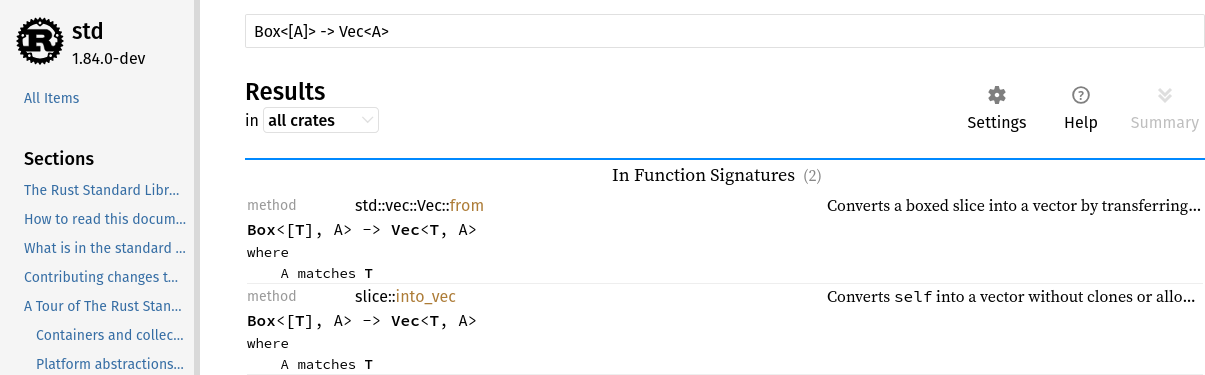
## Description
This commit is a response to feedback on the displayed type signatures results, by making generics act stricter.
- Order within generics is significant. This means `Vec<Allocator>` now matches only with a true vector of allocators, instead of matching the second type param. It also makes unboxing within generics stricter, so `Result<A, B>` only matches if `B` is in the error type and `A` is in the success type. The top level of the function search is unaffected.
- Generics are only "unboxed" if a type is explicitly opted into it. References and tuples are hardcoded to allow unboxing, and Box, Rc, Arc, Option, Result, and Future are opted in with an unstable attribute. Search result unboxing is the process that allows you to search for `i32 -> str` and get back a function with the type signature `&Future<i32> -> Box<str>`.
- Instead of ranking by set overlap, it ranks by the number of items in the type signature. This makes it easier to find single type signatures like transmute.
## Find the discussion on
* <https://rust-lang.zulipchat.com/#narrow/stream/393423-t-rustdoc.2Fmeetings/topic/meeting.202024-07-08/near/449965149>
* <https://github.com/rust-lang/rust/pull/124544#issuecomment-2204272265>
* <https://rust-lang.zulipchat.com/#narrow/channel/266220-t-rustdoc/topic/deciding.20on.20semantics.20of.20generics.20in.20rustdoc.20search>
|
|
|
|
rustc_target reexports a lot of things that are in rustc_abi, but
that will be over soon and now is probably a good time to switch.
Uses of rustc_target remain where they inquire about the target tuple.
|
|
|
|
This commit is a response to feedback on the displayed type
signatures results, by making generics act stricter.
Generics are tightened by making order significant. This means
`Vec<Allocator>` now matches only with a true vector of allocators,
instead of matching the second type param. It also makes unboxing
within generics stricter, so `Result<A, B>` only matches if `B`
is in the error type and `A` is in the success type. The top level
of the function search is unaffected.
Find the discussion on:
* <https://rust-lang.zulipchat.com/#narrow/stream/393423-t-rustdoc.2Fmeetings/topic/meeting.202024-07-08/near/449965149>
* <https://github.com/rust-lang/rust/pull/124544#issuecomment-2204272265>
* <https://rust-lang.zulipchat.com/#narrow/channel/266220-t-rustdoc/topic/deciding.20on.20semantics.20of.20generics.20in.20rustdoc.20search/near/476841363>
|
|
|
|
|
|
|
|
This reduces code size while still matching the common case
for plain, concrete types.
|
|
|
|
|
|
r=notriddle
[rustdoc] Unify variant struct fields margins with struct fields
As discussed in https://github.com/rust-lang/rust/pull/132220.
| before | after |
|-|-|
|  |  |
r? ```@notriddle```
|
|
|
|
|
|
expand: Stop using artificial `ast::Item` for macros loaded from metadata
You don't need a full `Item` for that, and not using a piece of AST helps with https://github.com/rust-lang/rust/pull/131808.
|
|
Fix code HTML items making big blocks if too long
Encountered this bug randomly where `code` item in docblocks would look like this:

With this fix it looks like this:

r? ``@notriddle``
|
|
allow type-based search on foreign functions
fixes https://github.com/rust-lang/rust/issues/131804
preferably will be merged after #129708, but that may take a while to be approved due to being a new feature, whereas this is definitely a bug, and should be fixed.
|
|
|
|
|
|
Fundamentally, we have *three* disjoint categories of functions:
1. const-stable functions
2. private/unstable functions that are meant to be callable from const-stable functions
3. functions that can make use of unstable const features
This PR implements the following system:
- `#[rustc_const_stable]` puts functions in the first category. It may only be applied to `#[stable]` functions.
- `#[rustc_const_unstable]` by default puts functions in the third category. The new attribute `#[rustc_const_stable_indirect]` can be added to such a function to move it into the second category.
- `const fn` without a const stability marker are in the second category if they are still unstable. They automatically inherit the feature gate for regular calls, it can now also be used for const-calls.
Also, several holes in recursive const stability checking are being closed.
There's still one potential hole that is hard to avoid, which is when MIR
building automatically inserts calls to a particular function in stable
functions -- which happens in the panic machinery. Those need to *not* be
`rustc_const_unstable` (or manually get a `rustc_const_stable_indirect`) to be
sure they follow recursive const stability. But that's a fairly rare and special
case so IMO it's fine.
The net effect of this is that a `#[unstable]` or unmarked function can be
constified simply by marking it as `const fn`, and it will then be
const-callable from stable `const fn` and subject to recursive const stability
requirements. If it is publicly reachable (which implies it cannot be unmarked),
it will be const-unstable under the same feature gate. Only if the function ever
becomes `#[stable]` does it need a `#[rustc_const_unstable]` or
`#[rustc_const_stable]` marker to decide if this should also imply
const-stability.
Adding `#[rustc_const_unstable]` is only needed for (a) functions that need to
use unstable const lang features (including intrinsics), or (b) `#[stable]`
functions that are not yet intended to be const-stable. Adding
`#[rustc_const_stable]` is only needed for functions that are actually meant to
be directly callable from stable const code. `#[rustc_const_stable_indirect]` is
used to mark intrinsics as const-callable and for `#[rustc_const_unstable]`
functions that are actually called from other, exposed-on-stable `const fn`. No
other attributes are required.
|
|
fixes https://github.com/rust-lang/rust/issues/131804
|
|
r=GuillaumeGomez,notriddle
rustdoc: Extend fake_variadic to "wrapped" tuples
This allows impls such as `impl QueryData for OneOf<(T,)>` to be displayed as variadic: `impl QueryData for OneOf<(T₁, T₂, …, Tₙ)>`.
See question on [zulip](https://rust-lang.zulipchat.com/#narrow/channel/266220-t-rustdoc/topic/Make.20.60.23.5Bdoc.28fake_variadic.29.5D.60.20more.20useful).
|
|
This allows impls such as `impl QueryData for OneOf<(T,)>`
to be displayed as variadic: `impl QueryData for OneOf<(T₁, T₂, …, Tₙ)>`.
See question on zulip:
<https://rust-lang.zulipchat.com/#narrow/channel/266220-t-rustdoc/topic/Make.20.60.23.5Bdoc.28fake_variadic.29.5D.60.20more.20useful>
|
|
rustdoc: adjust spacing and typography in header
Fixes #131589
Preview: https://notriddle.com/rustdoc-html-demo-12/spacing/std/index.html
| Before | After |
|--|--|
|  | 
|  | 
|  | 
|  | 
First of all, we put 4px additional margin below the search box, and 4px margin below the header to balance it out.
The bigger problem we have to solve is making the lines look logically spaced. This is troublesome, because Fira Sans (the typeface we use here) wants to look good on average, and to avoid breaking, with text that uses [ascenders and descenders](https://www.w3.org/TR/css-inline-3/images/text-edge.png). If the text we're putting in happens to not have any, things look weird (strictly speaking, there’s hand-tuning here, because the Copy Path button messes with stuff, but the overall point is that there is no true, one perfect layout).
In order to play nicely with the font, I've tweaked the text to use that space. The word "Source" for the link is now capitalized, and the Since version number now uses oldstyle nums with descenders.
|
|
r=GuillaumeGomez
rustdoc: hash assets at rustdoc build time
Since sha256 is slow enough to show up on small benchmarks, we can save time by embedding the hash in the executable.
Addresses https://github.com/rust-lang/rust/pull/131934#issuecomment-2424213861
|
|
|
|
rustdoc: Document `markdown` module.
Rustdoc markdown handling is currently split between:
- html::markdown, which contains all the meaty login
- markdown, which is only used for when rustdoc renders a standalone markdown file
Adds module-level doc-comment to markdown, and rename the function so it's clear that it's doing IO (instead of just rendering to a string).
|
