| Age | Commit message (Collapse) | Author | Lines |
|---|
|
Add an option for enabling and disabling Fluent's directionality
isolation markers in output. Disabled by default as these can render in
some terminals and applications.
Signed-off-by: David Wood <david.wood@huawei.com>
|
|
Extend loading of Fluent bundles so that bundles can be loaded from the
sysroot based on the language requested by the user, or using a nightly
flag.
Sysroot bundles are loaded from `$sysroot/share/locale/$locale/*.ftl`.
Signed-off-by: David Wood <david.wood@huawei.com>
|
|
This commit updates the signatures of all diagnostic functions to accept
types that can be converted into a `DiagnosticMessage`. This enables
existing diagnostic calls to continue to work as before and Fluent
identifiers to be provided. The `SessionDiagnostic` derive just
generates normal diagnostic calls, so these APIs had to be modified to
accept Fluent identifiers.
In addition, loading of the "fallback" Fluent bundle, which contains the
built-in English messages, has been implemented.
Each diagnostic now has "arguments" which correspond to variables in the
Fluent messages (necessary to render a Fluent message) but no API for
adding arguments has been added yet. Therefore, diagnostics (that do not
require interpolation) can be converted to use Fluent identifiers and
will be output as before.
|
|
Introduce a `DiagnosticMessage` type that will enable diagnostic
messages to be simple strings or Fluent identifiers.
`DiagnosticMessage` is now used in the implementation of the standard
`DiagnosticBuilder` APIs.
Signed-off-by: David Wood <david.wood@huawei.com>
|
|
private module
|
|
|
|
Remember mutability in `DefKind::Static`.
This allows to compute the `BodyOwnerKind` from `DefKind` only, and
removes a direct dependency of some MIR queries onto HIR.
As a side effect, it also simplifies metadata, since we don't need 4
flavours of `EntryKind::*Static` any more.
|
|
|
|
|
|
This allows to compute the `BodyOwnerKind` from `DefKind` only, and
removes a direct dependency of some MIR queries onto HIR.
As a side effect, it also simplifies metadata, since we don't need 4
flavours of `EntryKind::*Static` any more.
|
|
Do not construct or pass unused data
|
|
There are a few places were we have to construct it, though, and a few
places that are more invasive to change. To do this, we create a
constructor with a long obvious name.
|
|
fix typos
Rework of #94603 which got closed as I was trying to unmerge and repush. This is a subset of changes from the original pr as I sed'd whatever typos I remembered from the original PR
thanks to `@cuishuang` for the original PR
|
|
More robust fallback for `use` suggestion
Our old way to suggest where to add `use`s would first look for pre-existing `use`s in the relevant crate/module, and if there are *no* uses, it would fallback on trying to use another item as the basis for the suggestion.
But this was fragile, as illustrated in issue #87613
This PR instead identifies span of the first token after any inner attributes, and uses *that* as the fallback for the `use` suggestion.
Fix #87613
|
|
|
|
librustdoc: adopt let else in more places
Continuation of #89933, #91018, #91481, #93046, #93590, #94011.
I have extended my clippy lint to also recognize tuple passing and match statements. The diff caused by fixing it is way above 1 thousand lines. Thus, I split it up into multiple pull requests to make reviewing easier. This PR handles librustdoc.
|
|
This commit makes `AdtDef` use `Interned`. Much the commit is tedious
changes to introduce getter functions. The interesting changes are in
`compiler/rustc_middle/src/ty/adt.rs`.
|
|
rustdoc: Stop textually replacing `Self` in doc links before resolving them
Resolve it directly to a type / def-id instead.
Also never pass `Self` to `Resolver`, it is useless because it's guaranteed that no resolution will be found.
This is a pre-requisite for https://github.com/rust-lang/rust/issues/83761.
|
|
|
|
Support GATs in Rustdoc
Implements:
1. Rendering GATs in trait definitions and impl blocks
2. Rendering GATs in types (e.g. in the return type of a function)
Fixes #92341
This is my first rustdoc PR, so I have absolutely no idea how to produce tests for this. Advice from the rustdoc team would be wonderful!
I tested locally and things looked correct:
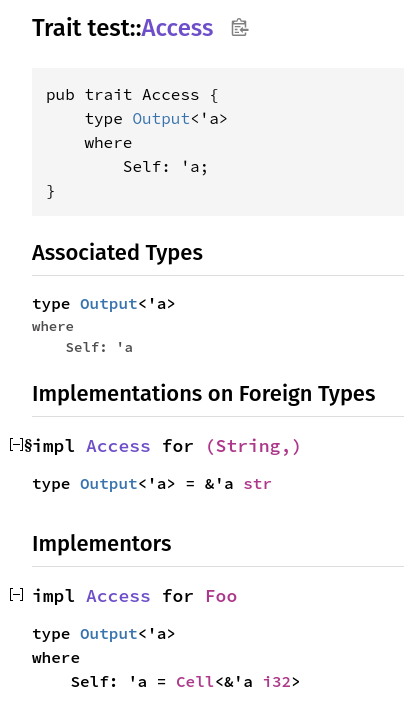
|
|
|
|
r=notriddle
Fix panic when handling intra doc links generated from macro
Fixes #78591.
Fixes #92789.
r? ``@notriddle``
|
|
|
|
|
|
|
|
|
|
|
|
r=GuillaumeGomez
rustdoc: resolve intra-doc links when checking HTML
Similar to #86451
CC #67799
Given this test case:
```rust
#![warn(rustdoc::invalid_html_tags)]
#![warn(rustdoc::broken_intra_doc_links)]
pub struct ExistentStruct<T>(T);
/// This [test][ExistentStruct<i32>] thing!
pub struct NoError;
```
This pull request silences the following, spurious warning:
```text
warning: unclosed HTML tag `i32`
--> test.rs:6:31
|
6 | /// This [test][ExistentStruct<i32>] thing!
| ^^^^^
|
note: the lint level is defined here
--> test.rs:1:9
|
1 | #![warn(rustdoc::invalid_html_tags)]
| ^^^^^^^^^^^^^^^^^^^^^^^^^^
help: try marking as source code
|
6 | /// This [test][`ExistentStruct<i32>`] thing!
| + +
warning: 1 warning emitted
```
|
|
|
|
|
|
Similar to #86451
CC #67799
|
|
|
|
Resolve it directly to a type / def-id instead.
Also never pass `Self` to `Resolver`, it is useless because it's guaranteed that no resolution will be found.
|
|
|
|
rustdoc: Special-case macro lookups less
Previously, rustdoc had 3 fallbacks it used:
1. `resolve_macro_path`
2. `all_macros`
3. `resolve_str_path_error`
Ideally, it would only use `resolve_str_path_error`, to be consistent with other namespaces.
Unfortunately, that doesn't consider macros that aren't defined at module scope;
consider for instance
```rust
{
struct S;
macro_rules! mac { () => {} }
// `mac`'s scope starts here
/// `mac` <- `resolve_str_path_error` won't see this
struct Z;
//`mac`'s scope ends here
}
```
This changes it to only use `all_macros` and `resolve_str_path_error`, and gives
`resolve_str_path_error` precedence over `all_macros` in case there are two macros with the same
name in the same module.
This is a smaller version of https://github.com/rust-lang/rust/pull/91427.
r? `@petrochenkov`
|
|
r=CraftSpider
rustdoc: correct unclosed HTML tags as generics
CC https://github.com/rust-lang/rust/issues/67799
|
|
Previously, rustdoc had 3 fallbacks it used:
1. `resolve_macro_path`
2. `all_macros`
3. `resolve_str_path_error`
Ideally, it would only use `resolve_str_path_error`, to be consistent with other namespaces.
Unfortunately, that doesn't consider macros that aren't defined at module scope;
consider for instance
```rust
{
struct S;
macro_rules! mac { () => {} }
// `mac`'s scope starts here
/// `mac` <- `resolve_str_path_error` won't see this
struct Z;
//`mac`'s scope ends here
}
```
This changes it to only use `all_macros` and `resolve_str_path_error`, and gives
`resolve_str_path_error` precedence over `all_macros` in case there are two macros with the same
name in the same module.
This also adds a failing test case which will catch trying to remove `all_macros`.
|
|
|
|
Another one of those "good grief, I just submitted it and NOW I think of it" moments.
|
|
|
|
|
|
|
|
rustdoc: Remove `def_id_no_primitives`
Fixes #90187.
|
|
Fixes #93428
This fix is a response to a couple of special cases related to the
`module_id`, which is eventually used for trait candidates:
* The module id is always set to the current crate, when checking `crate::`.
Normally, the set of in-scope traits would be set in `load_links_in_attrs`,
but if there are no doc comments, then that loop will never run.
* the module id is set to the parent module, when resolving a module
that is spelled like this:
// Notice how we use an outlined doc comment here!
// [`Test::my_fn`]
mod something {
}
As with the above problem with `crate::`, we need to make sure the
module gets its traits in scope resolved, even if it has no doc comments
of its own.
|
|
rustdoc: Pre-calculate traits that are in scope for doc links
This eliminates one more late use of resolver (part of #83761).
At early doc link resolution time we go through parent modules of items from the current crate, reexports of items from other crates, trait items, and impl items collected by `collect-intra-doc-links` pass, determine traits that are in scope in each such module, and put those traits into a map used by later rustdoc passes.
r? `@jyn514`
|
|
Store a `Symbol` instead of an `Ident` in `AssocItem`
This is the same idea as #92533, but for `AssocItem` instead
of `VariantDef`/`FieldDef`.
With this change, we no longer have any uses of
`#[stable_hasher(project(...))]`
|
|
This eliminates one more late use of resolver
|
|
They don't need to be `pub`. Making them crate-private improves code
clarity and `dead_code` linting.
|
|
This is the same idea as #92533, but for `AssocItem` instead
of `VariantDef`/`FieldDef`.
With this change, we no longer have any uses of
`#[stable_hasher(project(...))]`
|
|
Before, the trait's associated item would be used. Now, the impl's
associated item is used. The only exception is for impls that use
default values for associated items set by the trait. In that case,
the trait's associated item is still used.
As an example of the old and new behavior, take this code:
trait MyTrait {
type AssocTy;
}
impl MyTrait for String {
type AssocTy = u8;
}
Before, when resolving a link to `String::AssocTy`,
`resolve_associated_trait_item` would return the associated item for
`MyTrait::AssocTy`. Now, it would return the associated item for
`<String as MyTrait>::AssocTy`, as it claims in its docs.
|
