| Age | Commit message (Collapse) | Author | Lines |
|---|
|
fmease:rustdoc-effects-properly-elide-x-crate-host-args, r=GuillaumeGomez
rustdoc: properly elide cross-crate host effect args
Fixes FIXMEs introduced in #116670.
|
|
|
|
rustdoc: stop preloading Source Serif 4 Bold
According to #91170, italic fonts are not preloaded because they're rarely used, but bold fonts are. This seems to be true of bold Source Code Pro and bold Fira Sans, but bold and italic Source Serif Pro seem to be equally heavily used.
This is, I assume, the result of using Fira Sans Bold and Source Code Bold headings, so you only get bold Serif text when the doc author uses strong `**` emphasis (or within certain kinds of tooltip, which shouldn't be preloaded because they only show up long after the page is loaded).
To check this, run these two commands in the browser console to measure how much they're used. The measurement is extremely rough, but it gets the idea across: the two styles are about equally popular.
// count bold elements
Array.prototype.slice.call(document.querySelectorAll("*")).filter(x => { const y = document.defaultView.getComputedStyle(x); return y.fontFamily.indexOf("Source Serif 4") !== -1 && y.fontWeight > 400 }).length
// count italic elements
Array.prototype.slice.call(document.querySelectorAll("*")).filter(x => { const y = document.defaultView.getComputedStyle(x); return y.fontFamily.indexOf("Source Serif 4") !== -1 && y.fontStyle == "italic" }).length
| URL | Bold | Italic |
|--------------|-----:|-------:|
| [std] | 2 | 9 |
| [Vec] | 8 | 89 |
| [regex] | 33 | 17 |
| [test_suite] | 0 | 0 |
[std]: https://doc.rust-lang.org/nightly/std/index.html
[Vec]: https://doc.rust-lang.org/nightly/std/vec/struct.Vec.html
[regex]: https://docs.rs/regex/1.9.5/regex/index.html
[test_suite]: https://docs.rs/test-suite/3.2.9/test_suite/
|
|
|
|
matthiaskrgr:baby_dont_clone_me_dont_clone_me_no_more, r=est31
clone less
|
|
`rustc_span` cleanups
Just some things I found while looking over this crate.
r? `@oli-obk`
|
|
|
|
Fix order of implementations in the "implementations on foreign types" section
Fixes #117391.
We forgot to run the `sort_by_cached_key` on this section. This fixes it.
r? `@notriddle`
|
|
|
|
Most notably, this commit changes the `pub use crate::*;` in that file
to `use crate::*;`. This requires a lot of `use` items in other crates
to be adjusted, because everything defined within `rustc_span::*` was
also available via `rustc_span::source_map::*`, which is bizarre.
The commit also removes `SourceMap::span_to_relative_line_string`, which
is unused.
|
|
Update minifier-rs version to 0.3.0
It fixes https://github.com/GuillaumeGomez/minifier-rs/issues/105.
r? ```@notriddle```
|
|
|
|
Rollup of 5 pull requests
Successful merges:
- #113241 (rustdoc: Document lack of object safety on affected traits)
- #117388 (Turn const_caller_location from a query to a hook)
- #117417 (Add a stable MIR visitor)
- #117439 (prepopulate opaque ty storage before using it)
- #117451 (Add support for pre-unix-epoch file dates on Apple platforms (#108277))
r? `@ghost`
`@rustbot` modify labels: rollup
|
|
rustdoc: Document lack of object safety on affected traits
Closes #85138
I saw the issue didn't have any recent activity, if there is another MR for it I missed it.
I want the issue to move forward so here is my proposition.
It takes some space just before the "Implementors" section and only if the trait is **not** object
safe since it is the only case where special care must be taken in some cases and this has the
benefit of avoiding generation of HTML in (I hope) the common case.
|
|
|
|
Store #[deprecated] attribute's `since` value in parsed form
This PR implements the first followup bullet listed in https://github.com/rust-lang/rust/pull/117148#issue-1960240108.
We centralize error handling to the attribute parsing code in `compiler/rustc_attr/src/builtin.rs`, and thereby remove some awkward error codepaths from later phases of compilation that had to make sense of these #\[deprecated\] attributes, namely `compiler/rustc_passes/src/stability.rs` and `compiler/rustc_middle/src/middle/stability.rs`.
|
|
|
|
|
|
|
|
More `rustc_interface` cleanups
In particular, following up #117268 with more improvement to `--cfg`/`--check-cfg` handling.
r? ``@oli-obk``
|
|
r=GuillaumeGomez
rustdoc: elide cross-crate default generic arguments
Elide cross-crate generic arguments if they coincide with their default.
TL;DR: Most notably, no more `Box<…, Global>` in `std`'s docs, just `Box<…>` from now on.
Fixes #80379.
Also helps with #44306. Follow-up to #103885, #107637.
r? ``@ghost``
|
|
|
|
|
|
|
|
|
|
By storing the unparsed values in `Config` and then parsing them within
`run_compiler`, the parsing functions can use the main symbol interner,
and not create their own short-lived interners.
This change also eliminates the need for one `EarlyErrorHandler` in
rustdoc, because parsing errors can be reported by another, slightly
later `EarlyErrorHandler`.
|
|
|
|
|
|
This should hopefully reduce memory usage and improve performance since
these vectors are often empty (and `GenericParamDefKind` is constructed
*a lot*).
|
|
`rustc_interface` cleanups
Particularly in and around `--cfg` and `--check-cfg` handling.
r? `@oli-obk`
|
|
Parse rustc version at compile time
This PR eliminates a couple awkward codepaths where it was not clear how the compiler should proceed if its own version number is incomprehensible.
https://github.com/rust-lang/rust/blob/dab715641e96a61a534587fda9de1128b75b34dc/src/tools/clippy/clippy_utils/src/qualify_min_const_fn.rs#L385
https://github.com/rust-lang/rust/blob/dab715641e96a61a534587fda9de1128b75b34dc/compiler/rustc_attr/src/builtin.rs#L630
We can guarantee that every compiled rustc comes with a working version number, so the ICE codepaths above shouldn't need to be written.
|
|
rustdoc: use JS to inline target type impl docs into alias
Preview docs:
- https://notriddle.com/rustdoc-html-demo-5/js-trait-alias/std/io/type.Result.html
- https://notriddle.com/rustdoc-html-demo-5/js-trait-alias-compiler/rustc_middle/ty/type.PolyTraitRef.html
This pull request also includes a bug fix for trait alias inlining across crates. This means more documentation is generated, and is why ripgrep runs slower (it's a thin wrapper on top of the `grep` crate, so 5% of its docs are now the Result type).
- Before, built with rustdoc 1.75.0-nightly (aa1a71e9e 2023-10-26), Result type alias method docs are missing: http://notriddle.com/rustdoc-html-demo-5/ripgrep-js-nightly/rg/type.Result.html
- After, built with this branch, all the methods on Result are shown: http://notriddle.com/rustdoc-html-demo-5/ripgrep-js-trait-alias/rg/type.Result.html
*Review note: This is mostly just reverting https://github.com/rust-lang/rust/pull/115201. The last commit has the new work in it.*
Fixes #115718
This is an attempt to balance three problems, each of which would
be violated by a simpler implementation:
- A type alias should show all the `impl` blocks for the target
type, and vice versa, if they're applicable. If nothing was
done, and rustdoc continues to match them up in HIR, this
would not work.
- Copying the target type's docs into its aliases' HTML pages
directly causes far too much redundant HTML text to be generated
when a crate has large numbers of methods and large numbers
of type aliases.
- Using JavaScript exclusively for type alias impl docs would
be a functional regression, and could make some docs very hard
to find for non-JS readers.
- Making sure that only applicable docs are show in the
resulting page requires a type checkers. Do not reimplement
the type checker in JavaScript.
So, to make it work, rustdoc stashes these type-alias-inlined docs
in a JSONP "database-lite". The file is generated in `write_shared.rs`,
included in a `<script>` tag added in `print_item.rs`, and `main.js`
takes care of patching the additional docs into the DOM.
The format of `trait.impl` and `type.impl` JS files are superficially
similar. Each line, except the JSONP wrapper itself, belongs to a crate,
and they are otherwise separate (rustdoc should be idempotent). The
"meat" of the file is HTML strings, so the frontend code is very simple.
Links are relative to the doc root, though, so the frontend needs to fix
that up, and inlined docs can reuse these files.
However, there are a few differences, caused by the sophisticated
features that type aliases have. Consider this crate graph:
```text
---------------------------------
| crate A: struct Foo<T> |
| type Bar = Foo<i32> |
| impl X for Foo<i8> |
| impl Y for Foo<i32> |
---------------------------------
|
----------------------------------
| crate B: type Baz = A::Foo<i8> |
| type Xyy = A::Foo<i8> |
| impl Z for Xyy |
----------------------------------
```
The type.impl/A/struct.Foo.js JS file has a structure kinda like this:
```js
JSONP({
"A": [["impl Y for Foo<i32>", "Y", "A::Bar"]],
"B": [["impl X for Foo<i8>", "X", "B::Baz", "B::Xyy"], ["impl Z for Xyy", "Z", "B::Baz"]],
});
```
When the type.impl file is loaded, only the current crate's docs are
actually used. The main reason to bundle them together is that there's
enough duplication in them for DEFLATE to remove the redundancy.
The contents of a crate are a list of impl blocks, themselves
represented as lists. The first item in the sublist is the HTML block,
the second item is the name of the trait (which goes in the sidebar),
and all others are the names of type aliases that successfully match.
This way:
- There's no need to generate these files for types that have no aliases
in the current crate. If a dependent crate makes a type alias, it'll
take care of generating its own docs.
- There's no need to reimplement parts of the type checker in
JavaScript. The Rust backend does the checking, and includes its
results in the file.
- Docs defined directly on the type alias are dropped directly in the
HTML by `render_assoc_items`, and are accessible without JavaScript.
The JSONP file will not list impl items that are known to be part
of the main HTML file already.
[JSONP]: https://en.wikipedia.org/wiki/JSONP
|
|
`parse_cfgspecs` and `parse_check_cfg` run very early, before the main
interner is running. They each use a short-lived interner and convert
all interned symbols to strings in their output data structures. Once
the main interner starts up, these data structures get converted into
new data structures that are identical except with the strings converted
to symbols.
All is not obvious from the current code, which is a mess, particularly
with inconsistent naming that obscures the parallel string/symbol data
structures. This commit clean things up a lot.
- The existing `CheckCfg` type is generic, allowing both
`CheckCfg<String>` and `CheckCfg<Symbol>` forms. This is really
useful, but it defaults to `String`. The commit removes the default so
we have to use `CheckCfg<String>` and `CheckCfg<Symbol>` explicitly,
which makes things clearer.
- Introduces `Cfg`, which is generic over `String` and `Symbol`, similar
to `CheckCfg`.
- Renames some things.
- `parse_cfgspecs` -> `parse_cfg`
- `CfgSpecs` -> `Cfg<String>`, plus it's used in more places, rather
than the underlying `FxHashSet` type.
- `CrateConfig` -> `Cfg<Symbol>`.
- `CrateCheckConfig` -> `CheckCfg<Symbol>`
- Adds some comments explaining the string-to-symbol conversions.
- `to_crate_check_config`, which converts `CheckCfg<String>` to
`CheckCfg<Symbol>`, is inlined and removed and combined with the
overly-general `CheckCfg::map_data` to produce
`CheckCfg::<String>::intern`.
- `build_configuration` now does the `Cfg<String>`-to-`Cfg<Symbol>`
conversion, so callers don't need to, which removes the need for
`to_crate_config`.
The diff for two of the fields in `Config` is a good example of the
improved clarity:
```
- pub crate_cfg: FxHashSet<(String, Option<String>)>,
- pub crate_check_cfg: CheckCfg,
+ pub crate_cfg: Cfg<String>,
+ pub crate_check_cfg: CheckCfg<String>,
```
Compare that with the diff for the corresponding fields in `ParseSess`,
and the relationship to `Config` is much clearer than before:
```
- pub config: CrateConfig,
- pub check_config: CrateCheckConfig,
+ pub config: Cfg<Symbol>,
+ pub check_config: CheckCfg<Symbol>,
```
|
|
|
|
Store #[stable] attribute's `since` value in structured form
Followup to https://github.com/rust-lang/rust/pull/116773#pullrequestreview-1680913901.
Prior to this PR, if you wrote an improper `since` version in a `stable` attribute, such as `#[stable(feature = "foo", since = "wat.0")]`, rustc would emit a diagnostic saying **_'since' must be a Rust version number, such as "1.31.0"_** and then throw out the whole `stable` attribute as if it weren't there. This strategy had 2 problems, both fixed in this PR:
1. If there was also a `#[deprecated]` attribute on the same item, rustc would want to enforce that the stabilization version is older than the deprecation version. This involved reparsing the `stable` attribute's `since` version, with a diagnostic **_invalid stability version found_** if it failed to parse. Of course this diagnostic was unreachable because an invalid `since` version would have already caused the `stable` attribute to be thrown out. This PR deletes that unreachable diagnostic.
2. By throwing out the `stable` attribute when `since` is invalid, you'd end up with a second diagnostic saying **_function has missing stability attribute_** even though your function is not missing a stability attribute. This PR preserves the `stable` attribute even when `since` cannot be parsed, avoiding the misleading second diagnostic.
Followups I plan to try next:
- Do the same for the `since` value of `#[deprecated]`.
- See whether it makes sense to also preserve `stable` and/or `unstable` attributes when they contain an invalid `feature`. What redundant/misleading diagnostics can this eliminate? What problems arise from not having a usable feature name for some API, in the situation that we're already failing compilation, so not concerned about anything that happens in downstream code?
|
|
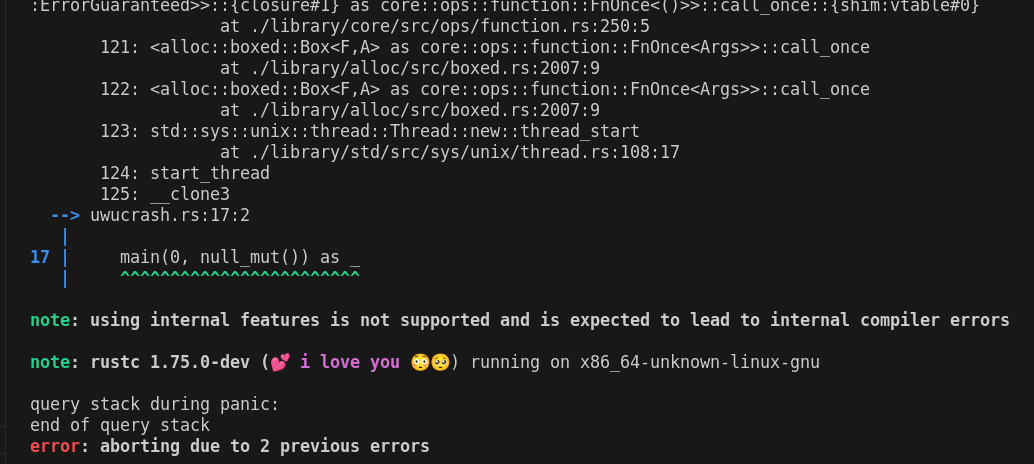
Stop telling people to submit bugs for internal feature ICEs
This keeps track of usage of internal features, and changes the message to instead tell them that using internal features is not supported.
I thought about several ways to do this but now used the explicit threading of an `Arc<AtomicBool>` through `Session`. This is not exactly incremental-safe, but this is fine, as this is set during macro expansion, which is pre-incremental, and also only affects the output of ICEs, at which point incremental correctness doesn't matter much anyways.
See [MCP 620.](https://github.com/rust-lang/compiler-team/issues/596)
|
|
This keeps track of usage of internal features, and changes the message
to instead tell them that using internal features is not supported.
See MCP 620.
|
|
|
|
|
|
rustdoc: wrap Type with Box instead of Generics
When these `Box<Generics>` types were introduced, `Generics` was made with `Vec` and much larger. Now that it's made with `ThinVec`, `Type` is bigger and should be boxed instead.
|
|
Co-authored-by: León Orell Valerian Liehr <me@fmease.dev>
|
|
rustdoc: align stability badge to baseline instead of bottom
| desc | img |
|------|-----|
| before |  |
| | |
| after |  |
Preview: http://notriddle.com/notriddle-rustdoc-demos/stab-baseline/test_dingus/index.html
Based on comment from https://github.com/rust-lang/rust/pull/105509#discussion_r1044816673
r? ``@joshtriplett``
|
|
When these `Box<Generics>` types were introduced,
`Generics` was made with `Vec` and much larger.
Now that it's made with `ThinVec`, `Type` is bigger
and should be boxed instead.
|
|
|
|
|
|
This line is longer than 100 characters, but apparently,
[tidy's list of checked extensions] doesn't include html,
so the line length doesn't matter.
[tidy's list of checked extensions]: https://github.com/rust-lang/rust/blob/31be8cc41148983e742fea8f559aacca0f6647db/src/tools/tidy/src/style.rs#L245
|
|
This is an attempt to balance three problems, each of which would
be violated by a simpler implementation:
- A type alias should show all the `impl` blocks for the target
type, and vice versa, if they're applicable. If nothing was
done, and rustdoc continues to match them up in HIR, this
would not work.
- Copying the target type's docs into its aliases' HTML pages
directly causes far too much redundant HTML text to be generated
when a crate has large numbers of methods and large numbers
of type aliases.
- Using JavaScript exclusively for type alias impl docs would
be a functional regression, and could make some docs very hard
to find for non-JS readers.
- Making sure that only applicable docs are show in the
resulting page requires a type checkers. Do not reimplement
the type checker in JavaScript.
So, to make it work, rustdoc stashes these type-alias-inlined docs
in a JSONP "database-lite". The file is generated in `write_shared.rs`,
included in a `<script>` tag added in `print_item.rs`, and `main.js`
takes care of patching the additional docs into the DOM.
The format of `trait.impl` and `type.impl` JS files are superficially
similar. Each line, except the JSONP wrapper itself, belongs to a crate,
and they are otherwise separate (rustdoc should be idempotent). The
"meat" of the file is HTML strings, so the frontend code is very simple.
Links are relative to the doc root, though, so the frontend needs to fix
that up, and inlined docs can reuse these files.
However, there are a few differences, caused by the sophisticated
features that type aliases have. Consider this crate graph:
```text
---------------------------------
| crate A: struct Foo<T> |
| type Bar = Foo<i32> |
| impl X for Foo<i8> |
| impl Y for Foo<i32> |
---------------------------------
|
----------------------------------
| crate B: type Baz = A::Foo<i8> |
| type Xyy = A::Foo<i8> |
| impl Z for Xyy |
----------------------------------
```
The type.impl/A/struct.Foo.js JS file has a structure kinda like this:
```js
JSONP({
"A": [["impl Y for Foo<i32>", "Y", "A::Bar"]],
"B": [["impl X for Foo<i8>", "X", "B::Baz", "B::Xyy"], ["impl Z for Xyy", "Z", "B::Baz"]],
});
```
When the type.impl file is loaded, only the current crate's docs are
actually used. The main reason to bundle them together is that there's
enough duplication in them for DEFLATE to remove the redundancy.
The contents of a crate are a list of impl blocks, themselves
represented as lists. The first item in the sublist is the HTML block,
the second item is the name of the trait (which goes in the sidebar),
and all others are the names of type aliases that successfully match.
This way:
- There's no need to generate these files for types that have no aliases
in the current crate. If a dependent crate makes a type alias, it'll
take care of generating its own docs.
- There's no need to reimplement parts of the type checker in
JavaScript. The Rust backend does the checking, and includes its
results in the file.
- Docs defined directly on the type alias are dropped directly in the
HTML by `render_assoc_items`, and are accessible without JavaScript.
The JSONP file will not list impl items that are known to be part
of the main HTML file already.
[JSONP]: https://en.wikipedia.org/wiki/JSONP
|
|
This reverts commit 19edb3ce808ee2b1190026b9d56cc6187e1ad9b1.
|
|
This reverts commit b3686c2fd6ad57912e1b0e778bedb0b9a05c73fa.
|
|
This reverts commit d882b2118e505d86a9f770ef862fb1ee6e91ced8.
|
