| Age | Commit message (Collapse) | Author | Lines |
|---|
|
|
|
Existing names for values of this type are `sess`, `parse_sess`,
`parse_session`, and `ps`. `sess` is particularly annoying because
that's also used for `Session` values, which are often co-located, and
it can be difficult to know which type a value named `sess` refers to.
(That annoyance is the main motivation for this change.) `psess` is nice
and short, which is good for a name used this much.
The commit also renames some `parse_sess_created` values as
`psess_created`.
|
|
It's always empty.
|
|
Rollup of 5 pull requests
Successful merges:
- #120761 (Add initial support for DataFlowSanitizer)
- #121622 (Preserve same vtable pointer when cloning raw waker, to fix Waker::will_wake)
- #121716 (match lowering: Lower bindings in a predictable order)
- #121731 (Now that inlining, mir validation and const eval all use reveal-all, we won't be constraining hidden types here anymore)
- #121841 (`f16` and `f128` step 2: intrinsics)
r? `@ghost`
`@rustbot` modify labels: rollup
|
|
Correctly generate item info of trait items
Fixes #121772.
The `document_info` function was wrongly used when documenting a trait item.
r? `@notriddle`
|
|
|
|
|
|
Add stubs in IR and ABI for `f16` and `f128`
This is the very first step toward the changes in https://github.com/rust-lang/rust/pull/114607 and the [`f16` and `f128` RFC](https://rust-lang.github.io/rfcs/3453-f16-and-f128.html). It adds the types to `rustc_type_ir::FloatTy` and `rustc_abi::Primitive`, and just propagates those out as `unimplemented!` stubs where necessary.
These types do not parse yet so there is no feature gate, and it should be okay to use `unimplemented!`.
The next steps will probably be AST support with parsing and the feature gate.
r? `@compiler-errors`
cc `@Nilstrieb` suggested breaking the PR up in https://github.com/rust-lang/rust/pull/120645#issuecomment-1925900572
|
|
Emitter cleanups
Some cleanups I made when reading emitter code. In particular, `HumanEmitter` and `JsonEmitter` have gone from three constructors to one.
r? `@oli-obk`
|
|
Use `derive(Setters)` to derive setters, and then change
`JsonEmitter::new` to only have the arguments that are always used.
|
|
They are so similar to `JsonEmitter::new` it's not worth having separate
functions, it makes the code harder to read.
|
|
Because `HumanEmitter::new` is enough, in conjunction with the (renamed)
`stderr_destination` function.
|
|
Because it's now the only constructor.
|
|
This `HumanEmitter` is only created to test if it supports colour. The
diagnostic width isn't relevant.
|
|
r=notriddle
[rustdoc] Prevent inclusion of whitespace character after macro_rules ident
Discovered this bug randomly when looking at:
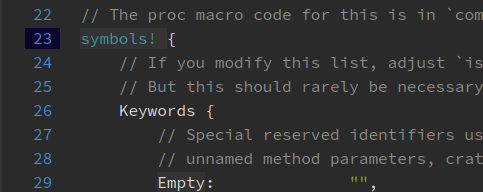
We were too eagerly trying to merge tokens that shouldn't be merged together (for example if you have a code comment followed by a code comment, we merge them in one attribute to reduce the DOM size).
r? ``@notriddle``
|
|
Diagnostic renaming
Renaming various diagnostic types from `Diagnostic*` to `Diag*`. Part of https://github.com/rust-lang/compiler-team/issues/722. There are more to do but this is enough for one PR.
r? `@davidtwco`
|
|
|
|
highlighting
|
|
Much better!
Note that this involves renaming (and updating the value of)
`DIAGNOSTIC_BUILDER` in clippy.
|
|
I started by changing it to `DiagData`, but that didn't feel right.
`DiagInner` felt much better.
|
|
|
|
|
|
Correctly handle if rustdoc JS script hash changed
It's something that annoyed me for quite some time: I have nightly docs open (for both std and compiler). And often, I don't look at the page for some days. Then when I come back to it, I make a search... except nothing happens. Took me a while to figure out that it was because the hash of one of the JS files we load for the search (either `search.js` or `search-index.js`) was updated in the meantime, preventing the search to be done. To go around it, I added to press `ENTER` to make the form submitted (which would reload the same page but with the correct hashes this time and the search being run).
r? `@notriddle`
|
|
Implement RFC 3373: Avoid non-local definitions in functions
This PR implements [RFC 3373: Avoid non-local definitions in functions](https://github.com/rust-lang/rust/issues/120363).
|
|
Add newtypes for bool fields/params/return types
Fixed all the cases of this found with some simple searches for `*/ bool` and `bool /*`; probably many more
|
|
|
|
It makes the link easier to use in cases in which
the path of the page where it will be embedded is not
known beforehand such as when we generate impls
dynamically from `register_type_impls` method in
`main.js`
Earlier for local primitives we would generate a path
that was relative to the current page depth passed in `cx.current`
. e.g if the current page was `std::simd::prelude::Simd` the
generated path would be `../../primitive.<prim>.html` After this
change the path will first take you to the the wesite root and add
the crate name. e.g. for `std::simd::prelude::Simd` the path now
will be `../../../std/primitive.<prim>.html`
|
|
Improve codegen diagnostic handling
Clarify the workings of the temporary `Diagnostic` type used to send diagnostics from codegen threads to the main thread.
r? `@estebank`
|
|
First, introduce a typedef `DiagnosticArgMap`.
Second, make the `args` field public, and remove the `args` getter and
`replace_args` setter. These were necessary previously because the getter
had a `#[allow(rustc::potential_query_instability)]` attribute, but that
was removed in #120931 when the args were changed from `FxHashMap` to
`FxIndexMap`. (All the other `Diagnostic` fields are public.)
|
|
It's clumsy and doesn't improve readability.
|
|
It currently is infallible and uses `abort_if_errors` and
`FatalError.raise()` to signal errors. It's easy to instead return a
`Result<_, ErrorGuaranteed>`, which is the more usual way of doing
things.
|
|
Currently `has_errors` excludes lint errors. This commit changes it to
include lint errors.
The motivation for this is that for most places it doesn't matter
whether lint errors are included or not. But there are multiple places
where they must be includes, and only one place where they must not be
included. So it makes sense for `has_errors` to do the thing that fits
the most situations, and the new `has_errors_excluding_lint_errors`
method in the one exceptional place.
The same change is made for `err_count`. Annoyingly, this requires the
introduction of `err_count_excluding_lint_errs` for one place, to
preserve existing error printing behaviour. But I still think the change
is worthwhile overall.
|
|
Expand weak alias types before collecting constrained/referenced late bound regions + refactorings
Fixes #114220.
Follow-up to #120780.
r? `@oli-obk`
|
|
bound regions
|
|
|
|
There are lots of functions that modify a diagnostic. This can be via a
`&mut Diagnostic` or a `&mut DiagnosticBuilder`, because the latter type
wraps the former and impls `DerefMut`.
This commit converts all the `&mut Diagnostic` occurrences to `&mut
DiagnosticBuilder`. This is a step towards greatly simplifying
`Diagnostic`. Some of the relevant function are made generic, because
they deal with both errors and warnings. No function bodies are changed,
because all the modifier methods are available on both `Diagnostic` and
`DiagnosticBuilder`.
|
|
Fix missing trait impls for type in rustc docs
Fixes #76736
|
|
r=GuillaumeGomez
rustdoc: fix and refactor HTML rendering a bit
* refactoring: get rid of a bunch of manual `f.alternate()` branches
* not sure why this wasn't done so already, is this perf-sensitive?
* fix an ICE in debug builds of rustdoc
* rustdoc used to crash on empty outlives-bounds: `where 'a:`
* properly escape const generic defaults
* actually print empty trait and outlives-bounds (doesn't work for cross-crate reexports yet, will fix that at some other point) since they can have semantic significance
* outlives-bounds: forces lifetime params to be early-bound instead of late-bound which is technically speaking part of the public API
* trait-bounds: can affect the well-formedness, consider
* makeshift “const-evaluatable” bounds under `generic_const_exprs`
* bounds to force wf-checking in light of #100041 (quite artificial I know, I couldn't figure out something better), see https://github.com/rust-lang/rust/pull/121160#discussion_r1491563816
|
|
rustdoc: Correctly handle long crate names on mobile
Fixes https://github.com/rust-lang/rust/issues/120471.
It now renders like this:

r? `@notriddle`
|
|
|
|
|
|
|
|
Implement intrinsics with fallback bodies
fixes #93145 (though we can port many more intrinsics)
cc #63585
The way this works is that the backend logic for generating custom code for intrinsics has been made fallible. The only failure path is "this intrinsic is unknown". The `Instance` (that was `InstanceDef::Intrinsic`) then gets converted to `InstanceDef::Item`, which represents the fallback body. A regular function call to that body is then codegenned. This is currently implemented for
* codegen_ssa (so llvm and gcc)
* codegen_cranelift
other backends will need to adjust, but they can just keep doing what they were doing if they prefer (though adding new intrinsics to the compiler will then require them to implement them, instead of getting the fallback body).
cc `@scottmcm` `@WaffleLapkin`
### todo
* [ ] miri support
* [x] default intrinsic name to name of function instead of requiring it to be specified in attribute
* [x] make sure that the bodies are always available (must be collected for metadata)
|
|
r=GuillaumeGomez
Add extra indent spaces for rust-playground link
Fixes #120998
Seems add `rustfmt` for this is somehow too heavy,
only adding indent spaces at the starting of each line of code seems good enough.
|
|
|
|
r=GuillaumeGomez
rustdoc: cross-crate re-exports: correctly render late-bound params in source order even if early-bound params are present
r? ghost
|
|
source order even if early-bound params are present
|
|
rustdoc: replace `clean::InstantiationParam` with `clean::GenericArg`
Probably better known as `SubstParam` (until #120958 which should've probably renamed it to `InstantiatedParam` but anyways).
It doesn't make any sense to me why it should exist as a separate type. `GenericArg` is exactly what we want here anyways from a semantic perspective. Both have the same size btw.
I also took the liberty of doing some drive-by cleanups.
|
|
r=GuillaumeGomez
rustdoc: Fix handling of doc_auto_cfg feature for cfg attributes on glob reexport
This is a follow-up of #120501 and a part of https://github.com/rust-lang/rust/issues/120487.
r? `@notriddle`
|
|
|
