| Age | Commit message (Collapse) | Author | Lines |
|---|
|
r=wesleywiser
Stabilize `-Z instrument-coverage` as `-C instrument-coverage`
(Tracking issue for `instrument-coverage`: https://github.com/rust-lang/rust/issues/79121)
This PR stabilizes support for instrumentation-based code coverage, previously provided via the `-Z instrument-coverage` option. (Continue supporting `-Z instrument-coverage` for compatibility for now, but show a deprecation warning for it.)
Many, many people have tested this support, and there are numerous reports of it working as expected.
Move the documentation from the unstable book to stable rustc documentation. Update uses and documentation to use the `-C` option.
Addressing questions raised in the tracking issue:
> If/when stabilized, will the compiler flag be updated to -C instrument-coverage? (If so, the -Z variant could also be supported for some time, to ease migrations for existing users and scripts.)
This stabilization PR updates the option to `-C` and keeps the `-Z` variant to ease migration.
> The Rust coverage implementation depends on (and automatically turns on) -Z symbol-mangling-version=v0. Will stabilizing this feature depend on stabilizing v0 symbol-mangling first? If so, what is the current status and timeline?
This stabilization PR depends on https://github.com/rust-lang/rust/pull/90128 , which stabilizes `-C symbol-mangling-version=v0` (but does not change the default symbol-mangling-version).
> The Rust coverage implementation implements the latest version of LLVM's Coverage Mapping Format (version 4), which forces a dependency on LLVM 11 or later. A compiler error is generated if attempting to compile with coverage, and using an older version of LLVM.
Given that LLVM 13 has now been released, requiring LLVM 11 for coverage support seems like a reasonable requirement. If people don't have at least LLVM 11, nothing else breaks; they just can't use coverage support. Given that coverage support currently requires a nightly compiler and LLVM 11 or newer, allowing it on a stable compiler built with LLVM 11 or newer seems like an improvement.
The [tracking issue](https://github.com/rust-lang/rust/issues/79121) and the [issue label A-code-coverage](https://github.com/rust-lang/rust/labels/A-code-coverage) link to a few open issues related to `instrument-coverage`, but none of them seem like showstoppers. All of them seem like improvements and refinements we can make after stabilization.
The original `-Z instrument-coverage` support went through a compiler-team MCP at https://github.com/rust-lang/compiler-team/issues/278 . Based on that, `@pnkfelix` suggested that this needed a stabilization PR and a compiler-team FCP.
|
|
|
|
rustdoc: remove unused Hash impl
|
|
rustdoc: clippy::complexity fixes
clippy::map_flatten
clippy::clone_on_copy
clippy::useless_conversion
clippy::needless_arbitrary_self_type
|
|
Add crate filter parameter in URL
Fixes #92621.
r? `@jsha`
|
|
|
|
clippy::map_flatten
clippy::clone_on_copy
clippy::useless_conversion
clippy::needless_arbitrary_self_type
|
|
|
|
|
|
|
|
Prevent lifetime elision in type alias
Fixes #93401.
Apparently, the problem has been fixed in the compiler.
r? `@oli-obk`
|
|
by using an opaque type obligation to bubble up comparisons between opaque types and other types
Also uses proper obligation causes so that the body id works, because out of some reason nll uses body ids for logic instead of just diagnostics.
|
|
Previously, tidy-html5 (`tidy`) would complain about a few things in our
HTML. The main thing is that `<summary>` tags can't contain `<div>`s.
That's easily fixed by changing out the `<div>`s for `<span>`s with
`display: block`.
However, there's also a rule that `<span>`s can't contain heading
elements. `<span>` permits only "phrasing content"
https://developer.mozilla.org/en-US/docs/Web/HTML/Element/span, and
`<h3>` (and friends) are "Flow content, heading content, palpable
content".
https://developer.mozilla.org/en-US/docs/Web/HTML/Element/Heading_Elements
We have a wrapping `<div>` that goes around each `<h3>`/`<h4>`,
etc. We turn that into a `<section>` rather than a `<span>` because
`<section>` permits "flow content".
https://developer.mozilla.org/en-US/docs/Web/HTML/Element/section
After this change we get only three warnings from tidy, run on
struct.String.html:
line 6 column 10790 - Warning: trimming empty <span>
line 1 column 1118 - Warning: <link> proprietary attribute "disabled"
line 1 column 1193 - Warning: <link> proprietary attribute "disabled"
The empty `<span>` is a known issue - there's a span in front of the
search box to work around a strange Safari issue.
The `<link>` attributes are the non-default stylesheets. We can probably
refactor theme application to avoid using this proprietary "disabled"
attribute.
|
|
Another one of those "good grief, I just submitted it and NOW I think of it" moments.
|
|
Improve wrapping on settings page
Previously, the radio button choices for themes would wrap awkwardly on
narrow screens. With this change, the group of choices will prefer
bumping down to the next line together, leaving the setting name on its
own line.
Also fix some minor spacing issues:
- Align the setting name vertically with the radio button choices.
- Use margin instead of padding for most spacing choices.
- Use no margin/padding on the right-hand side.
Demo: https://rustdoc.crud.net/jsha/adjust-settings-layout/settings.html
r? ``@GuillaumeGomez``
Before (narrow screen):

After (narrow screen):

|
|
|
|
|
|
|
|
|
|
Use spacing to distinguish what is related to a given heading.
|
|
Signed-off-by: Muhammad Falak R Wani <falakreyaz@gmail.com>
|
|
Signed-off-by: Muhammad Falak R Wani <falakreyaz@gmail.com>
|
|
Signed-off-by: Muhammad Falak R Wani <falakreyaz@gmail.com>
|
|
|
|
Previously, the radio button choices for themes would wrap awkwardly on
narrow screens. With this change, the group of choices will prefer
bumping down to the next line together, leaving the setting name on its
own line.
Also fix some minor spacing issues:
- Align the setting name vertically with the radio button choices.
- Use margin instead of padding for most spacing choices.
- Use no margin/padding on the right-hand side.
|
|
Fix some CSS warnings and errors from VS Code
There's no such CSS rule as `box-shadow-color`, so I instead copied the
whole `box-shadow` property to each rule to make it actually apply.
r? `@jsha`
|
|
rustdoc: Remove `def_id_no_primitives`
Fixes #90187.
|
|
rustdoc: mobile nav fixes
- Make sure the mobile-topbar doesn't overflow its height if the user sets a bigger font.
- Make sure the sidebar can be scrolled all the way to the bottom by shortening it to accommodate the mobile-topbar.
- Make the item name in the mobile-topbar clickable to go to the top of the page.
- Remove excess padding sidebar in mobile mode.
Demo https://rustdoc.crud.net/jsha/mobile-nav-fixes/std/string/struct.String.html
r? `@GuillaumeGomez`
|
|
Render more readable macro matcher tokens in rustdoc
Follow-up to #92334.
This PR lifts some of the token rendering logic from https://github.com/dtolnay/prettyplease into rustdoc so that even the matchers for which a source code snippet is not available (because they are macro-generated, or any other reason) follow some baseline good assumptions about where the tokens in the macro matcher are appropriate to space.
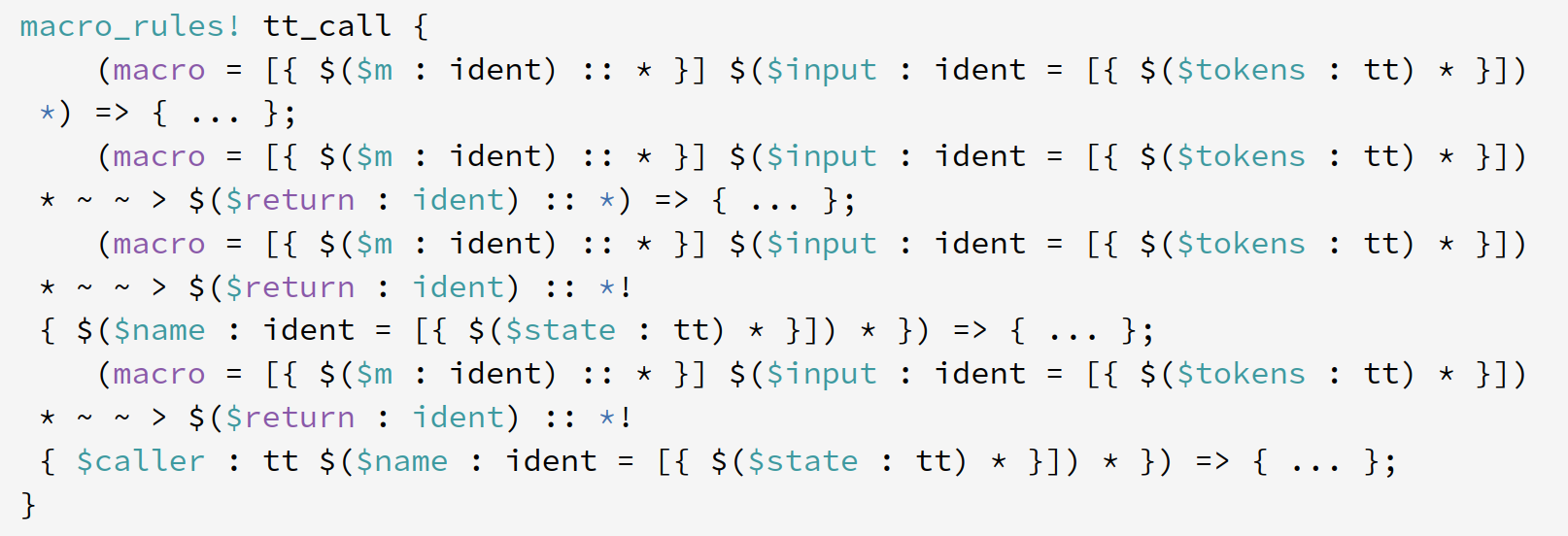
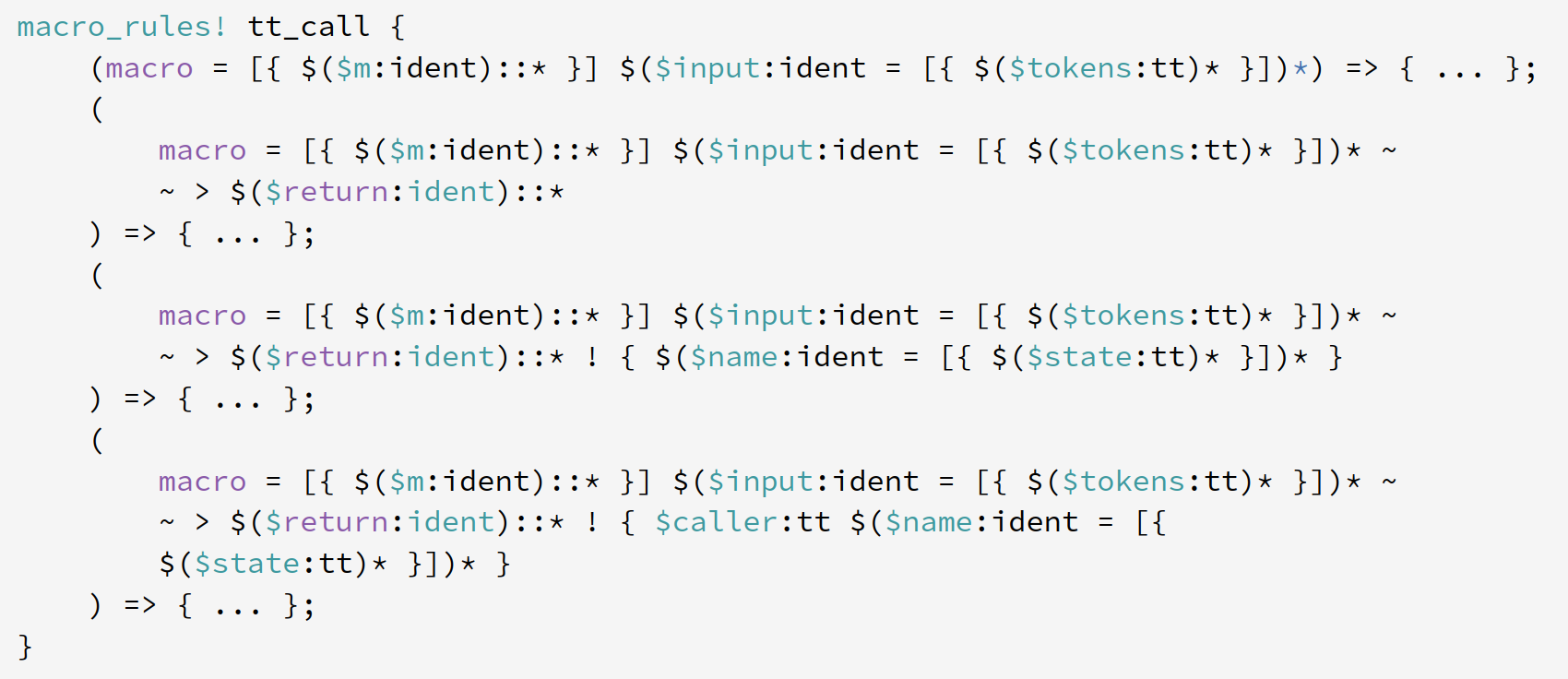
The below screenshots show an example of the difference using one of the gnarliest macros I could find. Some things to notice:
- In the **before**, notice how a couple places break in between `$(....)`↵`*`, which is just about the worst possible place that it could break.
- In the **before**, the lines that wrapped are weirdly indented by 1 space of indentation relative to column 0. In the **after**, we use the typical way of block indenting in Rust syntax which is put the open/close delimiters on their own line and indent their contents by 4 spaces relative to the previous line (so 8 spaces relative to column 0, because the matcher itself is indented by 4 relative to the `macro_rules` header).
- In the **after**, macro_rules metavariables like `$tokens:tt` are kept together, which is how just about everybody writing Rust today writes them.
## Before
## After
r? `@camelid`
|
|
- Make sure the mobile-topbar doesn't overflow its height if the user
sets a bigger font.
- Make sure the sidebar can be scrolled all the way to the bottom by
shortening it to accommodate the mobile-topbar.
- Make the item name in the mobile-topbar clickable to go to the top of
the page.
- Remove excess padding sidebar in mobile mode.
|
|
notriddle:notriddle/collect-crate-doc-links-very-early, r=petrochenkov
rustdoc: load the set of in-scope traits for modules with no docstring
Fixes #93428
This fix is a response to a couple of special cases related to the `module_id`, which is eventually used for trait candidates:
* The module id is always set to the current crate, when checking `crate::`.
Normally, the set of in-scope traits would be set in `load_links_in_attrs`, but if there are no doc comments, then that loop will never run.
* the module id is set to the parent module, when resolving a module that is spelled like this:
// Notice how we use an outlined doc comment here!
// [`Test::my_fn`]
mod something {
}
As with the above problem with `crate::`, we need to make sure the module gets its traits in scope resolved, even if it has no doc comments of its own.
|
|
r=jsha,GuillaumeGomez
rustdoc: remove tooltip from source link
This made more sense back when it was abbreviated, but now it seems redundant.
|
|
There's no such CSS rule as `box-shadow-color`, so I instead copied the
whole `box-shadow` property to each rule to make it actually apply.
|
|
Fix dot separator when there is no source link
Fixes #92973.
We did well adding this test since there was a bug:

r? `@jsha`
|
|
Fixes #93428
This fix is a response to a couple of special cases related to the
`module_id`, which is eventually used for trait candidates:
* The module id is always set to the current crate, when checking `crate::`.
Normally, the set of in-scope traits would be set in `load_links_in_attrs`,
but if there are no doc comments, then that loop will never run.
* the module id is set to the parent module, when resolving a module
that is spelled like this:
// Notice how we use an outlined doc comment here!
// [`Test::my_fn`]
mod something {
}
As with the above problem with `crate::`, we need to make sure the
module gets its traits in scope resolved, even if it has no doc comments
of its own.
|
|
|
|
|
|
|
|
|
|
|
|
|
|
This made more sense back when it was abbreviated, but now it
seems redundant.
|
|
|
|
|
|
Update minifier crate version to 0.0.42
Some issues on the CSS minification.
r? `@notriddle`
|
|
|
|
rustdoc: Pre-calculate traits that are in scope for doc links
This eliminates one more late use of resolver (part of #83761).
At early doc link resolution time we go through parent modules of items from the current crate, reexports of items from other crates, trait items, and impl items collected by `collect-intra-doc-links` pass, determine traits that are in scope in each such module, and put those traits into a map used by later rustdoc passes.
r? `@jyn514`
|
|
minor fix for #93231
In #93231 I introduced the new sidebar colours to make the contrast more balanced and easier to read, but it seems I made a copy-paste error in the light theme, resulting in functions appearing green.
This one line change replaces that colour with it's corrected orange/brown colour.
I have double checked the rest of the colours and they seem ok. Sorry for the inconvenience
|
|
Add white-space: nowrap to links in the sidebar
We already have overflow: hidden on these links, but if there is a possibility to wrap, they will wrap. This happens in particular for trait implementations because the punctuation (`<>, `) introduces opportunities for breaks. That produces inconsistent UI. Fix it by forcing them not to wrap.
Demo: https://rustdoc.crud.net/jsha/sidebar-nowrap/std/string/struct.String.html
To see the effect, scroll down to the "Trait Implementations" portion of the sidebar and look at IndexMut. Compare vs:
https://doc.rust-lang.org/std/string/struct.String.html
https://doc.rust-lang.org/nightly/std/string/struct.String.html
r? `@camelid`
|
|
Store a `Symbol` instead of an `Ident` in `AssocItem`
This is the same idea as #92533, but for `AssocItem` instead
of `VariantDef`/`FieldDef`.
With this change, we no longer have any uses of
`#[stable_hasher(project(...))]`
|
