| Age | Commit message (Collapse) | Author | Lines |
|---|
|
Add vectored read and write support
This functionality has lived for a while in the tokio ecosystem, where
it can improve performance by minimizing copies.
r? @alexcrichton
|
|
Use more impl header lifetime elision
Inspired by seeing explicit lifetimes on these two:
- https://doc.rust-lang.org/nightly/std/slice/struct.Iter.html#impl-FusedIterator
- https://doc.rust-lang.org/nightly/std/primitive.u32.html#impl-Not
And a follow-up to https://github.com/rust-lang/rust/pull/54687, that started using IHLE in libcore.
Most of the changes in here fall into two big categories:
- Removing lifetimes from common traits that can essentially never user a lifetime from an input (particularly `Drop`, `Debug`, and `Clone`)
- Forwarding impls that are only possible because the lifetime doesn't matter (like `impl<R: Read + ?Sized> Read for &mut R`)
I omitted things that seemed like they could be more controversial, like the handful of iterators that have a `Item: 'static` despite the iterator having a lifetime or the `PartialEq` implementations [where the flipped one cannot elide the lifetime](https://internals.rust-lang.org/t/impl-type-parameter-aliases/9403/2?u=scottmcm).
I also removed two lifetimes that turned out to be completely unused; see https://github.com/rust-lang/rust/issues/41960#issuecomment-464557423
|
|
There are two big categories of changes in here
- Removing lifetimes from common traits that can essentially never user a lifetime from an input (particularly `Drop` & `Debug`)
- Forwarding impls that are only possible because the lifetime doesn't matter (like `impl<R: Read + ?Sized> Read for &mut R`)
I omitted things that seemed like they could be more controversial, like the handful of iterators that have a `Item: 'static` despite the iterator having a lifetime or the `PartialEq` implementations where the flipped one cannot elide the lifetime.
|
|
|
|
Returning &'a mut [u8] was unsound, and we may as well just have them
directly deref to their slices to make it easier to work with them.
|
|
This functionality has lived for a while in the tokio ecosystem, where
it can improve performance by minimizing copies.
|
|
|
|
JosephTLyons:Fix-question-mark-operator-in-stdio-document, r=wesleywiser
Fixed the link to the ? operator
I'm working on updating all broken links, but figured I'd break up the pull requests so they are easier to review, versus just one big pull request.
|
|
|
|
|
|
|
|
Defactored Bytes::read
Removed unneeded refactoring of read_one_byte, which removed the unneeded dynamic dispatch (`dyn Read`) used by that function.
This function is only used in one place in the entire Rust codebase; there doesn't seem to be a reason for it to exist (and there especially doesn't seem to be a reason for it to use dynamic dispatch)
|
|
|
|
|
|
|
|
|
|
Removed unneeded refactoring of read_one_byte, which removed the unneeded dynamic dispatch (`dyn Read`) used by that function.
|
|
The std::io::read main documentation can lead to error because the
buffer is prefilled with 10 zeros that will pad the response.
Using an empty vector is better.
The `read_to_end` documentation is already correct though.
This is my first rust PR, don't hesitate to tell me if I did something
wrong.
|
|
Fixes #54562
|
|
Brings the documentation in line with the BufReader implementation.
Fixes #48022.
|
|
|
|
|
|
|
|
|
|
Per FCP:
* https://github.com/rust-lang/rust/issues/27802#issuecomment-377537778
* https://github.com/rust-lang/rust/issues/33906#issuecomment-377534308
|
|
Fixes #42781
|
|
|
|
Fixes https://github.com/rust-lang/rust/issues/49233.
|
|
|
|
This appears copied from fill_buf, but the above paragraph already indicates that a lack of delimiter at the end is EOF.
|
|
|
|
|
|
|
|
|
|
Remove invalid doc link
r? @rust-lang/docs
|
|
|
|
Optimize `read_to_end`.
This patch makes `read_to_end` use Vec's memory-growth pattern rather
than using a custom pattern.
This has some interesting effects:
- If memory is reserved up front, `read_to_end` can be faster, as it
starts reading at the buffer size, rather than always starting at 32
bytes. This speeds up file reading by 2x in one of my use cases.
- It can reduce the number of syscalls when reading large files.
Previously, `read_to_end` would settle into a sequence of 8192-byte
reads. With this patch, the read size follows Vec's allocation
pattern. For example, on a 16MiB file, it can do 21 read syscalls
instead of 2057. In simple benchmarks of large files though, overall
speed is still dominated by the actual I/O.
- A downside is that Read implementations that don't implement
`initializer()` may see increased memory zeroing overhead.
I benchmarked this on a variety of data sizes, with and without
preallocated buffers. Most benchmarks see no difference, but reading
a small/medium file with a pre-allocated buffer is faster.
|
|
r=GuillaumeGomez,QuietMisdreavus
show in docs whether the return type of a function impls Iterator/Read/Write
Closes #25928
This PR makes it so that when rustdoc documents a function, it checks the return type to see whether it implements a handful of specific traits. If so, it will print the impl and any associated types. Rather than doing this via a whitelist within rustdoc, i chose to do this by a new `#[doc]` attribute parameter, so things like `Future` could tap into this if desired.
### Known shortcomings
~~The printing of impls currently uses the `where` class over the whole thing to shrink the font size relative to the function definition itself. Naturally, when the impl has a where clause of its own, it gets shrunken even further:~~ (This is no longer a problem because the design changed and rendered this concern moot.)
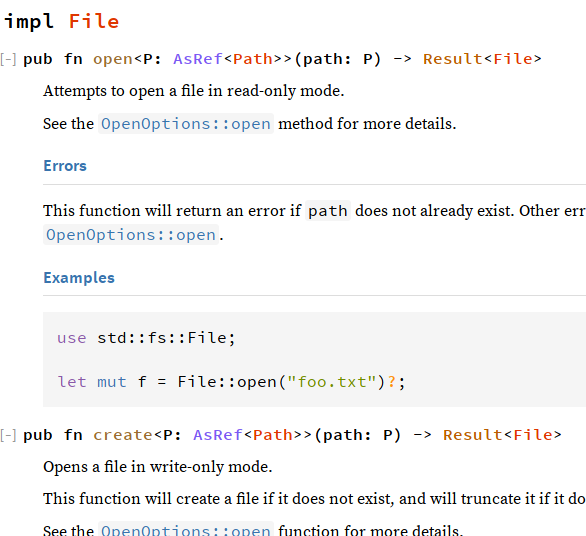
The lookup currently just looks at the top-level type, not looking inside things like Result or Option, which renders the spotlights on Read/Write a little less useful:
<details><summary>`File::{open, create}` don't have spotlight info (pic of old design)</summary>
</details>
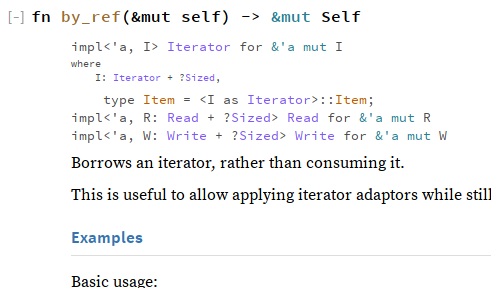
All three of the initially spotlighted traits are generically implemented on `&mut` references. Rustdoc currently treats a `&mut T` reference-to-a-generic as an impl on the reference primitive itself. `&mut Self` counts as a generic in the eyes of rustdoc. All this combines to create this lovely scene on `Iterator::by_ref`:
<details><summary>`Iterator::by_ref` spotlights Iterator, Read, and Write (pic of old design)</summary>
</details>
|
|
|
|
|
|
This patch makes `read_to_end` use Vec's memory-growth pattern rather
than using a custom pattern.
This has some interesting effects:
- If memory is reserved up front, `read_to_end` can be faster, as it
starts reading at the buffer size, rather than always starting at 32
bytes. This speeds up file reading by 2x in one of my use cases.
- It can reduce the number of syscalls when reading large files.
Previously, `read_to_end` would settle into a sequence of 8192-byte
reads. With this patch, the read size follows Vec's allocation
pattern. For example, on a 16MiB file, it can do 21 read syscalls
instead of 2057. In simple benchmarks of large files though, overall
speed is still dominated by the actual I/O.
- A downside is that Read implementations that don't implement
`initializer()` may see increased memory zeroing overhead.
I benchmarked this on a variety of data sizes, with and without
preallocated buffers. Most benchmarks see no difference, but reading
a small/medium file with a pre-allocated buffer is faster.
|
|
|
|
Fix incorrect error type in Read::byte docs
None
|
|
|
|
|
|
This is just undoing changes from #41991 because we are not running markdown rendering twice.
|
|
|
|
This fixes headings reading "Unsafety" and "Example", they should be
"Safety" and "Examples" according to RFC 1574.
|
|
|
|
|
