| Age | Commit message (Collapse) | Author | Lines |
|---|
|
Closes #43751.
|
|
This commit applies a few code size optimizations for the wasm target to
the standard library, namely around panics. We notably know that in most
configurations it's impossible for us to print anything in
wasm32-unknown-unknown so we can skip larger portions of panicking that
are otherwise simply informative. This allows us to get quite a nice
size reduction.
Finally we can also tweak where the allocation happens for the
`Box<Any>` that we panic with. By only allocating once unwinding starts
we can reduce the size of a panicking wasm module from 44k to 350 bytes.
|
|
Fixes #49608
|
|
|
|
|
|
… to make the name `alloc` available.
|
|
|
|
|
|
|
|
This permits easier iteration without having to worry about warnings
being denied.
Fixes #49517
|
|
Bump the bootstrap compiler to 1.26.0 beta
Holy cow that's a lot of `cfg(stage0)` removed and a lot of new stable language
features!
|
|
|
|
typos
|
|
Holy cow that's a lot of `cfg(stage0)` removed and a lot of new stable language
features!
|
|
|
|
|
|
Closes #22181, #27779
|
|
Implement `shrink_to` method on collections
Fixes #49385
|
|
|
|
Tracking issue: https://github.com/rust-lang/rust/issues/33417
|
|
|
|
|
|
Stabilize termination_trait, split out termination_trait_test
For #48453.
First time contribution, so I'd really appreciate any feedback on how this PR can be better.
Not sure exactly what kind of documentation update is needed. If there is no PR to update the reference, I can try doing that this week as I have time.
|
|
Add 12 num::NonZero* types for primitive integers, deprecate core::nonzero
RFC: https://github.com/rust-lang/rfcs/pull/2307
Tracking issue: ~~https://github.com/rust-lang/rust/issues/27730~~ https://github.com/rust-lang/rust/issues/49137
Fixes https://github.com/rust-lang/rust/issues/27730
|
|
This stabilizes `main` with non-() return types; see #48453.
|
|
RFC: https://github.com/rust-lang/rfcs/pull/2307
|
|
It stays in libcore rather than being private in HashMap’s module
because it shares code with the deprecated *stable* `SipHasher` type.
|
|
Make `assert` a built-in procedural macro
Makes `assert` macro a built-in one without touching its functionality. This is a prerequisite for RFC 2011 (#44838).
|
|
Stabilize inclusive range (`..=`)
Stabilize the followings:
* `inclusive_range` — The `std::ops::RangeInclusive` and `std::ops::RangeInclusiveTo` types, except its fields (tracked by #49022 separately).
* `inclusive_range_syntax` — The `a..=b` and `..=b` expression syntax
* `dotdoteq_in_patterns` — Using `a..=b` in a pattern
cc #28237
r? @rust-lang/lang
|
|
Stabilize std::ops::RangeInclusive and std::ops::RangeInclusiveTo.
|
|
Fallible allocation
Implementing RFC#2116 [Fallible Allocation](https://github.com/rust-lang/rust/issues/48043) .
Work in progress. Initially adding @Gankro's try_reserve for Vec.
|
|
|
|
Replace feature(never_type) with feature(exhaustive_patterns).
feature(exhaustive_patterns) only covers the pattern-exhaustives checks
that used to be covered by feature(never_type)
|
|
|
|
Stabilize FusedIterator
FusedIterator is a marker trait that promises that the implementing
iterator continues to return `None` from `.next()` once it has returned
`None` once (and/or `.next_back()`, if implemented).
The effects of FusedIterator are already widely available through
`.fuse()`, but with stable `FusedIterator`, stable Rust users can
implement this trait for their iterators when appropriate.
Closes #35602
|
|
FusedIterator is a marker trait that promises that the implementing
iterator continues to return `None` from `.next()` once it has returned
`None` once (and/or `.next_back()`, if implemented).
The effects of FusedIterator are already widely available through
`.fuse()`, but with stable `FusedIterator`, stable Rust users can
implement this trait for their iterators when appropriate.
|
|
This commit imports the `stdsimd` crate into the standard library,
creating an `arch` and `simd` module inside of both libcore and libstd.
Both of these modules are **unstable** and will continue to be so until
RFC 2335 is stabilized.
As a brief recap, the modules are organized as so:
* `arch` contains all current architectures with intrinsics, for example
`std::arch::x86`, `std::arch::x86_64`, `std::arch::arm`, etc. These
modules contain all of the intrinsics defined for the platform, like
`_mm_set1_epi8`.
* In the standard library, the `arch` module also exports a
`is_target_feature_detected` macro which performs runtime detection to
determine whether a target feature is available at runtime.
* The `simd` module contains experimental versions of strongly-typed
lane-aware SIMD primitives, to be fully fleshed out in a future RFC.
The main purpose of this commit is to start pulling in all these
intrinsics and such into the standard library on nightly and allow
testing and such. This'll help allow users to easily kick the tires and
see if intrinsics work as well as allow us to test out all the
infrastructure for moving the intrinsics into the standard library.
|
|
Termination trait in tests
Support the `Termination` trait in unit tests (cc https://github.com/rust-lang/rust/issues/43301)
Also, a drive-by fix for #47075.
This is joint work with @bkchr.
|
|
|
|
Also make `std::termination` module public and rename feature.
The lib feature needs a different name from the language feature.
|
|
|
|
RFC 2070 part 1: PanicInfo and Location API changes
This implements part of https://rust-lang.github.io/rfcs/2070-panic-implementation.html
Tracking issue: https://github.com/rust-lang/rust/issues/44489
* Move `std::panic::PanicInfo` and `std::panic::Location` to a new `core::panic` module. The two types and the `std` module were already `#[stable]` and stay that way, the new `core` module is `#[unstable]`.
* Add a new `PanicInfo::message(&self) -> Option<&fmt::Arguments>` method, which is `#[unstable]`.
* Implement `Display` for `PanicInfo` and `Location`
|
|
|
|
Per https://rust-lang.github.io/rfcs/2070-panic-implementation.html
|
|
|
|
|
|
|
|
`Shared` is now a deprecated `type` alias.
CC https://github.com/rust-lang/rust/issues/27730#issuecomment-352800629
|
|
|
|
r=estebank
type error method suggestions use whitelisted identity-like conversions
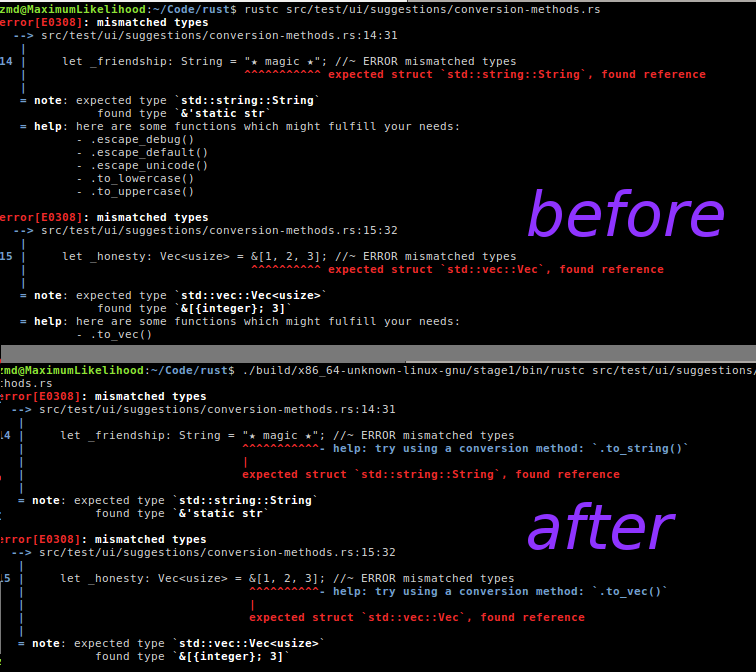
Previously, on a type mismatch (and if this wasn't preëmpted by a
higher-priority suggestion), we would look for argumentless methods
returning the expected type, and list them in a `help` note. This had two
major shortcomings: firstly, a lot of the suggestions didn't really make
sense (if you used a &str where a String was expected,
`.to_ascii_uppercase()` is probably not the solution you were hoping
for). Secondly, we weren't generating suggestions from the most useful
traits! We address the first problem with an internal
`#[rustc_conversion_suggestion]` attribute meant to mark methods that keep
the "same value" in the relevant sense, just converting the type. We
address the second problem by making `FnCtxt.probe_for_return_type` pass
the `ProbeScope::AllTraits` to `probe_op`: this would seem to be safe
because grep reveals no other callers of `probe_for_return_type`.
Also, structured suggestions are pretty and good for RLS and friends.
Unfortunately, the trait probing is still not all one would hope for: at a
minimum, we don't know how to rule out `into()` in cases where it wouldn't
actually work, and we don't know how to rule in `.to_owned()` where it
would. Issues #46459 and #46460 have been filed and are ref'd in a FIXME.
This is hoped to resolve #42929, #44672, and #45777.
|
