| Age | Commit message (Collapse) | Author | Lines |
|---|
|
for 180/π in to_degrees The current `f32|f64.to_degrees` implementation uses a division to calculate `180/π`, which causes a loss of precision. Using a constant is still not perfect (implementing a maximally-precise algorithm would come with a high performance cost), but improves precision with a minimal change. As per the discussion in #29944, this fixes #29944 (the costs of improving the precision further would not outweigh the gains).
|
|
Implement extensible syscall interface for wasm
Currently it's possible to run tests with the native wasm target, but it's not possible to tell whether they pass or to capture the output, because libstd throws away stdout, stderr and the exit code. While advanced libstd features should probably require more specific targets (eg. wasm-unknown-web) I think even the unknown target should at least support basic I/O.
Any solution is constrained by these factors:
- It must not be javascript specific
- There must not be too strong coupling between libstd and the host environment (because it's an "unknown" target)
- WebAssembly does not allow "optional" imports - all imports *must* be resolved.
- WebAssembly does not support calling the host environment through any channel *other* than imports.
The best solution I could find to these constraints was to give libstd a single required import, and implement a syscall-style interface through that import. Each syscall is designed such that a no-op implementation gives the most reasonable fallback behaviour. This means that the following import table would be perfectly valid:
```javascript
imports.env = { rust_wasm_syscall: function(index, data) {} }
```
Currently I have implemented these system calls:
- Read from stdin
- Write to stdout/stderr
- Set the exit code
- Get command line arguments
- Get environment variable
- Set environment variable
- Get time
It need not be extended beyond this set if being able to run tests for this target is the only goal.
edit:
As part of this PR I had to make a further change. Previously, the rust entry point would be automatically called when the webassembly module was instantiated. This was problematic because from the javascript side it was impossible to call exported functions, access program memory or get a reference to the instance.
To solve this, ~I changed the default behaviour to not automatically call the entry point, and added a crate-level attribute to regain the old behaviour. (`#![wasm_auto_run]`)~ I disabled this behaviour when building tests.
|
|
The current `f32|f64.to_degrees` implementation uses a division to calculate 180/π, which causes a loss of precision. Using a constant is still not perfect (implementing a maximally-precise algorithm would come with a high performance cost), but improves precision with a minimal change.
|
|
std: use more portable error number in from_raw_os_error docs
On MIPS, error number 98 is not `EADDRINUSE` (it is `EPROTOTYPE`). To fix the resulting test failure this causes, use a more portable error number in the example documentation. `EINVAL` shold be more reliable because it was defined in the original Unix as 22 so hopefully most derivatives have defined it the same way.
|
|
Move Duration to libcore
Fixes #46520; should be merged after #46508.
|
|
|
|
On MIPS, error number 98 is not EADDRINUSE (it is EPROTOTYPE). To fix the
resulting test failure this causes, use a more portable error number in
the example documentation. EINVAL shold be more reliable because it was
defined in the original Unix as 22 so hopefully most derivatives have
defined it the same way.
|
|
Document that `Index` ops can panic on `HashMap` & `BTreeMap`.
Fixes https://github.com/rust-lang/rust/issues/47011.
|
|
implement Send for process::Command on unix
closes https://github.com/rust-lang/rust/issues/47751
|
|
|
|
Fixes https://github.com/rust-lang/rust/issues/47011.
|
|
|
|
Implementing Send for a specific field rather than the whole struct is
safer: if a field is changed/modified and becomes non-Send, we can catch
it.
|
|
|
|
closes https://github.com/rust-lang/rust/issues/47751
|
|
Stabilized `#[repr(align(x))]` attribute (RFC 1358)
Stabilzed `#[repr(align(x))]` with attr_literal syntax as proposed by @eddyb https://github.com/rust-lang/rust/issues/33626#issuecomment-348467804
|
|
r=alexcrichton
Makes the constructors of Duration const fns.
This affects `Duration::new`, `Duration::from_secs`, `Duration::from_millis`, `Duration::from_micros`, and `Duration::from_nanos`.
|
|
Make core::ops::Place an unsafe trait
Consumers of `Place` would reasonably expect that the `pointer` function returns a valid pointer to memory that can actually be written to.
|
|
Expose float from_bits and to_bits in libcore.
These methods have no dependencies on libm and thus should be offered in libcore.
|
|
|
|
Only link res_init() on GNU/*nix
To workaround a bug in glibc <= 2.26 lookup_host() calls res_init() based on the glibc version detected at runtime. While this avoids calling res_init() on platforms where it's not required we will still end up linking against the symbol.
This causes an issue on macOS where res_init() is implemented in a separate library (libresolv.9.dylib) from the main libc. While this is harmless for standalone programs it becomes a problem if Rust code is statically linked against another program. If the linked program doesn't already specify -lresolv it will cause the link to fail. This is captured in issue #46797
Fix this by hooking in to the glibc workaround in `cvt_gai` and only activating it for the "gnu" environment on Unix This should include all glibc platforms while excluding musl, windows-gnu, macOS, FreeBSD, etc.
This has the side benefit of removing the #[cfg] in sys_common; only unix.rs has code related to the workaround now.
Before this commit:
```shell
> cat main.rs
use std::net::ToSocketAddrs;
#[no_mangle]
pub extern "C" fn resolve_test() -> () {
let addr_list = ("google.com.au", 0).to_socket_addrs().unwrap();
println!("{:?}", addr_list);
}
> rustc --crate-type=staticlib main.rs
> clang libmain.a test.c -o combined
Undefined symbols for architecture x86_64:
"_res_9_init", referenced from:
std::net::lookup_host::h93c17fe9ad38464a in libmain.a(std-826c8d3b356e180c.std0.rcgu.o)
ld: symbol(s) not found for architecture x86_64
clang-5.0: error: linker command failed with exit code 1 (use -v to see invocation)
```
Afterwards:
```shell
> rustc --crate-type=staticlib main.rs
> clang libmain.a test.c -o combined
> ./combined
IntoIter([V4(172.217.25.131:0)])
```
Fixes #46797
|
|
Update BTreeMap recommendation
Focus on the ordering / range(instead of all) benefit as it's the most important feature.
|
|
Add some edge cases to the documentation of `Path`
Affected methods are `starts_with` and `strip_prefix`.
|
|
Deprecate std::net::lookup_host
We intended to do this quite a while ago but it snuck through.
r? @alexcrichton
|
|
zackmdavis:and_the_case_of_the_needlessly_parenthesized_arguments, r=petrochenkov
in which the unused-parens lint comes to cover function and method args
Resolves #46137.
|
|
|
|
|
|
`Shared` is now a deprecated `type` alias.
CC https://github.com/rust-lang/rust/issues/27730#issuecomment-352800629
|
|
Focus on the ordering/range benefit.
|
|
Resolves #46137.
|
|
We intended to do this quite a while ago but it snuck through.
|
|
Affected methods are `starts_with` and `strip_prefix`.
|
|
Use File::metadata instead of fs::metadata to choose buffer size
This replaces a `stat` syscall with `fstat` or similar, which can be faster. Fixes #47519.
|
|
This replaces a `stat` syscall with `fstat` or similar, which can be
faster. Fixes #47519.
|
|
To workaround a bug in glibc <= 2.26 lookup_host() calls res_init()
based on the glibc version detected at runtime. While this avoids
calling res_init() on platforms where it's not required we will still
end up linking against the symbol.
This causes an issue on macOS where res_init() is implemented in a
separate library (libresolv.9.dylib) from the main libc. While this is
harmless for standalone programs it becomes a problem if Rust code is
statically linked against another program. If the linked program doesn't
already specify -lresolv it will cause the link to fail. This is
captured in issue #46797
Fix this by hooking in to the glibc workaround in `cvt_gai` and only
activating it for the "gnu" environment on Unix This should include all
glibc platforms while excluding musl, windows-gnu, macOS, FreeBSD, etc.
This has the side benefit of removing the #[cfg] in sys_common; only
unix.rs has code related to the workaround now.
|
|
|
|
Remove leftover Rand stuff
The in-tree version of `rand` was removed in 6bc8f164b09b9994e6a2d4c4ca60d7d36c09d3fe, but for some reason this lone file avoided the purge. Figured it's about time to finish the job. :smiling_imp:
|
|
fix off-by-one error
Fixes https://github.com/rust-lang/rust/issues/47325.
|
|
doc: show that `f32::log` and `f64::log` are not correctly rounded
Fixes #47273.
One thing I'm not sure about is whether the "calculated as `self.ln() / base.ln()`" bit is being too specific, maybe we do not want to make this such a strong commitment. I think it's fine, but we should not make commitments in the API documentation by accident.
In case that is removed, the added sentence "`self.log2()` can ... base 10." still makes it amply clear that the `log` methods can be more inaccurate than other methods. If the above clause is removed, this second sentence can be moved to the first paragraph, kind of like the accuracy comment for the [`mul_add`](https://doc.rust-lang.org/std/primitive.f32.html#method.mul_add) method.
|
|
Better Debug impl for io::Error.
This PR includes the below changes:
1. The former impl wrapped the entire thing in `Error { repr: ... }` which was unhelpful; this has been removed.
2. The `Os` variant of `io::Error` included the code and message, but not the kind; this has been fixed.
3. The `Custom` variant of `io::Error` included a `Custom(Custom { ... })`, which is now just `Custom { ... }`.
Example of previous impl:
```rust
Error {
repr: Custom(
Custom {
kind: InvalidData,
error: Error {
repr: Os {
code: 2,
message: "no such file or directory"
}
}
}
)
}
```
Example of new impl:
```rust
Custom {
kind: InvalidData,
error: Os {
code: 2,
kind: NotFound,
message: "no such file or directory"
}
}
```
|
|
|
|
Implement libstd for CloudABI.
Though CloudABI is strongly inspired by POSIX, its absence of features that don't work well with capability-based sandboxing makes it different enough that adding bits to `sys/unix` will make things a mess. This change therefore adds CloudABI specific platform code under `sys/cloudabi`.
One of the goals of this implementation is to build as much as possible directly on top of CloudABI's system call layer, as opposed to using the C library. This is preferred, as the system call layer is supposed to be stable, whereas the C library ABI technically is not. An advantage of this approach is that it allows us to implement certain interfaces, such as mutexes and condition variables more optimally. They can be lighter than the ones provided by pthreads.
This change disables some modules that cannot realistically be implemented right now. For example, libstd's pathname abstraction is not designed with POSIX `*at()` (e.g., `openat()`) in mind. The `*at()` functions are the only set of file system APIs available on CloudABI. There is no global file system namespace, nor a process working directory. Discussions on how to port these modules over are outside the scope of this change.
|
|
BufRead: Only flush the internal buffer if seeking outside of it.
Fixes #31100
r? @dtolnay
|
|
|
|
|
|
|
|
|
|
No longer parse it.
Remove AutoTrait variant from AST and HIR.
Remove backwards compatibility lint.
Remove coherence checks, they make no sense for the new syntax.
Remove from rustdoc.
|
|
|
|
r=estebank
type error method suggestions use whitelisted identity-like conversions
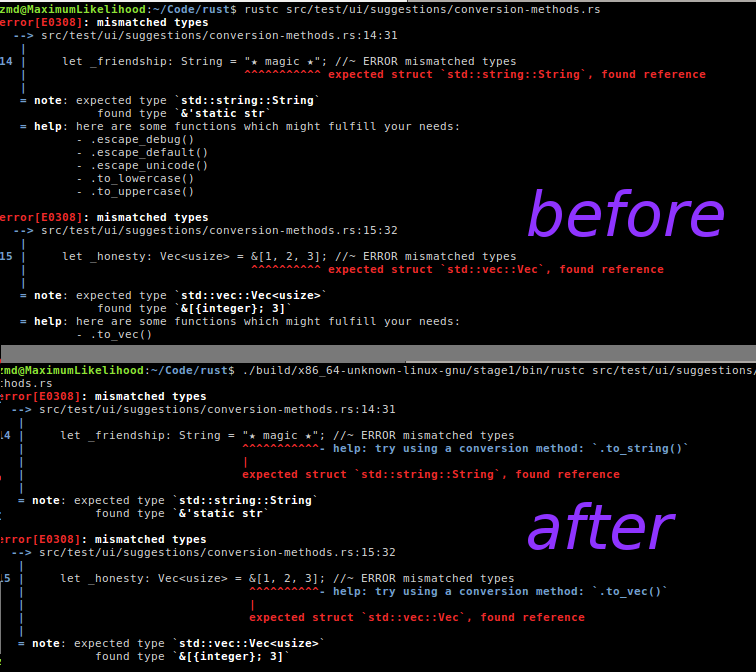
Previously, on a type mismatch (and if this wasn't preëmpted by a
higher-priority suggestion), we would look for argumentless methods
returning the expected type, and list them in a `help` note. This had two
major shortcomings: firstly, a lot of the suggestions didn't really make
sense (if you used a &str where a String was expected,
`.to_ascii_uppercase()` is probably not the solution you were hoping
for). Secondly, we weren't generating suggestions from the most useful
traits! We address the first problem with an internal
`#[rustc_conversion_suggestion]` attribute meant to mark methods that keep
the "same value" in the relevant sense, just converting the type. We
address the second problem by making `FnCtxt.probe_for_return_type` pass
the `ProbeScope::AllTraits` to `probe_op`: this would seem to be safe
because grep reveals no other callers of `probe_for_return_type`.
Also, structured suggestions are pretty and good for RLS and friends.
Unfortunately, the trait probing is still not all one would hope for: at a
minimum, we don't know how to rule out `into()` in cases where it wouldn't
actually work, and we don't know how to rule in `.to_owned()` where it
would. Issues #46459 and #46460 have been filed and are ref'd in a FIXME.
This is hoped to resolve #42929, #44672, and #45777.
|
