| Age | Commit message (Collapse) | Author | Lines |
|---|
|
|
|
|
|
Add read, read_string, and write functions to std::fs
New APIs in `std::fs`:
```rust
pub fn read<P: AsRef<Path>>(path: P) -> io::Result<Vec<u8>> { … }
pub fn read_string<P: AsRef<Path>>(path: P) -> io::Result<String> { … }
pub fn write<P: AsRef<Path>, C: AsRef<[u8]>>(path: P, contents: C) -> io::Result<()> { ... }
```
(`read_string` is based on `read_to_string` and so returns an error on non-UTF-8 content.)
Before:
```rust
use std::fs::File;
use std::io::Read;
let mut bytes = Vec::new();
File::open(filename)?.read_to_end(&mut bytes)?;
do_something_with(bytes)
```
After:
```rust
use std::fs;
do_something_with(fs::read(filename)?)
```
|
|
|
|
doc: macro `cfg!` evaluating at compile-time
|
|
|
|
|
|
|
|
|
|
|
|
Add a specialization of read_exact for Cursor.
The read_exact implementation for &[u8] is optimized and usually allows LLVM to reduce a read_exact call for small numbers of bytes to a bounds check and a register load instead of a generic memcpy. On a workload I have that decompresses, deserializes (via bincode), and processes some data, this leads to a 40% speedup by essentially eliminating the deserialization overhead entirely.
|
|
The read_exact implementation for &[u8] is optimized and usually allows LLVM to reduce a read_exact call for small numbers of bytes to a bounds check and a register load instead of a generic memcpy. On a workload I have that decompresses, deserializes (via bincode), and processes some data, this leads to a 40% speedup by essentially eliminating the deserialization overhead entirely.
|
|
Make doc stubs for builtin macros reflect existing support for trailing commas
This modifies the `macro_rules!` stubs in `std` for some of the compiler builtin macros in order to better reflect their currently supported grammar. To my understanding these stubs have no impact on compiler output whatsoever, and only exist so that they may appear in the documentation.
P.S. It is in fact true that `env!` supports trailing commas while `option_env!` currently does not. (I have another issue for this)
I don't imagine there's any way to automatically test these stubs, but I did *informally* test the new definitions on the playpen to see that they accept the desired invocations, as well as inspect the updated doc output.
|
|
rustc: Prepare to enable ThinLTO by default
This commit *almost* enables ThinLTO and multiple codegen units in release mode by
default but is blocked on #46346 now before pulling the trigger.
|
|
Bump to 1.24.0
* Update the in-tree version number
* Update the bootstrap compiler
* Remove `cfg(stage0)` annotations
* Update crate dependencies
* Update Cargo itself
|
|
|
|
Use the CTL_KERN.KERN_PROC_ARGS.-1.KERN_PROC_PATHNAME sysctl in
preference over the /proc/curproc/exe symlink.
Additionally, perform more validation of aformentioned symlink.
Particularly on pre-8.x NetBSD this symlink will point to '/' when
accurate information is unavailable.
|
|
This commit prepares to enable ThinLTO and multiple codegen units in release
mode by default. We've still got a debuginfo bug or two to sort out before
actually turning it on by default.
|
|
Also remove a number of `stage0` annotations and such
|
|
|
|
Fix since for mpsc_error_conversions
This is a followup of #45506.
|
|
Stabilize const-calling existing const-fns in std
Fixes #46038
|
|
Stabilize some `ascii_ctype` methods
As discussed in #39658, this PR stabilizes those methods for `u8` and `char`. All inherent `ascii_ctype` for `[u8]` and `str` are removed as we prefer the more explicit version `s.chars().all(|c| c.is_ascii_())`.
This PR doesn't modify the `AsciiExt` trait. There, the `ascii_ctype` methods are still unstable. It is planned to remove those in the future (I think). I had to modify some code in `ascii.rs` to properly implement `AsciiExt` for all types.
Fixes #39658.
|
|
Add std::sync::mpsc::Receiver::recv_deadline()
Essentially renames recv_max_until to recv_deadline (mostly copying recv_timeout
documentation). This function is useful to avoid the often unnecessary call to
Instant::now in recv_timeout (e.g. when the user already has a deadline). A
concrete example would be something along those lines:
```rust
use std::sync::mpsc::Receiver;
use std::time::{Duration, Instant};
/// Reads a batch of elements
///
/// Returns as soon as `max_size` elements have been received or `timeout` expires.
fn recv_batch_timeout<T>(receiver: &Receiver<T>, timeout: Duration, max_size: usize) -> Vec<T> {
recv_batch_deadline(receiver, Instant::now() + timeout, max_size)
}
/// Reads a batch of elements
///
/// Returns as soon as `max_size` elements have been received or `deadline` is reached.
fn recv_batch_deadline<T>(receiver: &Receiver<T>, deadline: Instant, max_size: usize) -> Vec<T> {
let mut result = Vec::new();
while let Ok(x) = receiver.recv_deadline(deadline) {
result.push(x);
if result.len() == max_size {
break;
}
}
result
}
```
|
|
|
|
|
|
|
|
|
|
Implement From<RecvError> for TryRecvError and RecvTimeoutError
According to the documentation, it looks to me that `TryRecvError` and `RecvTimeoutError` are strict extensions of `RecvError`. As such, it makes sense to allow conversion from the latter type to the two former types without constraining future developments.
This permits to write `input.recv()?` and `input.recv_timeout(timeout)?` in the same function for example.
|
|
Fixes #46038
|
|
|
|
Rollup of 7 pull requests
- Successful merges: #46201, #46224, #46234, #46252, #46259, #46264, #46269
- Failed merges:
|
|
Remove invalid doc link
r? @rust-lang/docs
|
|
Provides the following conversion implementations:
* `From<`{`CString`,`&CStr`}`>` for {`Arc`,`Rc`}`<CStr>`
* `From<`{`OsString`,`&OsStr`}`>` for {`Arc`,`Rc`}`<OsStr>`
* `From<`{`PathBuf`,`&Path`}`>` for {`Arc`,`Rc`}`<Path>`
|
|
See #46242.
|
|
This commit alters how we compile LLVM by default enabling the WebAssembly
backend. This then also adds the wasm32-unknown-unknown target to get compiled
on the `cross` builder and distributed through rustup. Tests are not yet enabled
for this target but that should hopefully be coming soon!
|
|
Turns out ThinLTO was internalizing this symbol and eliminating it. Worse yet if
you compiled with LTO turns out no TLS destructors would run on Windows! The
`#[used]` annotation should be a more bulletproof implementation (in the face of
LTO) of preserving this symbol all the way through in LLVM and ensuring it makes
it all the way to the linker which will take care of it.
|
|
Make float::from_bits transmute
See commit message for details.
See also this discussion here: https://github.com/rust-lang/rust/issues/40470#issuecomment-343803381
(may require libs team discussion before merging)
|
|
|
|
|
|
|
|
The current implementation/documentation was made to avoid sNaN because of
potential safety issues implied by old/bad LLVM documentation. These issues
aren't real, so we can just make the implementation transmute (as permitted
by the existing documentation of this method).
Also the documentation didn't actually match the behaviour: it said we may
change sNaNs, but in fact we canonicalized *all* NaNs.
Also an example in the documentation was wrong: it said we *always* change
sNaNs, when the documentation was explicitly written to indicate it was
implementation-defined.
This makes to_bits and from_bits perfectly roundtrip cross-platform, except
for one caveat: although the 2008 edition of IEEE-754 specifies how to
interpet the signaling bit, earlier editions didn't. This lead to some platforms
picking the opposite interpretation, so all signaling NaNs on x86/ARM are quiet
on MIPS, and vice-versa.
NaN-boxing is a fairly important optimization, while we don't even guarantee
that float operations properly preserve signalingness. As such, this seems like
the more natural strategy to take (as opposed to trying to mangle the signaling
bit on a per-platform basis).
This implementation is also, of course, faster.
|
|
Clarify stdin behavior of `Command::output`.
Fixes #44929.
|
|
|
|
Fixes #44929.
|
|
fix some typos
This is the result of me testing out a WIP source code typo-finder
and your project was the random target this time.
|
|
Fix a typo in ToSocketAddrs documentation
Fix a typo in `ToSocketAddrs` documentation: s/ToSocketsAddr/ToSocketAddrs
|
|
Optimize `read_to_end`.
This patch makes `read_to_end` use Vec's memory-growth pattern rather
than using a custom pattern.
This has some interesting effects:
- If memory is reserved up front, `read_to_end` can be faster, as it
starts reading at the buffer size, rather than always starting at 32
bytes. This speeds up file reading by 2x in one of my use cases.
- It can reduce the number of syscalls when reading large files.
Previously, `read_to_end` would settle into a sequence of 8192-byte
reads. With this patch, the read size follows Vec's allocation
pattern. For example, on a 16MiB file, it can do 21 read syscalls
instead of 2057. In simple benchmarks of large files though, overall
speed is still dominated by the actual I/O.
- A downside is that Read implementations that don't implement
`initializer()` may see increased memory zeroing overhead.
I benchmarked this on a variety of data sizes, with and without
preallocated buffers. Most benchmarks see no difference, but reading
a small/medium file with a pre-allocated buffer is faster.
|
|
|
|
r=GuillaumeGomez,QuietMisdreavus
show in docs whether the return type of a function impls Iterator/Read/Write
Closes #25928
This PR makes it so that when rustdoc documents a function, it checks the return type to see whether it implements a handful of specific traits. If so, it will print the impl and any associated types. Rather than doing this via a whitelist within rustdoc, i chose to do this by a new `#[doc]` attribute parameter, so things like `Future` could tap into this if desired.
### Known shortcomings
~~The printing of impls currently uses the `where` class over the whole thing to shrink the font size relative to the function definition itself. Naturally, when the impl has a where clause of its own, it gets shrunken even further:~~ (This is no longer a problem because the design changed and rendered this concern moot.)
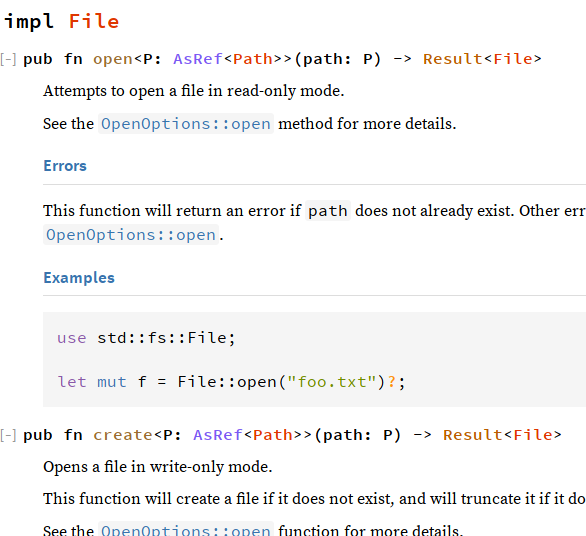
The lookup currently just looks at the top-level type, not looking inside things like Result or Option, which renders the spotlights on Read/Write a little less useful:
<details><summary>`File::{open, create}` don't have spotlight info (pic of old design)</summary>
</details>
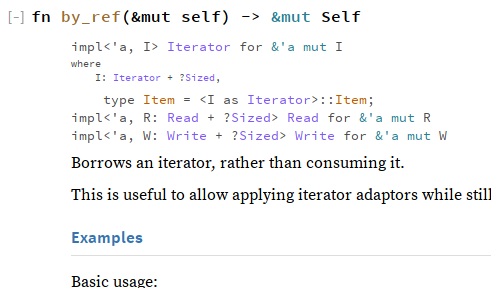
All three of the initially spotlighted traits are generically implemented on `&mut` references. Rustdoc currently treats a `&mut T` reference-to-a-generic as an impl on the reference primitive itself. `&mut Self` counts as a generic in the eyes of rustdoc. All this combines to create this lovely scene on `Iterator::by_ref`:
<details><summary>`Iterator::by_ref` spotlights Iterator, Read, and Write (pic of old design)</summary>
</details>
|
