| Age | Commit message (Collapse) | Author | Lines |
|---|
|
resolve: Functions introducing procedural macros reserve a slot in the macro namespace as well
Similarly to https://github.com/rust-lang/rust/pull/52234, this gives us symmetry between internal and external views of a crate, but in this case it's always an error to call a procedural macro in the same crate in which it's defined.
Closes https://github.com/rust-lang/rust/issues/52225
|
|
|
|
namespace as well
|
|
|
|
|
|
|
|
|
|
Technically, there are requirements imposed by the LLVM
`AMDGPUTargetMachine` on functions with this ABI (eg, the return type
must be void), but I'm unsure exactly where this should be enforced.
|
|
Deny bare trait objects in in src/libsyntax
Enforce `#![deny(bare_trait_objects)]` in `src/libsyntax`.
|
|
hygiene: Decouple transparencies from expansion IDs
And remove fallback to parent modules during resolution of names in scope.
This is a breaking change for users of unstable macros 2.0 (both procedural and declarative), code like this:
```rust
#![feature(decl_macro)]
macro m($S: ident) {
struct $S;
mod m {
type A = $S;
}
}
fn main() {
m!(S);
}
```
or equivalent
```rust
#![feature(decl_macro)]
macro m($S: ident) {
mod m {
type A = $S;
}
}
fn main() {
struct S;
m!(S);
}
```
stops working due to module boundaries being properly enforced.
For proc macro derives this is still reported as a compatibility warning to give `actix_derive`, `diesel_derives` and `palette_derive` time to fix their issues.
Fixes https://github.com/rust-lang/rust/issues/50504 in accordance with [this comment](https://github.com/rust-lang/rust/issues/50504#issuecomment-399764767).
|
|
|
|
|
|
Implement #[alloc_error_handler]
This to-be-stable attribute is equivalent to `#[lang = "oom"]`. It is required when using the `alloc` crate without the `std` crate. It is called by `handle_alloc_error`, which is in turned called by "infallible" allocations APIs such as `Vec::push`.
|
|
find and highlight the `&` or `'_` in `region_name`
Before:
```
--> $DIR/dyn-trait-underscore.rs:18:5
|
LL | fn a<T>(items: &[T]) -> Box<dyn Iterator<Item=&T>> {
- | ----- lifetime `'1` appears in this argument
LL | Box::new(items.iter()) //~ ERROR cannot infer an appropriate lifetime
| ^^^^^^^^^^^^^^^^^^^^^^ cast requires that `'1` must outlive `'static`
```
After:
```
--> $DIR/dyn-trait-underscore.rs:18:5
|
LL | fn a<T>(items: &[T]) -> Box<dyn Iterator<Item=&T>> {
+ | - let's call the lifetime of this reference `'1`
LL | Box::new(items.iter()) //~ ERROR cannot infer an appropriate lifetime
| ^^^^^^^^^^^^^^^^^^^^^^ cast requires that `'1` must outlive `'static`
```
Not intended as the final end point necessarily in any sense. I intentionally left some to-do points to fill in later:
- Does not apply to upvars in closures yet (should be relatively easy)
- Does not handle the case where we can't find a precise match very well
- And of course we can still tweak wording
but shows the basic idea of how to make the `Ty` and `hir::Ty` to find a good spot to highlight.
r? @estebank
cc @davidtwco
|
|
This to-be-stable attribute is equivalent to `#[lang = "oom"]`.
It is required when using the alloc crate without the std crate.
It is called by `handle_alloc_error`, which is in turned called
by "infallible" allocations APIs such as `Vec::push`.
|
|
|
|
|
|
clarify why we're suggesting removing semicolon after braced items
Previously (issue #46186, pull-request #46258), a suggestion was added
to remove the semicolon after we fail to parse an item, but issue #51603
complains that it's still insufficiently obvious why. Let's add a note.
Resolves #51603.
|
|
For a fuller description of the performance issue fixed by this:
https://github.com/rust-lang/rust/issues/51754#issuecomment-403242159
|
|
Implementation of tool lints.
Tracking issue: #44690
|
|
It's now https://github.com/rust-lang/rust/issues/52090
|
|
|
|
|
|
Show known meta items in unknown meta items error
This PR adds a label to E0541. It also factors built-in attribute parsing into a submodule of `attr` for ease of future refactoring.
Fixes #51469.
|
|
r=petrochenkov
add modifier keyword spans to hir::Visibility; improve unreachable-pub, private-no-mangle lint suggestions
#50455 pointed out that the unreachable-pub suggestion for brace-grouped `use`s was bogus; #50476 partially ameliorated this by marking the suggestion as `Applicability::MaybeIncorrect`, but this is the actual fix.
Meanwhile, another application of having spans available in `hir::Visibility` is found in the private-no-mangle lints, where we can now issue a suggestion to use `pub` if the item has a more restricted visibility marker (this seems much less likely to come up in practice than not having any visibility keyword at all, but thoroughness is a virtue). While we're there, we can also add a helpful note if the item does have a `pub` (but triggered the lint presumably because enclosing modules were private).
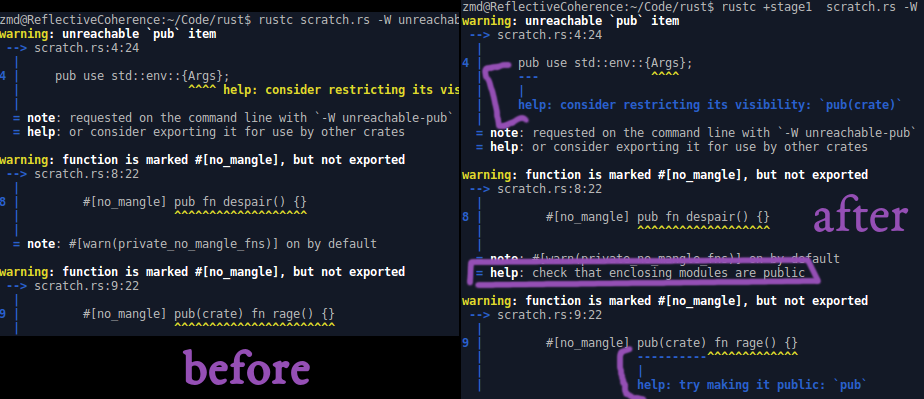
r? @nrc
cc @Manishearth
|
|
Suggest correct comparison against negative literal
When parsing as emplacement syntax (`x<-1`), suggest the correct syntax
for comparison against a negative value (`x< -1`).
Fix #45651.
|
|
Visibility spans were added to the AST in #47799 (d6bdf296) as a
`Spanned<_>`—which means that we need to choose a span even in the case
of inherited visibility (what you get when there's no `pub` &c. keyword
at all). That initial implementation's choice is pretty
counterintuitive, which could matter if we want to use it as a site to
suggest inserting a visibility modifier, &c.
(The phrase "Schelling span" in the comment is meant in analogy to the
game-theoretic concept of a "Schelling point", a value that is chosen
simply because it's what one can expect to agree upon with other agents
in the absence of explicit coördination.)
|
|
|
|
|
|
Previously (issue #46186, pull-request #46258), a suggestion was added
to remove the semicolon after we fail to parse an item, but issue #51603
complains that it's still insufficiently obvious why. Let's add a note.
Resolves #51603.
|
|
hygiene: Implement transparent marks and use them for call-site hygiene in proc-macros
Fixes https://github.com/rust-lang/rust/issues/50050
|
|
Lowering cleanups [1/N]
|
|
|
|
|
|
|
|
When parsing as emplacement syntax (`x<-1`), suggest the correct syntax
for comparison against a negative value (`x< -1`).
|
|
Make FileMap::{lines, multibyte_chars, non_narrow_chars} non-mutable.
This PR removes most of the interior mutability from `FileMap`, which should be beneficial, especially in a multithreaded setting. This is achieved by initializing the state in question when the filemap is constructed instead of during lexing. Hopefully this doesn't degrade performance.
cc @wesleywiser
|
|
The method relied on the FileMap still being under construction in
order for it to do what the name promises. It's now independent of
the current state.
|
|
Namely: labels, type parameters, bindings in patterns, parameter names in functions without body.
All of these do not need hygiene after lowering to HIR, only span locations.
|
|
Lower case some feature gate error messages
|
|
|
|
|
|
|
|
|
|
|
|
|
|
|
|
|
|
|
|
|
