| Age | Commit message (Collapse) | Author | Lines |
|---|
|
Avoid using `#[macro_export]` for documenting builtin macros
Use a special `rustc_*` attribute instead.
cc https://github.com/rust-lang/rust/pull/52234
|
|
Ever plagued by #43081 the compiler can return surprising spans in situations
related to procedural macros. This is exhibited by #47983 where whenever a
procedural macro is invoked in a nested item context it would fail to have
correct span information.
While #43230 provided a "hack" to cache the token stream used for each item in
the compiler it's not a full-blown solution. This commit continues to extend
this "hack" a bit more to work for nested items.
Previously in the parser the `parse_item` method would collect the tokens for an
item into a cache on the item itself. It turned out, however, that nested items
were parsed through the `parse_item_` method, so they didn't receive similar
treatment. To remedy this situation the hook for collecting tokens was moved
into `parse_item_` instead of `parse_item`.
Afterwards the token collection scheme was updated to support nested collection
of tokens. This is implemented by tracking `TokenStream` tokens instead of
`TokenTree` to allow for collecting items into streams at intermediate layers
and having them interleaved in the upper layers.
All in all, this...
Closes #47983
|
|
Improve suggestion for missing fmt str in println
Avoid using `concat!(fmt, "\n")` to improve the diagnostics being
emitted when the first `println!()` argument isn't a formatting string
literal.
Fix #52347.
|
|
|
|
Prepare proc_macro for decoupling it from the rest of the compiler.
This is #49219 up to the point where the bridge is introduced. Aside from moving some code around, the largest change is the rewrite of `proc_macro::quote` to be simpler and do less introspection.
I'd like to also extend `quote!` with `${stmt;...;expr}` instead of just `$variable` (and maybe even `$(... $iter ...)*`), which seems pretty straight-forward now, but I don't know if/when I should.
r? @alexcrichton or @dtolnay cc @jseyfried @petrochenkov
|
|
proc_macro: Preserve spans of attributes on functions
This commit updates the tokenization of items which are subsequently passed to
`proc_macro` to ensure that span information is preserved on attributes as much
as possible. Previously this area of the code suffered from #43081 where we
haven't actually implemented converting an attribute to to a token tree yet, but
a local fix was possible here.
Closes #47941
|
|
|
|
rustc: Fix two custom attributes with custom derive
This commit fixes an issue where multiple custom attributes could not be fed
into a custom derive in some situations with the `use_extern_macros` feature
enabled. The problem was that the macro expander didn't consider that it was
making progress when we were deducing that attributes should be lumped in with
custom derive invocations.
The fix applied here was to track in the expander if our attribute is changing
(getting stashed away elsewhere and replaced with a new invocation). If it is
swapped then it's considered progress, otherwise behavior should remain the
same.
Closes #52525
|
|
rustc: Stabilize #[wasm_import_module] as #[link(...)]
This commit stabilizes the `#[wasm_import_module]` attribute as
`#[link(wasm_import_module = "...")]`. Tracked by #52090 this new directive in
the `#[link]` attribute is used to configured the module name that the imports
are listed with. The WebAssembly specification indicates two utf-8 names are
associated with all imported items, one for the module the item comes from and
one for the item itself. The item itself is configurable in Rust via its
identifier or `#[link_name = "..."]`, but the module name was previously not
configurable and defaulted to `"env"`. This commit ensures that this is also
configurable.
Closes #52090
|
|
Avoid using `concat!(fmt, "\n")` to improve the diagnostics being
emitted when the first `println!()` argument isn't a formatting string
literal.
|
|
|
|
Implement existential types
(not for associated types yet)
r? @nikomatsakis
cc @Centril @varkor @alexreg
|
|
This commit fixes an issue where multiple custom attributes could not be fed
into a custom derive in some situations with the `use_extern_macros` feature
enabled. The problem was that the macro expander didn't consider that it was
making progress when we were deducing that attributes should be lumped in with
custom derive invocations.
The fix applied here was to track in the expander if our attribute is changing
(getting stashed away elsewhere and replaced with a new invocation). If it is
swapped then it's considered progress, otherwise behavior should remain the
same.
Closes #52525
|
|
This commit updates the tokenization of items which are subsequently passed to
`proc_macro` to ensure that span information is preserved on attributes as much
as possible. Previously this area of the code suffered from #43081 where we
haven't actually implemented converting an attribute to to a token tree yet, but
a local fix was possible here.
Closes #47941
|
|
This commit stabilizes the `#[wasm_import_module]` attribute as
`#[link(wasm_import_module = "...")]`. Tracked by #52090 this new directive in
the `#[link]` attribute is used to configured the module name that the imports
are listed with. The WebAssembly specification indicates two utf-8 names are
associated with all imported items, one for the module the item comes from and
one for the item itself. The item itself is configurable in Rust via its
identifier or `#[link_name = "..."]`, but the module name was previously not
configurable and defaulted to `"env"`. This commit ensures that this is also
configurable.
Closes #52090
|
|
rustc: Enable `use_extern_macros` in 2018 edition
This was previously enabled via `proc_macro`, but since `proc_macro` is now
stable this is no longer the case. Explicitly include it in the 2018 edition
here.
|
|
|
|
rustc: Use link_section, not wasm_custom_section
This commit transitions definitions of custom sections on the wasm target from
the unstable `#[wasm_custom_section]` attribute to the
already-stable-for-other-targets `#[link_section]` attribute. Mostly the same
restrictions apply as before, except that this now applies only to statics.
Closes #51088
|
|
This was previously enabled via `proc_macro`, but since `proc_macro` is now
stable this is no longer the case. Explicitly include it in the 2018 edition
here.
|
|
Fix macro parser quadratic complexity in small repeating groups
Observed in #51754, and more easily demonstrated with the following:
```rust
macro_rules! stress {
($($t:tt)+) => { };
}
fn main() {
stress!{
a a a a a a a a a a a a a a a a a a a a a a a a a a a a a a a a
a a a a a a a a a a a a a a a a a a a a a a a a a a a a a a a a
a a a a a a a a a a a a a a a a a a a a a a a a a a a a a a a a
a a a a a a a a a a a a a a a a a a a a a a a a a a a a a a a a
// ... 65536 copies of "a" total ...
a a a a a a a a a a a a a a a a a a a a a a a a a a a a a a a a
a a a a a a a a a a a a a a a a a a a a a a a a a a a a a a a a
a a a a a a a a a a a a a a a a a a a a a a a a a a a a a a a a
a a a a a a a a a a a a a a a a a a a a a a a a a a a a a a a a
}
}
```
which takes 50 seconds to compile prior to the fix and <1s after.
I hope this has a visible impact on the compile times for real code. (I think it is most likely to affect incremental TT munchers that deal with large inputs, though it depends on how they are written)
For a fuller description of the performance issue: https://github.com/rust-lang/rust/issues/51754#issuecomment-403242159
---
There is no test (yet) because I'm not sure how easily to measure this for regressions.
|
|
|
|
This commit transitions definitions of custom sections on the wasm target from
the unstable `#[wasm_custom_section]` attribute to the
already-stable-for-other-targets `#[link_section]` attribute. Mostly the same
restrictions apply as before, except that this now applies only to statics.
Closes #51088
|
|
This commit stabilizes some of the `proc_macro` language feature as well as a
number of APIs in the `proc_macro` crate as [previously discussed][1]. This
means that on stable Rust you can now define custom procedural macros which
operate as attributes attached to items or `macro_rules!`-like bang-style
invocations. This extends the suite of currently stable procedural macros,
custom derives, with custom attributes and custom bang macros.
Note though that despite the stabilization in this commit procedural macros are
still not usable on stable Rust. To stabilize that we'll need to stabilize at
least part of the `use_extern_macros` feature. Currently you can define a
procedural macro attribute but you can't import it to call it!
A summary of the changes made in this PR (as well as the various consequences)
is:
* The `proc_macro` language and library features are now stable.
* Other APIs not stabilized in the `proc_macro` crate are now named under a
different feature, such as `proc_macro_diagnostic` or `proc_macro_span`.
* A few checks in resolution for `proc_macro` being enabled have switched over
to `use_extern_macros` being enabled. This means that code using
`#![feature(proc_macro)]` today will likely need to move to
`#![feature(use_extern_macros)]`.
It's intended that this PR, once landed, will be followed up with an attempt to
stabilize a small slice of `use_extern_macros` just for procedural macros to
make this feature 100% usable on stable.
[1]: https://internals.rust-lang.org/t/help-stabilize-a-subset-of-macros-2-0/7252
|
|
resolve: Functions introducing procedural macros reserve a slot in the macro namespace as well
Similarly to https://github.com/rust-lang/rust/pull/52234, this gives us symmetry between internal and external views of a crate, but in this case it's always an error to call a procedural macro in the same crate in which it's defined.
Closes https://github.com/rust-lang/rust/issues/52225
|
|
|
|
namespace as well
|
|
|
|
|
|
|
|
|
|
Technically, there are requirements imposed by the LLVM
`AMDGPUTargetMachine` on functions with this ABI (eg, the return type
must be void), but I'm unsure exactly where this should be enforced.
|
|
Deny bare trait objects in in src/libsyntax
Enforce `#![deny(bare_trait_objects)]` in `src/libsyntax`.
|
|
hygiene: Decouple transparencies from expansion IDs
And remove fallback to parent modules during resolution of names in scope.
This is a breaking change for users of unstable macros 2.0 (both procedural and declarative), code like this:
```rust
#![feature(decl_macro)]
macro m($S: ident) {
struct $S;
mod m {
type A = $S;
}
}
fn main() {
m!(S);
}
```
or equivalent
```rust
#![feature(decl_macro)]
macro m($S: ident) {
mod m {
type A = $S;
}
}
fn main() {
struct S;
m!(S);
}
```
stops working due to module boundaries being properly enforced.
For proc macro derives this is still reported as a compatibility warning to give `actix_derive`, `diesel_derives` and `palette_derive` time to fix their issues.
Fixes https://github.com/rust-lang/rust/issues/50504 in accordance with [this comment](https://github.com/rust-lang/rust/issues/50504#issuecomment-399764767).
|
|
|
|
|
|
Implement #[alloc_error_handler]
This to-be-stable attribute is equivalent to `#[lang = "oom"]`. It is required when using the `alloc` crate without the `std` crate. It is called by `handle_alloc_error`, which is in turned called by "infallible" allocations APIs such as `Vec::push`.
|
|
find and highlight the `&` or `'_` in `region_name`
Before:
```
--> $DIR/dyn-trait-underscore.rs:18:5
|
LL | fn a<T>(items: &[T]) -> Box<dyn Iterator<Item=&T>> {
- | ----- lifetime `'1` appears in this argument
LL | Box::new(items.iter()) //~ ERROR cannot infer an appropriate lifetime
| ^^^^^^^^^^^^^^^^^^^^^^ cast requires that `'1` must outlive `'static`
```
After:
```
--> $DIR/dyn-trait-underscore.rs:18:5
|
LL | fn a<T>(items: &[T]) -> Box<dyn Iterator<Item=&T>> {
+ | - let's call the lifetime of this reference `'1`
LL | Box::new(items.iter()) //~ ERROR cannot infer an appropriate lifetime
| ^^^^^^^^^^^^^^^^^^^^^^ cast requires that `'1` must outlive `'static`
```
Not intended as the final end point necessarily in any sense. I intentionally left some to-do points to fill in later:
- Does not apply to upvars in closures yet (should be relatively easy)
- Does not handle the case where we can't find a precise match very well
- And of course we can still tweak wording
but shows the basic idea of how to make the `Ty` and `hir::Ty` to find a good spot to highlight.
r? @estebank
cc @davidtwco
|
|
This to-be-stable attribute is equivalent to `#[lang = "oom"]`.
It is required when using the alloc crate without the std crate.
It is called by `handle_alloc_error`, which is in turned called
by "infallible" allocations APIs such as `Vec::push`.
|
|
|
|
|
|
clarify why we're suggesting removing semicolon after braced items
Previously (issue #46186, pull-request #46258), a suggestion was added
to remove the semicolon after we fail to parse an item, but issue #51603
complains that it's still insufficiently obvious why. Let's add a note.
Resolves #51603.
|
|
For a fuller description of the performance issue fixed by this:
https://github.com/rust-lang/rust/issues/51754#issuecomment-403242159
|
|
Implementation of tool lints.
Tracking issue: #44690
|
|
It's now https://github.com/rust-lang/rust/issues/52090
|
|
|
|
|
|
Show known meta items in unknown meta items error
This PR adds a label to E0541. It also factors built-in attribute parsing into a submodule of `attr` for ease of future refactoring.
Fixes #51469.
|
|
r=petrochenkov
add modifier keyword spans to hir::Visibility; improve unreachable-pub, private-no-mangle lint suggestions
#50455 pointed out that the unreachable-pub suggestion for brace-grouped `use`s was bogus; #50476 partially ameliorated this by marking the suggestion as `Applicability::MaybeIncorrect`, but this is the actual fix.
Meanwhile, another application of having spans available in `hir::Visibility` is found in the private-no-mangle lints, where we can now issue a suggestion to use `pub` if the item has a more restricted visibility marker (this seems much less likely to come up in practice than not having any visibility keyword at all, but thoroughness is a virtue). While we're there, we can also add a helpful note if the item does have a `pub` (but triggered the lint presumably because enclosing modules were private).
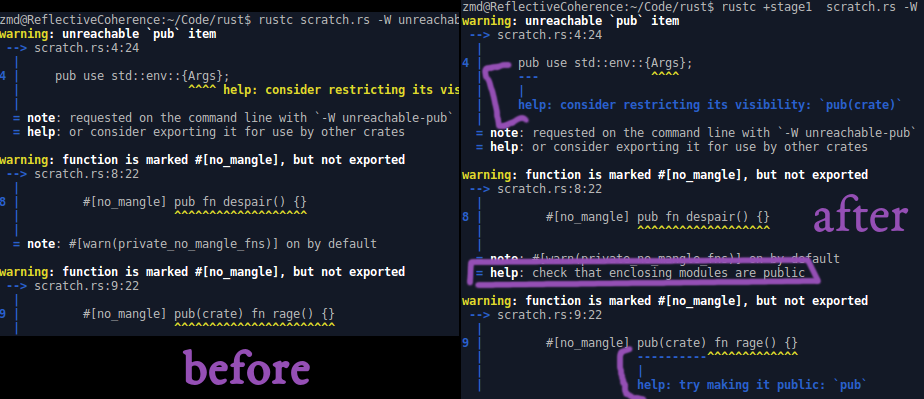
r? @nrc
cc @Manishearth
|
|
Suggest correct comparison against negative literal
When parsing as emplacement syntax (`x<-1`), suggest the correct syntax
for comparison against a negative value (`x< -1`).
Fix #45651.
|
|
Visibility spans were added to the AST in #47799 (d6bdf296) as a
`Spanned<_>`—which means that we need to choose a span even in the case
of inherited visibility (what you get when there's no `pub` &c. keyword
at all). That initial implementation's choice is pretty
counterintuitive, which could matter if we want to use it as a site to
suggest inserting a visibility modifier, &c.
(The phrase "Schelling span" in the comment is meant in analogy to the
game-theoretic concept of a "Schelling point", a value that is chosen
simply because it's what one can expect to agree upon with other agents
in the absence of explicit coördination.)
|
