| Age | Commit message (Collapse) | Author | Lines |
|---|
|
r=GuillaumeGomez,QuietMisdreavus
show in docs whether the return type of a function impls Iterator/Read/Write
Closes #25928
This PR makes it so that when rustdoc documents a function, it checks the return type to see whether it implements a handful of specific traits. If so, it will print the impl and any associated types. Rather than doing this via a whitelist within rustdoc, i chose to do this by a new `#[doc]` attribute parameter, so things like `Future` could tap into this if desired.
### Known shortcomings
~~The printing of impls currently uses the `where` class over the whole thing to shrink the font size relative to the function definition itself. Naturally, when the impl has a where clause of its own, it gets shrunken even further:~~ (This is no longer a problem because the design changed and rendered this concern moot.)
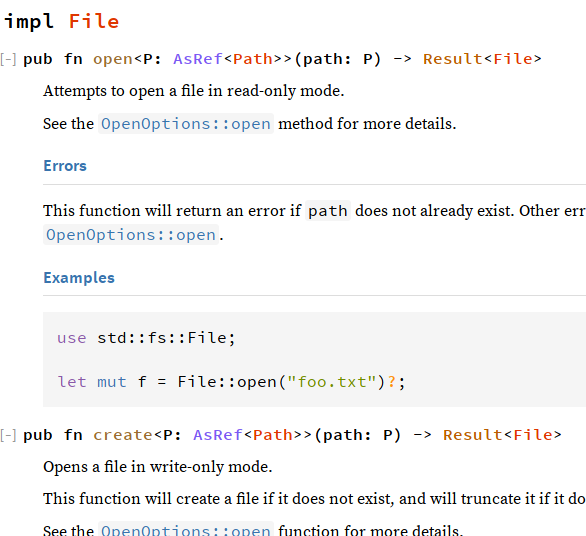
The lookup currently just looks at the top-level type, not looking inside things like Result or Option, which renders the spotlights on Read/Write a little less useful:
<details><summary>`File::{open, create}` don't have spotlight info (pic of old design)</summary>
</details>
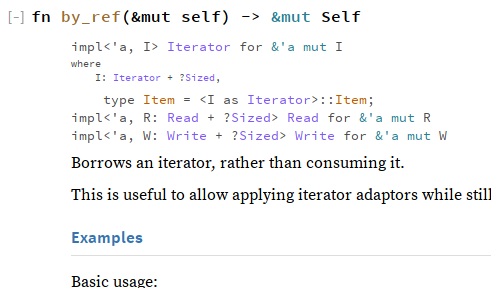
All three of the initially spotlighted traits are generically implemented on `&mut` references. Rustdoc currently treats a `&mut T` reference-to-a-generic as an impl on the reference primitive itself. `&mut Self` counts as a generic in the eyes of rustdoc. All this combines to create this lovely scene on `Iterator::by_ref`:
<details><summary>`Iterator::by_ref` spotlights Iterator, Read, and Write (pic of old design)</summary>
</details>
|
|
|
|
|
|
|
|
|
|
std: Add a new wasm32-unknown-unknown target
This commit adds a new target to the compiler: wasm32-unknown-unknown. This target is a reimagining of what it looks like to generate WebAssembly code from Rust. Instead of using Emscripten which can bring with it a weighty runtime this instead is a target which uses only the LLVM backend for WebAssembly and a "custom linker" for now which will hopefully one day be direct calls to lld.
Notable features of this target include:
* There is zero runtime footprint. The target assumes nothing exists other than the wasm32 instruction set.
* There is zero toolchain footprint beyond adding the target. No custom linker is needed, rustc contains everything.
* Very small wasm modules can be generated directly from Rust code using this target.
* Most of the standard library is stubbed out to return an error, but anything related to allocation works (aka `HashMap`, `Vec`, etc).
* Naturally, any `#[no_std]` crate should be 100% compatible with this new target.
This target is currently somewhat janky due to how linking works. The "linking" is currently unconditional whole program LTO (aka LLVM is being used as a linker). Naturally that means compiling programs is pretty slow! Eventually though this target should have a linker.
This target is also intended to be quite experimental. I'm hoping that this can act as a catalyst for further experimentation in Rust with WebAssembly. Breaking changes are very likely to land to this target, so it's not recommended to rely on it in any critical capacity yet. We'll let you know when it's "production ready".
### Building yourself
First you'll need to configure the build of LLVM and enable this target
```
$ ./configure --target=wasm32-unknown-unknown --set llvm.experimental-targets=WebAssembly
```
Next you'll want to remove any previously compiled LLVM as it needs to be rebuilt with WebAssembly support. You can do that with:
```
$ rm -rf build
```
And then you're good to go! A `./x.py build` should give you a rustc with the appropriate libstd target.
### Test support
Currently testing-wise this target is looking pretty good but isn't complete. I've got almost the entire `run-pass` test suite working with this target (lots of tests ignored, but many passing as well). The `core` test suite is [still getting LLVM bugs fixed](https://reviews.llvm.org/D39866) to get that working and will take some time. Relatively simple programs all seem to work though!
In general I've only tested this with a local fork that makes use of LLVM 5 rather than our current LLVM 4 on master. The LLVM 4 WebAssembly backend AFAIK isn't broken per se but is likely missing bug fixes available on LLVM 5. I'm hoping though that we can decouple the LLVM 5 upgrade and adding this wasm target!
### But the modules generated are huge!
It's worth nothing that you may not immediately see the "smallest possible wasm module" for the input you feed to rustc. For various reasons it's very difficult to get rid of the final "bloat" in vanilla rustc (again, a real linker should fix all this). For now what you'll have to do is:
cargo install --git https://github.com/alexcrichton/wasm-gc
wasm-gc foo.wasm bar.wasm
And then `bar.wasm` should be the smallest we can get it!
---
In any case for now I'd love feedback on this, particularly on the various integration points if you've got better ideas of how to approach them!
|
|
This commit adds a new target to the compiler: wasm32-unknown-unknown. This
target is a reimagining of what it looks like to generate WebAssembly code from
Rust. Instead of using Emscripten which can bring with it a weighty runtime this
instead is a target which uses only the LLVM backend for WebAssembly and a
"custom linker" for now which will hopefully one day be direct calls to lld.
Notable features of this target include:
* There is zero runtime footprint. The target assumes nothing exists other than
the wasm32 instruction set.
* There is zero toolchain footprint beyond adding the target. No custom linker
is needed, rustc contains everything.
* Very small wasm modules can be generated directly from Rust code using this
target.
* Most of the standard library is stubbed out to return an error, but anything
related to allocation works (aka `HashMap`, `Vec`, etc).
* Naturally, any `#[no_std]` crate should be 100% compatible with this new
target.
This target is currently somewhat janky due to how linking works. The "linking"
is currently unconditional whole program LTO (aka LLVM is being used as a
linker). Naturally that means compiling programs is pretty slow! Eventually
though this target should have a linker.
This target is also intended to be quite experimental. I'm hoping that this can
act as a catalyst for further experimentation in Rust with WebAssembly. Breaking
changes are very likely to land to this target, so it's not recommended to rely
on it in any critical capacity yet. We'll let you know when it's "production
ready".
---
Currently testing-wise this target is looking pretty good but isn't complete.
I've got almost the entire `run-pass` test suite working with this target (lots
of tests ignored, but many passing as well). The `core` test suite is still
getting LLVM bugs fixed to get that working and will take some time. Relatively
simple programs all seem to work though!
---
It's worth nothing that you may not immediately see the "smallest possible wasm
module" for the input you feed to rustc. For various reasons it's very difficult
to get rid of the final "bloat" in vanilla rustc (again, a real linker should
fix all this). For now what you'll have to do is:
cargo install --git https://github.com/alexcrichton/wasm-gc
wasm-gc foo.wasm bar.wasm
And then `bar.wasm` should be the smallest we can get it!
---
In any case for now I'd love feedback on this, particularly on the various
integration points if you've got better ideas of how to approach them!
|
|
|
|
Remove left over dead code from suggestion diagnostic refactoring
More cleanups after #41876 and #45741
|
|
|
|
|
|
|
|
avoid the pprust infrastructure in macro expansion
This changes macro expansion to format the path of a macro directly
instead of usng the pprust infrastructure. The pprust infrastructure
tries to perform line-breaking in a slow fashion, which is undesired
when formatting the path of a macro.
This should to speed up expansion by a fair amount (I saw 20% on a
profiler on `rustc_mir`, and 50% of the time marked as "expansion" in
the profiler/time-passes is actually spent loading dependencies).
r? @jseyfried
|
|
Move feature gate check to inside HIR lowering. Change error messages
and update tests.
|
|
This changes macro expansion to format the path of a macro directly
instead of usng the pprust infrastructure. The pprust infrastructure
tries to perform line-breaking in a slow fashion, which is undesired
when formatting the path of a macro.
This should to speed up expansion by a fair amount (I saw 20% on a
profiler on `rustc_mir`, and 50% of the time marked as "expansion" in
the profiler/time-passes is actually spent loading dependencies).
|
|
Implement arbitrary_self_types
r? @arielb1
cc @nikomatsakis
Partial implementation of #44874. Supports trait and struct methods with arbitrary self types, as long as the type derefs (transitively) to `Self`. Doesn't support raw-pointer `self` yet.
Methods with non-standard self types (i.e. anything other than `&self, &mut self, and Box<Self>`) are not object safe, because dynamic dispatch hasn't been implemented for them yet.
I believe this is also a (partial) fix for #27941.
|
|
Remove some outdated messages from "no patterns allowed" errors
|
|
Add error for `...` in expressions
Follow-up to https://github.com/rust-lang/rust/pull/44709
Tracking issue: https://github.com/rust-lang/rust/issues/28237
* Using `...` in expressions was a warning, now it's an error
* The error message suggests using `..` or `..=` instead, and explains the difference
* Updated remaining occurrences of `...` to `..=`
r? petrochenkov
|
|
Refactor internal suggestion API
~~The only functional change is that whitespace, which is suggested to be added, also gets `^^^^` under it. An example is shown in the tests (the only test that changed).~~
Continuation of #41876
r? @nagisa
the changes are probably best viewed [without whitespace](https://github.com/rust-lang/rust/pull/45741/files?w=1)
|
|
Detect `=` -> `:` typo in let bindings
When encountering a let binding type error, attempt to parse as
initializer instead. If successful, it is likely just a typo:
```rust
fn main() {
let x: Vec::with_capacity(10);
}
```
```
error: expected type, found `10`
--> file.rs:3:31
|
3 | let x: Vec::with_capacity(10, 20);
| -- ^^
| ||
| |help: did you mean assign here?: `=`
| while parsing the type for `x`
```
Fix #43703.
|
|
If the feature is enabled, allow method `self` types to be any type
that auto-derefs to `self`.
- Currently, this supports inherent methods as well as trait methods.
The plan AFAIK is to only allow this for trait methods, so I guess it
won’t stay this way
- Dynamic dispatch isn’t implemented yet, so the compiler will ICE if
you define a trait method that takes `self: Rc<Self>` and try to call
it on an `Rc<Trait>`. I will probably just make those methods
non-object-safe initially.
|
|
Pretty print parens around casts on the LHS of `<`/`<<`
When pretty printing a cast expression occuring on the LHS of a `<` or `<<` expression, we should add parens around the cast. Otherwise, the `<`/`<<` gets interpreted as the beginning of the generics for the type on the RHS of the cast.
Consider:
$ cat parens_cast.rs
macro_rules! negative {
($e:expr) => { $e < 0 }
}
fn main() {
negative!(1 as i32);
}
Before this PR, the output of the following is not valid Rust:
$ rustc -Z unstable-options --pretty=expanded parens_cast.rs
#![feature(prelude_import)]
#![no_std]
#[prelude_import]
use std::prelude::v1::*;
#[macro_use]
extern crate std as std;
macro_rules! negative(( $ e : expr ) => { $ e < 0 });
fn main() { 1 as i32 < 0; }
After this PR, the output of the following is valid Rust:
$ rustc -Z unstable-options --pretty=expanded parens_cast.rs
#![feature(prelude_import)]
#![no_std]
#[prelude_import]
use std::prelude::v1::*;
#[macro_use]
extern crate std as std;
macro_rules! negative(( $ e : expr ) => { $ e < 0 });
fn main() { (1 as i32) < 0; }
I've gone through several README/wiki style documents but I'm still not sure where to test this though. I'm not even sure if this sort of thing is tested...
|
|
|
|
|
|
Pretty print json in ui tests
I found the json output in one line to not be useful for reviewing
r? @petrochenkov
|
|
When pretty printing a cast expression occuring on the LHS of a '<'
or '<<' expression, we should add parens around the cast. Otherwise,
the '<'/'<<' gets interpreted as the beginning of the generics for
the type on the RHS of the cast.
|
|
r=alexcrichton
Copy all `AsciiExt` methods to the primitive types directly in order to deprecate it later
**EDIT:** [this PR is ready now](https://github.com/rust-lang/rust/pull/44042#issuecomment-333883548). I edited this post to reflect the current status of discussion, which is (apart from code review) pretty much settled.
---
This is my current progress in order to prepare stabilization of #39658. As discussed there (and in #39659), the idea is to deprecated `AsciiExt` and copy all methods to the type directly. Apparently there isn't really a reason to have those methods in an extension trait¹.
~~This is **work in progress**: copy&pasting code while slightly modifying the documentation isn't the most exciting thing to do. Therefore I wanted to already open this WIP PR after doing basically 1/4 of the job (copying methods to `&[u8]`, `char` and `&str` is still missing) to get some feedback before I continue. Some questions possibly worth discussing:~~
1. ~~Does everyone agree that deprecating `AsciiExt` is a good idea? Does everyone agree with the goal of this PR?~~ => apparently yes
2. ~~Are my changes OK so far? Did I do something wrong?~~
3. ~~The issue of the unstable-attribute is currently set to 0. I would wait until you say "Ok" to the whole thing, then create a tracking issue and then insert the correct issue id. Is that ok?~~
4. ~~I tweaked `eq_ignore_ascii_case()`: it now takes the argument `other: u8` instead of `other: &u8`. The latter was enforced by the trait. Since we're not bound to a trait anymore, we can drop the reference, ok?~~ => I reverted this, because the interface has to match the `AsciiExt` interface exactly.
¹ ~~Could it be that we can't write `impl [u8] {}`? This might be the reason for `AsciiExt`. If that is the case: is there a good reason we can't write such an impl block? What can we do instead?~~ => we couldn't at the time this PR was opened, but Simon made it possible.
/cc @SimonSapin @zackw
|
|
Right now symbol exports, particularly in a cdylib, are handled by
assuming that `pub extern` combined with `#[no_mangle]` means "export
this". This isn't actually what we want for some symbols that the
standard library uses to implement itself, for example symbols related
to allocation. Additionally other special symbols like
`rust_eh_personallity` have no need to be exported from cdylib crate
types (only needed in dylib crate types).
This commit updates how rustc handles these special symbols by adding to
the hardcoded logic of symbols like `rust_eh_personallity` but also
adding a new attribute, `#[rustc_std_internal_symbol]`, which forces the
export level to be considered the same as all other Rust functions
instead of looking like a C function.
The eventual goal here is to prevent functions like `__rdl_alloc` from
showing up as part of a Rust cdylib as it's just an internal
implementation detail. This then further allows such symbols to get gc'd
by the linker when creating a cdylib.
|
|
Display spans correctly when there are zero-width or wide characters
Hopefully...
* fixes #45211
* fixes #8706
---
Before:
```
error: invalid width `7` for integer literal
--> unicode_2.rs:12:25
|
12 | let _ = ("a̐éö̲", 0u7);
| ^^^
|
= help: valid widths are 8, 16, 32, 64 and 128
error: invalid width `42` for integer literal
--> unicode_2.rs:13:20
|
13 | let _ = ("아あ", 1i42);
| ^^^^
|
= help: valid widths are 8, 16, 32, 64 and 128
error: aborting due to 2 previous errors
```
After:
```
error: invalid width `7` for integer literal
--> unicode_2.rs:12:25
|
12 | let _ = ("a̐éö̲", 0u7);
| ^^^
|
= help: valid widths are 8, 16, 32, 64 and 128
error: invalid width `42` for integer literal
--> unicode_2.rs:13:20
|
13 | let _ = ("아あ", 1i42);
| ^^^^
|
= help: valid widths are 8, 16, 32, 64 and 128
error: aborting due to 2 previous errors
```
Spans might display incorrectly on the browser.
r? @estebank
|
|
RFC 2008: Future-proofing enums/structs with #[non_exhaustive] attribute
This work-in-progress pull request contains my changes to implement [RFC 2008](https://github.com/rust-lang/rfcs/pull/2008). The related tracking issue is #44109.
As of writing, enum-related functionality is not included and there are some issues related to tuple/unit structs. Enum related tests are currently ignored.
WIP PR requested by @nikomatsakis [in Gitter](https://gitter.im/rust-impl-period/WG-compiler-middle?at=59e90e6297cedeb0482ade3e).
|
|
Add a nicer error message for missing in for loop, fixes #40782.
As suggested by @estebank in issue #40782, this works in the same way as #42578: if the in keyword is missing, we continue parsing the expression and if this works correctly an adapted error message is produced. Otherwise we return the old error.
A specific test case has also been added.
This is my first PR on rust-lang/rust so any feedback is very welcome.
|
|
When encountering a let binding type error, attempt to parse as
initializer instead. If successful, it is likely just a typo:
```rust
fn main() {
let x: Vec::with_capacity(10);
}
```
```
error: expected type, found `10`
--> file.rs:3:31
|
3 | let x: Vec::with_capacity(10, 20);
| -- ^^
| ||
| |help: did you mean assign here?: `=`
| while parsing the type for `x`
```
|
|
This is done in order to deprecate AsciiExt eventually. Note that
this commit contains a bunch of `cfg(stage0)` statements. This is
due to a new compiler feature this commit depends on: the
`slice_u8` lang item. Once this lang item is available in the
stage0 compiler, all those cfg flags (and more) can be removed.
|
|
|
|
[Syntax] Implement auto trait syntax
Implements `auto trait Send {}` as a substitute for `trait Send {} impl Send for .. {}`.
See the [internals thread](https://internals.rust-lang.org/t/pre-rfc-renaming-oibits-and-changing-their-declaration-syntax/3086) for motivation. Part of #13231.
The first commit is just a rename moving from "default trait" to "auto trait". The rest is parser->AST->HIR work and making it the same as the current syntax for everything below HIR. It's under the `optin_builtin_traits` feature gate.
When can we remove the old syntax? Do we need to wait for a new `stage0`? We also need to formally decide for the new form (even if the keyword is not settled yet).
Observations:
- If you `auto trait Auto {}` and then `impl Auto for .. {}` that's accepted even if it's redundant.
- The new syntax is simpler internally which will allow for a net removal of code, for example well-formedness checks are effectively moved to the parser.
- Rustfmt and clippy are broken, need to fix those.
- Rustdoc just ignores it for now.
ping @petrochenkov @nikomatsakis
|
|
It was being printed wrong as auto unsafe trait
|
|
This moves the well formedness checks to the AST validation pass. Tests
were adjusted.
The auto keyword should be back-compat now.
|
|
Now we can do the well formedness checks in the parser, yay!
|
|
|
|
Adds an `IsAuto` field to `ItemTrait` which flags if the trait was
declared as an `auto trait`.
Auto traits cannot have generics nor super traits.
|
|
DefaultImpl is a highly confusing name for what we now call auto impls,
as in `impl Send for ..`. The name auto impl is not formally decided
but for sanity anything is better than `DefaultImpl` which refers
neither to `default impl` nor to `impl Default`.
|
|
|
|
|
|
|
|
|
|
|
|
|
|
incr.comp.: Implement compiler diagnostic persistence.
This PR implements storing and loading diagnostics that the compiler generates and thus allows for emitting warnings during incremental compilation without actually re-evaluating the thing the warning originally came from. It also lays some groundwork for storing and loading type information and MIR in the incr. comp. cache.
~~It is still work in progress:~~
- ~~There's still some documentation to be added.~~
- ~~The way anonymous queries are handled might lead to duplicated emissions of warnings. Not sure if there is a better way or how frequent such duplication would be in practice.~~
Diagnostic message duplication is addressed separately in #45519.
r? @nikomatsakis
|
|
|
|
|
