| Age | Commit message (Collapse) | Author | Lines |
|---|
|
Do not ICE on assoc type with bad placeholder
Fixes #74612
r? @estebank
|
|
Guard against non-monomorphized type_id intrinsic call
This PR checks whether the type is sufficient monomorphized when calling type_id or type_name intrinsics. If the type is not sufficiently monomorphized, e.g. used in a pattern, the code will be rejected.
Fixes #73976
|
|
rustdoc: Always warn when linking from public to private items
Change the logic such that linking from a public to a private item always triggers `intra_doc_link_resolution_failure`.
Previously, the warning was not emitted when `--document-private-items` is passed.
This came up during the discussion in https://github.com/rust-lang/rust/pull/74147#discussion_r452597901.
|
|
Detect when `'static` obligation might come from an `impl`
Partly address #71341.
|
|
|
|
The additional note helps explaining why the lint was triggered and that
--document-private-items directly influences the link resolution.
|
|
Change the logic such that linking from a public to a private item always
triggers intra_doc_link_resolution_failure. Previously, the warning was
not emitted when --document-private-items is passed.
Also don't rely anymore on the item's visibility, which would falsely trigger
the lint now that the check for --document-private-items is gone.
|
|
r=wesleywiser
Disable polymorphisation
Fixes #74614.
This PR disables polymorphisation to fix the regression in #74614 after investigation into the issue makes it clear that the fix won't be trivial. ~~I'll file an issue shortly to replace #74614 with the findings so far.~~ #74636 has been filed to track the fix of the underlying regression.
r? @eddyb
|
|
|
|
|
|
|
|
|
|
|
|
Address #71341.
|
|
refactor and reword intra-doc link errors
This commit refactors intra-doc link error reporting to deduplicate code
and decouple error construction from the type of error. This greatly
improves flexibility at each error construction site, while reducing the
complexity of the diagnostic creation.
This commit also rewords the diagnostics for clarity and style:
- Diagnostics should not end in periods.
- It's unnecessary to say "ignoring it". Since this is a warning by
default, it's already clear that the link is ignored.
|
|
compiletest: Rewrite extract_*_version functions
This makes extract_lldb_version has the same version type like
extract_gdb_version.
|
|
Stabilize control-flow-guard codegen option
This is the stabilization PR discussed in #68793. It converts the `-Z control-flow-guard` debugging option into a codegen option (`-C control-flow-guard`), and changes the associated tests.
|
|
va_args implementation for AAPCS.
Implement the va args in codegen for AAPCS, this will be used as the
default va_args implementation for AArch64 rather than the va_args
llvm-ir as it currently is.
This should fix the following issues:
https://github.com/rust-lang/rust/issues/56475
https://github.com/rust-lang/rust/issues/72579
|
|
This commit adds a regression test for #74614 so that it is fixed before
polymorphisation is re-enabled.
Signed-off-by: David Wood <david@davidtw.co>
|
|
This commit disables polymorphisation to resolve regressions related to
closures which inherit unused generic parameters and are then used in
casts or reflection.
Signed-off-by: David Wood <david@davidtw.co>
|
|
|
|
functions
This patch extends the existing `type_i8p` method so that it requires an
explicit address space to be specified. Before this patch, the
`type_i8p` method implcitily assumed the default address space, which is
not a safe transformation on all targets, namely AVR.
The Rust compiler already has support for tracking the "instruction
address space" on a per-target basis. This patch extends the code
generation routines so that an address space must always be specified.
In my estimation, around 15% of the callers of `type_i8p` produced
invalid code on AVR due to the loss of address space prior to LLVM final
code generation. This would lead to unavoidable assertion errors
relating to invalid bitcasts.
With this patch, the address space is always either 1) explicitly set to
the instruction address space because the logic is dealing with functions
which must be placed there, or 2) explicitly set to the default address
space 0 because the logic can only operate on data space pointers and thus
we keep the existing semantics of assuming the default, "data" address space.
|
|
Polymorphization
This PR implements an analysis to detect when functions could remain polymorphic during code generation.
Fixes #46477
r? @eddyb
cc @rust-lang/wg-mir-opt @nikomatsakis @pnkfelix
|
|
|
|
This commit refactors intra-doc link error reporting to deduplicate code
and decouple error construction from the type of error. This greatly
improves flexibility at each error construction site, while reducing the
complexity of the diagnostic creation.
This commit also rewords the diagnostics for clarity and style:
- Diagnostics should not end in periods.
- It's unnecessary to say "ignoring it". Since this is a warning by
default, it's already clear that the link is ignored.
|
|
Fix an ICE on an invalid `binding @ ...` in a tuple struct pattern
Fixes #74539.
|
|
disallow non-static lifetimes in const generics
Disallow non-static lifetimes in const generics in order to to patch over an ICE caused when we encounter a non-static lifetime in a const generic during borrow checking. This restriction may be relaxed in the future, but we need more discussion before then, and in the meantime we should still deal with this ICE.
Fixes issue #60814
|
|
r=ecstatic-morse
wf: check foreign fn decls for well-formedness
Fixes #73252 and fixes #73253.
This PR extends current well-formedness checking to apply to foreign function declarations, re-using the existing machinery for regular functions. In doing this, later parts of the compiler (such as the `improper_ctypes` lint) can rely on being operations not failing as a result of invalid code which would normally be caught earlier.
|
|
Fix debug assertion in typeck
Fixes #72410
|
|
This commit introduces a `FiniteBitSet` type which replaces the manual
bit manipulation which was being performed in polymorphization.
Signed-off-by: David Wood <david@davidtw.co>
|
|
This commit replaces the `-Z polymorphize-errors` debugging flag with a
`#[rustc_polymorphize_error]` attribute for use on functions.
Signed-off-by: David Wood <david@davidtw.co>
|
|
This commit normalizes function signatures for instances before
substituting, a workaround for polymorphization considering
parameters unused when they show up in the signature, but not the
body (due to being normalized).
Unfortunately, this causes test output to change with the parallel
compiler only.
Signed-off-by: David Wood <david@davidtw.co>
|
|
This commit implements the `unused_generic_params` query, an initial
version of polymorphization which detects when an item does not use
generic parameters and is being needlessly monomorphized as a result.
Signed-off-by: David Wood <david@davidtw.co>
|
|
|
|
This commit extends current well-formedness checking to apply to foreign
function declarations, re-using the existing machinery for regular
functions. In doing this, later parts of the compiler (such as the
`improper_ctypes` lint) can rely on being operations not failing as a
result of invalid code which would normally be caught earlier.
Signed-off-by: David Wood <david@davidtw.co>
|
|
Only skip impls of foreign unstable traits
Previously unstable impls were skipped, which meant that any impl with an unstable method would get skipped.
Fixes #74531.
|
|
do not try fetching the ancestors of errored trait impls
fixes #74483
While building the specialization graph, we use `tcx.all_impls` which discards impls with incorrect self types,
we do however call `trait_def.ancestors` with these impls which caused an ICE as they aren't part of the
specialization graph.
|
|
|
|
Previously unstable impls were skipped, which meant that any impl with an
unstable method would get skipped.
|
|
|
|
This has been put in place to patch over an ICE caused when we encounter
a non-static lifetime in a const generic during borrow checking. This
restriction may be relaxed in the future, but we need more discussion
before then, and in the meantime we should still deal with this ICE.
Fixes issue #60814
|
|
|
|
|
|
|
|
Generating the coverage map
@tmandry @wesleywiser
rustc now generates the coverage map and can support (limited)
coverage report generation, at the function level.
Example commands to generate a coverage report:
```shell
$ BUILD=$HOME/rust/build/x86_64-unknown-linux-gnu
$ $BUILD/stage1/bin/rustc -Zinstrument-coverage \
$HOME/rust/src/test/run-make-fulldeps/instrument-coverage/main.rs
$ LLVM_PROFILE_FILE="main.profraw" ./main
called
$ $BUILD/llvm/bin/llvm-profdata merge -sparse main.profraw -o main.profdata
$ $BUILD/llvm/bin/llvm-cov show --instr-profile=main.profdata main
```
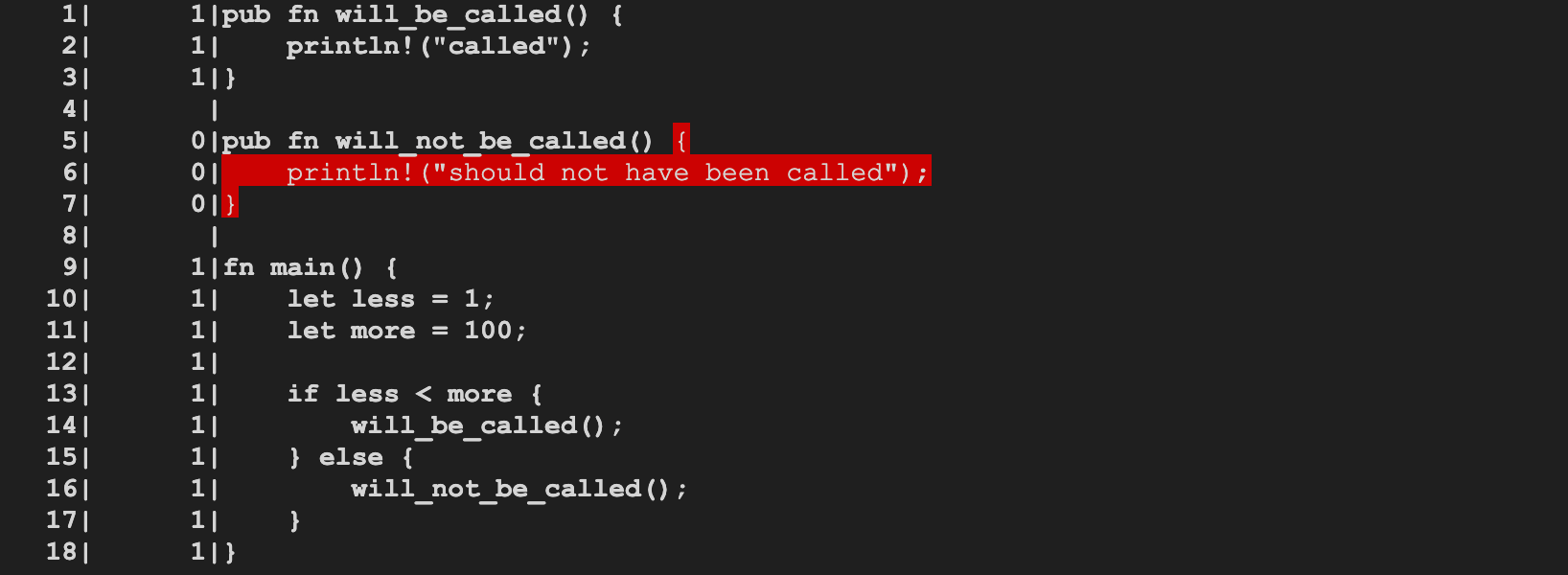
r? @wesleywiser
Rust compiler MCP rust-lang/compiler-team#278
Relevant issue: #34701 - Implement support for LLVMs code coverage instrumentation
|
|
Make unreachable_unchecked a const fn
This PR makes `std::hint::unreachable_unchecked` a const fn so we can use it inside a const function.
r? @RalfJung
Fixes #53188.
|
|
add test for #62878
forgot to push this as part of #74159
r? @Dylan-DPC
|
|
rustc_metadata: Make crate loading fully speculative
Instead of reporting `span_err`s on the spot crate loading errors are now wrapped into the `CrateError` enum and returned, so they are reported only at the top level `resolve_crate` call, and not reported at all if we are resolving speculatively with `maybe_resolve_crate`.
As a result we can attempt loading crates for error recovery (e.g. import suggestions) without any risk of producing extra errors.
Also, this means better separation between error reporting and actual logic.
Fixes https://github.com/rust-lang/rust/issues/55103
Fixes https://github.com/rust-lang/rust/issues/56590
|
|
|
|
|
