| Age | Commit message (Collapse) | Author | Lines |
|---|
|
Make dead code check a query.
Dead code check is run for each invocation of the compiler, even if no modifications were involved.
This PR makes dead code check a query keyed on the module. This allows to skip the check when a module has not changed.
To perform this, a query `live_symbols_and_ignored_derived_traits` is introduced to encapsulate the global analysis of finding live symbols. The second query `check_mod_deathness` outputs diagnostics for each module based on this first query's results.
|
|
When writing `Vec<A:B>`, suggest `Vec<A::B>`.
|
|
|
|
Continue work on associated const equality
This actually implements some more complex logic for assigning associated consts to values.
Inside of projection candidates, it now defers to a separate function for either consts or
types. To reduce amount of code, projections are now generic over T, where T is either a Type or
a Const. I can add some comments back later, but this was the fastest way to implement it.
It also now finds the correct type of consts in type_of.
---
The current main TODO is finding the const of the def id for the LeafDef.
Right now it works if the function isn't called, but once you use the trait impl with the bound it fails inside projection.
I was hoping to get some help in getting the `&'tcx ty::Const<'tcx>`, in addition to a bunch of other `todo!()`s which I think may not be hit.
r? `@oli-obk`
Updates #92827
|
|
Use spacing to distinguish what is related to a given heading.
|
|
|
|
Rollup of 7 pull requests
Successful merges:
- #86374 (Enable combining `+crt-static` and `relocation-model=pic` on `x86_64-unknown-linux-gnu`)
- #91828 (Implement `RawWaker` and `Waker` getters for underlying pointers)
- #92021 (Eliminate duplicate codes of is_single_fp_element)
- #92584 (add rustc lint, warning when iterating over hashmaps 2)
- #93267 (implement a lint for suspicious auto trait impls)
- #93290 (remove `TyS::same_type`)
- #93436 (Update compiler_builtins to fix duplicate symbols in `armv7-linux-androideabi` rlib)
Failed merges:
r? `@ghost`
`@rustbot` modify labels: rollup
|
|
implement a lint for suspicious auto trait impls
cc https://github.com/rust-lang/rust/pull/85048#issuecomment-1019805102
r? ``@nikomatsakis``
|
|
add rustc lint, warning when iterating over hashmaps 2
first introduced in #89558 and reverted in #90380 due to its perf impact
r? ``@estebank``
|
|
Enable combining `+crt-static` and `relocation-model=pic` on `x86_64-unknown-linux-gnu`
Modern `gcc` versions support `-static-pie`, and `rustc` will already fall-back to `-static` if the local `gcc` is too old (and hence this change is optimistic rather than absolute). This brings the `-musl` and `-gnu` targets to feature compatibility (albeit with different default settings).
Of note a `-static` or `-static-pie` binary based on glibc that uses NSS-backed functions (`gethostbyname` or `getpwuid` etc.) need to have access to the `libnss_X.so.2` libraries and any of their dynamic dependencies.
I wasn't sure about the `# only`/`# ignore` changes (I've not got a `gnux32` toolchain to test with hence not also enabling `-static-pie` there).
|
|
Disable drop range analysis
The previous PR, #93165, still performed the drop range analysis despite ignoring the results. Unfortunately, there were ICEs in the analysis as well, so some packages failed to build (see the issue #93197 for an example). This change further disables the analysis and just provides dummy results in that case.
|
|
|
|
|
|
|
|
are unique in debuginfo.
Before this change, closure/generator environments coming from different
instantiations of the same generic function were all assigned the same
name even though they were distinct types with potentially different data
layout. Now we append the generic arguments of the originating function
to the type name.
This commit also emits '{closure_env#0}' as the name of these types in
order to disambiguate them from the accompanying closure function
'{closure#0}'. Previously both were assigned the same name.
|
|
|
|
|
|
Allow any pretty printed line to have at least 60 chars
Follow-up to #93155. The rustc AST pretty printer has a tendency to get stuck in "vertical smear mode" when formatting highly nested code, where it puts a linebreak at *every possible* linebreak opportunity once the indentation goes beyond the pretty printer's target line width:
```rust
...
((&([("test"
as
&str)]
as
[&str; 1])
as
&[&str; 1]),
(&([]
as
[ArgumentV1; 0])
as
&[ArgumentV1; 0]))
...
```
```rust
...
[(1
as
i32),
(2
as
i32),
(3
as
i32)]
as
[i32; 3]
...
```
This is less common after #93155 because that PR greatly reduced the total amount of indentation, but the "vertical smear mode" failure mode is still just as present when you have deeply nested modules, functions, or trait impls, such as in the case of macro-expanded code from `-Zunpretty=expanded`.
Vertical smear mode is never the best way to format highly indented code though. It does not prevent the target line width from being exceeded, and it produces output that is less readable than just a longer line.
This PR makes the pretty printing algorithm allow a minimum of 60 chars on every line independent of indentation. So as code gets more indented, the right margin eventually recedes to make room for formatting without vertical smear.
```console
├─────────────────────────────────────┤
├─────────────────────────────────────┤
├─────────────────────────────────────┤
├───────────────────────────────────┤
├─────────────────────────────────┤
├───────────────────────────────┤
├─────────────────────────────┤
├───────────────────────────┤
├───────────────────────────┤
├───────────────────────────┤
├───────────────────────────┤
├───────────────────────────┤
├─────────────────────────────┤
├───────────────────────────────┤
├─────────────────────────────────┤
├───────────────────────────────────┤
├─────────────────────────────────────┤
```
|
|
If an integer is entered with an upper-case base prefix (0Xbeef, 0O755, 0B1010), suggest to make it lowercase
The current error for this case isn't really great, it just complains about the whole thing past the `0` being an invalid suffix.
|
|
Fix suggestion to slice if scrutinee is a `Result` or `Option`
Fixes #91328.
|
|
WaffleLapkin:rustc_must_implement_one_of_check_target, r=nagisa
Check that `#[rustc_must_implement_one_of]` is applied to a trait
`#[rustc_must_implement_one_of]` only makes sense when applied to a trait, so it's sensible to emit an error otherwise.
|
|
|
|
|
|
And use correct substs.
|
|
|
|
|
|
|
|
Move overlap_mode into trait level attribute
r? `@nikomatsakis`
Should fix some performance regressions noted on https://github.com/rust-lang/rust/pull/93175
|
|
|
|
|
|
|
|
|
|
|
|
Rollup of 8 pull requests
Successful merges:
- #90277 (Improve terminology around "after typeck")
- #92918 (Allow eliding GATs in expression position)
- #93039 (Don't suggest inaccessible fields)
- #93155 (Switch pretty printer to block-based indentation)
- #93214 (Respect doc(hidden) when suggesting available fields)
- #93347 (Make `char::DecodeUtf16::size_hist` more precise)
- #93392 (Clarify documentation on char::MAX)
- #93444 (Fix some CSS warnings and errors from VS Code)
Failed merges:
r? `@ghost`
`@rustbot` modify labels: rollup
|
|
Previously, the radio button choices for themes would wrap awkwardly on
narrow screens. With this change, the group of choices will prefer
bumping down to the next line together, leaving the setting name on its
own line.
Also fix some minor spacing issues:
- Align the setting name vertically with the radio button choices.
- Use margin instead of padding for most spacing choices.
- Use no margin/padding on the right-hand side.
|
|
Accommodate yield points in the format_args expansion
Fixes #93274.
For the case `println!("{} {:?}", "", async {}.await)` in the issue, the expansion before:
```rust
::std::io::_print(
::core::fmt::Arguments::new_v1(
&["", " ", "\n"],
&[
::core::fmt::ArgumentV1::new(&"", ::core::fmt::Display::fmt),
::core::fmt::ArgumentV1::new(&async {}.await, ::core::fmt::Debug::fmt),
],
),
);
```
After:
```rust
::std::io::_print(
::core::fmt::Arguments::new_v1(
&["", " ", "\n"],
&match (&"", &async {}.await) {
_args => [
::core::fmt::ArgumentV1::new(_args.0, ::core::fmt::Display::fmt),
::core::fmt::ArgumentV1::new(_args.1, ::core::fmt::Debug::fmt),
],
},
),
);
```
|
|
Improve suggestion for escaping reserved keywords
r? `@davidtwco`
|
|
Respect doc(hidden) when suggesting available fields
Resolves #93210
|
|
Switch pretty printer to block-based indentation
This PR backports https://github.com/dtolnay/prettyplease/commit/401d60c04213e6c66565e0e69a95b4588db5fdba from the `prettyplease` crate into `rustc_ast_pretty`.
A before and after:
```diff
- let res =
- ((::alloc::fmt::format as
- for<'r> fn(Arguments<'r>) -> String {format})(((::core::fmt::Arguments::new_v1
- as
- fn(&[&'static str], &[ArgumentV1]) -> Arguments {Arguments::new_v1})((&([("test"
- as
- &str)]
- as
- [&str; 1])
- as
- &[&str; 1]),
- (&([]
- as
- [ArgumentV1; 0])
- as
- &[ArgumentV1; 0]))
- as
- Arguments))
- as String);
+ let res =
+ ((::alloc::fmt::format as
+ for<'r> fn(Arguments<'r>) -> String {format})(((::core::fmt::Arguments::new_v1
+ as
+ fn(&[&'static str], &[ArgumentV1]) -> Arguments {Arguments::new_v1})((&([("test"
+ as &str)] as [&str; 1]) as
+ &[&str; 1]),
+ (&([] as [ArgumentV1; 0]) as &[ArgumentV1; 0])) as
+ Arguments)) as String);
```
Previously the pretty printer would compute indentation always relative to whatever column a block begins at, like this:
```rust
fn demo(arg1: usize,
arg2: usize);
```
This is never the thing to do in the dominant contemporary Rust style. Rustfmt's default and the style used by the vast majority of Rust codebases is block indentation:
```rust
fn demo(
arg1: usize,
arg2: usize,
);
```
where every indentation level is a multiple of 4 spaces and each level is indented relative to the indentation of the previous line, not the position that the block starts in.
By itself this PR doesn't get perfect formatting in all cases, but it is the smallest possible step in clearly the right direction. More backports from `prettyplease` to tune the ibox/cbox indent levels around various AST node types are upcoming.
|
|
Don't suggest inaccessible fields
Fixes: https://github.com/rust-lang/rust/issues/92999
|
|
Allow eliding GATs in expression position
Thoughts on whether this is worthwhile?
Fixes #92836
r? ``@jackh726``
|
|
|
|
|
|
Create `core::fmt::ArgumentV1` with generics instead of fn pointer
Split from (and prerequisite of) #90488, as this seems to have perf implication.
`@rustbot` label: +T-libs
|
|
|
|
Currently fails with:
error: future cannot be sent between threads safely
--> $DIR/src/test/ui/fmt/format-with-yield-point.rs:21:17
|
LL | assert_send(with_await());
| ^^^^^^^^^^^^ future returned by `with_await` is not `Send`
|
= help: the trait `Sync` is not implemented for `core::fmt::Opaque`
note: future is not `Send` as this value is used across an await
--> $DIR/src/test/ui/fmt/format-with-yield-point.rs:11:37
|
LL | println!("{} {:?}", "", async {}.await);
| --------------------------------^^^^^^-
| | |
| | await occurs here, with `$crate::format_args_nl!($($arg)*)` maybe used later
| has type `ArgumentV1<'_>` which is not `Send`
| `$crate::format_args_nl!($($arg)*)` is later dropped here
note: required by a bound in `assert_send`
--> $DIR/src/test/ui/fmt/format-with-yield-point.rs:18:24
|
LL | fn assert_send(_: impl Send) {}
| ^^^^ required by this bound in `assert_send`
error: future cannot be sent between threads safely
--> $DIR/src/test/ui/fmt/format-with-yield-point.rs:22:17
|
LL | assert_send(with_macro_call());
| ^^^^^^^^^^^^^^^^^ future returned by `with_macro_call` is not `Send`
|
= help: the trait `Sync` is not implemented for `core::fmt::Opaque`
note: future is not `Send` as this value is used across an await
--> $DIR/src/test/ui/fmt/format-with-yield-point.rs:6:17
|
LL | async {}.await
| ^^^^^^ await occurs here, with `$crate::format_args_nl!($($arg)*)` maybe used later
...
LL | println!("{} {:?}", "", m!());
| -----------------------------
| | |
| | in this macro invocation
| has type `ArgumentV1<'_>` which is not `Send`
| `$crate::format_args_nl!($($arg)*)` is later dropped here
note: required by a bound in `assert_send`
--> $DIR/src/test/ui/fmt/format-with-yield-point.rs:18:24
|
LL | fn assert_send(_: impl Send) {}
| ^^^^ required by this bound in `assert_send`
= note: this error originates in the macro `m` (in Nightly builds, run with -Z macro-backtrace for more info)
error: aborting due to 2 previous errors
|
|
Add test to ensure that theme is applied correctly when going back in history
Fixes #93258.
r? `@jsha`
|
|
rustdoc: mobile nav fixes
- Make sure the mobile-topbar doesn't overflow its height if the user sets a bigger font.
- Make sure the sidebar can be scrolled all the way to the bottom by shortening it to accommodate the mobile-topbar.
- Make the item name in the mobile-topbar clickable to go to the top of the page.
- Remove excess padding sidebar in mobile mode.
Demo https://rustdoc.crud.net/jsha/mobile-nav-fixes/std/string/struct.String.html
r? `@GuillaumeGomez`
|
|
Render more readable macro matcher tokens in rustdoc
Follow-up to #92334.
This PR lifts some of the token rendering logic from https://github.com/dtolnay/prettyplease into rustdoc so that even the matchers for which a source code snippet is not available (because they are macro-generated, or any other reason) follow some baseline good assumptions about where the tokens in the macro matcher are appropriate to space.
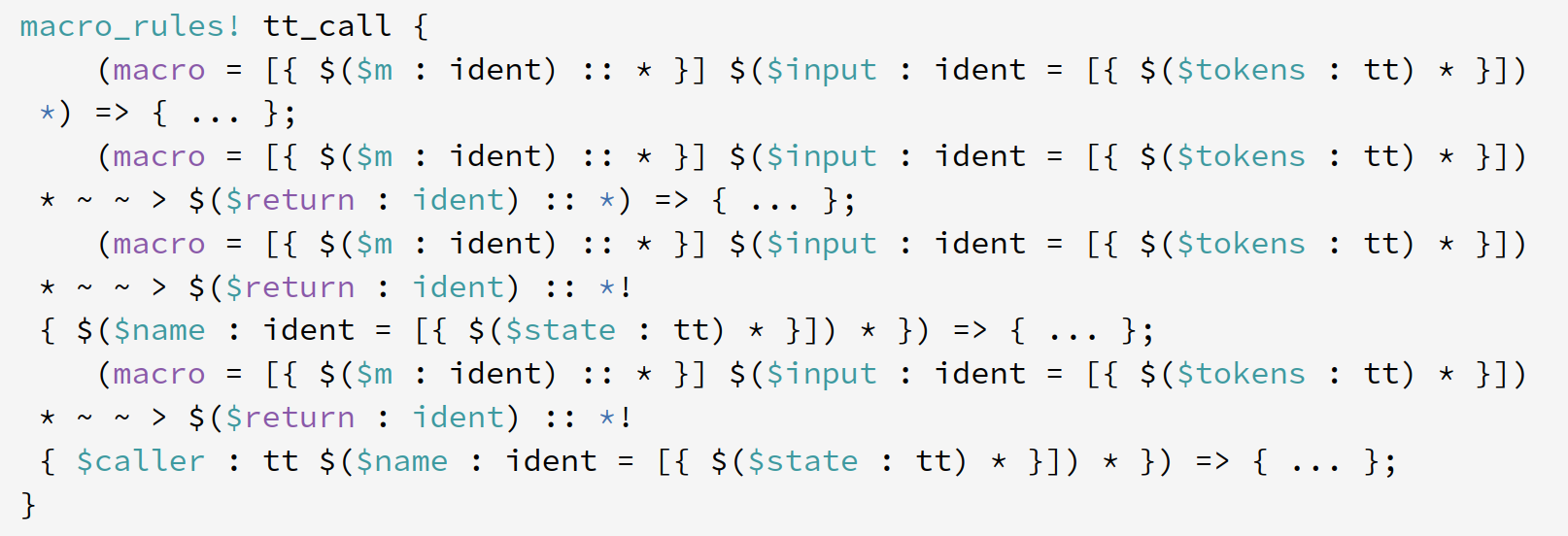
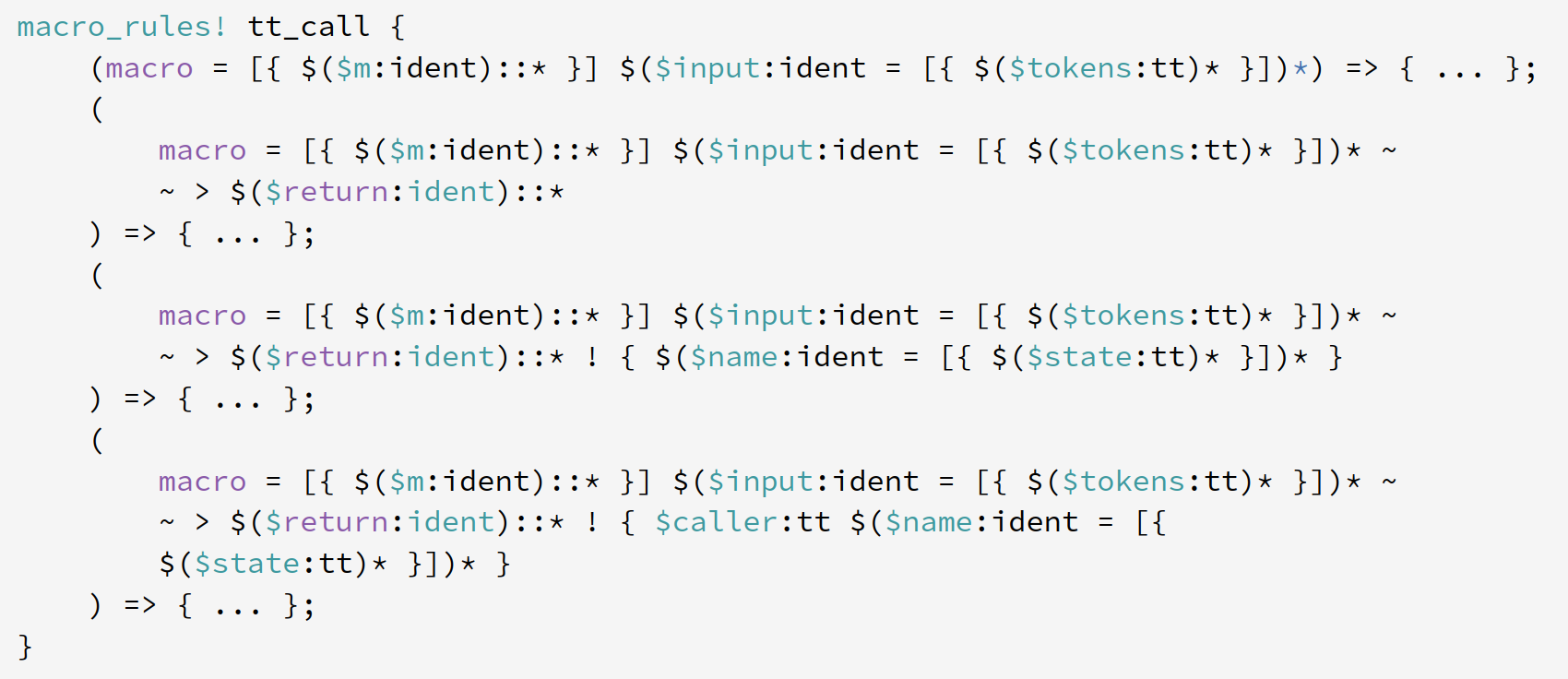
The below screenshots show an example of the difference using one of the gnarliest macros I could find. Some things to notice:
- In the **before**, notice how a couple places break in between `$(....)`↵`*`, which is just about the worst possible place that it could break.
- In the **before**, the lines that wrapped are weirdly indented by 1 space of indentation relative to column 0. In the **after**, we use the typical way of block indenting in Rust syntax which is put the open/close delimiters on their own line and indent their contents by 4 spaces relative to the previous line (so 8 spaces relative to column 0, because the matcher itself is indented by 4 relative to the `macro_rules` header).
- In the **after**, macro_rules metavariables like `$tokens:tt` are kept together, which is how just about everybody writing Rust today writes them.
## Before
## After
r? `@camelid`
|
|
|
