| Age | Commit message (Collapse) | Author | Lines |
|---|
|
|
|
|
|
|
|
|
|
Add a system for creating diffs across multiple mir optimizations.
r? @wesleywiser
|
|
|
|
compiletest: Rewrite extract_*_version functions
This makes extract_lldb_version has the same version type like
extract_gdb_version.
|
|
|
|
|
|
|
|
|
|
|
|
|
|
|
|
|
|
|
|
This makes extract_lldb_version has the same version type like
extract_gdb_version.
This is technically a breaking change for rustc-dev users.
But note that rustc-dev is a nightly component.
|
|
Generating the coverage map
@tmandry @wesleywiser
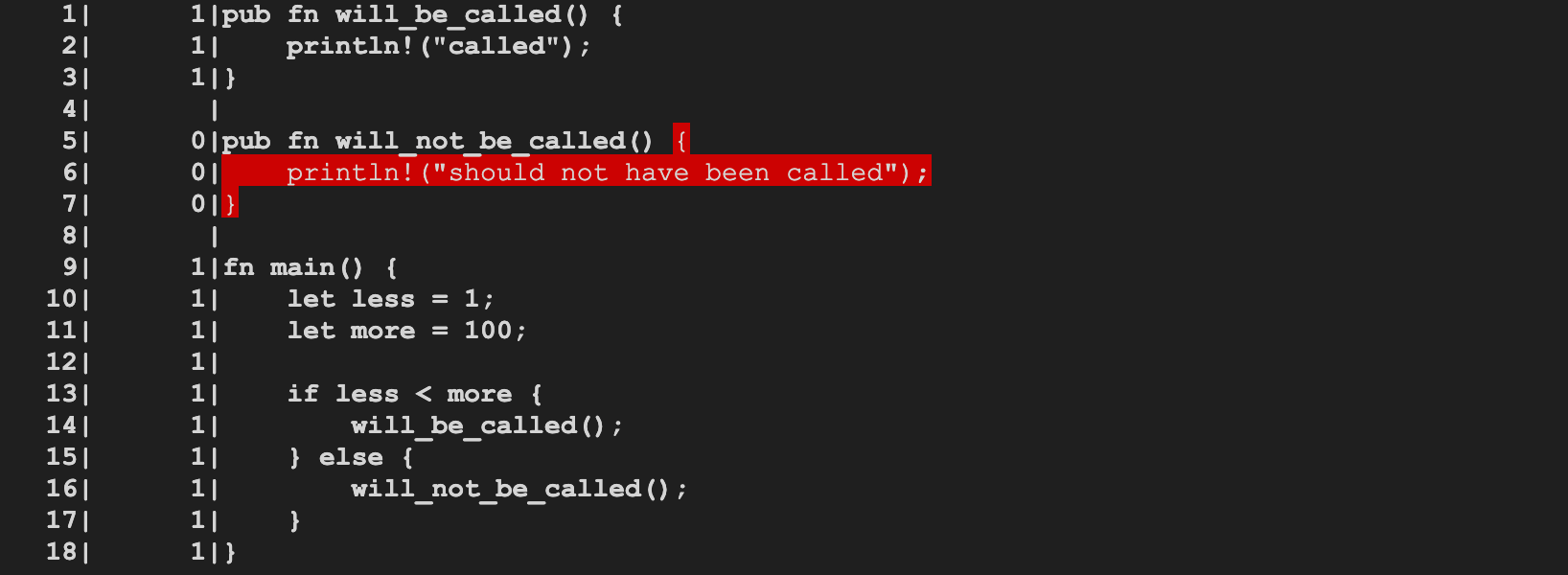
rustc now generates the coverage map and can support (limited)
coverage report generation, at the function level.
Example commands to generate a coverage report:
```shell
$ BUILD=$HOME/rust/build/x86_64-unknown-linux-gnu
$ $BUILD/stage1/bin/rustc -Zinstrument-coverage \
$HOME/rust/src/test/run-make-fulldeps/instrument-coverage/main.rs
$ LLVM_PROFILE_FILE="main.profraw" ./main
called
$ $BUILD/llvm/bin/llvm-profdata merge -sparse main.profraw -o main.profdata
$ $BUILD/llvm/bin/llvm-cov show --instr-profile=main.profdata main
```
r? @wesleywiser
Rust compiler MCP rust-lang/compiler-team#278
Relevant issue: #34701 - Implement support for LLVMs code coverage instrumentation
|
|
rustc now generates the coverage map and can support (limited)
coverage report generation, at the function level.
Example:
$ BUILD=$HOME/rust/build/x86_64-unknown-linux-gnu
$ $BUILD/stage1/bin/rustc -Zinstrument-coverage \
$HOME/rust/src/test/run-make-fulldeps/instrument-coverage/main.rs
$ LLVM_PROFILE_FILE="main.profraw" ./main
called
$ $BUILD/llvm/bin/llvm-profdata merge -sparse main.profraw -o main.profdata
$ $BUILD/llvm/bin/llvm-cov show --instr-profile=main.profdata main
1| 1|pub fn will_be_called() {
2| 1| println!("called");
3| 1|}
4| |
5| 0|pub fn will_not_be_called() {
6| 0| println!("should not have been called");
7| 0|}
8| |
9| 1|fn main() {
10| 1| let less = 1;
11| 1| let more = 100;
12| 1|
13| 1| if less < more {
14| 1| will_be_called();
15| 1| } else {
16| 1| will_not_be_called();
17| 1| }
18| 1|}
|
|
|
|
Other terms are more inclusive and precise.
Clippy still has a lint named "blacklisted-name", but renaming it would
be a breaking change, so is left for future work.
The target configuration option "abi-blacklist" has been depreciated and
renamed to "unsupported-abis". The old name continues to work.
|
|
Prepare for LLVM 11
These are just the code changes needed to build with the current LLVM master (version 11).
r? @nikic
|
|
|
|
|
|
|
|
Upgrade Chalk
Things done in this PR:
- Upgrade Chalk to `0.11.0`
- Added compare-mode=chalk
- Bump rustc-hash in `librustc_data_structures` to `1.1.0` to match Chalk
- Removed `RustDefId` since the builtin type support is there
- Add a few more `FIXME(chalk)`s for problem spots I hit when running all tests with chalk
- Added some more implementation code for some newer builtin Chalk types (e.g. `FnDef`, `Array`)
- Lower `RegionOutlives` and `ObjectSafe` predicates
- Lower `Dyn` without the region
- Handle `Int`/`Float` `CanonicalVarKind`s
- Uncomment some Chalk tests that actually work now
- Remove the revisions in `src/test/ui/coherence/coherence-subtyping.rs` since they aren't doing anything different
r? @nikomatsakis
|
|
r=Mark-Simulacrum
Deprecate `Vec::remove_item`
In #40062 we decided to remove that method. In #71834 it was said that we want to deprecate it for a few cycles before removing it. That's what this PR does.
|
|
|
|
|
|
|
|
compiletest: Add directives to detect sanitizer support
Add needs-sanitizer-{address,leak,memory,thread} directive indicating
that test requires target with support for specific sanitizer.
This is an addition to the existing needs-sanitizer-support directive
indicating that test requires a sanitizer runtime library.
The existing needs-sanitizer-support directive could be incorporated into the
new ones, but I decided to retain it, since it enables running sanitizer
codegen tests even when building of sanitizer runtime libraries is disabled.
|
|
Implement new gdb/lldb pretty-printers
Reopened #60826
This PR replaces current gdb and lldb pretty-printers with new ones that were originally written for [IntelliJ Rust](https://github.com/intellij-rust/intellij-rust/tree/master/prettyPrinters).
The current state of lldb pretty-printers is poor, because [they don't use synthetic children](https://github.com/rust-lang/rust/issues/55586#issuecomment-436610063). When I started to reimplement lldb pretty-printers with synthetic children support, I've found current version strange and hard to support. I think `debugger_pretty_printers_common.py` is overkill, so I got rid of it.
The new pretty-printers have to support all types supported by current pretty-printers, and also support `Rc`, `Arc`, `Cell`, `Ref`, `RefCell`, `RefMut`, `HashMap`, `HashSet`.
Fixes #56252
|
|
Add needs-sanitizer-{address,leak,memory,thread} directive indicating
that test requires target with support for specific sanitizer.
This is an addition to the existing needs-sanitizer-support directive
indicating that test requires a sanitizer runtime library.
|
|
Replace old GDB and LLDB pretty-printers with new ones
which were originally written for IntelliJ Rust.
New LLDB pretty-printers support synthetic children.
New GDB/LLDB pretty-printers support all Rust types
supported by old pretty-printers, and also support:
Rc, Arc, Cell, Ref, RefCell, RefMut, HashMap, HashSet.
|
|
|
|
|
|
Allow tests to use
// ignore-remote
to ignore the test when using remote-test-{client,server}. In most
situations this would be covered by
// ignore-cross-compile
but I see no reason that a non-cross compiled remote test runner
shouldn't work.
|
|
Since cargo appends executable/args, the support_lib count
parameter has to come first.
|
|
`compiletest` and `remote-test-client`:
The command line for `remote-test-client` was changed slightly
to allow cross-platform compatible paths. The old way of supplying
the support libs was by joining their paths with the executable path
with `:`. This caused Windows-style paths to be split after the
directory letter. Now, the number of support libs is provided
as a parameter as well, and the support lib paths are split off
from the regular args in the client.
`remote-test-server`:
- Marked Unix-only parts as such and implemented Windows alternatives
- On Windows `LD_LIBRARY_PATH` doesn't exist. Libraries are
loaded from `PATH` though, so that's the way around it.
- Tiny cleanup: `Command::args`/`envs` instead of manually
looping over them
- The temp path for Windows has to be set via environment variable,
since there isn't a global temp directory that would work on every
machine (as a static string)
|
|
|
|
Use lib crate type for SGX in `fn build_auxiliary`
since SGX does not support `dylib`
cc @Goirad
|
|
Bump bootstrap compiler
This bumps the bootstrap compiler and the rustfmt that x.py fmt uses.
|
|
|
|
Let compiletest recognize gdb 10.x
git gdb has moved to version 10. My build prints this as its
--version:
GNU gdb (GDB) 10.0.50.20200420-git
Unfortunately this conflicts with this comment in compiletest:
// We limit major to 1 digit, otherwise, on openSUSE, we parse the openSUSE version
This patch changes the version parsing to follow the GNU coding
standard, which accounts for both the openSUSE case as well as
handling gdb 10.
My debuginfo test run now says:
NOTE: compiletest thinks it is using GDB with native rust support
NOTE: compiletest thinks it is using GDB version 10000050
... where previously it failed to find that gdb 10 had rust support.
|
|
content there before the current changes
|
|
|
|
The compiletest version-parsing tests failed after the previous patch.
However, I don't believe these tests are correct, in that I don't
think RHEL or CentOS ever put the gdb version number into parentheses.
Instead they display like:
GNU gdb (GDB) Red Hat Enterprise Linux 7.6.1-119.el7
|
|
git gdb has moved to version 10. My build prints this as its
--version:
GNU gdb (GDB) 10.0.50.20200420-git
Unfortunately this conflicts with this comment in compiletest:
// We limit major to 1 digit, otherwise, on openSUSE, we parse the openSUSE version
This patch changes the version parsing to follow the GNU coding
standard, which accounts for both the openSUSE case as well as
handling gdb 10.
My debuginfo test run now says:
NOTE: compiletest thinks it is using GDB with native rust support
NOTE: compiletest thinks it is using GDB version 10000050
... where previously it failed to find that gdb 10 had rust support.
|
|
Add illumos triple
This fixes rust-lang/rust#55553 and adds support for `illumos` as a `target_os` on `x86_64`. In addition to the compile spec and libstd additions, several library dependencies have been bumped in order to permit working builds of cargo and rustup for the new target.
Work originally started by @jasonbking, with subsequent additions by @pfmooney and @jclulow.
|
|
End cleanup on rustdoc-js tools
Fixes #70689.
It removes a lot of code, which is pretty nice. :3
We now only have one entry point and a small set of options.
r? @ollie27
|
