| Age | Commit message (Collapse) | Author | Lines |
|---|
|
Try running lldb_batchmode.py with PYTHONUNBUFFERED
When reporting fatal errors, LLVM calls abort() to exit the program. There is a chance that might interfere with Python printing stuff to stdout, as by default it relies on buffering to increase performance.
This commit tries to disable Python buffering, to hopefully get useful logs while debugging #78665.
|
|
When reporting fatal errors, LLVM calls abort() to exit the program.
There is a chance that might interfere with Python printing stuff to
stdout, as by default it relies on buffering to increase performance.
This commit tries to disable Python buffering, to hopefully get useful
logs while debugging #78665.
|
|
|
|
|
|
|
|
|
|
|
|
|
|
|
|
|
|
The logging in compiletest was migrated from log crate to a tracing, but
the initialization code was never changed, so logging is non-functional.
Initialize tracing subscriber using default settings.
|
|
This is a combination of 18 commits.
Commit #2:
Additional examples and some small improvements.
Commit #3:
fixed mir-opt non-mir extensions and spanview title elements
Corrected a fairly recent assumption in runtest.rs that all MIR dump
files end in .mir. (It was appending .mir to the graphviz .dot and
spanview .html file names when generating blessed output files. That
also left outdated files in the baseline alongside the files with the
incorrect names, which I've now removed.)
Updated spanview HTML title elements to match their content, replacing a
hardcoded and incorrect name that was left in accidentally when
originally submitted.
Commit #4:
added more test examples
also improved Makefiles with support for non-zero exit status and to
force validation of tests unless a specific test overrides it with a
specific comment.
Commit #5:
Fixed rare issues after testing on real-world crate
Commit #6:
Addressed PR feedback, and removed temporary -Zexperimental-coverage
-Zinstrument-coverage once again supports the latest capabilities of
LLVM instrprof coverage instrumentation.
Also fixed a bug in spanview.
Commit #7:
Fix closure handling, add tests for closures and inner items
And cleaned up other tests for consistency, and to make it more clear
where spans start/end by breaking up lines.
Commit #8:
renamed "typical" test results "expected"
Now that the `llvm-cov show` tests are improved to normally expect
matching actuals, and to allow individual tests to override that
expectation.
Commit #9:
test coverage of inline generic struct function
Commit #10:
Addressed review feedback
* Removed unnecessary Unreachable filter.
* Replaced a match wildcard with remining variants.
* Added more comments to help clarify the role of successors() in the
CFG traversal
Commit #11:
refactoring based on feedback
* refactored `fn coverage_spans()`.
* changed the way I expand an empty coverage span to improve performance
* fixed a typo that I had accidently left in, in visit.rs
Commit #12:
Optimized use of SourceMap and SourceFile
Commit #13:
Fixed a regression, and synched with upstream
Some generated test file names changed due to some new change upstream.
Commit #14:
Stripping out crate disambiguators from demangled names
These can vary depending on the test platform.
Commit #15:
Ignore llvm-cov show diff on test with generics, expand IO error message
Tests with generics produce llvm-cov show results with demangled names
that can include an unstable "crate disambiguator" (hex value). The
value changes when run in the Rust CI Windows environment. I added a sed
filter to strip them out (in a prior commit), but sed also appears to
fail in the same environment. Until I can figure out a workaround, I'm
just going to ignore this specific test result. I added a FIXME to
follow up later, but it's not that critical.
I also saw an error with Windows GNU, but the IO error did not
specify a path for the directory or file that triggered the error. I
updated the error messages to provide more info for next, time but also
noticed some other tests with similar steps did not fail. Looks
spurious.
Commit #16:
Modify rust-demangler to strip disambiguators by default
Commit #17:
Remove std::process::exit from coverage tests
Due to Issue #77553, programs that call std::process::exit() do not
generate coverage results on Windows MSVC.
Commit #18:
fix: test file paths exceeding Windows max path len
|
|
|
|
|
|
|
|
|
|
The ability to "bless" output for some of these tests is critical to
making it practical to adapt tests to unrelated changes.
This is needed for new coverage tests, as shown in PR #75828 (or its
derivative).
|
|
|
|
|
|
|
|
|
|
Check whether locals are too large instead of whether accesses into them are too large
Essentially this stops const prop from attempting to optimize
```rust
let mut x = [0_u8; 5000];
x[42] = 3;
```
I don't expect this to be a perf improvement without #73656 (which is also where the lack of this PR will be a perf regression).
r? @wesleywiser
|
|
Use outermost invocation span for doctest names
Fixes #70090.
This PR also allows using aux-build files in rustdoc-ui tests.
|
|
compiletest: ignore-endian-big, fixes #74829, fixes #74885
See discussion on #74829
I tested it on a Debian s390x machine, works well.
|
|
compiletest: Support ignoring tests requiring missing LLVM components
This PR implements a more principled solution to the problem described in https://github.com/rust-lang/rust/pull/66084.
Builds of LLVM backends take a lot of time and disk space.
So it usually makes sense to build rustc with
```toml
[llvm]
targets = "X86"
experimental-targets = ""
```
unless you are working on some target-specific tasks.
A few tests, however, require non-x86 backends to be built.
A new test directive `// needs-llvm-components: component1 component2 component3` makes such tests to be automatically ignored if one of the listed components is missing in the provided LLVM (this is determined through `llvm-config --components`).
As a result, the test suite now fully passes with LLVM built only with the x86 backend. The component list in this case is
```
aggressiveinstcombine all all-targets analysis asmparser asmprinter binaryformat bitreader bitstreamreader bitwriter cfguard codegen core coroutines coverage debuginfocodeview debuginfodwarf debuginfogsym debuginfomsf debuginfopdb demangle dlltooldriver dwarflinker engine executionengine frontendopenmp fuzzmutate globalisel instcombine instrumentation interpreter ipo irreader jitlink libdriver lineeditor linker lto mc mca mcdisassembler mcjit mcparser mirparser native nativecodegen objcarcopts object objectyaml option orcerror orcjit passes profiledata remarks runtimedyld scalaropts selectiondag support symbolize tablegen target textapi transformutils vectorize windowsmanifest x86 x86asmparser x86codegen x86desc x86disassembler x86info x86utils xray
```
(With the default target list it's much larger.)
```
aarch64 aarch64asmparser aarch64codegen aarch64desc aarch64disassembler aarch64info aarch64utils aggressiveinstcombine all all-targets analysis arm armasmparser armcodegen armdesc armdisassembler arminfo armutils asmparser asmprinter avr avrasmparser avrcodegen avrdesc avrdisassembler avrinfo binaryformat bitreader bitstreamreader bitwriter cfguard codegen core coroutines coverage debuginfocodeview debuginfodwarf debuginfogsym debuginfomsf debuginfopdb demangle dlltooldriver dwarflinker engine executionengine frontendopenmp fuzzmutate globalisel hexagon hexagonasmparser hexagoncodegen hexagondesc hexagondisassembler hexagoninfo instcombine instrumentation interpreter ipo irreader jitlink libdriver lineeditor linker lto mc mca mcdisassembler mcjit mcparser mips mipsasmparser mipscodegen mipsdesc mipsdisassembler mipsinfo mirparser msp430 msp430asmparser msp430codegen msp430desc msp430disassembler msp430info native nativecodegen nvptx nvptxcodegen nvptxdesc nvptxinfo objcarcopts object objectyaml option orcerror orcjit passes powerpc powerpcasmparser powerpccodegen powerpcdesc powerpcdisassembler powerpcinfo profiledata remarks riscv riscvasmparser riscvcodegen riscvdesc riscvdisassembler riscvinfo riscvutils runtimedyld scalaropts selectiondag sparc sparcasmparser sparccodegen sparcdesc sparcdisassembler sparcinfo support symbolize systemz systemzasmparser systemzcodegen systemzdesc systemzdisassembler systemzinfo tablegen target textapi transformutils vectorize webassembly webassemblyasmparser webassemblycodegen webassemblydesc webassemblydisassembler webassemblyinfo windowsmanifest x86 x86asmparser x86codegen x86desc x86disassembler x86info x86utils xray
```
https://github.com/rust-lang/rust/pull/66084 is also reverted now.
r? @Mark-Simulacrum
|
|
|
|
This commit modifies compiletest so that a diff of actual and expected
output is shown for pretty tests. This makes it far easier to work out
what has changed.
Signed-off-by: David Wood <david@davidtw.co>
|
|
|
|
|
|
|
|
|
|
|
|
|
|
Add a system for creating diffs across multiple mir optimizations.
r? @wesleywiser
|
|
|
|
compiletest: Rewrite extract_*_version functions
This makes extract_lldb_version has the same version type like
extract_gdb_version.
|
|
|
|
|
|
|
|
|
|
|
|
|
|
|
|
|
|
|
|
This makes extract_lldb_version has the same version type like
extract_gdb_version.
This is technically a breaking change for rustc-dev users.
But note that rustc-dev is a nightly component.
|
|
Generating the coverage map
@tmandry @wesleywiser
rustc now generates the coverage map and can support (limited)
coverage report generation, at the function level.
Example commands to generate a coverage report:
```shell
$ BUILD=$HOME/rust/build/x86_64-unknown-linux-gnu
$ $BUILD/stage1/bin/rustc -Zinstrument-coverage \
$HOME/rust/src/test/run-make-fulldeps/instrument-coverage/main.rs
$ LLVM_PROFILE_FILE="main.profraw" ./main
called
$ $BUILD/llvm/bin/llvm-profdata merge -sparse main.profraw -o main.profdata
$ $BUILD/llvm/bin/llvm-cov show --instr-profile=main.profdata main
```
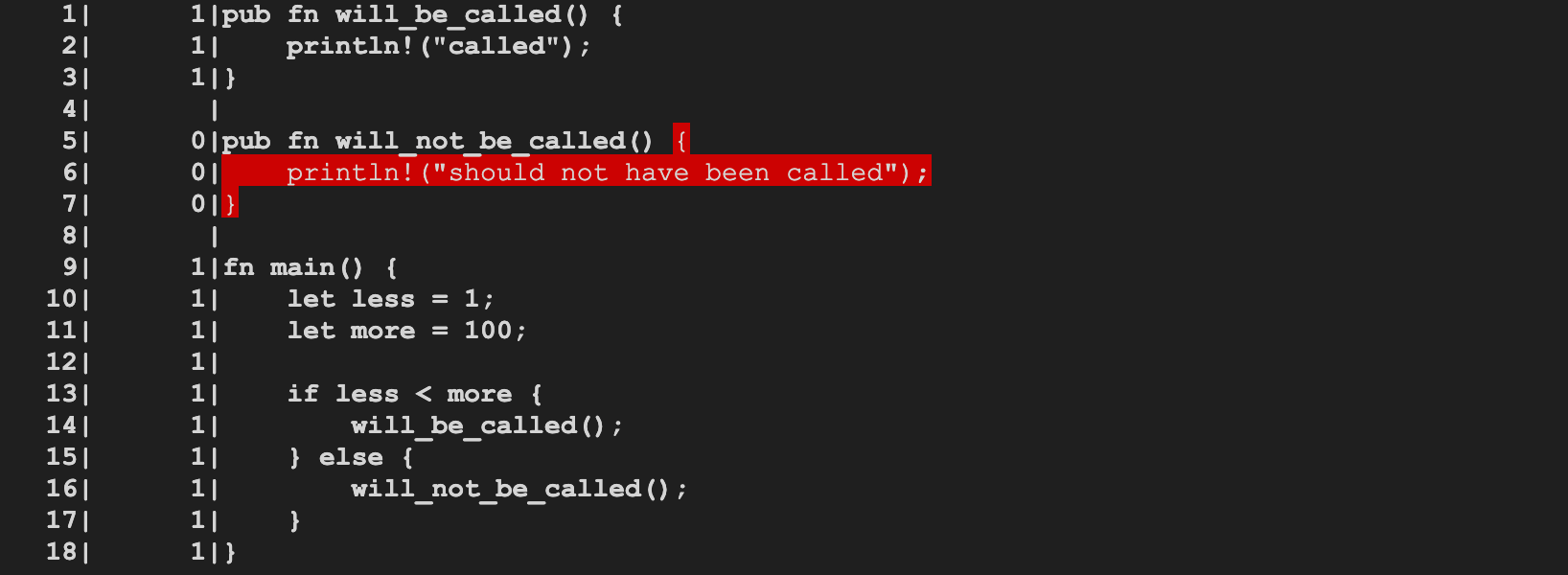
r? @wesleywiser
Rust compiler MCP rust-lang/compiler-team#278
Relevant issue: #34701 - Implement support for LLVMs code coverage instrumentation
|
|
rustc now generates the coverage map and can support (limited)
coverage report generation, at the function level.
Example:
$ BUILD=$HOME/rust/build/x86_64-unknown-linux-gnu
$ $BUILD/stage1/bin/rustc -Zinstrument-coverage \
$HOME/rust/src/test/run-make-fulldeps/instrument-coverage/main.rs
$ LLVM_PROFILE_FILE="main.profraw" ./main
called
$ $BUILD/llvm/bin/llvm-profdata merge -sparse main.profraw -o main.profdata
$ $BUILD/llvm/bin/llvm-cov show --instr-profile=main.profdata main
1| 1|pub fn will_be_called() {
2| 1| println!("called");
3| 1|}
4| |
5| 0|pub fn will_not_be_called() {
6| 0| println!("should not have been called");
7| 0|}
8| |
9| 1|fn main() {
10| 1| let less = 1;
11| 1| let more = 100;
12| 1|
13| 1| if less < more {
14| 1| will_be_called();
15| 1| } else {
16| 1| will_not_be_called();
17| 1| }
18| 1|}
|
|
|
|
Other terms are more inclusive and precise.
Clippy still has a lint named "blacklisted-name", but renaming it would
be a breaking change, so is left for future work.
The target configuration option "abi-blacklist" has been depreciated and
renamed to "unsupported-abis". The old name continues to work.
|
