| Age | Commit message (Collapse) | Author | Lines |
|---|
|
Also doing fmt inplace as requested.
|
|
|
|
Switch to Snappy compression for metadata
|
|
Introduce expect snapshot testing library into rustc
Snapshot testing is a technique for writing maintainable unit tests.
Unlike usual `assert_eq!` tests, snapshot tests allow
to *automatically* upgrade expected values on test failure.
In a sense, snapshot tests are inline-version of our beloved
UI-tests.
Example:
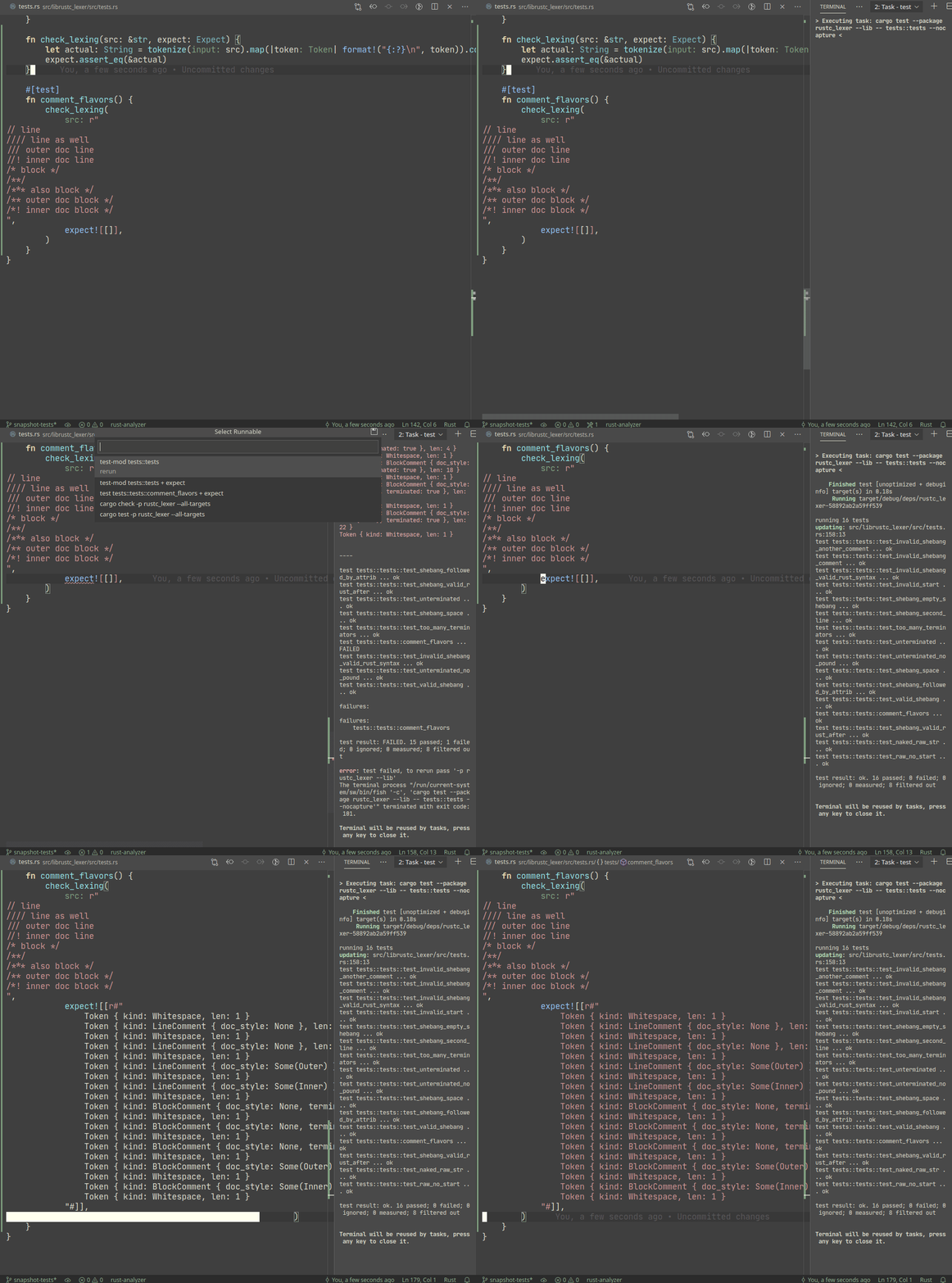
A particular library we use, `expect_test` provides an `expect!`
macro, which creates a sort of self-updating string literal (by using
`file!` macro). Self-update is triggered by setting `UPDATE_EXPECT`
environmental variable (this info is printed during the test failure).
This library was extracted from rust-analyzer, where we use it for
most of our tests.
There are some other, more popular snapshot testing libraries:
* https://github.com/mitsuhiko/insta
* https://github.com/aaronabramov/k9
The main differences of `expect` are:
* first-class snapshot objects (so, tests can be written as functions,
rather than as macros)
* focus on inline-snapshots (but file snapshots are also supported)
* restricted feature set (only `assert_eq` and `assert_debug_eq`)
* no extra runtime (ie, no `cargo insta`)
See rust-analyzer/rust-analyzer#5101 for a
an extended comparison.
It is unclear if this testing style will stick with rustc in the long
run. At the moment, rustc is mainly tested via integrated UI tests.
But in the library-ified world, unit-tests will become somewhat more
important (that's why use use `rustc_lexer` library-ified library as
an example in this PR). Given that the cost of removal shouldn't be
too high, it probably makes sense to just see if this flies!
|
|
bump tidy to cargo_metadata 0.11
Updates cargo_metadata in tidy's Cargo.toml from 0.9.1 to 0.11
Real version change 0.9.11 -> 0.11.1
https://github.com/oli-obk/cargo_metadata/compare/v0.9.1...v0.11.1
|
|
Snapshot testing is a technique for writing maintainable unit tests.
Unlike usual `assert_eq!` tests, snapshot tests allow
to *automatically* upgrade expected values on test failure.
In a sense, snapshot tests are inline-version of our beloved
UI-tests.
Example:

A particular library we use, `expect_test` provides an `expect!`
macro, which creates a sort of self-updating string literal (by using
`file!` macro). Self-update is triggered by setting `UPDATE_EXPECT`
environmental variable (this info is printed during the test failure).
This library was extracted from rust-analyzer, where we use it for
most of our tests.
There are some other, more popular snapshot testing libraries:
* https://github.com/mitsuhiko/insta
* https://github.com/aaronabramov/k9
The main differences of `expect` are:
* first-class snapshot objects (so, tests can be written as functions,
rather than as macros)
* focus on inline-snapshots (but file snapshots are also supported)
* restricted feature set (only `assert_eq` and `assert_debug_eq`)
* no extra runtime (ie, no `cargo insta`)
See https://github.com/rust-analyzer/rust-analyzer/pull/5101 for a
an extended comparison.
It is unclear if this testing style will stick with rustc in the long
run. At the moment, rustc is mainly tested via integrated UI tests.
But in the library-ified world, unit-tests will become somewhat more
important (that's why use use `rustc_lexer` library-ified library as
an example in this PR). Given that the cost of removal shouldn't be
too high, it probably makes sense to just see if this flies!
|
|
|
|
|
|
Updates cargo_metadata in tidy's Cargo.toml from 0.9.1 to 0.11
Real version change 0.9.11 -> 0.11.1
https://github.com/oli-obk/cargo_metadata/compare/v0.9.1...v0.11.1
|
|
|
|
Per https://github.com/rust-lang/rust/pull/75555#issuecomment-675090858
Zlib license might be OK. "OR Apache-2.0 OR MIT" definitely is.
unicode-normalization depends on this and rustc_parse, clippy,
and many other things depend on unicode-normalization.
|
|
|
|
without text after SAFETY:)
|
|
|
|
|
|
This removes all dependencies on pre-1.0 proc-macro ecosystem crates
(syn, quote, and proc-macro2)
|
|
|
|
std: Switch from libbacktrace to gimli (take 2)
This is the second attempt to land https://github.com/rust-lang/rust/pull/73441 after being reverted in https://github.com/rust-lang/rust/pull/74613. Will be gathering precise perf numbers here in this take.
Closes #71060
|
|
|
|
This commit is a proof-of-concept for switching the standard library's
backtrace symbolication mechanism on most platforms from libbacktrace to
gimli. The standard library's support for `RUST_BACKTRACE=1` requires
in-process parsing of object files and DWARF debug information to
interpret it and print the filename/line number of stack frames as part
of a backtrace.
Historically this support in the standard library has come from a
library called "libbacktrace". The libbacktrace library seems to have
been extracted from gcc at some point and is written in C. We've had a
lot of issues with libbacktrace over time, unfortunately, though. The
library does not appear to be actively maintained since we've had
patches sit for months-to-years without comments. We have discovered a
good number of soundness issues with the library itself, both when
parsing valid DWARF as well as invalid DWARF. This is enough of an issue
that the libs team has previously decided that we cannot feed untrusted
inputs to libbacktrace. This also doesn't take into account the
portability of libbacktrace which has been difficult to manage and
maintain over time. While possible there are lots of exceptions and it's
the main C dependency of the standard library right now.
For years it's been the desire to switch over to a Rust-based solution
for symbolicating backtraces. It's been assumed that we'll be using the
Gimli family of crates for this purpose, which are targeted at safely
and efficiently parsing DWARF debug information. I've been working
recently to shore up the Gimli support in the `backtrace` crate. As of a
few weeks ago the `backtrace` crate, by default, uses Gimli when loaded
from crates.io. This transition has gone well enough that I figured it
was time to start talking seriously about this change to the standard
library.
This commit is a preview of what's probably the best way to integrate
the `backtrace` crate into the standard library with the Gimli feature
turned on. While today it's used as a crates.io dependency, this commit
switches the `backtrace` crate to a submodule of this repository which
will need to be updated manually. This is not done lightly, but is
thought to be the best solution. The primary reason for this is that the
`backtrace` crate needs to do some pretty nontrivial filesystem
interactions to locate debug information. Working without `std::fs` is
not an option, and while it might be possible to do some sort of
trait-based solution when prototyped it was found to be too unergonomic.
Using a submodule allows the `backtrace` crate to build as a submodule
of the `std` crate itself, enabling it to use `std::fs` and such.
Otherwise this adds new dependencies to the standard library. This step
requires extra attention because this means that these crates are now
going to be included with all Rust programs by default. It's important
to note, however, that we're already shipping libbacktrace with all Rust
programs by default and it has a bunch of C code implementing all of
this internally anyway, so we're basically already switching
already-shipping functionality to Rust from C.
* `object` - this crate is used to parse object file headers and
contents. Very low-level support is used from this crate and almost
all of it is disabled. Largely we're just using struct definitions as
well as convenience methods internally to read bytes and such.
* `addr2line` - this is the main meat of the implementation for
symbolication. This crate depends on `gimli` for DWARF parsing and
then provides interfaces needed by the `backtrace` crate to turn an
address into a filename / line number. This crate is actually pretty
small (fits in a single file almost!) and mirrors most of what
`dwarf.c` does for libbacktrace.
* `miniz_oxide` - the libbacktrace crate transparently handles
compressed debug information which is compressed with zlib. This crate
is used to decompress compressed debug sections.
* `gimli` - not actually used directly, but a dependency of `addr2line`.
* `adler32`- not used directly either, but a dependency of
`miniz_oxide`.
The goal of this change is to improve the safety of backtrace
symbolication in the standard library, especially in the face of
possibly malformed DWARF debug information. Even to this day we're still
seeing segfaults in libbacktrace which could possibly become security
vulnerabilities. This change should almost entirely eliminate this
possibility whilc also paving the way forward to adding more features
like split debug information.
Some references for those interested are:
* Original addition of libbacktrace - #12602
* OOM with libbacktrace - #24231
* Backtrace failure due to use of uninitialized value - #28447
* Possibility to feed untrusted data to libbacktrace - #21889
* Soundness fix for libbacktrace - #33729
* Crash in libbacktrace - #39468
* Support for macOS, never merged - ianlancetaylor/libbacktrace#2
* Performance issues with libbacktrace - #29293, #37477
* Update procedure is quite complicated due to how many patches we
need to carry - #50955
* Libbacktrace doesn't work on MinGW with dynamic libs - #71060
* Segfault in libbacktrace on macOS - #71397
Switching to Rust will not make us immune to all of these issues. The
crashes are expected to go away, but correctness and performance may
still have bugs arise. The gimli and `backtrace` crates, however, are
actively maintained unlike libbacktrace, so this should enable us to at
least efficiently apply fixes as situations come up.
|
|
|
|
This reverts commit 13db3cc1e8d2fd4b8e7c74d91002274d7b62801b.
|
|
rustc_metadata: Make crate loading fully speculative
Instead of reporting `span_err`s on the spot crate loading errors are now wrapped into the `CrateError` enum and returned, so they are reported only at the top level `resolve_crate` call, and not reported at all if we are resolving speculatively with `maybe_resolve_crate`.
As a result we can attempt loading crates for error recovery (e.g. import suggestions) without any risk of producing extra errors.
Also, this means better separation between error reporting and actual logic.
Fixes https://github.com/rust-lang/rust/issues/55103
Fixes https://github.com/rust-lang/rust/issues/56590
|
|
std: Switch from libbacktrace to gimli
This commit is a proof-of-concept for switching the standard library's
backtrace symbolication mechanism on most platforms from libbacktrace to
gimli. The standard library's support for `RUST_BACKTRACE=1` requires
in-process parsing of object files and DWARF debug information to
interpret it and print the filename/line number of stack frames as part
of a backtrace.
Historically this support in the standard library has come from a
library called "libbacktrace". The libbacktrace library seems to have
been extracted from gcc at some point and is written in C. We've had a
lot of issues with libbacktrace over time, unfortunately, though. The
library does not appear to be actively maintained since we've had
patches sit for months-to-years without comments. We have discovered a
good number of soundness issues with the library itself, both when
parsing valid DWARF as well as invalid DWARF. This is enough of an issue
that the libs team has previously decided that we cannot feed untrusted
inputs to libbacktrace. This also doesn't take into account the
portability of libbacktrace which has been difficult to manage and
maintain over time. While possible there are lots of exceptions and it's
the main C dependency of the standard library right now.
For years it's been the desire to switch over to a Rust-based solution
for symbolicating backtraces. It's been assumed that we'll be using the
Gimli family of crates for this purpose, which are targeted at safely
and efficiently parsing DWARF debug information. I've been working
recently to shore up the Gimli support in the `backtrace` crate. As of a
few weeks ago the `backtrace` crate, by default, uses Gimli when loaded
from crates.io. This transition has gone well enough that I figured it
was time to start talking seriously about this change to the standard
library.
This commit is a preview of what's probably the best way to integrate
the `backtrace` crate into the standard library with the Gimli feature
turned on. While today it's used as a crates.io dependency, this commit
switches the `backtrace` crate to a submodule of this repository which
will need to be updated manually. This is not done lightly, but is
thought to be the best solution. The primary reason for this is that the
`backtrace` crate needs to do some pretty nontrivial filesystem
interactions to locate debug information. Working without `std::fs` is
not an option, and while it might be possible to do some sort of
trait-based solution when prototyped it was found to be too unergonomic.
Using a submodule allows the `backtrace` crate to build as a submodule
of the `std` crate itself, enabling it to use `std::fs` and such.
Otherwise this adds new dependencies to the standard library. This step
requires extra attention because this means that these crates are now
going to be included with all Rust programs by default. It's important
to note, however, that we're already shipping libbacktrace with all Rust
programs by default and it has a bunch of C code implementing all of
this internally anyway, so we're basically already switching
already-shipping functionality to Rust from C.
* `object` - this crate is used to parse object file headers and
contents. Very low-level support is used from this crate and almost
all of it is disabled. Largely we're just using struct definitions as
well as convenience methods internally to read bytes and such.
* `addr2line` - this is the main meat of the implementation for
symbolication. This crate depends on `gimli` for DWARF parsing and
then provides interfaces needed by the `backtrace` crate to turn an
address into a filename / line number. This crate is actually pretty
small (fits in a single file almost!) and mirrors most of what
`dwarf.c` does for libbacktrace.
* `miniz_oxide` - the libbacktrace crate transparently handles
compressed debug information which is compressed with zlib. This crate
is used to decompress compressed debug sections.
* `gimli` - not actually used directly, but a dependency of `addr2line`.
* `adler32`- not used directly either, but a dependency of
`miniz_oxide`.
The goal of this change is to improve the safety of backtrace
symbolication in the standard library, especially in the face of
possibly malformed DWARF debug information. Even to this day we're still
seeing segfaults in libbacktrace which could possibly become security
vulnerabilities. This change should almost entirely eliminate this
possibility whilc also paving the way forward to adding more features
like split debug information.
Some references for those interested are:
* Original addition of libbacktrace - #12602
* OOM with libbacktrace - #24231
* Backtrace failure due to use of uninitialized value - #28447
* Possibility to feed untrusted data to libbacktrace - #21889
* Soundness fix for libbacktrace - #33729
* Crash in libbacktrace - #39468
* Support for macOS, never merged - ianlancetaylor/libbacktrace#2
* Performance issues with libbacktrace - #29293, #37477
* Update procedure is quite complicated due to how many patches we
need to carry - #50955
* Libbacktrace doesn't work on MinGW with dynamic libs - #71060
* Segfault in libbacktrace on macOS - #71397
Switching to Rust will not make us immune to all of these issues. The
crashes are expected to go away, but correctness and performance may
still have bugs arise. The gimli and `backtrace` crates, however, are
actively maintained unlike libbacktrace, so this should enable us to at
least efficiently apply fixes as situations come up.
---
I want to note that my purpose for creating a PR here is to start a conversation about this. I think that all the various pieces are in place that this is compelling enough that I think this transition should be talked about seriously. There are a number of items which still need to be addressed before actually merging this PR, however:
* [ ] `gimli` needs to be published to crates.io
* [ ] `addr2line` needs a publish
* [ ] `miniz_oxide` needs a publish
* [ ] Tests probably shouldn't recommend the `gimli` crate's traits for implementing
* [ ] The `backtrace` crate's branch changes need to be merged to the master branch (https://github.com/rust-lang/backtrace-rs/pull/349)
* [ ] The support for `libbacktrace` on some platforms needs to be audited to see if we should support more strategies in the gimli implementation - https://github.com/rust-lang/backtrace-rs/issues/325, https://github.com/rust-lang/backtrace-rs/issues/326, https://github.com/rust-lang/backtrace-rs/issues/350, https://github.com/rust-lang/backtrace-rs/issues/351
Most of the merging/publishing I'm not actively pushing on right now. It's a bit wonky for crates to support libstd so I'm holding off on pulling the trigger everywhere until there's a bit more discussion about how to go through with this. Namely https://github.com/rust-lang/backtrace-rs/pull/349 I'm going to hold off merging until we decide to go through with the submodule strategy.
In any case this is a pretty major change, so I suspect that the compiler team is likely going to be interested in this. I don't mean to force changes by dumping a bunch of code by any means. Integration of external crates into the standard library is so difficult I wanted to have a proof-of-concept to review while talking about whether to do this at all (hence the PR), but I'm more than happy to follow any processes needed to merge this. I must admit though that I'm not entirely sure myself at this time what the process would be to decide to merge this, so I'm hoping others can help me figure that out!
|
|
They are deprecated so doing extra work for error recovery doesn't make sense
|
|
Use pathdiff crate
I wanted to tackle a simple issue, and stumbled upon #67108: this pr removes the function which was exported to the external crate as required in the todo/issue.
I've tested it with:
```
./x.py build --stage 1 --keep-stage 1 src/librustc_codegen_ssa
```
And it looks like it's compiling
|
|
|
|
This commit is a proof-of-concept for switching the standard library's
backtrace symbolication mechanism on most platforms from libbacktrace to
gimli. The standard library's support for `RUST_BACKTRACE=1` requires
in-process parsing of object files and DWARF debug information to
interpret it and print the filename/line number of stack frames as part
of a backtrace.
Historically this support in the standard library has come from a
library called "libbacktrace". The libbacktrace library seems to have
been extracted from gcc at some point and is written in C. We've had a
lot of issues with libbacktrace over time, unfortunately, though. The
library does not appear to be actively maintained since we've had
patches sit for months-to-years without comments. We have discovered a
good number of soundness issues with the library itself, both when
parsing valid DWARF as well as invalid DWARF. This is enough of an issue
that the libs team has previously decided that we cannot feed untrusted
inputs to libbacktrace. This also doesn't take into account the
portability of libbacktrace which has been difficult to manage and
maintain over time. While possible there are lots of exceptions and it's
the main C dependency of the standard library right now.
For years it's been the desire to switch over to a Rust-based solution
for symbolicating backtraces. It's been assumed that we'll be using the
Gimli family of crates for this purpose, which are targeted at safely
and efficiently parsing DWARF debug information. I've been working
recently to shore up the Gimli support in the `backtrace` crate. As of a
few weeks ago the `backtrace` crate, by default, uses Gimli when loaded
from crates.io. This transition has gone well enough that I figured it
was time to start talking seriously about this change to the standard
library.
This commit is a preview of what's probably the best way to integrate
the `backtrace` crate into the standard library with the Gimli feature
turned on. While today it's used as a crates.io dependency, this commit
switches the `backtrace` crate to a submodule of this repository which
will need to be updated manually. This is not done lightly, but is
thought to be the best solution. The primary reason for this is that the
`backtrace` crate needs to do some pretty nontrivial filesystem
interactions to locate debug information. Working without `std::fs` is
not an option, and while it might be possible to do some sort of
trait-based solution when prototyped it was found to be too unergonomic.
Using a submodule allows the `backtrace` crate to build as a submodule
of the `std` crate itself, enabling it to use `std::fs` and such.
Otherwise this adds new dependencies to the standard library. This step
requires extra attention because this means that these crates are now
going to be included with all Rust programs by default. It's important
to note, however, that we're already shipping libbacktrace with all Rust
programs by default and it has a bunch of C code implementing all of
this internally anyway, so we're basically already switching
already-shipping functionality to Rust from C.
* `object` - this crate is used to parse object file headers and
contents. Very low-level support is used from this crate and almost
all of it is disabled. Largely we're just using struct definitions as
well as convenience methods internally to read bytes and such.
* `addr2line` - this is the main meat of the implementation for
symbolication. This crate depends on `gimli` for DWARF parsing and
then provides interfaces needed by the `backtrace` crate to turn an
address into a filename / line number. This crate is actually pretty
small (fits in a single file almost!) and mirrors most of what
`dwarf.c` does for libbacktrace.
* `miniz_oxide` - the libbacktrace crate transparently handles
compressed debug information which is compressed with zlib. This crate
is used to decompress compressed debug sections.
* `gimli` - not actually used directly, but a dependency of `addr2line`.
* `adler32`- not used directly either, but a dependency of
`miniz_oxide`.
The goal of this change is to improve the safety of backtrace
symbolication in the standard library, especially in the face of
possibly malformed DWARF debug information. Even to this day we're still
seeing segfaults in libbacktrace which could possibly become security
vulnerabilities. This change should almost entirely eliminate this
possibility whilc also paving the way forward to adding more features
like split debug information.
Some references for those interested are:
* Original addition of libbacktrace - #12602
* OOM with libbacktrace - #24231
* Backtrace failure due to use of uninitialized value - #28447
* Possibility to feed untrusted data to libbacktrace - #21889
* Soundness fix for libbacktrace - #33729
* Crash in libbacktrace - #39468
* Support for macOS, never merged - ianlancetaylor/libbacktrace#2
* Performance issues with libbacktrace - #29293, #37477
* Update procedure is quite complicated due to how many patches we
need to carry - #50955
* Libbacktrace doesn't work on MinGW with dynamic libs - #71060
* Segfault in libbacktrace on macOS - #71397
Switching to Rust will not make us immune to all of these issues. The
crashes are expected to go away, but correctness and performance may
still have bugs arise. The gimli and `backtrace` crates, however, are
actively maintained unlike libbacktrace, so this should enable us to at
least efficiently apply fixes as situations come up.
|
|
|
|
Other terms are more inclusive and precise.
|
|
The current plan is that submodule tracks the `release` branch of
rust-analyzer, which is updated once a week.
rust-analyzer is a workspace (with a virtual manifest), the actual
binary is provide by `crates/rust-analyzer` package.
Note that we intentionally don't add rust-analyzer to `Kind::Test`,
for two reasons.
*First*, at the moment rust-analyzer's test suite does a couple of
things which might not work in the context of rust repository. For
example, it shells out directly to `rustup` and `rustfmt`. So, making
this work requires non-trivial efforts.
*Second*, it seems unlikely that running tests in rust-lang/rust repo
would provide any additional guarantees. rust-analyzer builds with
stable and does not depend on the specifics of the compiler, so
changes to compiler can't break ra, unless they break stability
guarantee. Additionally, rust-analyzer itself is gated on bors, so we
are pretty confident that test suite passes.
|
|
|
|
|
|
r=sfackler
disable collectionbenches for android
Fixes #73535
Signed-off-by: Nell Shamrell <nellshamrell@gmail.com>
|
|
|
|
Signed-off-by: Nell Shamrell <nellshamrell@gmail.com>
|
|
A way forward for pointer equality in const eval
r? @varkor on the first commit and @RalfJung on the second commit
cc #53020
|
|
|
|
|
|
|
|
Update transitive dependencies to remove some deps
Similar to #71919, this removes some (duplicate) dependencies.
|
|
|
|
Shebang handling was too agressive in stripping out the first line in cases where it is actually _not_ a shebang, but instead, valid rust (#70528). This is a second attempt at resolving this issue (the first attempt was flawed, for, among other reasons, causing an ICE in certain cases (#71372, #71471).
The behavior is now codified by a number of UI tests, but simply:
For the first line to be a shebang, the following must all be true:
1. The line must start with `#!`
2. The line must contain a non whitespace character after `#!`
3. The next character in the file, ignoring comments & whitespace must not be `[`
I believe this is a strict superset of what we used to allow, so perhaps a crater run is unnecessary, but probably not a terrible idea.
|
|
|
|
|
|
|
|
|
|
code and also that 'compile_fail' isn't mispelled
|
|
|
|
* Adds either an MD5 or SHA1 hash to the debug info.
* Adds new unstable option `-Z src-hash-algorithm` to control the hashing algorithm.
|
