| Age | Commit message (Collapse) | Author | Lines |
|---|
|
|
|
This also adds a little leeway to the test limit.
|
|
|
|
Update tracing to 0.1.25
* Update tracing from 0.1.18 to 0.1.25
* Update tracing-subscriber from 0.2.13 to 0.2.16
* Update tracing-tree from 0.1.6 to 0.1.8
* Add pin-project-lite to the list of allowed dependencies (it is now a direct dependency of tracing).
|
|
Rename the `tidy` binary to `rust-tidy`
This avoids naming collisions, particularly on Windows where the
dynamic library variable is PATH and setting it causes the in-tree
`tidy` to take precedence over the HTML tidy used by compiletest.
This doesn't change the x.py interface in any way, it still accepts `x.py test tidy` and prints error messages about `tidy`. It only changes the name of the file on disk.
Fixes https://github.com/rust-lang/rust/issues/82501.
|
|
|
|
Update measureme dependency to the latest version
This version adds the ability to use `rdpmc` hardware-based performance
counters instead of wall-clock time for measuring duration. This also
introduces a dependency on the `perf-event-open-sys` crate on Linux
which is used when using hardware counters.
r? ```@oli-obk```
|
|
Replace const_cstr with cstr crate
This PR replaces the `const_cstr` macro inside `rustc_data_structures` with `cstr` macro from [cstr](https://crates.io/crates/cstr) crate.
The two macros basically serve the same purpose, which is to generate `&'static CStr` from a string literal. `cstr` is better because it validates the literal at compile time, while the existing `const_cstr` does it at runtime when `debug_assertions` is enabled. In addition, the value `cstr` generates can be used in constant context (which is seemingly not needed anywhere currently, though).
|
|
Stabilize str_split_once
Closes #74773
|
|
This version adds the ability to use `rdpmc` hardware-based performance
counters instead of wall-clock time for measuring duration. This also
introduces a dependency on the `perf-event-open-sys` crate on Linux
which is used when using hardware counters.
|
|
This avoids naming collisions, particularly on Windows where the
dynamic library variable is PATH and setting it causes the in-tree
`tidy` to take precedence over the HTML tidy used by compiletest.
|
|
Almost all safety comments are of the form `// SAFETY:`,
so normalize the rest and fix a few of them that should
have been a `/// # Safety` section instead.
Furthermore, make `tidy` only allow the uppercase form. While
currently `tidy` only checks `core`, it is a good idea to prevent
`core` from drifting to non-uppercase comments, so that later
we can start checking `alloc` etc. too.
Signed-off-by: Miguel Ojeda <ojeda@kernel.org>
|
|
Move some tests to more reasonable directories - 4
cc #81941
|
|
|
|
|
|
|
|
|
|
|
|
|
|
rustc: Stabilize `-Zrun-dsymutil` as `-Csplit-debuginfo`
This commit adds a new stable codegen option to rustc,
`-Csplit-debuginfo`. The old `-Zrun-dsymutil` flag is deleted and now
subsumed by this stable flag. Additionally `-Zsplit-dwarf` is also
subsumed by this flag but still requires `-Zunstable-options` to
actually activate. The `-Csplit-debuginfo` flag takes one of
three values:
* `off` - This indicates that split-debuginfo from the final artifact is
not desired. This is not supported on Windows and is the default on
Unix platforms except macOS. On macOS this means that `dsymutil` is
not executed.
* `packed` - This means that debuginfo is desired in one location
separate from the main executable. This is the default on Windows
(`*.pdb`) and macOS (`*.dSYM`). On other Unix platforms this subsumes
`-Zsplit-dwarf=single` and produces a `*.dwp` file.
* `unpacked` - This means that debuginfo will be roughly equivalent to
object files, meaning that it's throughout the build directory
rather than in one location (often the fastest for local development).
This is not the default on any platform and is not supported on Windows.
Each target can indicate its own default preference for how debuginfo is
handled. Almost all platforms default to `off` except for Windows and
macOS which default to `packed` for historical reasons.
Some equivalencies for previous unstable flags with the new flags are:
* `-Zrun-dsymutil=yes` -> `-Csplit-debuginfo=packed`
* `-Zrun-dsymutil=no` -> `-Csplit-debuginfo=unpacked`
* `-Zsplit-dwarf=single` -> `-Csplit-debuginfo=packed`
* `-Zsplit-dwarf=split` -> `-Csplit-debuginfo=unpacked`
Note that `-Csplit-debuginfo` still requires `-Zunstable-options` for
non-macOS platforms since split-dwarf support was *just* implemented in
rustc.
There's some more rationale listed on #79361, but the main gist of the
motivation for this commit is that `dsymutil` can take quite a long time
to execute in debug builds and provides little benefit. This means that
incremental compile times appear that much worse on macOS because the
compiler is constantly running `dsymutil` over every single binary it
produces during `cargo build` (even build scripts!). Ideally rustc would
switch to not running `dsymutil` by default, but that's a problem left
to get tackled another day.
Closes #79361
|
|
This commit adds a new stable codegen option to rustc,
`-Csplit-debuginfo`. The old `-Zrun-dsymutil` flag is deleted and now
subsumed by this stable flag. Additionally `-Zsplit-dwarf` is also
subsumed by this flag but still requires `-Zunstable-options` to
actually activate. The `-Csplit-debuginfo` flag takes one of
three values:
* `off` - This indicates that split-debuginfo from the final artifact is
not desired. This is not supported on Windows and is the default on
Unix platforms except macOS. On macOS this means that `dsymutil` is
not executed.
* `packed` - This means that debuginfo is desired in one location
separate from the main executable. This is the default on Windows
(`*.pdb`) and macOS (`*.dSYM`). On other Unix platforms this subsumes
`-Zsplit-dwarf=single` and produces a `*.dwp` file.
* `unpacked` - This means that debuginfo will be roughly equivalent to
object files, meaning that it's throughout the build directory
rather than in one location (often the fastest for local development).
This is not the default on any platform and is not supported on Windows.
Each target can indicate its own default preference for how debuginfo is
handled. Almost all platforms default to `off` except for Windows and
macOS which default to `packed` for historical reasons.
Some equivalencies for previous unstable flags with the new flags are:
* `-Zrun-dsymutil=yes` -> `-Csplit-debuginfo=packed`
* `-Zrun-dsymutil=no` -> `-Csplit-debuginfo=unpacked`
* `-Zsplit-dwarf=single` -> `-Csplit-debuginfo=packed`
* `-Zsplit-dwarf=split` -> `-Csplit-debuginfo=unpacked`
Note that `-Csplit-debuginfo` still requires `-Zunstable-options` for
non-macOS platforms since split-dwarf support was *just* implemented in
rustc.
There's some more rationale listed on #79361, but the main gist of the
motivation for this commit is that `dsymutil` can take quite a long time
to execute in debug builds and provides little benefit. This means that
incremental compile times appear that much worse on macOS because the
compiler is constantly running `dsymutil` over every single binary it
produces during `cargo build` (even build scripts!). Ideally rustc would
switch to not running `dsymutil` by default, but that's a problem left
to get tackled another day.
Closes #79361
|
|
This will cause a failure due to the warning after the next beta branch
as https://github.com/rust-lang/rust/pull/79812 will hit beta.
|
|
These exceptions are no longer necessary.
|
|
The cargo check was checking that every dependency had an `extern crate`.
The compiler has not used `extern crate` in a long time (edition 2018).
The test was broken (the call to `!super::filter_dirs(path)` was backwards).
This just removes it since it is no longer valid.
|
|
- Only feature gate associated items
- Add docs to unstable book
|
|
Address comments
Update limits
|
|
|
|
|
|
make MIR graphviz generation use gsgdt
gsgdt [https://crates.io/crates/gsgdt] is a crate which provides an
interface for stringly typed graphs. It also provides generation of
graphviz dot format from said graph.
This is the first in a series of PRs on moving graphviz code out of rustc into normal crates and then implementating graph diffing on top of these crates.
r? `@oli-obk`
|
|
|
|
|
|
|
|
* Use a match statement.
* Clarify why we can't use `file_stem()`.
* Error if the `:` is missing for Tidy error codes, rather than no-oping.
|
|
|
|
|
|
gsgdt [https://crates.io/crates/gsgdt] is a crate which provides an
interface for stringly typed graphs. It also provides generation of
graphviz dot format from said graph.
|
|
Add support for SHA256 source file hashing
Adds support for `-Z src-hash-algorithm sha256`, which became available in LLVM 11.
Using an older version of LLVM will cause an error `invalid checksum kind` if the hash algorithm is set to sha256.
r? `@eddyb`
cc #70401 `@est31`
|
|
Add cg_clif as optional codegen backend
Rustc_codegen_cranelift is an alternative codegen backend for rustc based on Cranelift. It has the potential to improve compilation times in debug mode. In my experience the compile time improvements over debug mode LLVM for a clean build are about 20-30% in most cases.
This PR adds cg_clif as optional codegen backend. By default it is only enabled for `./x.py check`. It can be enabled for `./x.py build` too by adding `cranelift` to the `rust.codegen-backends` array in `config.toml`.
MCP: https://github.com/rust-lang/compiler-team/issues/270
r? `@Mark-Simulacrum`
|
|
|
|
Modify executable checking to be more universal
This uses a dummy file to check if the filesystem being used supports the executable bit in general.
Supersedes #74753.
|
|
|
|
|
|
This uses a dummy file to check if the filesystem being used supports the
executable bit in general.
|
|
Also doing fmt inplace as requested.
|
|
|
|
Switch to Snappy compression for metadata
|
|
Introduce expect snapshot testing library into rustc
Snapshot testing is a technique for writing maintainable unit tests.
Unlike usual `assert_eq!` tests, snapshot tests allow
to *automatically* upgrade expected values on test failure.
In a sense, snapshot tests are inline-version of our beloved
UI-tests.
Example:
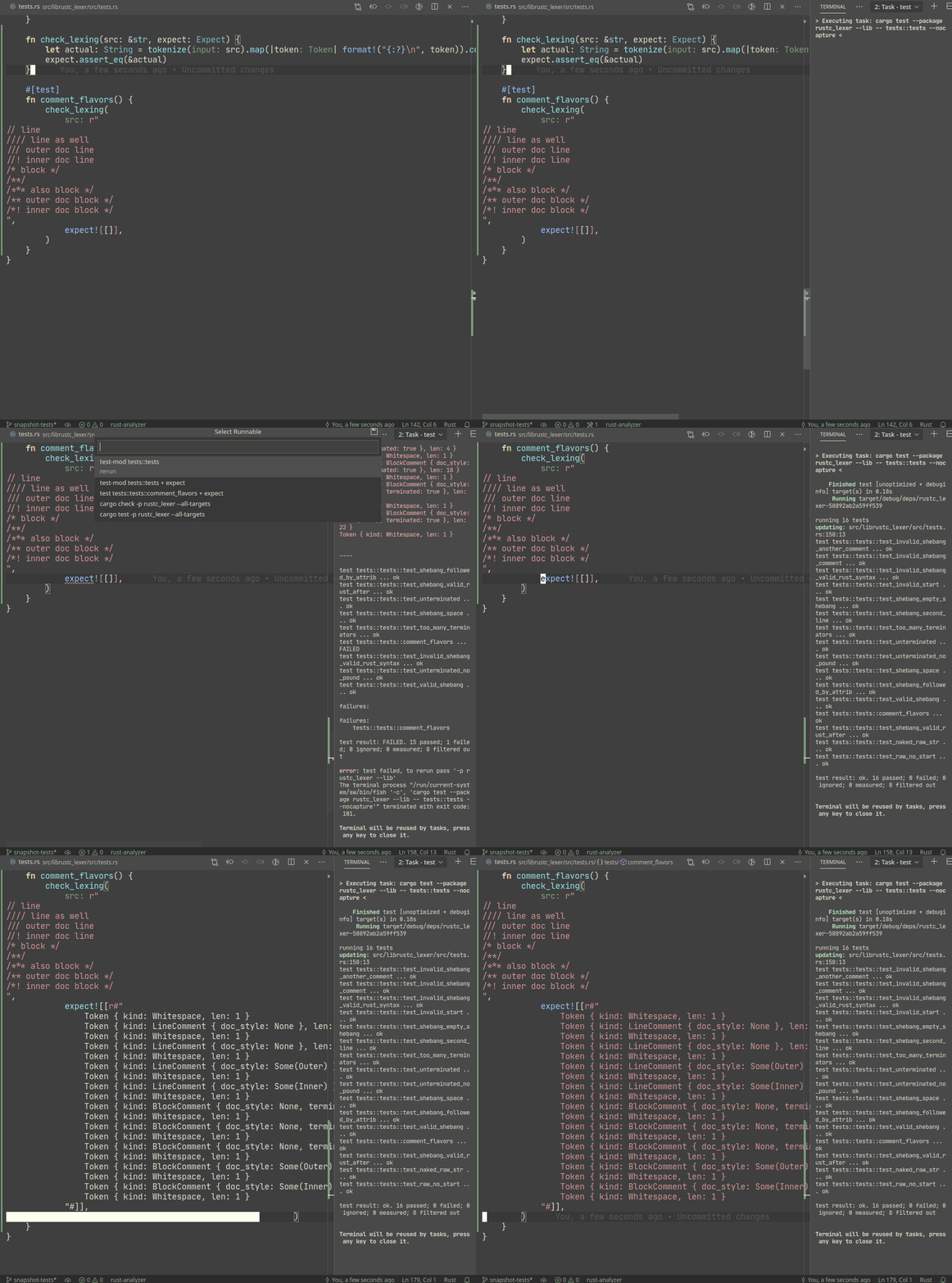
A particular library we use, `expect_test` provides an `expect!`
macro, which creates a sort of self-updating string literal (by using
`file!` macro). Self-update is triggered by setting `UPDATE_EXPECT`
environmental variable (this info is printed during the test failure).
This library was extracted from rust-analyzer, where we use it for
most of our tests.
There are some other, more popular snapshot testing libraries:
* https://github.com/mitsuhiko/insta
* https://github.com/aaronabramov/k9
The main differences of `expect` are:
* first-class snapshot objects (so, tests can be written as functions,
rather than as macros)
* focus on inline-snapshots (but file snapshots are also supported)
* restricted feature set (only `assert_eq` and `assert_debug_eq`)
* no extra runtime (ie, no `cargo insta`)
See rust-analyzer/rust-analyzer#5101 for a
an extended comparison.
It is unclear if this testing style will stick with rustc in the long
run. At the moment, rustc is mainly tested via integrated UI tests.
But in the library-ified world, unit-tests will become somewhat more
important (that's why use use `rustc_lexer` library-ified library as
an example in this PR). Given that the cost of removal shouldn't be
too high, it probably makes sense to just see if this flies!
|
|
bump tidy to cargo_metadata 0.11
Updates cargo_metadata in tidy's Cargo.toml from 0.9.1 to 0.11
Real version change 0.9.11 -> 0.11.1
https://github.com/oli-obk/cargo_metadata/compare/v0.9.1...v0.11.1
|
|
Snapshot testing is a technique for writing maintainable unit tests.
Unlike usual `assert_eq!` tests, snapshot tests allow
to *automatically* upgrade expected values on test failure.
In a sense, snapshot tests are inline-version of our beloved
UI-tests.
Example:

A particular library we use, `expect_test` provides an `expect!`
macro, which creates a sort of self-updating string literal (by using
`file!` macro). Self-update is triggered by setting `UPDATE_EXPECT`
environmental variable (this info is printed during the test failure).
This library was extracted from rust-analyzer, where we use it for
most of our tests.
There are some other, more popular snapshot testing libraries:
* https://github.com/mitsuhiko/insta
* https://github.com/aaronabramov/k9
The main differences of `expect` are:
* first-class snapshot objects (so, tests can be written as functions,
rather than as macros)
* focus on inline-snapshots (but file snapshots are also supported)
* restricted feature set (only `assert_eq` and `assert_debug_eq`)
* no extra runtime (ie, no `cargo insta`)
See https://github.com/rust-analyzer/rust-analyzer/pull/5101 for a
an extended comparison.
It is unclear if this testing style will stick with rustc in the long
run. At the moment, rustc is mainly tested via integrated UI tests.
But in the library-ified world, unit-tests will become somewhat more
important (that's why use use `rustc_lexer` library-ified library as
an example in this PR). Given that the cost of removal shouldn't be
too high, it probably makes sense to just see if this flies!
|
|
|
