| Age | Commit message (Collapse) | Author | Lines |
|---|
|
Generating the coverage map
@tmandry @wesleywiser
rustc now generates the coverage map and can support (limited)
coverage report generation, at the function level.
Example commands to generate a coverage report:
```shell
$ BUILD=$HOME/rust/build/x86_64-unknown-linux-gnu
$ $BUILD/stage1/bin/rustc -Zinstrument-coverage \
$HOME/rust/src/test/run-make-fulldeps/instrument-coverage/main.rs
$ LLVM_PROFILE_FILE="main.profraw" ./main
called
$ $BUILD/llvm/bin/llvm-profdata merge -sparse main.profraw -o main.profdata
$ $BUILD/llvm/bin/llvm-cov show --instr-profile=main.profdata main
```
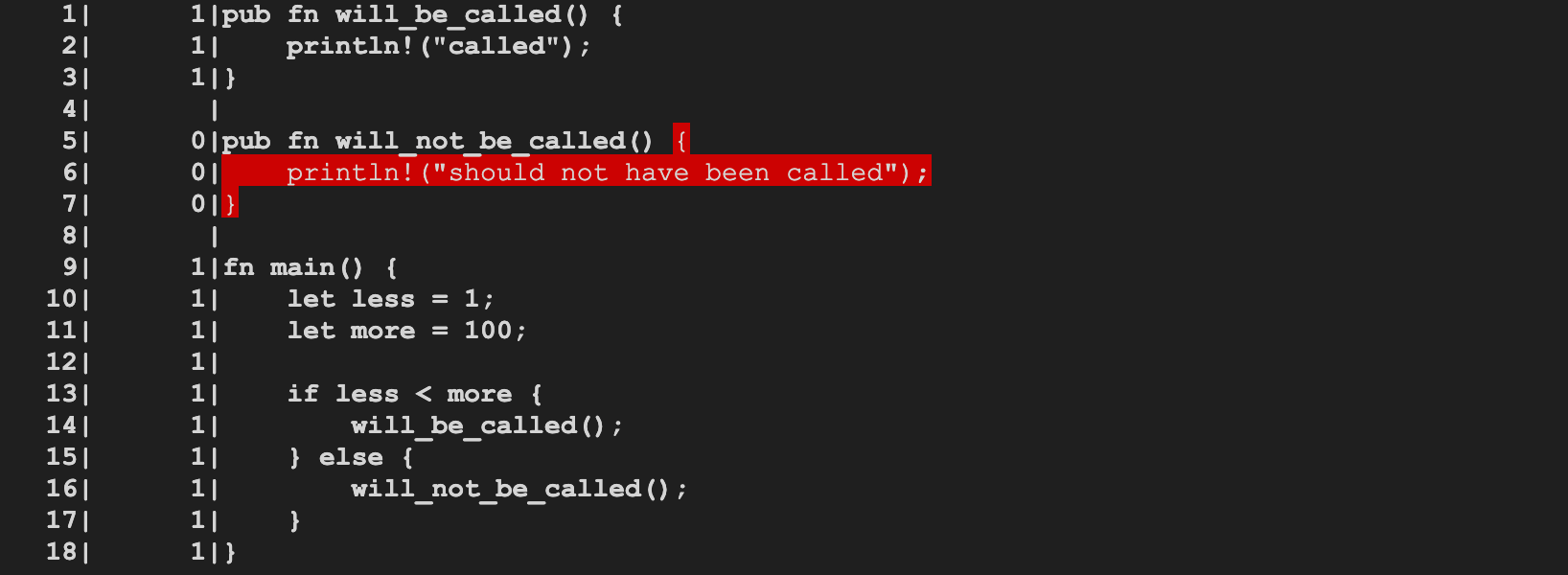
r? @wesleywiser
Rust compiler MCP rust-lang/compiler-team#278
Relevant issue: #34701 - Implement support for LLVMs code coverage instrumentation
|
|
|
|
Co-authored-by: Joshua Nelson <joshua@yottadb.com>
|
|
rustc_metadata: Make crate loading fully speculative
Instead of reporting `span_err`s on the spot crate loading errors are now wrapped into the `CrateError` enum and returned, so they are reported only at the top level `resolve_crate` call, and not reported at all if we are resolving speculatively with `maybe_resolve_crate`.
As a result we can attempt loading crates for error recovery (e.g. import suggestions) without any risk of producing extra errors.
Also, this means better separation between error reporting and actual logic.
Fixes https://github.com/rust-lang/rust/issues/55103
Fixes https://github.com/rust-lang/rust/issues/56590
|
|
|
|
|
|
|
|
std: Switch from libbacktrace to gimli
This commit is a proof-of-concept for switching the standard library's
backtrace symbolication mechanism on most platforms from libbacktrace to
gimli. The standard library's support for `RUST_BACKTRACE=1` requires
in-process parsing of object files and DWARF debug information to
interpret it and print the filename/line number of stack frames as part
of a backtrace.
Historically this support in the standard library has come from a
library called "libbacktrace". The libbacktrace library seems to have
been extracted from gcc at some point and is written in C. We've had a
lot of issues with libbacktrace over time, unfortunately, though. The
library does not appear to be actively maintained since we've had
patches sit for months-to-years without comments. We have discovered a
good number of soundness issues with the library itself, both when
parsing valid DWARF as well as invalid DWARF. This is enough of an issue
that the libs team has previously decided that we cannot feed untrusted
inputs to libbacktrace. This also doesn't take into account the
portability of libbacktrace which has been difficult to manage and
maintain over time. While possible there are lots of exceptions and it's
the main C dependency of the standard library right now.
For years it's been the desire to switch over to a Rust-based solution
for symbolicating backtraces. It's been assumed that we'll be using the
Gimli family of crates for this purpose, which are targeted at safely
and efficiently parsing DWARF debug information. I've been working
recently to shore up the Gimli support in the `backtrace` crate. As of a
few weeks ago the `backtrace` crate, by default, uses Gimli when loaded
from crates.io. This transition has gone well enough that I figured it
was time to start talking seriously about this change to the standard
library.
This commit is a preview of what's probably the best way to integrate
the `backtrace` crate into the standard library with the Gimli feature
turned on. While today it's used as a crates.io dependency, this commit
switches the `backtrace` crate to a submodule of this repository which
will need to be updated manually. This is not done lightly, but is
thought to be the best solution. The primary reason for this is that the
`backtrace` crate needs to do some pretty nontrivial filesystem
interactions to locate debug information. Working without `std::fs` is
not an option, and while it might be possible to do some sort of
trait-based solution when prototyped it was found to be too unergonomic.
Using a submodule allows the `backtrace` crate to build as a submodule
of the `std` crate itself, enabling it to use `std::fs` and such.
Otherwise this adds new dependencies to the standard library. This step
requires extra attention because this means that these crates are now
going to be included with all Rust programs by default. It's important
to note, however, that we're already shipping libbacktrace with all Rust
programs by default and it has a bunch of C code implementing all of
this internally anyway, so we're basically already switching
already-shipping functionality to Rust from C.
* `object` - this crate is used to parse object file headers and
contents. Very low-level support is used from this crate and almost
all of it is disabled. Largely we're just using struct definitions as
well as convenience methods internally to read bytes and such.
* `addr2line` - this is the main meat of the implementation for
symbolication. This crate depends on `gimli` for DWARF parsing and
then provides interfaces needed by the `backtrace` crate to turn an
address into a filename / line number. This crate is actually pretty
small (fits in a single file almost!) and mirrors most of what
`dwarf.c` does for libbacktrace.
* `miniz_oxide` - the libbacktrace crate transparently handles
compressed debug information which is compressed with zlib. This crate
is used to decompress compressed debug sections.
* `gimli` - not actually used directly, but a dependency of `addr2line`.
* `adler32`- not used directly either, but a dependency of
`miniz_oxide`.
The goal of this change is to improve the safety of backtrace
symbolication in the standard library, especially in the face of
possibly malformed DWARF debug information. Even to this day we're still
seeing segfaults in libbacktrace which could possibly become security
vulnerabilities. This change should almost entirely eliminate this
possibility whilc also paving the way forward to adding more features
like split debug information.
Some references for those interested are:
* Original addition of libbacktrace - #12602
* OOM with libbacktrace - #24231
* Backtrace failure due to use of uninitialized value - #28447
* Possibility to feed untrusted data to libbacktrace - #21889
* Soundness fix for libbacktrace - #33729
* Crash in libbacktrace - #39468
* Support for macOS, never merged - ianlancetaylor/libbacktrace#2
* Performance issues with libbacktrace - #29293, #37477
* Update procedure is quite complicated due to how many patches we
need to carry - #50955
* Libbacktrace doesn't work on MinGW with dynamic libs - #71060
* Segfault in libbacktrace on macOS - #71397
Switching to Rust will not make us immune to all of these issues. The
crashes are expected to go away, but correctness and performance may
still have bugs arise. The gimli and `backtrace` crates, however, are
actively maintained unlike libbacktrace, so this should enable us to at
least efficiently apply fixes as situations come up.
---
I want to note that my purpose for creating a PR here is to start a conversation about this. I think that all the various pieces are in place that this is compelling enough that I think this transition should be talked about seriously. There are a number of items which still need to be addressed before actually merging this PR, however:
* [ ] `gimli` needs to be published to crates.io
* [ ] `addr2line` needs a publish
* [ ] `miniz_oxide` needs a publish
* [ ] Tests probably shouldn't recommend the `gimli` crate's traits for implementing
* [ ] The `backtrace` crate's branch changes need to be merged to the master branch (https://github.com/rust-lang/backtrace-rs/pull/349)
* [ ] The support for `libbacktrace` on some platforms needs to be audited to see if we should support more strategies in the gimli implementation - https://github.com/rust-lang/backtrace-rs/issues/325, https://github.com/rust-lang/backtrace-rs/issues/326, https://github.com/rust-lang/backtrace-rs/issues/350, https://github.com/rust-lang/backtrace-rs/issues/351
Most of the merging/publishing I'm not actively pushing on right now. It's a bit wonky for crates to support libstd so I'm holding off on pulling the trigger everywhere until there's a bit more discussion about how to go through with this. Namely https://github.com/rust-lang/backtrace-rs/pull/349 I'm going to hold off merging until we decide to go through with the submodule strategy.
In any case this is a pretty major change, so I suspect that the compiler team is likely going to be interested in this. I don't mean to force changes by dumping a bunch of code by any means. Integration of external crates into the standard library is so difficult I wanted to have a proof-of-concept to review while talking about whether to do this at all (hence the PR), but I'm more than happy to follow any processes needed to merge this. I must admit though that I'm not entirely sure myself at this time what the process would be to decide to merge this, so I'm hoping others can help me figure that out!
|
|
They are deprecated so doing extra work for error recovery doesn't make sense
|
|
Use pathdiff crate
I wanted to tackle a simple issue, and stumbled upon #67108: this pr removes the function which was exported to the external crate as required in the todo/issue.
I've tested it with:
```
./x.py build --stage 1 --keep-stage 1 src/librustc_codegen_ssa
```
And it looks like it's compiling
|
|
|
|
This commit is a proof-of-concept for switching the standard library's
backtrace symbolication mechanism on most platforms from libbacktrace to
gimli. The standard library's support for `RUST_BACKTRACE=1` requires
in-process parsing of object files and DWARF debug information to
interpret it and print the filename/line number of stack frames as part
of a backtrace.
Historically this support in the standard library has come from a
library called "libbacktrace". The libbacktrace library seems to have
been extracted from gcc at some point and is written in C. We've had a
lot of issues with libbacktrace over time, unfortunately, though. The
library does not appear to be actively maintained since we've had
patches sit for months-to-years without comments. We have discovered a
good number of soundness issues with the library itself, both when
parsing valid DWARF as well as invalid DWARF. This is enough of an issue
that the libs team has previously decided that we cannot feed untrusted
inputs to libbacktrace. This also doesn't take into account the
portability of libbacktrace which has been difficult to manage and
maintain over time. While possible there are lots of exceptions and it's
the main C dependency of the standard library right now.
For years it's been the desire to switch over to a Rust-based solution
for symbolicating backtraces. It's been assumed that we'll be using the
Gimli family of crates for this purpose, which are targeted at safely
and efficiently parsing DWARF debug information. I've been working
recently to shore up the Gimli support in the `backtrace` crate. As of a
few weeks ago the `backtrace` crate, by default, uses Gimli when loaded
from crates.io. This transition has gone well enough that I figured it
was time to start talking seriously about this change to the standard
library.
This commit is a preview of what's probably the best way to integrate
the `backtrace` crate into the standard library with the Gimli feature
turned on. While today it's used as a crates.io dependency, this commit
switches the `backtrace` crate to a submodule of this repository which
will need to be updated manually. This is not done lightly, but is
thought to be the best solution. The primary reason for this is that the
`backtrace` crate needs to do some pretty nontrivial filesystem
interactions to locate debug information. Working without `std::fs` is
not an option, and while it might be possible to do some sort of
trait-based solution when prototyped it was found to be too unergonomic.
Using a submodule allows the `backtrace` crate to build as a submodule
of the `std` crate itself, enabling it to use `std::fs` and such.
Otherwise this adds new dependencies to the standard library. This step
requires extra attention because this means that these crates are now
going to be included with all Rust programs by default. It's important
to note, however, that we're already shipping libbacktrace with all Rust
programs by default and it has a bunch of C code implementing all of
this internally anyway, so we're basically already switching
already-shipping functionality to Rust from C.
* `object` - this crate is used to parse object file headers and
contents. Very low-level support is used from this crate and almost
all of it is disabled. Largely we're just using struct definitions as
well as convenience methods internally to read bytes and such.
* `addr2line` - this is the main meat of the implementation for
symbolication. This crate depends on `gimli` for DWARF parsing and
then provides interfaces needed by the `backtrace` crate to turn an
address into a filename / line number. This crate is actually pretty
small (fits in a single file almost!) and mirrors most of what
`dwarf.c` does for libbacktrace.
* `miniz_oxide` - the libbacktrace crate transparently handles
compressed debug information which is compressed with zlib. This crate
is used to decompress compressed debug sections.
* `gimli` - not actually used directly, but a dependency of `addr2line`.
* `adler32`- not used directly either, but a dependency of
`miniz_oxide`.
The goal of this change is to improve the safety of backtrace
symbolication in the standard library, especially in the face of
possibly malformed DWARF debug information. Even to this day we're still
seeing segfaults in libbacktrace which could possibly become security
vulnerabilities. This change should almost entirely eliminate this
possibility whilc also paving the way forward to adding more features
like split debug information.
Some references for those interested are:
* Original addition of libbacktrace - #12602
* OOM with libbacktrace - #24231
* Backtrace failure due to use of uninitialized value - #28447
* Possibility to feed untrusted data to libbacktrace - #21889
* Soundness fix for libbacktrace - #33729
* Crash in libbacktrace - #39468
* Support for macOS, never merged - ianlancetaylor/libbacktrace#2
* Performance issues with libbacktrace - #29293, #37477
* Update procedure is quite complicated due to how many patches we
need to carry - #50955
* Libbacktrace doesn't work on MinGW with dynamic libs - #71060
* Segfault in libbacktrace on macOS - #71397
Switching to Rust will not make us immune to all of these issues. The
crashes are expected to go away, but correctness and performance may
still have bugs arise. The gimli and `backtrace` crates, however, are
actively maintained unlike libbacktrace, so this should enable us to at
least efficiently apply fixes as situations come up.
|
|
Add CSS tidy check
r? @Mark-Simulacrum
|
|
Fix MinGW `run-make-fulldeps` tests
`compiler-rt-works-on-mingw` and `libs-search-path` were not ran because `only-mingw` doesn't match any target.
Enabled and verified few ignored tests with `windows-gnu` toolchain. They are still ignored on MSVC since I'm not experienced with this target.
|
|
rustc now generates the coverage map and can support (limited)
coverage report generation, at the function level.
Example:
$ BUILD=$HOME/rust/build/x86_64-unknown-linux-gnu
$ $BUILD/stage1/bin/rustc -Zinstrument-coverage \
$HOME/rust/src/test/run-make-fulldeps/instrument-coverage/main.rs
$ LLVM_PROFILE_FILE="main.profraw" ./main
called
$ $BUILD/llvm/bin/llvm-profdata merge -sparse main.profraw -o main.profdata
$ $BUILD/llvm/bin/llvm-cov show --instr-profile=main.profdata main
1| 1|pub fn will_be_called() {
2| 1| println!("called");
3| 1|}
4| |
5| 0|pub fn will_not_be_called() {
6| 0| println!("should not have been called");
7| 0|}
8| |
9| 1|fn main() {
10| 1| let less = 1;
11| 1| let more = 100;
12| 1|
13| 1| if less < more {
14| 1| will_be_called();
15| 1| } else {
16| 1| will_not_be_called();
17| 1| }
18| 1|}
|
|
Rename TypeckTables to TypeckResults.
Originally suggested by @eddyb.
|
|
|
|
|
|
|
|
|
|
Add RISC-V GNU/Linux to src/tools/build-manifest as a host platform
Missed during https://github.com/rust-lang/rust/pull/72973
|
|
Some `Symbol` related improvements
These commits make things nicer and avoid some `Symbol::as_str()` calls.
r? @oli-obk
|
|
Add build support for Cargo's build-std feature.
This makes some changes to the standard library to make it easier to use with Cargo's build-std feature. The primary goal is to make it so that Cargo and its users do not need to know which crates to build and which features to use for every platform.
Conditional cfgs are adjusted so that there is usually a fall-through for unsupported platforms. Additionally, there is a "restricted-std" feature to mark `std` as unstable when used with build-std on no_std platforms. There is no intent to stabilize this feature for the foreseeable future.
This borrows some of the implementation for wasm which already does what this needs. More code sharing can be done with some other platforms (there is a lot of duplication with cloudabi, hermit, and sgx), but I figure that can be done in a future PR.
There are some small changes to stable behavior in this PR:
- `std::env::consts::ARCH` on asmjs now reports "wasm32", to match its actual architecture.
- Some of the wasm error messages for unsupported features report a slightly different error message so that the code can be reused.
There should otherwise not be any changes to how std is built for distribution via bootstrap.
This does not yet support all platforms when used with build-std.
- It doesn't work with 16-bit targets (hashbrown does not support that).
- It does not work with JSON spec targets.
- In particular, all target triple snooping will need to be replaced with appropriate target option checking.
- Switching to gimli (#73441) will make cross-building *much* easier.
- There are still a ton of issues on the Cargo side to resolve. A big one is panic strategy support.
Future PRs are intended to address some of these issues.
|
|
It's intended only for very temporary use.
|
|
rustdoc: Rename internal API fns to `into_string`
to avoid surprising listed in API guidelines.
|
|
|
|
|
|
Support const args in type dependent paths (Take 2)
once more, except it is sound this time :smiling_face_with_three_hearts: previously #71154
-----
```rust
#![feature(const_generics)]
struct A;
impl A {
fn foo<const N: usize>(&self) -> usize { N }
}
struct B;
impl B {
fn foo<const N: usize>(&self) -> usize { 42 }
}
fn main() {
let a = A;
a.foo::<7>();
}
```
When calling `type_of` for generic const arguments, we now use the `TypeckTables` of the surrounding body to get the expected type.
This alone causes cycle errors though, as we now have `typeck_tables_of(main)` -> `...` ->
`type_of(main_ANON0 := 7)` -> `typeck_tables_of(main)` :zap: (see https://github.com/rust-lang/rust/issues/68400#issuecomment-611760290)
To prevent this we must not call `type_of(const_arg)` during `typeck_tables_of`. This is achieved by
calling `type_of(param_def_id)` instead.
We have to somehow remember the `DefId` of the param through all of typeck, which is done using the
struct `ty::WithOptConstParam<DefId>`, which replaces `DefId` where needed and contains an `Option<DefId>` to
be able to store the const parameter in case it exists.
Queries which are currently cached on disk are split into two variants: `query_name`(cached) and `query_name_(of|for)_const_arg`(not cached), with `query_name_of_const_arg` taking a pair `(did, param_did): (LocalDefId, DefId)`.
For some queries a method `query_name_of_opt_const_arg` is added to `TyCtxt` which takes a `ty::WithOptConstParam` and either calls `query_name` or `query_name_of_const_arg` depending on the value of `const_param_did`.
r? @eddyb @varkor
|
|
|
|
|
|
|
|
to avoid surprising listed in API guidelines.
|
|
build dist for x86_64-unknown-illumos
This change creates a new Docker image, "dist-x86_64-illumos", and sets
things up to build the full set of "dist" packages for illumos hosts, so
that illumos users can use "rustup" to install packages. It also
adjusts the manifest builder to expect complete toolchains for this
platform.
|
|
More static symbols
These commits add some more static symbols and convert lots of places to use them.
r? @oli-obk
|
|
In various ways, such as changing functions to take a `Symbol` instead
of a `&str`.
|
|
Update cargo
4 commits in 4f74d9b2a771c58b7ef4906b2668afd075bc8081..43cf77395cad5b79887b20b7cf19d418bbd703a9
2020-07-08 17:13:00 +0000 to 2020-07-13 17:35:42 +0000
- fix: add space to comments (rust-lang/cargo#8476)
- Allow configuring unstable flags via config file (rust-lang/cargo#8393)
- Add support for rustc's `-Z terminal-width`. (rust-lang/cargo#8427)
- Avoid colliding with older Cargo fingerprint changes (rust-lang/cargo#8473)
|
|
|
|
|
|
update miri
This incorporates https://github.com/rust-lang/miri/pull/1474. [Last time](https://github.com/rust-lang/rust/pull/74146) that change caused trouble but I fixed xargo since then and [now it should work](https://github.com/rust-lang/rust/pull/74146#issuecomment-657051446).
Cc @rust-lang/miri r? @ghost
|
|
Stabilize `transmute` in constants and statics but not const fn
cc #53605 (leaving issue open so we can add `transmute` to `const fn` later)
Previous attempt: #64011
r? @RalfJung
cc @rust-lang/wg-const-eval
|
|
|
|
|
|
Update rust-installer to latest version
This pulls in a fix for the install script on some tr(1) implementations,
as well as an update to use `anyhow` instead of `failure` for error
handling.
|
|
:arrow_up: rust-analyzer
This updates rust-analyzer submodule to the latest release.
I plan to do that every Monday after rust-analyzer release (about 16:00 CET).
This is semi-automated by https://github.com/rust-analyzer/rust-analyzer/pull/5253/files#diff-c06f6a9cbd0ad2421bcc2ddc28805457R77-R100.
Who would be the appropriate person to r? on Mondays?
|
|
Other terms are more inclusive and precise.
|
|
Avoid "blacklist"
Other terms are more inclusive and precise.
Clippy still has a lint named "blacklisted-name", but renaming it would
be a breaking change, so is left for future work.
The target configuration option "abi-blacklist" has been depreciated and
renamed to "unsupported-abis". The old name continues to work.
|
|
update miri
Fixes https://github.com/rust-lang/rust/issues/74132
Cc @rust-lang/miri r? @ghost
|
|
Update cargo
6 commits in fede83ccf973457de319ba6fa0e36ead454d2e20..4f74d9b2a771c58b7ef4906b2668afd075bc8081
2020-07-02 21:51:34 +0000 to 2020-07-08 17:13:00 +0000
- Disable long_file_names test if not supported on Windows. (rust-lang/cargo#8469)
- Add support for deserializing enums in config files (rust-lang/cargo#8454)
- Write GNU tar files, supporting long names. (rust-lang/cargo#8453)
- Don't overwrite existing `rustdoc` args with --document-private-items (rust-lang/cargo#8449)
- Add some help about rustup's +toolchain syntax. (rust-lang/cargo#8455)
- Update metadata man page. (rust-lang/cargo#8451)
|
|
Eliminate confusing "globals" terminology.
There are some structures that are called "globals", but are they global
to a compilation session, and not truly global. I have always found this
highly confusing, so this commit renames them as "session globals" and
adds a comment explaining things.
Also, the commit fixes an unnecessary nesting of `set()` calls
`src/librustc_errors/json/tests.rs`
r? @Aaron1011
|
|
|
