| Age | Commit message (Collapse) | Author | Lines |
|---|
|
Fix "item info" width
Fixes #87202.
It now looks again like this:
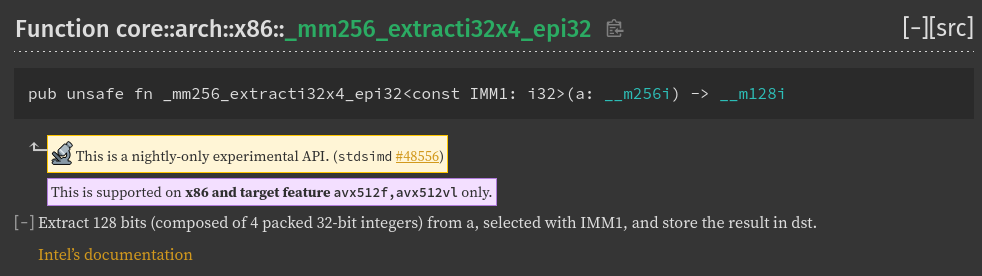
cc `@jyn514`
r? `@notriddle`
|
|
r=GuillaumeGomez
Rustdoc accessibility: make the sidebar headers actual headers
Part of #87059
Preview it at: https://notriddle.com/notriddle-rustdoc-test/rustdoc-sidebar-header/std/index.html
|
|
Add --nocapture option to rustdoc
Fixes https://github.com/rust-lang/rust/issues/26309.
Fixes #45724.
Once this PR is merged, I'll send a PR to cargo to also pass `--nocapture` to rustdoc.
cc `@jyn514`
r? `@camelid`
|
|
Compute a better `lint_node_id` during expansion
When we need to emit a lint at a macro invocation, we currently use the
`NodeId` of its parent definition (e.g. the enclosing function). This
means that any `#[allow]` / `#[deny]` attributes placed 'closer' to the
macro (e.g. on an enclosing block or statement) will have no effect.
This commit computes a better `lint_node_id` in `InvocationCollector`.
When we visit/flat_map an AST node, we assign it a `NodeId` (earlier
than we normally would), and store than `NodeId` in current
`ExpansionData`. When we collect a macro invocation, the current
`lint_node_id` gets cloned along with our `ExpansionData`, allowing it
to be used if we need to emit a lint later on.
This improves the handling of `#[allow]` / `#[deny]` for
`SEMICOLON_IN_EXPRESSIONS_FROM_MACROS` and some `asm!`-related lints.
The 'legacy derive helpers' lint retains its current behavior
(I've inlined the now-removed `lint_node_id` function), since
there isn't an `ExpansionData` readily available.
|
|
feat(rustc_lint): add `dyn_drop`
Based on the conversation in #86747.
Explanation
-----------
A trait object bound of the form `dyn Drop` is most likely misleading and not what the programmer intended.
`Drop` bounds do not actually indicate whether a type can be trivially dropped or not, because a composite type containing `Drop` types does not necessarily implement `Drop` itself. Naïvely, one might be tempted to write a deferred drop system, to pull cleaning up memory out of a latency-sensitive code path, using `dyn Drop` trait objects. However, this breaks down e.g. when `T` is `String`, which does not implement `Drop`, but should probably be accepted.
To write a trait object bound that accepts anything, use a placeholder trait with a blanket implementation.
```rust
trait Placeholder {}
impl<T> Placeholder for T {}
fn foo(_x: Box<dyn Placeholder>) {}
```
|
|
Use existing declaration of rust_eh_personality
If crate declares `rust_eh_personality`, re-use existing declaration
as otherwise attempts to set function attributes that follow the
declaration will fail (unless it happens to have exactly the same
type signature as the one predefined in the compiler).
Fixes #70117.
Fixes https://github.com/rust-lang/rust/pull/81469#issuecomment-809428126; probably.
|
|
|
|
These are all testing corner-cases in the compiler.
Adding a new warning broke these test cases, but --cap-lints stops
it from actually breaking things in production.
|
|
Based on the conversation in #86747.
Explanation
-----------
A trait object bound of the form `dyn Drop` is most likely misleading
and not what the programmer intended.
`Drop` bounds do not actually indicate whether a type can be trivially
dropped or not, because a composite type containing `Drop` types does
not necessarily implement `Drop` itself. Naïvely, one might be tempted
to write a deferred drop system, to pull cleaning up memory out of a
latency-sensitive code path, using `dyn Drop` trait objects. However,
this breaks down e.g. when `T` is `String`, which does not implement
`Drop`, but should probably be accepted.
To write a trait object bound that accepts anything, use a placeholder
trait with a blanket implementation.
```rust
trait Placeholder {}
impl<T> Placeholder for T {}
fn foo(_x: Box<dyn Placeholder>) {}
```
|
|
|
|
|
|
|
|
|
|
|
|
|
|
|
|
|
|
Rollup of 8 pull requests
Successful merges:
- #86763 (Add a regression test for issue-63355)
- #86814 (Recover from a misplaced inner doc comment)
- #86843 (Check that const parameters of trait methods have compatible types)
- #86889 (rustdoc: Cleanup ExternalCrate)
- #87092 (Remove nondeterminism in multiple-definitions test)
- #87170 (Add diagnostic items for Clippy)
- #87183 (fix typo in compile_fail doctest)
- #87205 (rustc_middle: remove redundant clone)
Failed merges:
r? `@ghost`
`@rustbot` modify labels: rollup
|
|
Add diagnostics for mistyped inclusive range
Inclusive ranges are correctly typed as `..=`. However, it's quite easy to think of it as being like `==`, and type `..==` instead. This PR adds helpful diagnostics for this case.
Resolves #86395 (there are some other cases there, but I think those should probably have separate issues).
r? `@estebank`
|
|
r=petrochenkov
Remove nondeterminism in multiple-definitions test
Compare all fields in `DllImport` when sorting to avoid nondeterminism in the error for multiple inconsistent definitions of an extern function. Restore the multiple-definitions test.
Resolves #87084.
|
|
rustdoc: Cleanup ExternalCrate
- Remove unnecessary CrateNum from Cache.externs
- Remove trival impl Clean for CrateNum
|
|
Check that const parameters of trait methods have compatible types
This PR fixes #86820. The problem is that this currently passes the type checker:
```rust
trait Tr {
fn foo<const N: u8>(self) -> u8;
}
impl Tr for f32 {
fn foo<const N: bool>(self) -> u8 { 42 }
}
```
i.e. the type checker fails to check whether const parameters in `impl` methods have the same type as the corresponding declaration in the trait. With my changes, I get, for the above code:
```
error[E0053]: method `foo` has an incompatible const parameter type for trait
--> test.rs:6:18
|
6 | fn foo<const N: bool>(self) -> u8 { 42 }
| ^
|
note: the const parameter `N` has type `bool`, but the declaration in trait `Tr::foo` has type `u8`
--> test.rs:2:18
|
2 | fn foo<const N: u8>(self) -> u8;
| ^
error: aborting due to previous error
```
This fixes #86820, where an ICE happens later on because the trait method is declared with a const parameter of type `u8`, but the `impl` uses one of type `usize`:
> `expected int of size 8, but got size 1`
|
|
Recover from a misplaced inner doc comment
Fixes #86781
|
|
Add a regression test for issue-63355
Closes #63355
r? ``@nikomatsakis``
|
|
|
|
|
|
When we need to emit a lint at a macro invocation, we currently use the
`NodeId` of its parent definition (e.g. the enclosing function). This
means that any `#[allow]` / `#[deny]` attributes placed 'closer' to the
macro (e.g. on an enclosing block or statement) will have no effect.
This commit computes a better `lint_node_id` in `InvocationCollector`.
When we visit/flat_map an AST node, we assign it a `NodeId` (earlier
than we normally would), and store than `NodeId` in current
`ExpansionData`. When we collect a macro invocation, the current
`lint_node_id` gets cloned along with our `ExpansionData`, allowing it
to be used if we need to emit a lint later on.
This improves the handling of `#[allow]` / `#[deny]` for
`SEMICOLON_IN_EXPRESSIONS_FROM_MACROS` and some `asm!`-related lints.
The 'legacy derive helpers' lint retains its current behavior
(I've inlined the now-removed `lint_node_id` function), since
there isn't an `ExpansionData` readily available.
|
|
Add help on reinitialization between move and access
Fixes #83760
|
|
Warn about useless assignments of variables/fields to themselves
This PR fixes #75356. Following `@varkor's` suggestion in https://github.com/rust-lang/rust/issues/75356#issuecomment-700339154, I have implemented this warning as part of the `dead_code` lint. Unlike the `-Wself-assign` implementation in [Clang](https://github.com/llvm/llvm-project/blob/56e6d4742e6909bd7d2db201cc5e0e3e77c6f282/clang/lib/Sema/SemaExpr.cpp#L13875-L13909), my implementation also warns about self-assignments of struct fields (`s.x = s.x`).
r? `@varkor`
|
|
|
|
|
|
|
|
Part of #87059
Preview it at: https://notriddle.com/notriddle-rustdoc-test/rustdoc-sidebar-header/std/index.html
|
|
Make expansions stable for incr. comp.
This PR aims to make expansions stable for incr. comp. by using the same architecture as definitions:
- the interned identifier `ExpnId` contains a `CrateNum` and a crate-local id;
- bidirectional maps `ExpnHash <-> ExpnId` are setup;
- incr. comp. on-disk cache saves and reconstructs expansions using their `ExpnHash`.
I tried to use as many `LocalExpnId` as I could in the resolver code, but I may have missed a few opportunities.
All this will allow to use an `ExpnId` as a query key, and to force this query without recomputing caller queries. For instance, this will be used to implement #85999.
r? `@petrochenkov`
|
|
|
|
CTFE/Miri engine Pointer type overhaul
This fixes the long-standing problem that we are using `Scalar` as a type to represent pointers that might be integer values (since they point to a ZST). The main problem is that with int-to-ptr casts, there are multiple ways to represent the same pointer as a `Scalar` and it is unclear if "normalization" (i.e., the cast) already happened or not. This leads to ugly methods like `force_mplace_ptr` and `force_op_ptr`.
Another problem this solves is that in Miri, it would make a lot more sense to have the `Pointer::offset` field represent the full absolute address (instead of being relative to the `AllocId`). This means we can do ptr-to-int casts without access to any machine state, and it means that the overflow checks on pointer arithmetic are (finally!) accurate.
To solve this, the `Pointer` type is made entirely parametric over the provenance, so that we can use `Pointer<AllocId>` inside `Scalar` but use `Pointer<Option<AllocId>>` when accessing memory (where `None` represents the case that we could not figure out an `AllocId`; in that case the `offset` is an absolute address). Moreover, the `Provenance` trait determines if a pointer with a given provenance can be cast to an integer by simply dropping the provenance.
I hope this can be read commit-by-commit, but the first commit does the bulk of the work. It introduces some FIXMEs that are resolved later.
Fixes https://github.com/rust-lang/miri/issues/841
Miri PR: https://github.com/rust-lang/miri/pull/1851
r? `@oli-obk`
|
|
Update Rust Float-Parsing Algorithms to use the Eisel-Lemire algorithm.
# Summary
Rust, although it implements a correct float parser, has major performance issues in float parsing. Even for common floats, the performance can be 3-10x [slower](https://arxiv.org/pdf/2101.11408.pdf) than external libraries such as [lexical](https://github.com/Alexhuszagh/rust-lexical) and [fast-float-rust](https://github.com/aldanor/fast-float-rust).
Recently, major advances in float-parsing algorithms have been developed by Daniel Lemire, along with others, and implement a fast, performant, and correct float parser, with speeds up to 1200 MiB/s on Apple's M1 architecture for the [canada](https://github.com/lemire/simple_fastfloat_benchmark/blob/0e2b5d163d4074cc0bde2acdaae78546d6e5c5f1/data/canada.txt) dataset, 10x faster than Rust's 130 MiB/s.
In addition, [edge-cases](https://github.com/rust-lang/rust/issues/85234) in Rust's [dec2flt](https://github.com/rust-lang/rust/tree/868c702d0c9a471a28fb55f0148eb1e3e8b1dcc5/library/core/src/num/dec2flt) algorithm can lead to over a 1600x slowdown relative to efficient algorithms. This is due to the use of Clinger's correct, but slow [AlgorithmM and Bellepheron](http://citeseerx.ist.psu.edu/viewdoc/download?doi=10.1.1.45.4152&rep=rep1&type=pdf), which have been improved by faster big-integer algorithms and the Eisel-Lemire algorithm, respectively.
Finally, this algorithm provides substantial improvements in the number of floats the Rust core library can parse. Denormal floats with a large number of digits cannot be parsed, due to use of the `Big32x40`, which simply does not have enough digits to round a float correctly. Using a custom decimal class, with much simpler logic, we can parse all valid decimal strings of any digit count.
```rust
// Issue in Rust's dec2fly.
"2.47032822920623272088284396434110686182e-324".parse::<f64>(); // Err(ParseFloatError { kind: Invalid })
```
# Solution
This pull request implements the Eisel-Lemire algorithm, modified from [fast-float-rust](https://github.com/aldanor/fast-float-rust) (which is licensed under Apache 2.0/MIT), along with numerous modifications to make it more amenable to inclusion in the Rust core library. The following describes both features in fast-float-rust and improvements in fast-float-rust for inclusion in core.
**Documentation**
Extensive documentation has been added to ensure the code base may be maintained by others, which explains the algorithms as well as various associated constants and routines. For example, two seemingly magical constants include documentation to describe how they were derived as follows:
```rust
// Round-to-even only happens for negative values of q
// when q ≥ −4 in the 64-bit case and when q ≥ −17 in
// the 32-bitcase.
//
// When q ≥ 0,we have that 5^q ≤ 2m+1. In the 64-bit case,we
// have 5^q ≤ 2m+1 ≤ 2^54 or q ≤ 23. In the 32-bit case,we have
// 5^q ≤ 2m+1 ≤ 2^25 or q ≤ 10.
//
// When q < 0, we have w ≥ (2m+1)×5^−q. We must have that w < 2^64
// so (2m+1)×5^−q < 2^64. We have that 2m+1 > 2^53 (64-bit case)
// or 2m+1 > 2^24 (32-bit case). Hence,we must have 2^53×5^−q < 2^64
// (64-bit) and 2^24×5^−q < 2^64 (32-bit). Hence we have 5^−q < 2^11
// or q ≥ −4 (64-bit case) and 5^−q < 2^40 or q ≥ −17 (32-bitcase).
//
// Thus we have that we only need to round ties to even when
// we have that q ∈ [−4,23](in the 64-bit case) or q∈[−17,10]
// (in the 32-bit case). In both cases,the power of five(5^|q|)
// fits in a 64-bit word.
const MIN_EXPONENT_ROUND_TO_EVEN: i32;
const MAX_EXPONENT_ROUND_TO_EVEN: i32;
```
This ensures maintainability of the code base.
**Improvements for Disguised Fast-Path Cases**
The fast path in float parsing algorithms attempts to use native, machine floats to represent both the significant digits and the exponent, which is only possible if both can be exactly represented without rounding. In practice, this means that the significant digits must be 53-bits or less and the then exponent must be in the range `[-22, 22]` (for an f64). This is similar to the existing dec2flt implementation.
However, disguised fast-path cases exist, where there are few significant digits and an exponent above the valid range, such as `1.23e25`. In this case, powers-of-10 may be shifted from the exponent to the significant digits, discussed at length in https://github.com/rust-lang/rust/issues/85198.
**Digit Parsing Improvements**
Typically, integers are parsed from string 1-at-a-time, requiring unnecessary multiplications which can slow down parsing. An approach to parse 8 digits at a time using only 3 multiplications is described in length [here](https://johnnylee-sde.github.io/Fast-numeric-string-to-int/). This leads to significant performance improvements, and is implemented for both big and little-endian systems.
**Unsafe Changes**
Relative to fast-float-rust, this library makes less use of unsafe functionality and clearly documents it. This includes the refactoring and documentation of numerous unsafe methods undesirably marked as safe. The original code would look something like this, which is deceptively marked as safe for unsafe functionality.
```rust
impl AsciiStr {
#[inline]
pub fn step_by(&mut self, n: usize) -> &mut Self {
unsafe { self.ptr = self.ptr.add(n) };
self
}
}
...
#[inline]
fn parse_scientific(s: &mut AsciiStr<'_>) -> i64 {
// the first character is 'e'/'E' and scientific mode is enabled
let start = *s;
s.step();
...
}
```
The new code clearly documents safety concerns, and does not mark unsafe functionality as safe, leading to better safety guarantees.
```rust
impl AsciiStr {
/// Advance the view by n, advancing it in-place to (n..).
pub unsafe fn step_by(&mut self, n: usize) -> &mut Self {
// SAFETY: same as step_by, safe as long n is less than the buffer length
self.ptr = unsafe { self.ptr.add(n) };
self
}
}
...
/// Parse the scientific notation component of a float.
fn parse_scientific(s: &mut AsciiStr<'_>) -> i64 {
let start = *s;
// SAFETY: the first character is 'e'/'E' and scientific mode is enabled
unsafe {
s.step();
}
...
}
```
This allows us to trivially demonstrate the new implementation of dec2flt is safe.
**Inline Annotations Have Been Removed**
In the previous implementation of dec2flt, inline annotations exist practically nowhere in the entire module. Therefore, these annotations have been removed, which mostly does not impact [performance](https://github.com/aldanor/fast-float-rust/issues/15#issuecomment-864485157).
**Fixed Correctness Tests**
Numerous compile errors in `src/etc/test-float-parse` were present, due to deprecation of `time.clock()`, as well as the crate dependencies with `rand`. The tests have therefore been reworked as a [crate](https://github.com/Alexhuszagh/rust/tree/master/src/etc/test-float-parse), and any errors in `runtests.py` have been patched.
**Undefined Behavior**
An implementation of `check_len` which relied on undefined behavior (in fast-float-rust) has been refactored, to ensure that the behavior is well-defined. The original code is as follows:
```rust
#[inline]
pub fn check_len(&self, n: usize) -> bool {
unsafe { self.ptr.add(n) <= self.end }
}
```
And the new implementation is as follows:
```rust
/// Check if the slice at least `n` length.
fn check_len(&self, n: usize) -> bool {
n <= self.as_ref().len()
}
```
Note that this has since been fixed in [fast-float-rust](https://github.com/aldanor/fast-float-rust/pull/29).
**Inferring Binary Exponents**
Rather than explicitly store binary exponents, this new implementation infers them from the decimal exponent, reducing the amount of static storage required. This removes the requirement to store [611 i16s](https://github.com/rust-lang/rust/blob/868c702d0c9a471a28fb55f0148eb1e3e8b1dcc5/library/core/src/num/dec2flt/table.rs#L8).
# Code Size
The code size, for all optimizations, does not considerably change relative to before for stripped builds, however it is **significantly** smaller prior to stripping the resulting binaries. These binary sizes were calculated on x86_64-unknown-linux-gnu.
**new**
Using rustc version 1.55.0-dev.
opt-level|size|size(stripped)
|:-:|:-:|:-:|
0|400k|300K
1|396k|292K
2|392k|292K
3|392k|296K
s|396k|292K
z|396k|292K
**old**
Using rustc version 1.53.0-nightly.
opt-level|size|size(stripped)
|:-:|:-:|:-:|
0|3.2M|304K
1|3.2M|292K
2|3.1M|284K
3|3.1M|284K
s|3.1M|284K
z|3.1M|284K
# Correctness
The dec2flt implementation passes all of Rust's unittests and comprehensive float parsing tests, along with numerous other tests such as Nigel Toa's comprehensive float [tests](https://github.com/nigeltao/parse-number-fxx-test-data) and Hrvoje Abraham [strtod_tests](https://github.com/ahrvoje/numerics/blob/master/strtod/strtod_tests.toml). Therefore, it is unlikely that this algorithm will incorrectly round parsed floats.
# Issues Addressed
This will fix and close the following issues:
- resolves #85198
- resolves #85214
- resolves #85234
- fixes #31407
- fixes #31109
- fixes #53015
- resolves #68396
- closes https://github.com/aldanor/fast-float-rust/issues/15
|
|
Do not allow JSON targets to set is-builtin: true
Note that this will affect (and make builds fail for) all of the projects out there that have target files invalid in this way. Crater, however, does not really cover these kinds of the codebases, so it is quite difficult to measure the impact. That said, the target files invalid in this way can start causing build failures each time LLVM is upgraded, anyway, so it is probably a good opportunity to disallow this property, entirely.
Another approach considered was to simply not parse this field anymore, which would avoid making the builds explicitly fail, but it wasn't clear to me if `is-builtin` was always set unintentionally… In case this was the case, I'd expect people to file a feature request stating specifically for what purpose they were using `is-builtin`.
Fixes #86017
|
|
Implementation is based off fast-float-rust, with a few notable changes.
- Some unsafe methods have been removed.
- Safe methods with inherently unsafe functionality have been removed.
- All unsafe functionality is documented and provably safe.
- Extensive documentation has been added for simpler maintenance.
- Inline annotations on internal routines has been removed.
- Fixed Python errors in src/etc/test-float-parse/runtests.py.
- Updated test-float-parse to be a library, to avoid missing rand dependency.
- Added regression tests for #31109 and #31407 in core tests.
- Added regression tests for #31109 and #31407 in ui tests.
- Use the existing slice primitive to simplify shared dec2flt methods
- Remove Miri ignores from dec2flt, due to faster parsing times.
- resolves #85198
- resolves #85214
- resolves #85234
- fixes #31407
- fixes #31109
- fixes #53015
- resolves #68396
- closes https://github.com/aldanor/fast-float-rust/issues/15
|
|
rename assert_matches module
Fixes nightly breakage introduced in https://github.com/rust-lang/rust/pull/86947
|
|
Add initial implementation of HIR-based WF checking for diagnostics
During well-formed checking, we walk through all types 'nested' in
generic arguments. For example, WF-checking `Option<MyStruct<u8>>`
will cause us to check `MyStruct<u8>` and `u8`. However, this is done
on a `rustc_middle::ty::Ty`, which has no span information. As a result,
any errors that occur will have a very general span (e.g. the
definintion of an associated item).
This becomes a problem when macros are involved. In general, an
associated type like `type MyType = Option<MyStruct<u8>>;` may
have completely different spans for each nested type in the HIR. Using
the span of the entire associated item might end up pointing to a macro
invocation, even though a user-provided span is available in one of the
nested types.
This PR adds a framework for HIR-based well formed checking. This check
is only run during error reporting, and is used to obtain a more precise
span for an existing error. This is accomplished by individually
checking each 'nested' type in the HIR for the type, allowing us to
find the most-specific type (and span) that produces a given error.
The majority of the changes are to the error-reporting code. However,
some of the general trait code is modified to pass through more
information.
Since this has no soundness implications, I've implemented a minimal
version to begin with, which can be extended over time. In particular,
this only works for HIR items with a corresponding `DefId` (e.g. it will
not work for WF-checking performed within function bodies).
|
|
During well-formed checking, we walk through all types 'nested' in
generic arguments. For example, WF-checking `Option<MyStruct<u8>>`
will cause us to check `MyStruct<u8>` and `u8`. However, this is done
on a `rustc_middle::ty::Ty`, which has no span information. As a result,
any errors that occur will have a very general span (e.g. the
definintion of an associated item).
This becomes a problem when macros are involved. In general, an
associated type like `type MyType = Option<MyStruct<u8>>;` may
have completely different spans for each nested type in the HIR. Using
the span of the entire associated item might end up pointing to a macro
invocation, even though a user-provided span is available in one of the
nested types.
This PR adds a framework for HIR-based well formed checking. This check
is only run during error reporting, and is used to obtain a more precise
span for an existing error. This is accomplished by individually
checking each 'nested' type in the HIR for the type, allowing us to
find the most-specific type (and span) that produces a given error.
The majority of the changes are to the error-reporting code. However,
some of the general trait code is modified to pass through more
information.
Since this has no soundness implications, I've implemented a minimal
version to begin with, which can be extended over time. In particular,
this only works for HIR items with a corresponding `DefId` (e.g. it will
not work for WF-checking performed within function bodies).
|
|
|
|
Rollup of 7 pull requests
Successful merges:
- #87107 (Loop over all opaque types instead of looking at just the first one with the same DefId)
- #87158 (Suggest full enum variant for local modules)
- #87174 (Stabilize `[T; N]::map()`)
- #87179 (Mark `const_trait_impl` as active)
- #87180 (feat(rustdoc): open sidebar menu when links inside it are focused)
- #87188 (Add GUI test for auto-hide-trait-implementations setting)
- #87200 (TAIT: Infer all inference variables in opaque type substitutions via InferCx)
Failed merges:
r? `@ghost`
`@rustbot` modify labels: rollup
|
|
|
|
multiple-definitions test
|
|
TAIT: Infer all inference variables in opaque type substitutions via InferCx
The previous algorithm was correct for the example given in its
documentation, but when the TAIT was declared as a free item
instead of an associated item, the generic parameters were the
wrong ones.
cc `@spastorino`
r? `@nikomatsakis`
|
|
r=notriddle
Add GUI test for auto-hide-trait-implementations setting
Fixes #85592.
r? ``@notriddle``
|
|
r=GuillaumeGomez
feat(rustdoc): open sidebar menu when links inside it are focused
Fixes #87172
Based on #87167 (which should be merged first)
r? ``@GuillaumeGomez``
Preview it at https://notriddle.com/notriddle-rustdoc-test/std/index.html
|
|
Mark `const_trait_impl` as active
See [this zulip thread](https://rust-lang.zulipchat.com/#narrow/stream/146212-t-compiler.2Fconst-eval/topic/implementation.20path.20for.20const.20trait.20impls).
r? ``@oli-obk``
|
