| Age | Commit message (Collapse) | Author | Lines |
|---|
|
|
|
This tweaks it to use less space for the breadcrumbs.
|
|
This adds labels to the icons and moves them away from the search box.
These changes are made together, because they work together, but are based on
several complaints:
* The [+/-] thing are a Reddit-ism. They don't look like buttons, but look
like syntax
<https://rust-lang.zulipchat.com/#narrow/stream/266220-t-rustdoc/topic/More.20visual.20difference.20for.20the.20.2B.2F-.20.20Icons>,
<https://github.com/rust-lang/rust/issues/59851>
(some of these are laundry lists with more suggestions, but they all
mention [+/-] looking wrong)
* The settings, help, and summary buttons are also too hard to recognize
<https://lwn.net/Articles/987070/>,
<https://github.com/rust-lang/rust/issues/90310>,
<https://github.com/rust-lang/rust/issues/14475#issuecomment-274241997>,
<https://internals.rust-lang.org/t/improve-rustdoc-design/12758>
("Not all functionality is self-explanatory, for example the [+] button in
the top right corner, the theme picker or the settings button.")
The toggle-all and toggle-individual buttons both need done at once, since we
want them to look like they go together. This changes them from both being
[+/-] to both being arrows.
Settings and Help are also migrated, so that the whole group can benefit from
being described using actual words.
Additionally, the Help button is only shown on SERPs, not all the time.
This is done for two major reasons:
* Most of what's in there is search-related. The things that aren't are
keyboard commands, and the search box tells you about that anyway.
Pressing <kbd>?</kbd> will temporarily show the button and its popover.
* I'm trading it off by showing the help button, even on mobile.
It's useful since you can use the search engine suggestions there.
* The three buttons were causing line wrapping on too many desktop layouts.
|
|
Ban non-array SIMD
Nearing the end of https://github.com/rust-lang/compiler-team/issues/621 !
Currently blocked on ~~https://github.com/rust-lang/compiler-builtins/pull/673~~ ~~https://github.com/rust-lang/compiler-builtins/pull/674~~ ~~https://github.com/rust-lang/rust/pull/129400~~ ~~https://github.com/rust-lang/rust/pull/129481~~ for windows.
|
|
|
|
* Adds tests for the behavior from rfc#3662 in `tests/rustdoc/`
|
|
|
|
|
|
|
|
rustdoc: add header map to the table of contents
## Summary
Add header sections to the sidebar TOC.
### Preview

* http://notriddle.com/rustdoc-html-demo-9/toc/rust/std/index.html
* http://notriddle.com/rustdoc-html-demo-9/toc/rust-derive-builder/derive_builder/index.html
## Motivation
Some pages are very wordy, like these.
| crate | word count |
|--|--|
| [std::option](https://doc.rust-lang.org/stable/std/option/index.html) | 2,138
| [derive_builder](https://docs.rs/derive_builder/0.13.0/derive_builder/index.html) | 2,403
| [tracing](https://docs.rs/tracing/0.1.40/tracing/index.html) | 3,912
| [regex](https://docs.rs/regex/1.10.3/regex/index.html) | 8,412
This kind of very long document is more navigable with a table of contents, like Wikipedia's or the one [GitHub recently added](https://github.blog/changelog/2021-04-13-table-of-contents-support-in-markdown-files/) for READMEs.
In fact, the use case is so compelling, that it's been requested multiple times and implemented in an extension:
* https://github.com/rust-lang/rust/issues/80858
* https://github.com/rust-lang/rust/issues/28056
* https://github.com/rust-lang/rust/issues/14475
* https://rust.extension.sh/#show-table-of-content
(Some of these issues ask for more than this, so don’t close them.)
It's also been implemented by hand in some crates, because the author really thought it was needed. Protip: for a more exhaustive list, run [`site:docs.rs table of contents`](https://duckduckgo.com/?t=ffab&q=site%3Adocs.rs+table+of+contents&ia=web), though some of them are false positives.
* https://docs.rs/figment/0.10.14/figment/index.html#table-of-contents
* https://docs.rs/csv/1.3.0/csv/tutorial/index.html#table-of-contents
* https://docs.rs/axum/0.7.4/axum/response/index.html#table-of-contents
* https://docs.rs/regex-automata/0.4.5/regex_automata/index.html#table-of-contents
Unfortunately for these hand-built ToCs, because they're just part of the docs, there's no consistent way to turn them off if the reader doesn't want them. It's also more complicated to ensure they stay in sync with the docs they're supposed to describe, and they don't stay with you when you scroll like Wikipedia's [does now](https://uxdesign.cc/design-notes-on-the-2023-wikipedia-redesign-d6573b9af28d).
## Guide-level explanation
When writing docs for a top-level item, the first and second level of headers will be shown in an outline in the sidebar. In this context, "top level" means "not associated".
This means, if you're writing very long guides or explanations, and you want it to have a table of contents in the sidebar for its headings, the ideal place to attach it is usually the *module* or *crate*, because this page has fewer other things on it (and is the ideal place to describe "cross-cutting concerns" for its child items).
If you're reading documentation, and want to get rid of the table of contents, open the  Settings panel and checkmark "Hide table of contents."
## Reference-level explanation
Top-level items have an outline generated. This works for potentially-malformed header trees by pairing a header with the nearest header with a higher level. For example:
```markdown
## A
# B
# C
## D
## E
```
A, B, and C are all siblings, and D and E are children of C.
Rustdoc only presents two layers of tree, but it tracks up to the full depth of 6 while preparing it.
That means that these two doc comment both generate the same outline:
```rust
/// # First
/// ## Second
struct One;
/// ## First
/// ### Second
struct Two;
```
## Drawbacks
The biggest drawback is adding more stuff to the sidebar.
My crawl through docs.rs shows this to, surprisingly, be less of a problem than I thought. The manually-built tables of contents, and the pages with dozens of headers, usually seem to be modules or crates, not types (where extreme scrolling would become a problem, since they already have methods to deal with).
The best example of a type with many headers is [vec::Vec](https://doc.rust-lang.org/1.75.0/std/vec/struct.Vec.html), which still only has five headers, not dozens like [axum::extract](https://docs.rs/axum/0.7.4/axum/extract/index.html).
## Rationale and alternatives
### Why in the existing sidebar?
The method links and the top-doc header links have more in common with each other than either of them do with the "In [parent module]" links, and should go together.
### Why limited to two levels?
The sidebar is pretty narrow, and I don't want too much space used by indentation. Making the sidebar wider, while it has some upsides, also takes up more space on middling-sized screens or tiled WMs.
### Why not line wrap?
That behaves strangely when resizing.
## Prior art
### Doc generators that have TOC for headers
https://hexdocs.pm/phoenix/Phoenix.Controller.html is very close, in the sense that it also has header sections directly alongside functions and types.
Another example, referenced as part of the [early sidebar discussion](https://github.com/rust-lang/rust/issues/37856) that added methods, Ruby will show a table of contents in the sidebar (for example, on the [ARGF](https://docs.ruby-lang.org/en/master/ARGF.html) class). According to their changelog, [they added it in 2013](https://github.com/ruby/rdoc/blob/06137bde8ccc48cd502bc28178bcd8f2dfe37624/History.rdoc#400--2013-02-24-).
Haskell seems to mix text and functions even more freely than Elixir. For example, this [Naming conventions](https://hackage.haskell.org/package/base-4.19.0.0/docs/Control-Monad.html#g:3) is plain text, and is immediately followed by functions. And the [Pandoc top level](https://hackage.haskell.org/package/pandoc-3.1.11.1/docs/Text-Pandoc.html) has items split up by function, rather than by kind. Their TOC matches exactly with the contents of the page.
### Doc generators that don't have header TOC, but still have headers
Elm, interestingly enough, seems to have the same setup that Rust used to have: sibling navigation between modules, and no index within a single page. [They keep Haskell's habit of named sections with machine-generated type signatures](https://package.elm-lang.org/packages/elm/browser/latest/Browser-Dom), though.
[PHP](https://www.php.net/manual/en/book.datetime.php), like elm, also has a right-hand sidebar with sibling navigation. However, PHP has a single page for a single method, unlike Rust's page for an entire "class." So even though these pages have headers, it's never more than ten at most. And when they have guides, those guides are also multi-page.
## Unresolved questions
* Writing recommendations for anyone who wants to take advantage of this.
* Right now, it does not line wrap. That might be a bad idea: a lot of these are getting truncated.
* Split sidebars, which I [tried implementing](https://rust-lang.zulipchat.com/#narrow/stream/266220-t-rustdoc/topic/Table.20of.20contents), are not required. The TOC can be turned off, if it's really a problem. Implemented in https://github.com/rust-lang/rust/pull/120818, but needs more, separate, discussion.
## Future possibilities
I would like to do a better job of distinguishing global navigation from local navigation. Rustdoc has a pretty reasonable information architecture, if only we did a better job of communicating it.
This PR aims, mostly, to help doc authors help their users by writing docs that can be more effectively skimmed. But it doesn't do anything to make it easier to tell the TOC and the Module Nav apart.
|
|
r=notriddle
[rustdoc] Generate source link on impl associated types
Currently, impl associated types are generated but don't get a source link. This PR fixes that.
Before:

After:
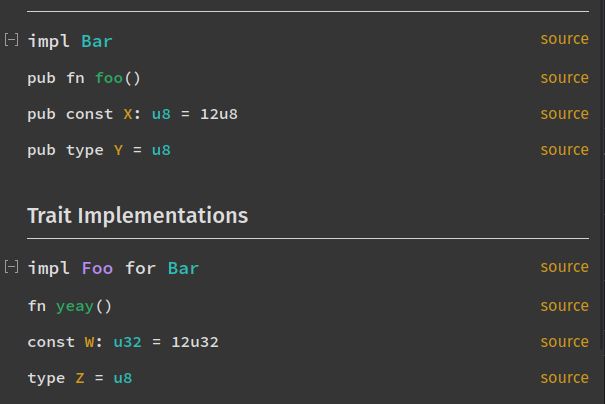
r? `@notriddle`
|
|
|
|
|
|
This adds a minor missing feature to `fake_variadic`,
so that it can render `impl From<(T,)> for [T; 1]` correctly.
|
|
|
|
|
|
|
|
|
|
|
|
|
|
This commit adds the headers for the top level documentation to
rustdoc's existing table of contents, along with associated items.
It only show two levels of headers. Going further would require the
sidebar to be wider, and that seems unnecessary (the crates that
have manually-built TOCs usually don't need deeply nested headers).
|
|
|
|
Unify run button display with "copy code" button and with mdbook buttons
Follow-up of https://github.com/rust-lang/rust/pull/128339.
It looks like this (coherency++, yeay!):

Can be tested [here](https://rustdoc.crud.net/imperio/run-button/foo/struct.Bar.html).
r? `@notriddle`
|
|
|
|
|
|
r=compiler-errors
Stabilize unsafe extern blocks (RFC 3484)
# Stabilization report
## Summary
This is a tracking issue for the RFC 3484: Unsafe Extern Blocks
We are stabilizing `#![feature(unsafe_extern_blocks)]`, as described in [Unsafe Extern Blocks RFC 3484](https://github.com/rust-lang/rfcs/pull/3484). This feature makes explicit that declaring an extern block is unsafe. Starting in Rust 2024, all extern blocks must be marked as unsafe. In all editions, items within unsafe extern blocks may be marked as safe to use.
RFC: https://github.com/rust-lang/rfcs/pull/3484
Tracking issue: #123743
## What is stabilized
### Summary of stabilization
We now need extern blocks to be marked as unsafe and items inside can also have safety modifiers (unsafe or safe), by default items with no modifiers are unsafe to offer easy migration without surprising results.
```rust
unsafe extern {
// sqrt (from libm) may be called with any `f64`
pub safe fn sqrt(x: f64) -> f64;
// strlen (from libc) requires a valid pointer,
// so we mark it as being an unsafe fn
pub unsafe fn strlen(p: *const c_char) -> usize;
// this function doesn't say safe or unsafe, so it defaults to unsafe
pub fn free(p: *mut core::ffi::c_void);
pub safe static IMPORTANT_BYTES: [u8; 256];
pub safe static LINES: SyncUnsafeCell<i32>;
}
```
## Tests
The relevant tests are in `tests/ui/rust-2024/unsafe-extern-blocks`.
## History
- https://github.com/rust-lang/rust/pull/124482
- https://github.com/rust-lang/rust/pull/124455
- https://github.com/rust-lang/rust/pull/125077
- https://github.com/rust-lang/rust/pull/125522
- https://github.com/rust-lang/rust/issues/126738
- https://github.com/rust-lang/rust/issues/126749
- https://github.com/rust-lang/rust/issues/126755
- https://github.com/rust-lang/rust/pull/126757
- https://github.com/rust-lang/rust/pull/126758
- https://github.com/rust-lang/rust/issues/126756
- https://github.com/rust-lang/rust/pull/126973
- https://github.com/rust-lang/rust/pull/127535
- https://github.com/rust-lang/rustfmt/pull/6204
## Unresolved questions
I am not aware of any unresolved questions.
|
|
nested aux-build in tests/rustdoc/ tests
* Fixes bug that prevented using nested aux-build in `tests/rustdoc/` tests. Before, `fn document` and the auxiliary builder disagreed about where to find the nested aux-build source file (`auxiliary/auxiliary/aux.rs` vs `auxiliary/aux.rs`), preventing them from building. Picked the latter in line with other builders in compiletest.
* Adds `//@ doc-flags` header, which forwards flags to rustdoc and not rustc.
* Adds `//@ unique-doc-out-dir` header, which sets the --out-dir for the rustdoc invocation to a unique directory: `<root out dir>/docs/<test name>/doc`
* Changes working directory of the rustdoc invocation to the root out directory (common among all aux-builds). Prior art: exec_compiled_test in runtest.rs
* Adds tests that use nested aux builds and new headers
These changes provide useful capabilities for writing rustdoc tests on their own. They are also needed to test the implementation for the [mergable-rustdoc-cross-crate-info](https://github.com/rust-lang/rfcs/pull/3662) RFC.
try-job: x86_64-msvc
|
|
|
|
|
|
This is an alternative to ee6459d6521cf6a4c2e08b6e13ce3c6ce5d55ed0.
That is, it fixes the issue that affects the very long type names
in https://docs.rs/async-stripe/0.31.0/stripe/index.html#structs.
This is, necessarily, a pile of nasty heuristics.
We need to balance a few issues:
- Sometimes, there's no real word break.
For example, `BTreeMap` should be `BTree<wbr>Map`,
not `B<wbr>Tree<wbr>Map`.
- Sometimes, there's a legit word break,
but the name is tiny and the HTML overhead isn't worth it.
For example, if we're typesetting `TyCtx`,
writing `Ty<wbr>Ctx` would have an HTML overhead of 50%.
Line breaking inside it makes no sense.
|
|
|
|
|
|
|
|
|
|
Remove unnecessary impl sorting in queries and metadata
Removes unnecessary impl sorting because queries already return their keys in HIR definition order: https://github.com/rust-lang/rust/issues/120371#issuecomment-1926422838
r? `@cjgillot` or `@lcnr` -- unless I totally misunderstood what was being asked for here? 😆
fixes #120371
|
|
r=compiler-errors
Forbid borrows and unsized types from being used as the type of a const generic under `adt_const_params`
Fixes #112219
Fixes #112124
Fixes #112125
### Motivation
Currently the `adt_const_params` feature allows writing `Foo<const N: [u8]>` this is entirely useless as it is not possible to write an expression which evaluates to a type that is not `Sized`. In order to actually use unsized types in const generics they are typically written as `const N: &[u8]` which *is* possible to provide a value of.
Unfortunately allowing the types of const parameters to contain references is non trivial (#120961) as it introduces a number of difficult questions about how equality of references in the type system should behave. References in the types of const generics is largely only useful for using unsized types in const generics.
This PR introduces a new feature gate `unsized_const_parameters` and moves support for `const N: [u8]` and `const N: &...` from `adt_const_params` into it. The goal here hopefully is to experiment with allowing `const N: [u8]` to work without references and then eventually completely forbid references in const generics.
Splitting this out into a new feature gate means that stabilization of `adt_const_params` does not have to resolve #120961 which is the only remaining "big" blocker for the feature. Remaining issues after this are a few ICEs and naming bikeshed for `ConstParamTy`.
### Implementation
The implementation is slightly subtle here as we would like to ensure that a stabilization of `adt_const_params` is forwards compatible with any outcome of `unsized_const_parameters`. This is inherently tricky as we do not support unstable trait implementations and we determine whether a type is valid as the type of a const parameter via a trait bound.
There are a few constraints here:
- We would like to *allow for the possibility* of adding a `Sized` supertrait to `ConstParamTy` in the event that we wind up opting to not support unsized types and instead requiring people to write the 'sized version', e.g. `const N: [u8; M]` instead of `const N: [u8]`.
- Crates should be able to enable `unsized_const_parameters` and write trait implementations of `ConstParamTy` for `!Sized` types without downstream crates that only enable `adt_const_params` being able to observe this (required for std to be able to `impl<T> ConstParamTy for [T]`
Ultimately the way this is accomplished is via having two traits (sad), `ConstParamTy` and `UnsizedConstParamTy`. Depending on whether `unsized_const_parameters` is enabled or not we change which trait is used to check whether a type is allowed to be a const parameter.
Long term (when stabilizing `UnsizedConstParamTy`) it should be possible to completely merge these traits (and derive macros), only having a single `trait ConstParamTy` and `macro ConstParamTy`.
Under `adt_const_params` it is now illegal to directly refer to `ConstParamTy` it is only used as an internal impl detail by `derive(ConstParamTy)` and checking const parameters are well formed. This is necessary in order to ensure forwards compatibility with all possible future directions for `feature(unsized_const_parameters)`.
Generally the intuition here should be that `ConstParamTy` is the stable trait that everything uses, and `UnsizedConstParamTy` is that plus unstable implementations (well, I suppose `ConstParamTy` isn't stable yet :P).
|
|
|
|
|
|
|
|
rustdoc: rename `issue-\d+.rs` tests to have meaningful names (part 8)
Follow up
* https://github.com/rust-lang/rust/pull/116214
* https://github.com/rust-lang/rust/pull/116432
* https://github.com/rust-lang/rust/pull/116824
* https://github.com/rust-lang/rust/pull/118105
* https://github.com/rust-lang/rust/pull/119561
* https://github.com/rust-lang/rust/pull/123574
* https://github.com/rust-lang/rust/pull/125382
As always, it's easier to review the commits one at a time. Don't use the Files Changed tab. It's confusing.
|
|
|
|
|
|
|
|
|
|
|
|
|
|
|
|
rustdoc: Add support for `missing_unsafe_on_extern` feature
Follow-up of https://github.com/rust-lang/rust/pull/124482.
Not sure if the `safe` keyword is supposed to be displayed or not though? For now I didn't add it in the generated doc, only `unsafe` as usual.
cc `@spastorino`
r? `@fmease`
|
|
|
|
|
